
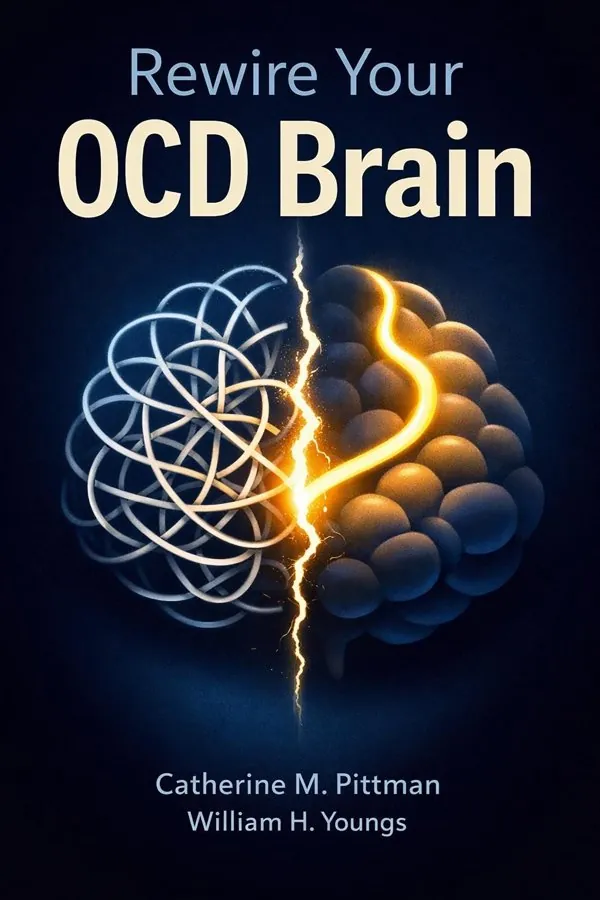
Rewire Your OCD Brain: Powerful Neuroscience-Based Skills to Break Free from Obsessive Thoughts and Fears: Summary & Key Insights
by Catherine M. Pittman, William H. Youngs
 10 min6 chaptersAudio available
What Is Rewire Your OCD Brain: Powerful Neuroscience-Based Skills to Break Free from Obsessive Thoughts and Fears About?
Rewire Your OCD Brain: Powerful Neuroscience-Based Skills to Break Free from Obsessive Thoughts and Fears by Catherine M. Pittman, William H. Youngs is a mental_health book spanning 6 pages. This book offers practical, neuroscience-based strategies to help individuals with obsessive-compulsive disorder (OCD) retrain their brains and reduce intrusive thoughts and compulsive behaviors. It combines cognitive-behavioral techniques with insights from brain science to empower readers to change their mental patterns and regain control over their lives.
This FizzRead summary covers all 6 key chapters of Rewire Your OCD Brain: Powerful Neuroscience-Based Skills to Break Free from Obsessive Thoughts and Fears in approximately 10 minutes, distilling the most important ideas, arguments, and takeaways from Catherine M. Pittman, William H. Youngs's work. Also available as an audio summary and Key Quotes Podcast.
Rewire Your OCD Brain: Powerful Neuroscience-Based Skills to Break Free from Obsessive Thoughts and Fears
This book offers practical, neuroscience-based strategies to help individuals with obsessive-compulsive disorder (OCD) retrain their brains and reduce intrusive thoughts and compulsive behaviors. It combines cognitive-behavioral techniques with insights from brain science to empower readers to change their mental patterns and regain control over their lives.
Who Should Read Rewire Your OCD Brain: Powerful Neuroscience-Based Skills to Break Free from Obsessive Thoughts and Fears?
This book is perfect for anyone interested in mental_health and looking to gain actionable insights in a short read. Whether you're a student, professional, or lifelong learner, the key ideas from Rewire Your OCD Brain: Powerful Neuroscience-Based Skills to Break Free from Obsessive Thoughts and Fears by Catherine M. Pittman, William H. Youngs will help you think differently.
- ✓Readers who enjoy mental_health and want practical takeaways
- ✓Professionals looking to apply new ideas to their work and life
- ✓Anyone who wants the core insights of Rewire Your OCD Brain: Powerful Neuroscience-Based Skills to Break Free from Obsessive Thoughts and Fears in just 10 minutes
Want the full summary?
Get instant access to this book summary and 100K+ more with Fizz Moment.
Get Free SummaryAvailable on App Store • Free to download
Key Chapters
To truly overcome OCD, we need to dive into the workings of fear itself. The fear response begins deep in the amygdala—a pair of almond-shaped clusters in the temporal lobes that act like the brain’s alarm system. The amygdala doesn’t wait for reasoned analysis; it reacts instantly to potential danger. That speed is a survival advantage when facing real threats, but in OCD, the amygdala misfires. It rings the danger bell for thoughts, sensations, or uncertainties that don’t actually require protection. The result is a flood of anxiety that feels utterly convincing, even when the rational mind knows better.
OCD can thus be understood as a neurological loop between the overactive amygdala and a frustrated cortex that tries to solve the unsolvable. When the amygdala sends an alarm, the cortex rushes in to rationalize it, searching for explanations and solutions. Compulsions—whether checking, cleaning, seeking reassurance, or mentally reviewing—emerge as attempts to quiet the alarm. Ironically, these attempts teach the amygdala that the threat must have been real after all, reinforcing the fear circuit.
The liberating insight is that the amygdala can learn. It doesn't respond to words or logic; it learns only through experience. By confronting fear without performing compulsions, you give the amygdala crucial evidence that the alarm was false. Each repetition rewires the network, weakening the association between intrusive thought and danger. Understanding this principle shifts recovery from a fight against fear to a process of teaching the brain safety through experience.
While the amygdala specializes in rapid emotional signaling, the prefrontal cortex serves as our brain’s thoughtful regulator. It’s the region responsible for reflection, planning, and inhibition. In OCD, the prefrontal cortex often remains fully aware that the fear is irrational, yet it fails to override the intense anxiety generated by the amygdala. This disconnect can make sufferers feel divided—rationally calm but emotionally panicked.
Part of recovery involves strengthening the communication between these two brain systems. Every time you deliberately observe your anxiety without reacting—breathing, naming your feelings, delaying a compulsion—you are exercising your cortex’s regulatory power. You are reminding your thinking brain that it can coexist with discomfort without needing to eliminate it. Over time, these moments accumulate, allowing cortical pathways of patience and self-regulation to take root.
The cortex also plays a role in reframing obsessive thoughts. When you consciously identify a thought as an amygdala-generated alarm rather than a meaningful warning, you engage higher-order reasoning. You begin to question, rather than obey, the emotional dictates of fear. The cortex provides the space in which you can notice: 'This is my brain sending an alert. It doesn’t mean there is danger.' That single insight—acknowledging emotion as a brain event rather than a fact—becomes a cornerstone of mastery.
+ 4 more chapters — available in the FizzRead app
All Chapters in Rewire Your OCD Brain: Powerful Neuroscience-Based Skills to Break Free from Obsessive Thoughts and Fears
About the Authors
Catherine M. Pittman, PhD, is a clinical psychologist and professor of psychology at Saint Mary’s College in Notre Dame, Indiana. William H. Youngs is a writer and collaborator specializing in psychology and mental health topics.
Get This Summary in Your Preferred Format
Read or listen to the Rewire Your OCD Brain: Powerful Neuroscience-Based Skills to Break Free from Obsessive Thoughts and Fears summary by Catherine M. Pittman, William H. Youngs anytime, anywhere. FizzRead offers multiple formats so you can learn on your terms — all free.
Available formats: App · Audio · PDF · EPUB — All included free with FizzRead
Download Rewire Your OCD Brain: Powerful Neuroscience-Based Skills to Break Free from Obsessive Thoughts and Fears PDF and EPUB Summary
Key Quotes from Rewire Your OCD Brain: Powerful Neuroscience-Based Skills to Break Free from Obsessive Thoughts and Fears
“To truly overcome OCD, we need to dive into the workings of fear itself.”
“While the amygdala specializes in rapid emotional signaling, the prefrontal cortex serves as our brain’s thoughtful regulator.”
Frequently Asked Questions about Rewire Your OCD Brain: Powerful Neuroscience-Based Skills to Break Free from Obsessive Thoughts and Fears
Rewire Your OCD Brain: Powerful Neuroscience-Based Skills to Break Free from Obsessive Thoughts and Fears by Catherine M. Pittman, William H. Youngs is a mental_health book that explores key ideas across 6 chapters. This book offers practical, neuroscience-based strategies to help individuals with obsessive-compulsive disorder (OCD) retrain their brains and reduce intrusive thoughts and compulsive behaviors. It combines cognitive-behavioral techniques with insights from brain science to empower readers to change their mental patterns and regain control over their lives.
You Might Also Like

Big Feelings: How to Be Okay When Things Are Not Okay
Liz Fosslien, Mollie West Duffy
10 min
Creative Arts Therapies Handbook: Art, Music and Dance Therapy Practices for Wellbeing
Susan I. Buchalter
10 min
Emotional First Aid: Healing Rejection, Guilt, Failure, and Other Everyday Hurts
Guy Winch
10 min
Lost Connections: Why You're Depressed and How to Find Hope
Johann Hari
10 min
No Time to Panic: How to Stop Worrying and Embrace Life
Matt Gutman
10 min
Overcoming Mobbing: A Recovery Guide for Workplace Aggression and Bullying
Maureen Duffy, Len Sperry
10 minBrowse by Category
Ready to read Rewire Your OCD Brain: Powerful Neuroscience-Based Skills to Break Free from Obsessive Thoughts and Fears?
Get the full summary and 100K+ more books with Fizz Moment.