
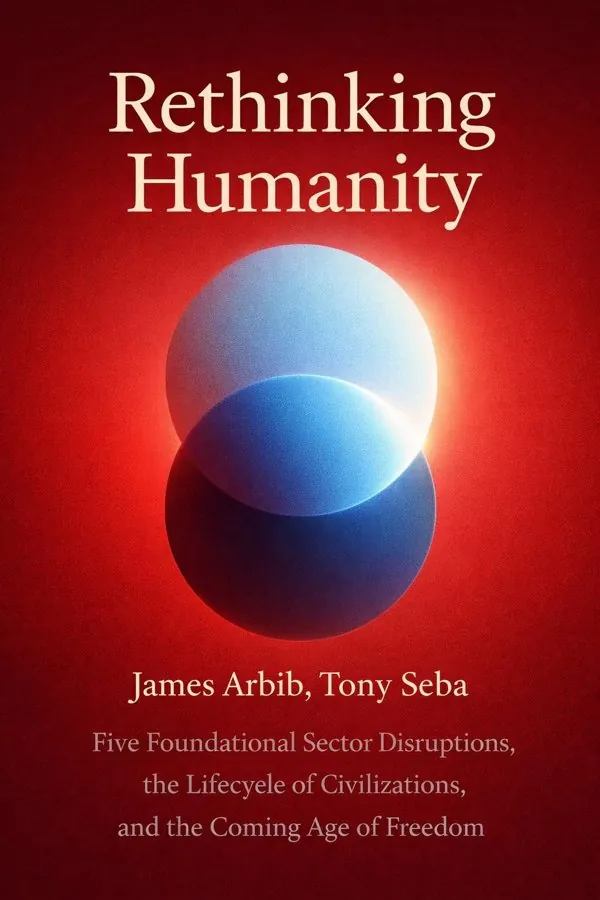
Rethinking Humanity: Five Foundational Sector Disruptions, the Lifecycle of Civilizations, and the Coming Age of Freedom: Summary & Key Insights
by James Arbib, Tony Seba
 10 min11 chaptersAudio available
What Is Rethinking Humanity: Five Foundational Sector Disruptions, the Lifecycle of Civilizations, and the Coming Age of Freedom About?
Rethinking Humanity: Five Foundational Sector Disruptions, the Lifecycle of Civilizations, and the Coming Age of Freedom by James Arbib, Tony Seba is a future_trends book spanning 11 pages. Rethinking Humanity explores how technological disruptions across five foundational sectors—energy, transportation, information, food, and materials—are driving a profound transformation of civilization. The authors argue that humanity is entering a new age characterized by abundance, sustainability, and freedom, enabled by exponential technologies and systemic change. The book examines historical patterns of civilizational rise and fall, proposing that the current transition could redefine human progress and societal organization.
This FizzRead summary covers all 11 key chapters of Rethinking Humanity: Five Foundational Sector Disruptions, the Lifecycle of Civilizations, and the Coming Age of Freedom in approximately 10 minutes, distilling the most important ideas, arguments, and takeaways from James Arbib, Tony Seba's work. Also available as an audio summary and Key Quotes Podcast.
Rethinking Humanity: Five Foundational Sector Disruptions, the Lifecycle of Civilizations, and the Coming Age of Freedom
Rethinking Humanity explores how technological disruptions across five foundational sectors—energy, transportation, information, food, and materials—are driving a profound transformation of civilization. The authors argue that humanity is entering a new age characterized by abundance, sustainability, and freedom, enabled by exponential technologies and systemic change. The book examines historical patterns of civilizational rise and fall, proposing that the current transition could redefine human progress and societal organization.
Who Should Read Rethinking Humanity: Five Foundational Sector Disruptions, the Lifecycle of Civilizations, and the Coming Age of Freedom?
This book is perfect for anyone interested in future_trends and looking to gain actionable insights in a short read. Whether you're a student, professional, or lifelong learner, the key ideas from Rethinking Humanity: Five Foundational Sector Disruptions, the Lifecycle of Civilizations, and the Coming Age of Freedom by James Arbib, Tony Seba will help you think differently.
- ✓Readers who enjoy future_trends and want practical takeaways
- ✓Professionals looking to apply new ideas to their work and life
- ✓Anyone who wants the core insights of Rethinking Humanity: Five Foundational Sector Disruptions, the Lifecycle of Civilizations, and the Coming Age of Freedom in just 10 minutes
Want the full summary?
Get instant access to this book summary and 100K+ more with Fizz Moment.
Get Free SummaryAvailable on App Store • Free to download
Key Chapters
Every civilization follows a rhythm—a rise fueled by innovation, a maturity sustained by stability, and eventually, a decline precipitated by rigidity. Throughout history, societies expanded their power through new energy sources, modes of transportation, and systems of communication. Yet these very systems often became the seeds of stagnation, as vested interests and institutional inertia resisted further change.
From the Sumerians who mastered irrigation to the British Empire that harnessed coal and steam, civilizations have been born from their capacity to coordinate energy, materials, and information. They expanded until the cost of maintaining complexity exceeded their returns, triggering collapse or transformation.
In *Rethinking Humanity*, we emphasize that these cycles were not inevitable acts of fate—they were technological and systemic phenomena. When a society’s foundational sectors—its energy, transport, food, information, and materials systems—hit resource or efficiency limits, its ability to adapt determines whether it falls or evolves.
Today, all five foundational sectors are approaching disruption simultaneously. This convergence is unprecedented. Whereas shifts like the industrial revolution took centuries, exponential technologies now operate on a time horizon of decades or even years. The key insight is that we are not merely witnessing a wave of innovation; we are standing at the edge of a complete reorganization of civilization’s operating system.
Civilization rests on five pillars that sustain human life and organization: energy, transportation, information, food, and materials. Each sector serves as a vital subsystem in the broader human organism. Historically, changes in these sectors catalyzed social revolutions—when one pillar transformed, the entire societal structure followed.
Energy determines how much we can produce, move, and communicate. Transportation connects people and resources across space. Information governs coordination, planning, and innovation. Food sustains populations, and materials form the infrastructure upon which everything rests.
Our hypothesis is simple yet radical: when disruption occurs in all five foundational sectors, the result is not incremental improvement—it is civilizational transformation. This convergence explains why the next twenty years may compress the equivalent of several centuries of historical change.
+ 9 more chapters — available in the FizzRead app
All Chapters in Rethinking Humanity: Five Foundational Sector Disruptions, the Lifecycle of Civilizations, and the Coming Age of Freedom
About the Authors
James Arbib is a futurist, philanthropist, and co-founder of RethinkX, focusing on technology-driven societal transformation. Tony Seba is an entrepreneur, educator, and thought leader known for his work on clean energy and disruptive innovation. Together, they analyze how exponential technologies reshape industries and civilizations.
Get This Summary in Your Preferred Format
Read or listen to the Rethinking Humanity: Five Foundational Sector Disruptions, the Lifecycle of Civilizations, and the Coming Age of Freedom summary by James Arbib, Tony Seba anytime, anywhere. FizzRead offers multiple formats so you can learn on your terms — all free.
Available formats: App · Audio · PDF · EPUB — All included free with FizzRead
Download Rethinking Humanity: Five Foundational Sector Disruptions, the Lifecycle of Civilizations, and the Coming Age of Freedom PDF and EPUB Summary
Key Quotes from Rethinking Humanity: Five Foundational Sector Disruptions, the Lifecycle of Civilizations, and the Coming Age of Freedom
“Every civilization follows a rhythm—a rise fueled by innovation, a maturity sustained by stability, and eventually, a decline precipitated by rigidity.”
“Civilization rests on five pillars that sustain human life and organization: energy, transportation, information, food, and materials.”
Frequently Asked Questions about Rethinking Humanity: Five Foundational Sector Disruptions, the Lifecycle of Civilizations, and the Coming Age of Freedom
Rethinking Humanity: Five Foundational Sector Disruptions, the Lifecycle of Civilizations, and the Coming Age of Freedom by James Arbib, Tony Seba is a future_trends book that explores key ideas across 11 chapters. Rethinking Humanity explores how technological disruptions across five foundational sectors—energy, transportation, information, food, and materials—are driving a profound transformation of civilization. The authors argue that humanity is entering a new age characterized by abundance, sustainability, and freedom, enabled by exponential technologies and systemic change. The book examines historical patterns of civilizational rise and fall, proposing that the current transition could redefine human progress and societal organization.
You Might Also Like
Futureproof: 9 Rules for Humans in the Age of Automation
Kevin Roose
10 min
The Third Wave
Alvin Toffler
10 min
2030: How Today's Biggest Trends Will Collide and Reshape the Future of Everything
Mauro F. Guillén
10 min
A Very Human Future: Enriching Humanity in a Digitized World
Rohit Talwar, Steve Wells, Alexandra Whittington
10 min
AI 2041: Ten Visions for Our Future
Kai-Fu Lee, Chen Qiufan
10 min
Abundance: The Future Is Better Than You Think
Peter H. Diamandis, Steven Kotler
10 minBrowse by Category
Ready to read Rethinking Humanity: Five Foundational Sector Disruptions, the Lifecycle of Civilizations, and the Coming Age of Freedom?
Get the full summary and 100K+ more books with Fizz Moment.