
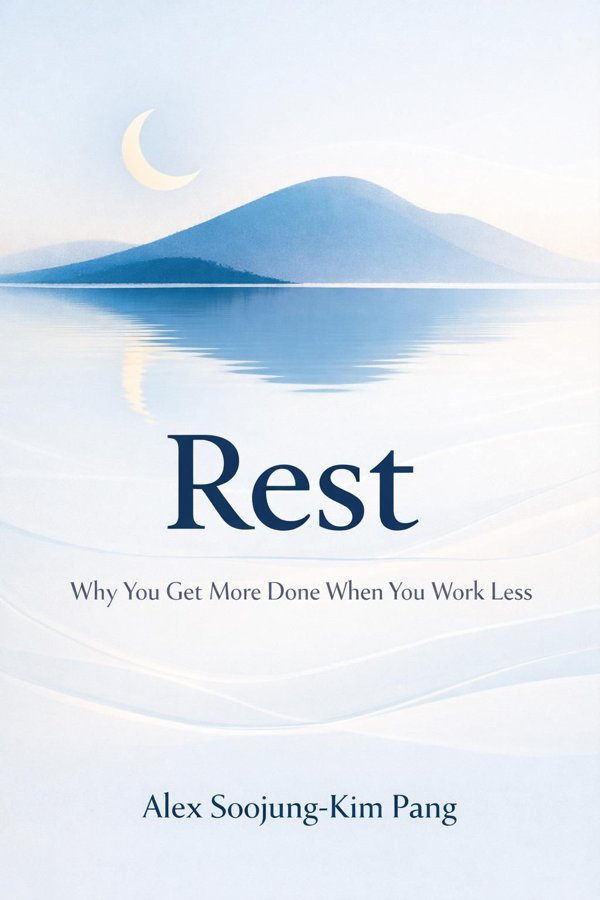
Rest: Why You Get More Done When You Work Less: Summary & Key Insights
 10 min9 chaptersAudio available
Key Takeaways from Rest: Why You Get More Done When You Work Less
One of the book’s most provocative ideas is that rest is not the opposite of work; it is one of the conditions that makes good work possible.
A striking pattern among great thinkers and creators is that many of them did not work endlessly; they worked intensely within clear boundaries.
If there is a practical rule that captures Pang’s philosophy, it is this: most people can sustain only about four hours of truly deep, demanding cognitive work per day.
Rest does not always mean lying still.
Sleep is often the first sacrifice in ambitious lives, yet Pang makes clear that it should be one of the last.
What Is Rest: Why You Get More Done When You Work Less About?
Rest: Why You Get More Done When You Work Less by Alex Soojung-Kim Pang is a productivity book spanning 11 pages. Rest: Why You Get More Done When You Work Less challenges one of modern productivity culture’s most stubborn assumptions: that the path to achievement is paved with longer hours, constant availability, and relentless effort. Alex Soojung-Kim Pang argues the opposite. Drawing on neuroscience, psychology, history, and the routines of scientists, artists, writers, and athletes, he shows that rest is not the reward we earn after work is finished, but a vital part of doing great work in the first place. Deep performance depends on cycles of focus and recovery, not endless strain. What makes this book especially compelling is Pang’s ability to connect research with real lives. He examines figures such as Charles Darwin and other high performers whose days were structured around limited periods of intense work, followed by walks, naps, play, hobbies, and long stretches of renewal. Pang writes with the authority of a researcher and consultant who has spent years studying how technology, work, and human well-being intersect. The result is a practical, persuasive guide for anyone who wants to be more creative, productive, and sustainably successful without sacrificing health or joy.
This FizzRead summary covers all 9 key chapters of Rest: Why You Get More Done When You Work Less in approximately 10 minutes, distilling the most important ideas, arguments, and takeaways from Alex Soojung-Kim Pang's work. Also available as an audio summary and Key Quotes Podcast.
Rest: Why You Get More Done When You Work Less
Rest: Why You Get More Done When You Work Less challenges one of modern productivity culture’s most stubborn assumptions: that the path to achievement is paved with longer hours, constant availability, and relentless effort. Alex Soojung-Kim Pang argues the opposite. Drawing on neuroscience, psychology, history, and the routines of scientists, artists, writers, and athletes, he shows that rest is not the reward we earn after work is finished, but a vital part of doing great work in the first place. Deep performance depends on cycles of focus and recovery, not endless strain.
What makes this book especially compelling is Pang’s ability to connect research with real lives. He examines figures such as Charles Darwin and other high performers whose days were structured around limited periods of intense work, followed by walks, naps, play, hobbies, and long stretches of renewal. Pang writes with the authority of a researcher and consultant who has spent years studying how technology, work, and human well-being intersect. The result is a practical, persuasive guide for anyone who wants to be more creative, productive, and sustainably successful without sacrificing health or joy.
Who Should Read Rest: Why You Get More Done When You Work Less?
This book is perfect for anyone interested in productivity and looking to gain actionable insights in a short read. Whether you're a student, professional, or lifelong learner, the key ideas from Rest: Why You Get More Done When You Work Less by Alex Soojung-Kim Pang will help you think differently.
- ✓Readers who enjoy productivity and want practical takeaways
- ✓Professionals looking to apply new ideas to their work and life
- ✓Anyone who wants the core insights of Rest: Why You Get More Done When You Work Less in just 10 minutes
Want the full summary?
Get instant access to this book summary and 100K+ more with Fizz Moment.
Get Free SummaryAvailable on App Store • Free to download
Key Chapters
One of the book’s most provocative ideas is that rest is not the opposite of work; it is one of the conditions that makes good work possible. Modern culture often treats rest as laziness, indulgence, or time lost. Pang argues that this is a profound misunderstanding. The human mind does not operate like a machine that improves simply by running longer. It works in rhythms, and those rhythms require periods of disengagement in order to sustain attention, solve problems, and maintain motivation.
Pang draws on neuroscience to explain that the brain remains active even when we are not consciously focused on a task. During restful states, especially when the mind is wandering, the brain’s default mode network becomes active. This network helps with memory consolidation, meaning-making, self-reflection, and creative association. In other words, some of our most important mental processing happens when we step away from the desk.
This helps explain why solutions often appear while walking, showering, resting, or daydreaming after periods of concentrated effort. Rest also protects us from the diminishing returns of overwork. Beyond a certain point, more hours lead to more mistakes, weaker judgment, and lower-quality output.
In practice, this means building workdays around alternating periods of focused effort and genuine recovery. Rather than treating breaks as interruptions, we should see them as investments in better thinking. Short pauses between deep work sessions, evenings that are not consumed by email, and weekends that create real distance from professional demands can all improve performance.
Actionable takeaway: Stop measuring productivity only by hours worked. Design your day as a cycle of intense focus followed by real rest, and judge success by the quality of your thinking and output.
A striking pattern among great thinkers and creators is that many of them did not work endlessly; they worked intensely within clear boundaries. Pang highlights this through the example of Charles Darwin, who structured his day around a few concentrated bursts of intellectual labor. Darwin was not idle, but neither was he grinding for twelve or fourteen hours. He understood that serious cognitive work has a natural ceiling.
This observation leads to one of the book’s central lessons: high-value mental work is often best done in relatively short, demanding sessions. Pang points to researchers, composers, and writers who did their most important work in two, three, or four concentrated hours a day. What distinguished them was not duration but consistency and depth. They protected these hours carefully, approached them with full attention, and then stopped before exhaustion degraded performance.
This idea directly challenges the assumption that elite performers simply outwork everyone by doing more hours. Often they outperform because they preserve the conditions for excellence. They know that fatigue narrows perception, weakens originality, and encourages shallow effort over meaningful progress.
Applied today, this means identifying the cognitively hardest work you do and giving it your freshest energy. Instead of scattering your attention across meetings, messages, and multitasking, reserve uninterrupted blocks for strategic thinking, writing, analysis, or design. Then accept that after a certain point, continuing may feel virtuous but becomes counterproductive.
Actionable takeaway: Identify your most mentally demanding task and schedule it during your best energy window. Work on it in a protected block, then stop while your mind is still sharp rather than pushing into diminishing returns.
If there is a practical rule that captures Pang’s philosophy, it is this: most people can sustain only about four hours of truly deep, demanding cognitive work per day. This is not a sign of weakness. It is a feature of how human attention and mental effort function. The real problem is not that we can’t work deeply for ten hours; it is that we pretend we can, then fill the day with low-value busyness and call it productivity.
Pang shows that many accomplished people naturally converged on this limit. Their schedules included a few hours of serious work, often in the morning, while the rest of the day was devoted to walking, correspondence, reading, reflection, teaching, exercise, or leisure. These activities were not distractions from work. They were the supporting structure that made deep work sustainable.
The four-hour idea is especially useful because it forces prioritization. If your truly valuable cognitive capacity is limited, then you must become more intentional about what deserves it. You stop wasting your best hours on inbox management or reactive tasks. You also become less guilty about stepping back after a strong session because rest becomes part of the method, not a failure of discipline.
For knowledge workers, this can transform daily planning. A writer might dedicate two morning sessions to drafting. A manager might reserve one block for strategic planning and another for decision-making. An entrepreneur might use that time for product design or complex problem-solving, while routine tasks are handled later.
Actionable takeaway: Treat four hours of deep work as a daily upper limit to protect, not exceed. Build your schedule so your highest-value tasks receive those hours, and let everything else fit around them.
Rest does not always mean lying still. One of Pang’s most useful distinctions is between passive rest and active rest. Active rest includes activities such as walking, hiking, gardening, knitting, playing music, swimming, or engaging in hands-on hobbies. These forms of rest may involve physical movement or light effort, yet they refresh the mind because they draw us out of narrow, goal-driven concentration.
This kind of rest works partly because it changes the texture of attention. During active rest, the brain shifts away from the tightly focused mode used for demanding intellectual tasks. That shift can loosen mental knots, reduce stress, and allow fresh connections to emerge. This is why so many people experience insight while on a walk or doing something repetitive with their hands. The body is engaged, but the mind is free enough to wander productively.
Pang also emphasizes that active rest is often more restorative than passive consumption. Collapsing in front of a screen after work may feel easy, but it does not always replenish us. By contrast, a walk through the neighborhood, time in nature, or an absorbing craft can create a deeper sense of renewal. These activities also support long-term health, which in turn supports better work.
In modern life, active rest can be built into small routines. Walking meetings, evening bike rides, gardening on weekends, or a few minutes of sketching or music after a work block can all shift mental state. The key is not performance but recovery.
Actionable takeaway: Choose one form of active rest you can practice several times a week, such as walking or gardening, and treat it as essential recovery that improves your next period of focused work.
Sleep is often the first sacrifice in ambitious lives, yet Pang makes clear that it should be one of the last. Far from being unproductive downtime, sleep is a biological process essential to learning, emotional regulation, memory formation, immune function, and creative problem-solving. When we cut sleep to extend the workday, we may gain time in the short term, but we lose clarity, judgment, and resilience.
Pang places sleep at the center of sustainable achievement. During sleep, the brain consolidates information, filters what matters, and integrates experiences into memory. This is why ideas practiced during the day can become more fluent after a night’s rest. Sleep also helps regulate mood and stress, both of which shape how effectively we think and collaborate.
The costs of sleep deprivation are especially dangerous because they are easy to underestimate. Tired people often believe they are functioning better than they actually are. They make more mistakes, struggle with complex reasoning, become more reactive, and require more effort to do the same work. In that sense, sleeping less often makes us work longer for worse results.
Pang’s argument is practical rather than idealistic. He does not merely say sleep is healthy; he shows it is a competitive advantage. For professionals, students, and creators, better sleep improves the very capacities they value most: focus, originality, patience, and high-quality output.
Actionable takeaway: Protect sleep as a core productivity practice. Set a consistent bedtime, reduce late-night digital stimulation, and stop treating sleep as optional if you want sharper thinking and more sustainable performance.
A surprising truth at the heart of Rest is that play is not childish, trivial, or separate from excellence. In many cases, play helps create the mental flexibility that serious work demands. Pang argues that playful activities, whether sports, games, music, tinkering, or imaginative hobbies, cultivate curiosity, experimentation, and resilience. These are the same qualities that support creativity and innovation.
Play matters because it changes our relationship to effort. In play, we are engaged but not burdened by the same pressure for measurable output. That freedom allows us to explore, try unusual combinations, and enjoy uncertainty. It is often in these lower-stakes environments that new ideas emerge. Historically, many accomplished people had vigorous lives outside their formal work: they climbed mountains, painted, played instruments, built things, or pursued outdoor adventures. These activities did not dilute their seriousness; they broadened it.
Play also helps us recover a sense of intrinsic motivation. When all of life becomes optimization, obligation, and performance, energy drains away. Play restores vitality because it reconnects action with enjoyment. That renewed energy can then flow back into work.
This is highly relevant in workplaces where burnout and disengagement are common. Teams that allow room for experimentation, learning, and informal exploration often produce better ideas than those ruled entirely by urgency. On an individual level, cultivating a playful hobby can reduce stress while making the mind more inventive.
Actionable takeaway: Reintroduce one genuinely playful activity into your week, something you do for enjoyment rather than achievement, and notice how it affects your energy, mood, and creative thinking.
Not all rest fits neatly into evenings and weekends. Pang also explores the value of sabbaticals and extended breaks, showing that longer periods away from routine work can do more than provide recovery. They can renew perspective, deepen learning, and even reshape identity. In a culture that prizes continuity and constant motion, stepping away for weeks or months can seem risky. Pang suggests it may sometimes be one of the wisest choices a person or organization can make.
Extended rest creates a kind of distance that shorter breaks cannot. It allows accumulated fatigue to dissipate and gives deeper questions room to surface: What matters most? What kind of work do I want to do? What assumptions have I been carrying without examining? Without the noise of daily obligations, people often return with clearer priorities and a refreshed sense of purpose.
Historically, sabbaticals have supported major breakthroughs in scholarship, writing, and reflection. But their value is not limited to academics. Professionals in demanding fields can use longer breaks for learning, travel, creative projects, health recovery, or simply to regain mental spaciousness. Organizations can benefit too, because employees who periodically renew themselves are more likely to stay engaged and innovative over the long term.
Even if a formal sabbatical is unrealistic, the principle still applies. Seasonal slowdowns, unused vacation time, mini-retreats, and true off-grid holidays can all function as extended recovery if they are protected from work intrusion.
Actionable takeaway: Plan at least one substantial period of real disconnection each year, whether a vacation, retreat, or mini-sabbatical, and use it not just to escape work but to regain perspective on how you want to live and work.
One reason rest has become harder is that technology has made work feel omnipresent. Email, messaging platforms, smartphones, and social media blur the boundary between effort and recovery. Pang does not argue that technology is inherently harmful, but he shows that without conscious limits it can quietly colonize every pause in the day. We may be physically away from work while mentally remaining on call.
This matters because rest requires more than the absence of formal labor. It requires a shift in attention and nervous system state. If every free moment is filled with notifications, status checks, and ambient anxiety, the brain never fully enters restorative modes. Even leisure can become fragmented and shallow when constantly interrupted.
Pang’s broader body of work on technology gives this argument credibility. He understands that digital tools can increase convenience and connectivity, but he insists they must serve human rhythms rather than override them. Real productivity comes not from total responsiveness but from strategic engagement. People who create better boundaries often do better work because they protect focus when working and protect renewal when resting.
Practical applications include disabling nonessential notifications, setting email windows rather than checking constantly, keeping phones out of bedrooms, and creating tech-free spaces for meals, walks, or evenings. Teams can help by clarifying communication norms and reducing the expectation of immediate response.
Actionable takeaway: Audit the ways technology interrupts your rest. Remove one major source of digital intrusion this week, such as after-hours email checking or unnecessary notifications, and replace it with a protected period of uninterrupted recovery.
Perhaps the book’s most important practical lesson is that rest rarely happens by accident. In a culture optimized for busyness, recovery has to be designed. Pang argues that if we simply hope to rest whenever work is finished, rest will always be postponed. There will always be another message, another task, another reason to keep going. A restorative life requires structure, habits, and values that make room for both accomplishment and renewal.
Designing a restful life begins with rejecting the idea that constant activity equals significance. It means identifying what forms of work matter most, then building routines that support them sustainably. This includes setting limits on work hours, protecting sleep, planning exercise and active leisure, using vacations fully, and making space for relationships, hobbies, and reflection. It also means recognizing that different seasons of life may require different balances.
Pang is not advocating laziness or withdrawal from ambition. He is proposing a more intelligent model of ambition, one rooted in longevity rather than self-exhaustion. Sustainable productivity depends on matching energy expenditure with energy renewal. Over time, this creates not only better results but also a more humane and satisfying life.
For many readers, this chapter reframes rest as a design challenge. What would your calendar look like if you treated recovery as seriously as deadlines? What commitments would you reduce if you believed your best work depended on margin, not overload? These are strategic questions, not indulgent ones.
Actionable takeaway: Redesign one part of your weekly schedule around deliberate rest, such as a technology-free evening, a daily walk, or a firm stopping time, and protect it as seriously as an important meeting.
All Chapters in Rest: Why You Get More Done When You Work Less
About the Author
Alex Soojung-Kim Pang is an American author, researcher, and consultant whose work focuses on the intersection of technology, productivity, creativity, and rest. He is the founder of the Restful Company, where he helps organizations and leaders develop healthier, more sustainable approaches to high performance. Pang has built a reputation for combining historical examples with current research in psychology and neuroscience, making complex ideas accessible and practical. His writing often challenges modern assumptions about busyness, digital overload, and the culture of constant work. Through books, speaking, and consulting, he has become a leading voice on the idea that deliberate rest is essential for doing meaningful work well and for sustaining achievement over the long term.
Get This Summary in Your Preferred Format
Read or listen to the Rest: Why You Get More Done When You Work Less summary by Alex Soojung-Kim Pang anytime, anywhere. FizzRead offers multiple formats so you can learn on your terms — all free.
Available formats: App · Audio · PDF · EPUB — All included free with FizzRead
Download Rest: Why You Get More Done When You Work Less PDF and EPUB Summary
Key Quotes from Rest: Why You Get More Done When You Work Less
“One of the book’s most provocative ideas is that rest is not the opposite of work; it is one of the conditions that makes good work possible.”
“A striking pattern among great thinkers and creators is that many of them did not work endlessly; they worked intensely within clear boundaries.”
“If there is a practical rule that captures Pang’s philosophy, it is this: most people can sustain only about four hours of truly deep, demanding cognitive work per day.”
“One of Pang’s most useful distinctions is between passive rest and active rest.”
“Sleep is often the first sacrifice in ambitious lives, yet Pang makes clear that it should be one of the last.”
Frequently Asked Questions about Rest: Why You Get More Done When You Work Less
Rest: Why You Get More Done When You Work Less by Alex Soojung-Kim Pang is a productivity book that explores key ideas across 9 chapters. Rest: Why You Get More Done When You Work Less challenges one of modern productivity culture’s most stubborn assumptions: that the path to achievement is paved with longer hours, constant availability, and relentless effort. Alex Soojung-Kim Pang argues the opposite. Drawing on neuroscience, psychology, history, and the routines of scientists, artists, writers, and athletes, he shows that rest is not the reward we earn after work is finished, but a vital part of doing great work in the first place. Deep performance depends on cycles of focus and recovery, not endless strain. What makes this book especially compelling is Pang’s ability to connect research with real lives. He examines figures such as Charles Darwin and other high performers whose days were structured around limited periods of intense work, followed by walks, naps, play, hobbies, and long stretches of renewal. Pang writes with the authority of a researcher and consultant who has spent years studying how technology, work, and human well-being intersect. The result is a practical, persuasive guide for anyone who wants to be more creative, productive, and sustainably successful without sacrificing health or joy.
More by Alex Soojung-Kim Pang
You Might Also Like
Browse by Category
Ready to read Rest: Why You Get More Done When You Work Less?
Get the full summary and 100K+ more books with Fizz Moment.