
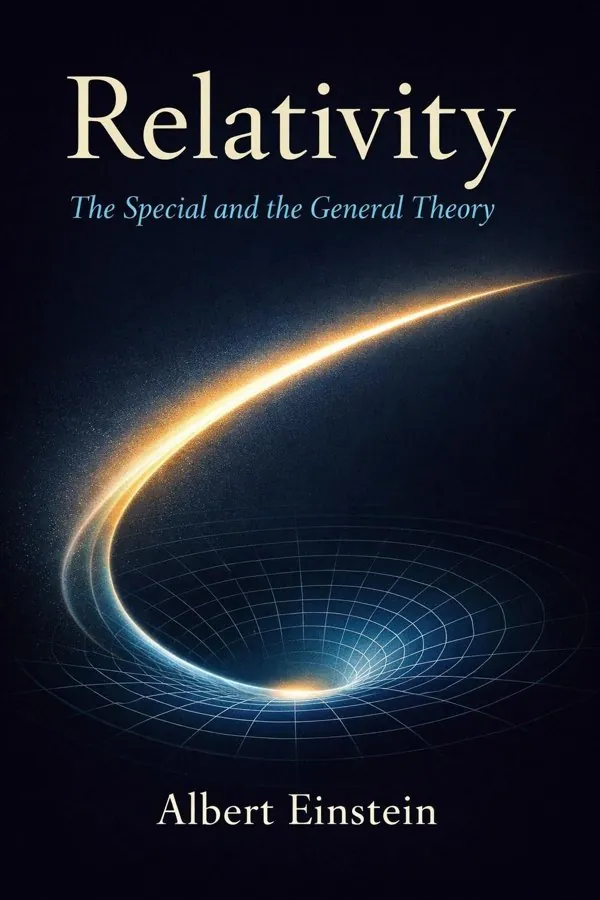
Relativity: The Special and the General Theory: Summary & Key Insights
 10 min3 chaptersAudio available
What Is Relativity: The Special and the General Theory About?
Relativity: The Special and the General Theory by Albert Einstein is a space_physics book spanning 3 pages. This book is a popular exposition of the special and general theories of relativity, written by Albert Einstein himself. It explains the fundamental structure of space and time, the relativity of motion and gravitation, and provides an accessible introduction to the concepts that revolutionized modern physics.
This FizzRead summary covers all 3 key chapters of Relativity: The Special and the General Theory in approximately 10 minutes, distilling the most important ideas, arguments, and takeaways from Albert Einstein's work. Also available as an audio summary and Key Quotes Podcast.
Relativity: The Special and the General Theory
This book is a popular exposition of the special and general theories of relativity, written by Albert Einstein himself. It explains the fundamental structure of space and time, the relativity of motion and gravitation, and provides an accessible introduction to the concepts that revolutionized modern physics.
Who Should Read Relativity: The Special and the General Theory?
This book is perfect for anyone interested in space_physics and looking to gain actionable insights in a short read. Whether you're a student, professional, or lifelong learner, the key ideas from Relativity: The Special and the General Theory by Albert Einstein will help you think differently.
- ✓Readers who enjoy space_physics and want practical takeaways
- ✓Professionals looking to apply new ideas to their work and life
- ✓Anyone who wants the core insights of Relativity: The Special and the General Theory in just 10 minutes
Want the full summary?
Get instant access to this book summary and 100K+ more with Fizz Moment.
Get Free SummaryAvailable on App Store • Free to download
Key Chapters
Let us begin with motion—so common a word that we forget how subtle it is. When I watch a train pass, I may think the train moves while I stand still. But to a passenger on the train, I am the one moving backward. Which viewpoint is correct? Classical mechanics, following Galileo and Newton, tells us both are equally valid provided neither is accelerating. These unaccelerated systems we call inertial frames of reference. The laws of mechanics, such as the trajectory of a thrown stone, appear identical in all such frames. This is the Galilean principle of relativity.
Yet as physics advanced, particularly through discoveries in electromagnetism, a contradiction arose. Maxwell’s equations predicted that light always travels at a fixed speed, independent of source or observer. If we applied the classical idea of relative velocities, light emitted from a moving source should appear to travel faster or slower depending on our motion. It does not. The speed is constant for all observers. To preserve both the relativity principle and the light postulate, I realized our conceptions of time and space must change.
Imagine you hold a clock and watch another clock moving quickly past you. Each believes their own clock runs normally, but when compared, each sees the other’s slowed down. This is time dilation. Similarly, lengths contract along the direction of motion, known as length contraction. The simultaneity of distant events—say, two lightning strikes—depends on the observer’s motion. These effects are not illusions but reflections of a single reality described by spacetime.
Mathematically, this relationship is expressed by the Lorentz transformation, which replaces Newton’s and ensures that the laws of physics, including light behavior, remain invariant in all inertial frames. From the same reasoning arises the most famous consequence, the equivalence of mass and energy, E = mc². Matter is condensed energy; motion and matter weave together into one continuum. What we once considered separate—the material and the energetic—turns out to be two aspects of the same truth.
The special theory applies only when motion is uniform, free from acceleration. But nature is seldom so polite. A turning train or a falling apple feels forces beyond the reach of the special theory. To embrace these, I had to generalize the principle of relativity itself so that it included all observers, even those accelerated.
The key lies in an observation I call the equivalence principle: the equality of inertial and gravitational mass. In a freely falling elevator, you would feel weightless; within that small region, gravity vanishes. Locally, a uniform gravitational field and a constant acceleration are indistinguishable. This simple fact led me to a startling conclusion: gravity is not a mysterious pulling force acting at a distance as Newton imagined, but a manifestation of spacetime geometry.
Matter tells spacetime how to curve; spacetime tells matter how to move. A planet orbits the sun not because it is mechanically tugged, but because the sun’s mass bends the spacetime around it, guiding the planet’s path like a marble rolling on a curved surface. To describe this curvature rigorously, I turned to non-Euclidean geometry—mathematics that allows lines to bend and angles to defy Euclid’s familiar postulates.
From this geometric view arise the field equations of gravitation, expressing quantitatively how matter and energy dictate the curvature of spacetime. These equations predict phenomena unseen in Newtonian theory: the bending of light by massive bodies, the slowing of time in gravitational fields, and the precise precession of Mercury’s orbit. Each has been confirmed by observation, giving nature’s approval to geometry’s insight.
In this way, general relativity unifies physics not by force but by form. The distinction between ‘force’ and ‘geometry’ dissolves, and reality itself becomes an elegant harmony between matter, motion, and curvature.
+ 1 more chapters — available in the FizzRead app
All Chapters in Relativity: The Special and the General Theory
About the Author
Albert Einstein (1879–1955) was a German-born theoretical physicist who developed the theory of relativity and is regarded as one of the most influential scientists in history. He received the 1921 Nobel Prize in Physics for his explanation of the photoelectric effect.
Get This Summary in Your Preferred Format
Read or listen to the Relativity: The Special and the General Theory summary by Albert Einstein anytime, anywhere. FizzRead offers multiple formats so you can learn on your terms — all free.
Available formats: App · Audio · PDF · EPUB — All included free with FizzRead
Download Relativity: The Special and the General Theory PDF and EPUB Summary
Key Quotes from Relativity: The Special and the General Theory
“Let us begin with motion—so common a word that we forget how subtle it is.”
“The special theory applies only when motion is uniform, free from acceleration.”
Frequently Asked Questions about Relativity: The Special and the General Theory
Relativity: The Special and the General Theory by Albert Einstein is a space_physics book that explores key ideas across 3 chapters. This book is a popular exposition of the special and general theories of relativity, written by Albert Einstein himself. It explains the fundamental structure of space and time, the relativity of motion and gravitation, and provides an accessible introduction to the concepts that revolutionized modern physics.
More by Albert Einstein
You Might Also Like
The Means Of Prediction
Mark P. Silverman
10 min
AstroTech
Various Authors
10 min
Black Holes and Time Warps: Einstein’s Outrageous Legacy
Kip S. Thorne
10 min
Dark Matter and the Dinosaurs: The Astounding Interconnectedness of the Universe
Lisa Randall
10 min
Helgoland
Carlo Rovelli
10 min
Hyperspace: A Scientific Odyssey Through Parallel Universes, Time Warps, and the 10th Dimension
Michio Kaku
10 minBrowse by Category
Ready to read Relativity: The Special and the General Theory?
Get the full summary and 100K+ more books with Fizz Moment.