
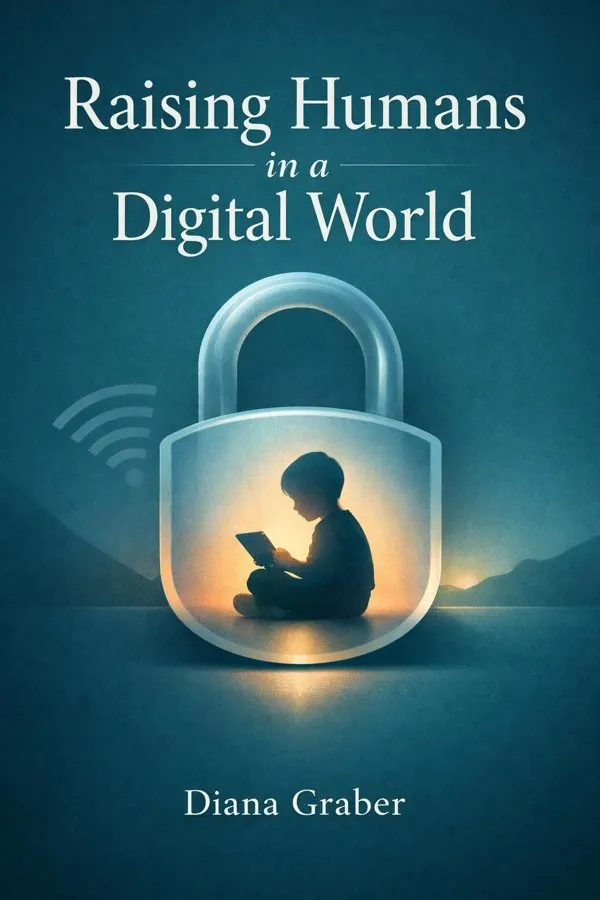
Raising Humans in a Digital World: Helping Kids Build a Healthy Relationship with Technology: Summary & Key Insights
by Diana Graber
 10 min13 chaptersAudio available
What Is Raising Humans in a Digital World: Helping Kids Build a Healthy Relationship with Technology About?
Raising Humans in a Digital World: Helping Kids Build a Healthy Relationship with Technology by Diana Graber is a parenting book spanning 13 pages. In this practical guide, digital literacy educator Diana Graber helps parents and teachers navigate the challenges of raising children in the digital age. The book offers strategies for teaching kids to use technology responsibly, covering topics such as online safety, empathy, privacy, and digital citizenship. It provides actionable advice for fostering healthy digital habits and building resilience in a connected world.
This FizzRead summary covers all 13 key chapters of Raising Humans in a Digital World: Helping Kids Build a Healthy Relationship with Technology in approximately 10 minutes, distilling the most important ideas, arguments, and takeaways from Diana Graber's work. Also available as an audio summary and Key Quotes Podcast.
Raising Humans in a Digital World: Helping Kids Build a Healthy Relationship with Technology
In this practical guide, digital literacy educator Diana Graber helps parents and teachers navigate the challenges of raising children in the digital age. The book offers strategies for teaching kids to use technology responsibly, covering topics such as online safety, empathy, privacy, and digital citizenship. It provides actionable advice for fostering healthy digital habits and building resilience in a connected world.
Who Should Read Raising Humans in a Digital World: Helping Kids Build a Healthy Relationship with Technology?
This book is perfect for anyone interested in parenting and looking to gain actionable insights in a short read. Whether you're a student, professional, or lifelong learner, the key ideas from Raising Humans in a Digital World: Helping Kids Build a Healthy Relationship with Technology by Diana Graber will help you think differently.
- ✓Readers who enjoy parenting and want practical takeaways
- ✓Professionals looking to apply new ideas to their work and life
- ✓Anyone who wants the core insights of Raising Humans in a Digital World: Helping Kids Build a Healthy Relationship with Technology in just 10 minutes
Want the full summary?
Get instant access to this book summary and 100K+ more with Fizz Moment.
Get Free SummaryAvailable on App Store • Free to download
Key Chapters
Children growing up today have never known a world without the internet, smartphones, or instant connectivity. Their brains are wired differently—not better or worse, but different. Neuroscience shows that continual digital engagement affects attention spans, impulse control, and social development. Parents often misunderstand this, imagining digital distraction as laziness or defiance, when in truth, it’s often a physiological response to a constant stream of stimuli.
I encourage parents to start with empathy. Our kids are navigating a developmental landscape that is utterly transformed. Imagine being an adolescent whose social life unfolds in group chats, whose achievements are validated by likes, and whose identity can be reshaped through filters and posts. It’s complicated—emotionally and psychologically. Recognizing this reality is the first step toward guiding them.
To raise kids who can navigate this digital complexity, we must understand that digital engagement isn’t simply a habit; it’s an environment. Technology shapes how children form relationships, engage with information, and define who they are. The role of adults is not to isolate them from it, but to help them become conscious participants—to use technology mindfully instead of reflexively. That begins with curiosity, not condemnation.
Every adult who touches a child’s life now shares a new responsibility: digital mentorship. Parents and teachers serve as mirrors, showing young people how to navigate technology with balance and intention. That means modeling the same behaviors we hope to see—whether it’s putting our phones away at dinner or demonstrating how to check sources before sharing an article.
In my experience, when adults step into a mentoring rather than a policing role, children respond with openness instead of defiance. Our goal isn’t control—it’s connection. Children need to see why rules about online behavior exist; they need context and conversation. Schools, too, have a vital role to play. Digital citizenship education—what we teach through Cyber Civics—shouldn’t be an add-on course; it’s as fundamental today as reading and math.
Adults who model mindful engagement with technology lay the foundation for trust. From that trust flows guidance that children can internalize, carrying it forward into their digital identities.
+ 11 more chapters — available in the FizzRead app
All Chapters in Raising Humans in a Digital World: Helping Kids Build a Healthy Relationship with Technology
About the Author
Diana Graber is a digital literacy educator and co-founder of Cyberwise, an organization dedicated to helping parents and educators teach digital citizenship. She developed the Cyber Civics curriculum, which is used in schools across the United States to teach students how to use technology safely and responsibly.
Get This Summary in Your Preferred Format
Read or listen to the Raising Humans in a Digital World: Helping Kids Build a Healthy Relationship with Technology summary by Diana Graber anytime, anywhere. FizzRead offers multiple formats so you can learn on your terms — all free.
Available formats: App · Audio · PDF · EPUB — All included free with FizzRead
Download Raising Humans in a Digital World: Helping Kids Build a Healthy Relationship with Technology PDF and EPUB Summary
Key Quotes from Raising Humans in a Digital World: Helping Kids Build a Healthy Relationship with Technology
“Children growing up today have never known a world without the internet, smartphones, or instant connectivity.”
“Every adult who touches a child’s life now shares a new responsibility: digital mentorship.”
Frequently Asked Questions about Raising Humans in a Digital World: Helping Kids Build a Healthy Relationship with Technology
Raising Humans in a Digital World: Helping Kids Build a Healthy Relationship with Technology by Diana Graber is a parenting book that explores key ideas across 13 chapters. In this practical guide, digital literacy educator Diana Graber helps parents and teachers navigate the challenges of raising children in the digital age. The book offers strategies for teaching kids to use technology responsibly, covering topics such as online safety, empathy, privacy, and digital citizenship. It provides actionable advice for fostering healthy digital habits and building resilience in a connected world.
You Might Also Like

Never Enough
Jennifer Breheny Wallace
10 min
Bluey: Sleepytime
Joe Brumm
10 min
In My Heart: A Book of Feelings
Jo Witek
10 min
Love From The Crayons
Drew Daywalt, Oliver Jeffers
10 min
Pete The Cat: Big Easter Adventure
James Dean, Kimberly Dean
10 min
Smart Money Smart Kids: Raising the Next Generation to Win with Money
Dave Ramsey, Rachel Cruze
10 minBrowse by Category
Ready to read Raising Humans in a Digital World: Helping Kids Build a Healthy Relationship with Technology?
Get the full summary and 100K+ more books with Fizz Moment.