
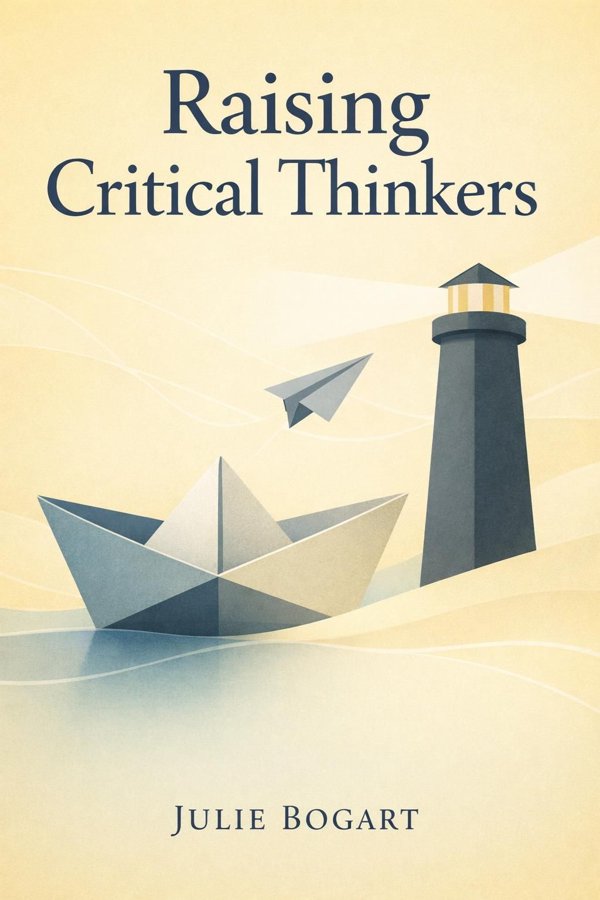
Raising Critical Thinkers: A Parent's Guide to Growing Wise Kids in the Digital Age: Summary & Key Insights
by Julie Bogart
 10 min12 chaptersAudio available
What Is Raising Critical Thinkers: A Parent's Guide to Growing Wise Kids in the Digital Age About?
Raising Critical Thinkers: A Parent's Guide to Growing Wise Kids in the Digital Age by Julie Bogart is a education book spanning 12 pages. Raising Critical Thinkers es una guía para padres que desean ayudar a sus hijos a desarrollar habilidades de pensamiento crítico en un mundo saturado de información digital. Julie Bogart ofrece estrategias prácticas para fomentar la curiosidad, la empatía y el análisis reflexivo, ayudando a los niños a distinguir hechos de opiniones y a formar juicios informados.
This FizzRead summary covers all 12 key chapters of Raising Critical Thinkers: A Parent's Guide to Growing Wise Kids in the Digital Age in approximately 10 minutes, distilling the most important ideas, arguments, and takeaways from Julie Bogart's work. Also available as an audio summary and Key Quotes Podcast.
Raising Critical Thinkers: A Parent's Guide to Growing Wise Kids in the Digital Age
Raising Critical Thinkers es una guía para padres que desean ayudar a sus hijos a desarrollar habilidades de pensamiento crítico en un mundo saturado de información digital. Julie Bogart ofrece estrategias prácticas para fomentar la curiosidad, la empatía y el análisis reflexivo, ayudando a los niños a distinguir hechos de opiniones y a formar juicios informados.
Who Should Read Raising Critical Thinkers: A Parent's Guide to Growing Wise Kids in the Digital Age?
This book is perfect for anyone interested in education and looking to gain actionable insights in a short read. Whether you're a student, professional, or lifelong learner, the key ideas from Raising Critical Thinkers: A Parent's Guide to Growing Wise Kids in the Digital Age by Julie Bogart will help you think differently.
- ✓Readers who enjoy education and want practical takeaways
- ✓Professionals looking to apply new ideas to their work and life
- ✓Anyone who wants the core insights of Raising Critical Thinkers: A Parent's Guide to Growing Wise Kids in the Digital Age in just 10 minutes
Want the full summary?
Get instant access to this book summary and 100K+ more with Fizz Moment.
Get Free SummaryAvailable on App Store • Free to download
Key Chapters
Before we can teach our children to think critically, we must first understand what it really means. Too often, critical thinking is mistaken for skepticism or argumentation—a way of poking holes in ideas until everything crumbles. But I see it differently. True critical thinking is the art of noticing, questioning, and holding ideas with care. It’s not combative; it’s curious.
Critical thinking, as I describe it, begins with awareness. Each of us interprets the world through a personal lens shaped by culture, experience, and emotion. When a child learns to recognize that lens—to see how it affects their understanding—they gain power over how they consume information. This process moves them beyond memorization or rote learning; it trains them to seek meaning and ask why.
In education, we often reward children for having answers. But critical thinking thrives in the realm of questions. Rather than celebrating certainty, I encourage parents to model uncertainty with confidence: to say, “I don’t know,” and then explore what could be true. That simple act invites children into discovery and reminds them that thinking is a process, not a destination.
The distinction from skepticism is also vital. Skepticism alone tends to create distance—it encourages disbelief rather than understanding. Critical thinking calls for engagement. It asks, “What might I learn from this person’s viewpoint?” It grows through empathy and patience, not just intellectual rigor. Even when children encounter misinformation online, their goal should not only be to reject it but to understand what makes it appealing and how trust is built.
In short, critical thinking isn’t a tool for winning debates. It’s a way of living thoughtfully, perceiving deeply, and approaching information with humility.
Parents hold immense power in shaping the intellectual climate of their homes. Our attitudes toward truth, curiosity, and disagreement become the invisible air our children breathe. If we react defensively when challenged, our children learn that questions are dangerous. If we value exploration—even when it unsettles our own views—they learn that thinking is an act of courage.
Throughout my years working with families, I’ve noticed that children mirror our emotional tone far more than our expressed intention. To raise critical thinkers, we must model the very qualities we hope to cultivate: open-mindedness, curiosity, and reflective judgment. When we encounter news, instead of rushing to opinion, we can verbalize our thought process—"Let’s check where this article came from" or "I wonder why they chose that headline." These small habits create conversational touchpoints that invite reasoning.
Our role is less about instruction and more about modeling. Children absorb nuance through observation. When parents admit mistakes, consider multiple sides of an issue, and manage disagreement respectfully, the entire family becomes a classroom of thinking. Instead of teaching kids what to think, we teach them how thinking feels—balanced, uncertain, alive.
Parenting critical thinkers involves emotional maturity. When conversations get heated or when children present views that challenge us, responding thoughtfully can be harder than it sounds. But each moment of discomfort is a chance to reinforce intellectual resilience. The message we give is: “Your ideas matter. Let’s explore them together.” And that spirit of collaboration lays the foundation for lifelong discernment.
+ 10 more chapters — available in the FizzRead app
All Chapters in Raising Critical Thinkers: A Parent's Guide to Growing Wise Kids in the Digital Age
About the Author
Julie Bogart es una educadora y escritora estadounidense, conocida por su trabajo en el ámbito de la educación en el hogar y el pensamiento crítico. Es fundadora de Brave Writer, un programa de escritura para familias que educan en casa, y autora de varios libros sobre aprendizaje y crianza.
Get This Summary in Your Preferred Format
Read or listen to the Raising Critical Thinkers: A Parent's Guide to Growing Wise Kids in the Digital Age summary by Julie Bogart anytime, anywhere. FizzRead offers multiple formats so you can learn on your terms — all free.
Available formats: App · Audio · PDF · EPUB — All included free with FizzRead
Download Raising Critical Thinkers: A Parent's Guide to Growing Wise Kids in the Digital Age PDF and EPUB Summary
Key Quotes from Raising Critical Thinkers: A Parent's Guide to Growing Wise Kids in the Digital Age
“Before we can teach our children to think critically, we must first understand what it really means.”
“Parents hold immense power in shaping the intellectual climate of their homes.”
Frequently Asked Questions about Raising Critical Thinkers: A Parent's Guide to Growing Wise Kids in the Digital Age
Raising Critical Thinkers: A Parent's Guide to Growing Wise Kids in the Digital Age by Julie Bogart is a education book that explores key ideas across 12 chapters. Raising Critical Thinkers es una guía para padres que desean ayudar a sus hijos a desarrollar habilidades de pensamiento crítico en un mundo saturado de información digital. Julie Bogart ofrece estrategias prácticas para fomentar la curiosidad, la empatía y el análisis reflexivo, ayudando a los niños a distinguir hechos de opiniones y a formar juicios informados.
You Might Also Like

Bedtime Biography: Florence Nightingale
Isabel Thomas
10 min
Introduction To Museum Studies
Howard H. Hoyt
10 min
A Mind for Numbers: How to Excel at Math and Science (Even If You Flunked Algebra)
Barbara Oakley
10 min
AI for Educators: Learning Strategies, Teacher Empowerment, and the Future of Education
Matt Miller
10 min
Animation For Beginners
Morr Meroz
10 min
Artificial Intelligence for Learning
Donald Clark
10 minBrowse by Category
Ready to read Raising Critical Thinkers: A Parent's Guide to Growing Wise Kids in the Digital Age?
Get the full summary and 100K+ more books with Fizz Moment.