
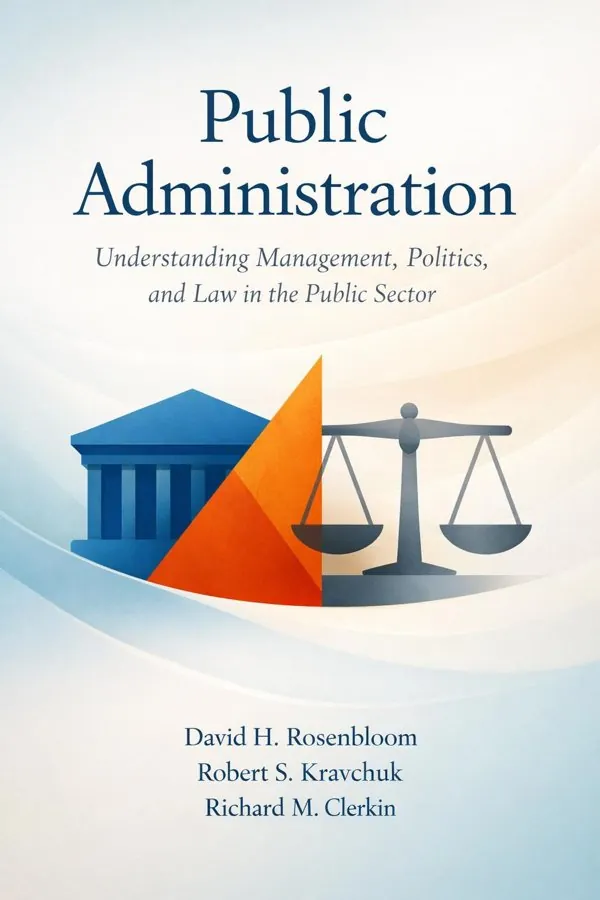
Public Administration: Understanding Management, Politics, and Law in the Public Sector: Summary & Key Insights
by David H. Rosenbloom, Robert S. Kravchuk, Richard M. Clerkin
 10 min7 chaptersAudio available
What Is Public Administration: Understanding Management, Politics, and Law in the Public Sector About?
Public Administration: Understanding Management, Politics, and Law in the Public Sector by David H. Rosenbloom, Robert S. Kravchuk, Richard M. Clerkin is a education book spanning 7 pages. This foundational textbook provides a comprehensive overview of public administration in the United States, integrating perspectives from management, politics, and law. It explores how these three approaches shape the functioning of public organizations, policy implementation, and administrative ethics. The book is widely used in graduate programs to introduce students to the complexities of governance and bureaucratic accountability.
This FizzRead summary covers all 7 key chapters of Public Administration: Understanding Management, Politics, and Law in the Public Sector in approximately 10 minutes, distilling the most important ideas, arguments, and takeaways from David H. Rosenbloom, Robert S. Kravchuk, Richard M. Clerkin's work. Also available as an audio summary and Key Quotes Podcast.
Public Administration: Understanding Management, Politics, and Law in the Public Sector
This foundational textbook provides a comprehensive overview of public administration in the United States, integrating perspectives from management, politics, and law. It explores how these three approaches shape the functioning of public organizations, policy implementation, and administrative ethics. The book is widely used in graduate programs to introduce students to the complexities of governance and bureaucratic accountability.
Who Should Read Public Administration: Understanding Management, Politics, and Law in the Public Sector?
This book is perfect for anyone interested in education and looking to gain actionable insights in a short read. Whether you're a student, professional, or lifelong learner, the key ideas from Public Administration: Understanding Management, Politics, and Law in the Public Sector by David H. Rosenbloom, Robert S. Kravchuk, Richard M. Clerkin will help you think differently.
- ✓Readers who enjoy education and want practical takeaways
- ✓Professionals looking to apply new ideas to their work and life
- ✓Anyone who wants the core insights of Public Administration: Understanding Management, Politics, and Law in the Public Sector in just 10 minutes
Want the full summary?
Get instant access to this book summary and 100K+ more with Fizz Moment.
Get Free SummaryAvailable on App Store • Free to download
Key Chapters
The roots of American public administration lie in the country’s constitutional and democratic development. When we explore its origins, we must begin with the republic’s founding paradox: how can government be strong enough to govern effectively yet limited enough to preserve liberty? The United States resolved this by embedding administration within a framework of checks and balances. From the beginning, administrators were not mere functionaries; they were instruments of constitutional governance.
Early American government had little in the way of a professional bureaucracy. It was the spoils system of the 19th century—tense, partisan, and often corrupt—that forced reformers to imagine a different kind of administration. The Pendleton Act of 1883 marked a turning point, institutionalizing the merit system and professionalizing public employment. This genesis shaped the enduring managerial dream of neutrality and competence.
As the industrial age matured, reformers like Woodrow Wilson and Frederick Taylor pushed for efficiency, rationalization, and scientific management. They saw public administration as a discipline akin to engineering, one that could bring order and logic to the messiness of politics. Yet alongside this managerial vision grew a countercurrent emphasizing responsiveness to democratic values—particularly during the New Deal, when government’s responsibilities expanded dramatically.
By the mid-twentieth century, the law-based approach reasserted itself, especially through judicial oversight and due process guarantees. The administrative state, by then, was permanent and vast. Balancing technical expertise with legal accountability and political answerability became the field’s enduring challenge. This historical course underscores a central theme of this book: public administration in America is not a single, uniform model—it is the product of continuous negotiation among management, politics, and law.
When I speak of the managerial approach, I am not invoking a cold science of efficiency. I am talking about an ethic of stewardship—the responsible use of resources in service of public goals. The managerial perspective emphasizes rational planning, performance standards, and results-based management. It asks: how can administrators produce more effective outcomes with finite means?
This approach found early champions in scientific management and continues to resonate today in movements like New Public Management (NPM). Performance indicators, outcome evaluations, and strategic planning tools form its modern language. Yet managerialism in the public sector must always contend with the fact that our success cannot be measured solely in profit terms. Efficiency must coexist with equity and legality.
Through the managerial lens, the administrator is an executive: a leader who turns policy into operational reality. They must master budgeting, personnel management, and program implementation. But effective managers also cultivate organizational culture and morale—they recognize that human motivation and institutional ethics determine whether efficiency is meaningful or hollow.
By grounding performance in public accountability, the managerial approach becomes one leg of the triad. It imparts discipline and focus, ensuring that government remains capable and competent in carrying out the will of the people.
+ 5 more chapters — available in the FizzRead app
All Chapters in Public Administration: Understanding Management, Politics, and Law in the Public Sector
About the Authors
David H. Rosenbloom is a distinguished scholar in public administration and a professor at American University. His research focuses on administrative law, public management, and democratic governance. Robert S. Kravchuk and Richard M. Clerkin are respected academics contributing to the study of public finance and organizational behavior in the public sector.
Get This Summary in Your Preferred Format
Read or listen to the Public Administration: Understanding Management, Politics, and Law in the Public Sector summary by David H. Rosenbloom, Robert S. Kravchuk, Richard M. Clerkin anytime, anywhere. FizzRead offers multiple formats so you can learn on your terms — all free.
Available formats: App · Audio · PDF · EPUB — All included free with FizzRead
Download Public Administration: Understanding Management, Politics, and Law in the Public Sector PDF and EPUB Summary
Key Quotes from Public Administration: Understanding Management, Politics, and Law in the Public Sector
“The roots of American public administration lie in the country’s constitutional and democratic development.”
“When I speak of the managerial approach, I am not invoking a cold science of efficiency.”
Frequently Asked Questions about Public Administration: Understanding Management, Politics, and Law in the Public Sector
Public Administration: Understanding Management, Politics, and Law in the Public Sector by David H. Rosenbloom, Robert S. Kravchuk, Richard M. Clerkin is a education book that explores key ideas across 7 chapters. This foundational textbook provides a comprehensive overview of public administration in the United States, integrating perspectives from management, politics, and law. It explores how these three approaches shape the functioning of public organizations, policy implementation, and administrative ethics. The book is widely used in graduate programs to introduce students to the complexities of governance and bureaucratic accountability.
You Might Also Like

Bedtime Biography: Florence Nightingale
Isabel Thomas
10 min
Introduction To Museum Studies
Howard H. Hoyt
10 min
A Mind for Numbers: How to Excel at Math and Science (Even If You Flunked Algebra)
Barbara Oakley
10 min
AI for Educators: Learning Strategies, Teacher Empowerment, and the Future of Education
Matt Miller
10 min
Animation For Beginners
Morr Meroz
10 min
Artificial Intelligence for Learning
Donald Clark
10 minBrowse by Category
Ready to read Public Administration: Understanding Management, Politics, and Law in the Public Sector?
Get the full summary and 100K+ more books with Fizz Moment.