
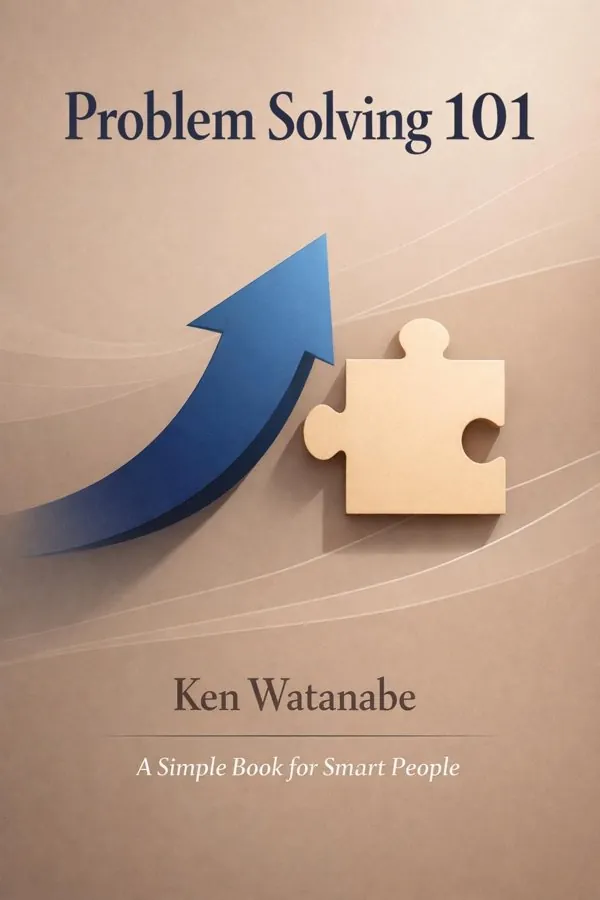
Problem Solving 101: A Simple Book for Smart People: Summary & Key Insights
by Ken Watanabe
 10 min10 chaptersAudio available
What Is Problem Solving 101: A Simple Book for Smart People About?
Problem Solving 101: A Simple Book for Smart People by Ken Watanabe is a education book spanning 10 pages. Problem Solving 101 is a concise and engaging guide to logical thinking and problem-solving, originally written for Japanese schoolchildren by former McKinsey consultant Ken Watanabe. Using simple diagrams and relatable stories, the book teaches readers how to identify problems, analyze causes, and develop effective solutions—skills that are valuable in both business and everyday life. Its clear and practical approach has made it a global favorite among readers seeking to improve their critical thinking abilities.
This FizzRead summary covers all 10 key chapters of Problem Solving 101: A Simple Book for Smart People in approximately 10 minutes, distilling the most important ideas, arguments, and takeaways from Ken Watanabe's work. Also available as an audio summary and Key Quotes Podcast.
Problem Solving 101: A Simple Book for Smart People
Problem Solving 101 is a concise and engaging guide to logical thinking and problem-solving, originally written for Japanese schoolchildren by former McKinsey consultant Ken Watanabe. Using simple diagrams and relatable stories, the book teaches readers how to identify problems, analyze causes, and develop effective solutions—skills that are valuable in both business and everyday life. Its clear and practical approach has made it a global favorite among readers seeking to improve their critical thinking abilities.
Who Should Read Problem Solving 101: A Simple Book for Smart People?
This book is perfect for anyone interested in education and looking to gain actionable insights in a short read. Whether you're a student, professional, or lifelong learner, the key ideas from Problem Solving 101: A Simple Book for Smart People by Ken Watanabe will help you think differently.
- ✓Readers who enjoy education and want practical takeaways
- ✓Professionals looking to apply new ideas to their work and life
- ✓Anyone who wants the core insights of Problem Solving 101: A Simple Book for Smart People in just 10 minutes
Want the full summary?
Get instant access to this book summary and 100K+ more with Fizz Moment.
Get Free SummaryAvailable on App Store • Free to download
Key Chapters
The first and most common mistake people make when facing a challenge is that they try to fix it before understanding it. In consulting, I saw this often—clients would rush to implement solutions without clearly identifying the real issue. The same happens in everyday life: we mistake symptoms for problems.
In *Problem Solving 101*, I begin by helping readers recognize that a problem isn’t simply something that went wrong. A problem is a gap—a difference between where you are now and where you want to be. If you can describe that gap precisely and objectively, you’ve already taken the first step toward solving it.
For example, imagine a band complaining they’re unpopular. If they simply say, “We don’t have fans,” that’s vague and unhelpful. But if they define their problem as “We want more people to come to our concerts,” suddenly it becomes actionable. Once defined, questions emerge: why aren’t people attending? Is it due to poor publicity, inconvenient timing, or lack of musical quality? Each of these leads to a different solution.
Defining a problem means resisting the urge to jump to conclusions. It’s about putting emotions aside and looking at the situation objectively. You must learn to ask, “What exactly do we want to achieve?” and “What’s preventing us from getting there?” Once you’ve written down a clear problem statement, you’ve built a foundation for all the logic and creativity that follows.
After defining a problem, we need a practical process to tackle it. My consulting experience taught me that systematic thinking doesn’t eliminate creativity—it enhances it. The framework I share in *Problem Solving 101* has four main stages: understand the current situation, identify root causes, generate possible solutions, and implement them.
Understanding the current situation means collecting facts, not opinions. We must see reality as it is, not as we assume it to be. Then we dig deeper: what are the root causes? Too often we fix surface issues—like adding more advertising to boost attendance—without realizing the deeper problem might be poor product quality or unclear messaging.
Once causes are understood, we enter the world of ideas. Generating solutions is where creativity blends with analysis. I encourage readers not to limit themselves at this stage; every idea, no matter how small or unusual, should be considered. Finally, we select the best solutions and act. Implementation turns thinking into doing, and monitoring results teaches us whether our logic holds true.
This four-step method sounds simple, and it is—but true simplicity requires discipline. By following this structure, children and adults alike can learn to approach any challenge not as chaos but as a system that can be understood and improved.
+ 8 more chapters — available in the FizzRead app
All Chapters in Problem Solving 101: A Simple Book for Smart People
About the Author
Ken Watanabe is a Japanese management consultant and author. After graduating from the University of Tokyo, he worked at McKinsey & Company before dedicating himself to education and social issues. He is known for promoting logical thinking and problem-solving skills through his writing and teaching.
Get This Summary in Your Preferred Format
Read or listen to the Problem Solving 101: A Simple Book for Smart People summary by Ken Watanabe anytime, anywhere. FizzRead offers multiple formats so you can learn on your terms — all free.
Available formats: App · Audio · PDF · EPUB — All included free with FizzRead
Download Problem Solving 101: A Simple Book for Smart People PDF and EPUB Summary
Key Quotes from Problem Solving 101: A Simple Book for Smart People
“The first and most common mistake people make when facing a challenge is that they try to fix it before understanding it.”
“After defining a problem, we need a practical process to tackle it.”
Frequently Asked Questions about Problem Solving 101: A Simple Book for Smart People
Problem Solving 101: A Simple Book for Smart People by Ken Watanabe is a education book that explores key ideas across 10 chapters. Problem Solving 101 is a concise and engaging guide to logical thinking and problem-solving, originally written for Japanese schoolchildren by former McKinsey consultant Ken Watanabe. Using simple diagrams and relatable stories, the book teaches readers how to identify problems, analyze causes, and develop effective solutions—skills that are valuable in both business and everyday life. Its clear and practical approach has made it a global favorite among readers seeking to improve their critical thinking abilities.
You Might Also Like

Bedtime Biography: Florence Nightingale
Isabel Thomas
10 min
Introduction To Museum Studies
Howard H. Hoyt
10 min
A Mind for Numbers: How to Excel at Math and Science (Even If You Flunked Algebra)
Barbara Oakley
10 min
AI for Educators: Learning Strategies, Teacher Empowerment, and the Future of Education
Matt Miller
10 min
Animation For Beginners
Morr Meroz
10 min
Artificial Intelligence for Learning
Donald Clark
10 minBrowse by Category
Ready to read Problem Solving 101: A Simple Book for Smart People?
Get the full summary and 100K+ more books with Fizz Moment.