
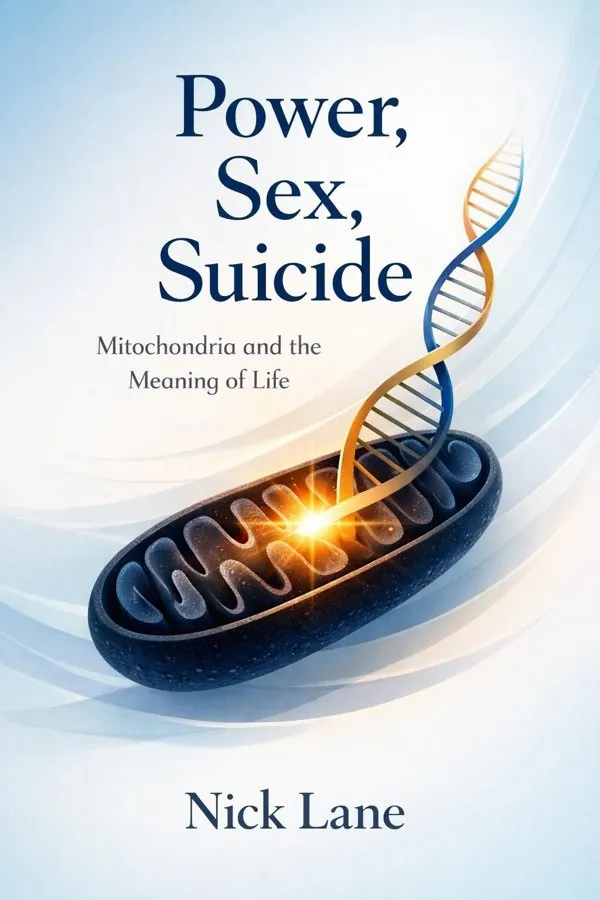
Power, Sex, Suicide: Mitochondria and the Meaning of Life: Summary & Key Insights
by Nick Lane
 10 min9 chaptersAudio available
Key Takeaways from Power, Sex, Suicide: Mitochondria and the Meaning of Life
The origin of complex life may have depended on one improbable biological partnership.
Life is not just information; it is power management.
Sex may seem like a strange and costly strategy, yet it became central to complex life.
Aging is often described as wear and tear, but Lane gives it a more specific engine: mitochondrial decline.
It seems paradoxical that healthy organisms would evolve a mechanism for self-destruction, yet programmed cell death is essential to life.
What Is Power, Sex, Suicide: Mitochondria and the Meaning of Life About?
Power, Sex, Suicide: Mitochondria and the Meaning of Life by Nick Lane is a life_science book spanning 8 pages. What if the deepest answers to life, death, sex, aging, and human complexity were hidden inside tiny structures within our cells? In Power, Sex, Suicide, biochemist Nick Lane argues exactly that. This book is a sweeping scientific narrative about mitochondria—the microscopic organelles best known for generating cellular energy—and their astonishing role in shaping the history of life on Earth. Lane shows that mitochondria are far more than cellular batteries. They helped make complex organisms possible, influenced the evolution of sex, contribute to aging, trigger programmed cell death, and sit at the center of many diseases. What makes the book especially powerful is its ability to connect molecular biology with the biggest existential questions. Lane does not treat biochemistry as a narrow specialty; he uses it to explain why complex life emerged, why bodies fail, and why evolution took the path it did. As a leading researcher in bioenergetics and evolutionary biology, Lane brings both scientific authority and unusual clarity to the subject. The result is an intellectually ambitious and deeply readable work that invites readers to see life itself through the lens of energy.
This FizzRead summary covers all 9 key chapters of Power, Sex, Suicide: Mitochondria and the Meaning of Life in approximately 10 minutes, distilling the most important ideas, arguments, and takeaways from Nick Lane's work. Also available as an audio summary and Key Quotes Podcast.
Power, Sex, Suicide: Mitochondria and the Meaning of Life
What if the deepest answers to life, death, sex, aging, and human complexity were hidden inside tiny structures within our cells? In Power, Sex, Suicide, biochemist Nick Lane argues exactly that. This book is a sweeping scientific narrative about mitochondria—the microscopic organelles best known for generating cellular energy—and their astonishing role in shaping the history of life on Earth. Lane shows that mitochondria are far more than cellular batteries. They helped make complex organisms possible, influenced the evolution of sex, contribute to aging, trigger programmed cell death, and sit at the center of many diseases.
What makes the book especially powerful is its ability to connect molecular biology with the biggest existential questions. Lane does not treat biochemistry as a narrow specialty; he uses it to explain why complex life emerged, why bodies fail, and why evolution took the path it did. As a leading researcher in bioenergetics and evolutionary biology, Lane brings both scientific authority and unusual clarity to the subject. The result is an intellectually ambitious and deeply readable work that invites readers to see life itself through the lens of energy.
Who Should Read Power, Sex, Suicide: Mitochondria and the Meaning of Life?
This book is perfect for anyone interested in life_science and looking to gain actionable insights in a short read. Whether you're a student, professional, or lifelong learner, the key ideas from Power, Sex, Suicide: Mitochondria and the Meaning of Life by Nick Lane will help you think differently.
- ✓Readers who enjoy life_science and want practical takeaways
- ✓Professionals looking to apply new ideas to their work and life
- ✓Anyone who wants the core insights of Power, Sex, Suicide: Mitochondria and the Meaning of Life in just 10 minutes
Want the full summary?
Get instant access to this book summary and 100K+ more with Fizz Moment.
Get Free SummaryAvailable on App Store • Free to download
Key Chapters
The origin of complex life may have depended on one improbable biological partnership. Lane explains that mitochondria were once free-living bacteria that entered into a relationship with another cell around two billion years ago. Instead of being digested, these bacteria stayed, and the alliance transformed evolution. This event, known as endosymbiosis, gave rise to the eukaryotic cell—the kind of cell that makes up animals, plants, fungi, and humans.
The significance of this merger is hard to overstate. Before it, life consisted mainly of simple cells struggling to generate enough energy to do much beyond basic survival and replication. By taking up residence inside a host cell, the ancestral mitochondrion provided a new and efficient source of energy. Over time, many of its genes moved into the host nucleus, and the two lineages became inseparable. What began as a biological accident became the foundation of all complex organisms.
A practical way to understand this is to compare a workshop powered by hand tools with one connected to an electrical grid. The workshop may function in both cases, but only the second can scale, specialize, and innovate. Mitochondria gave cells that kind of internal power infrastructure.
Lane uses this origin story to show that major evolutionary breakthroughs often come not from competition alone but from cooperation, integration, and energy gain. If you want to understand why humans exist at all, start by understanding this cellular marriage.
Actionable takeaway: When thinking about evolution, look beyond genes and natural selection alone—ask what new energy systems made greater complexity possible.
Life is not just information; it is power management. One of Lane’s central arguments is that energy availability determines what life can become. Every organism must extract energy from its environment, but simple cells face severe physical limits. Their energy production happens across membranes, and the amount of membrane they have scales poorly as they grow. That means bigger simple cells do not automatically gain enough extra energy to support more genes, more internal structures, or more complexity.
Mitochondria broke that limit. By internalizing energy-producing membranes in large numbers, eukaryotic cells gained access to vast amounts of power per gene. This surplus allowed them to maintain large genomes, build cytoskeletons, transport systems, signaling networks, and eventually multicellular bodies. In Lane’s view, complexity did not arise simply because evolution “wanted” it. It arose because mitochondria made it energetically affordable.
This idea has implications beyond evolutionary theory. It reminds us that every complex system, from a body to a city to a company, depends on hidden energy budgets. Ambition without infrastructure collapses. Cells, like organizations, need enough power to support added layers of coordination.
For readers, this concept sharpens how we interpret biology. A trait does not evolve merely because it is useful; it must be supportable. Complexity is not free. It must be paid for in ATP, membranes, and metabolic capacity.
Actionable takeaway: Whenever you encounter a biological puzzle, ask the energy question first: what powers this system, and what limits that power?
Sex may seem like a strange and costly strategy, yet it became central to complex life. Lane explores a provocative possibility: mitochondria helped make sex necessary. Because mitochondria retain a small set of their own genes, cells must manage a delicate relationship between nuclear DNA and mitochondrial DNA. These two genomes have to cooperate precisely for respiration to work. But mitochondrial DNA mutates relatively quickly, creating potential mismatches that can damage cellular energy production.
Sex and recombination may have evolved, in part, as a way to keep the nuclear genome flexible enough to adapt to these mitochondrial changes. By shuffling genes each generation, sexual reproduction helps preserve compatibility between the nucleus and the mitochondria. This turns sex from a mere reproductive curiosity into a deep bioenergetic strategy.
Lane also explains why mitochondria are usually inherited from only one parent, typically the mother. If two competing mitochondrial lineages entered the same embryo, conflict could arise, with different mitochondrial variants racing to replicate at the expense of the organism. Uniparental inheritance reduces that conflict and stabilizes cooperation inside the cell.
This idea changes how we think about sex. Rather than seeing it only as a mechanism for producing variety, Lane encourages us to see it as a system for maintaining internal harmony between intertwined genetic partners. Even intimate features of animal life may reflect ancient cellular negotiations.
Actionable takeaway: See reproduction not just as a means of passing on genes, but as a way organisms maintain compatibility across complex biological systems.
Aging is often described as wear and tear, but Lane gives it a more specific engine: mitochondrial decline. Mitochondria generate energy through respiration, a process that inevitably produces reactive oxygen species. These molecules can damage proteins, membranes, and especially mitochondrial DNA. Over time, damaged mitochondria may function less efficiently, generating even more oxidative stress and further weakening the cell.
Lane does not present aging as a single-cause phenomenon, but he argues that mitochondria are deeply involved in the cascade. Because tissues like muscle, heart, and brain have high energy demands, they are especially vulnerable when mitochondrial performance slips. That helps explain why aging often appears as a decline in stamina, cognition, and tissue maintenance.
This framework has practical relevance. It helps us understand why exercise, sleep, and metabolic health matter so much. Regular physical activity can stimulate mitochondrial biogenesis, improving both the number and quality of mitochondria. Good nutrition and lower chronic inflammation also support mitochondrial function. While no lifestyle habit stops aging, some may slow the loss of energetic resilience.
Lane’s approach also tempers simplistic anti-aging promises. If aging is tied to the very chemistry that makes oxygen-based life so powerful, then there may be no clean escape from it. The same system that gives us high energy also carries long-term costs.
Actionable takeaway: Support your mitochondria through sustained exercise, metabolic health, and recovery habits, because aging is closely linked to how well cells maintain their energy systems.
It seems paradoxical that healthy organisms would evolve a mechanism for self-destruction, yet programmed cell death is essential to life. Lane shows that apoptosis—the orderly process by which cells dismantle themselves—is intimately connected to mitochondria. These organelles can release signals that activate cascades leading a cell to die in a controlled way. This process shapes embryonic development, protects organisms from cancer, and removes damaged cells before they become dangerous.
Why would the powerhouses of life also be agents of death? Lane’s answer is evolutionary and biochemical. Mitochondria are central regulators of cellular stress and internal state. Because they sit at the crossroads of metabolism, they are well placed to judge whether a cell remains viable or has become too compromised to keep.
Examples make this clearer. During development, apoptosis sculpts fingers by removing the tissue between them. In adult life, it helps eliminate cells infected by viruses or cells carrying severe DNA damage. Without apoptosis, multicellular organisms would be chaotic masses of defective cells. Too little cell death contributes to cancer; too much can worsen degenerative disease.
Lane reframes death not as the opposite of life, but as one of its maintenance tools. Complex organisms survive because some cells are able to die for the whole.
Actionable takeaway: When evaluating health and disease, remember that biological success depends on balance—not merely keeping cells alive, but removing them at the right time and in the right way.
Some illnesses begin not with infection or injury, but with failures in cellular energy. Lane examines the many ways mitochondrial dysfunction contributes to disease. Because mitochondria are crucial for ATP production, tissues with high energy demands—brain, muscle, heart, retina—are often the first to suffer. Problems in mitochondrial genes can lead to rare inherited disorders, but mitochondrial impairment may also play a role in common conditions such as neurodegeneration, diabetes, infertility, and cardiovascular disease.
A striking feature of mitochondrial disease is its variability. The same mutation can cause different symptoms in different people or even in different tissues within one person. That happens partly because each cell contains many mitochondria, often with a mixture of healthy and damaged mitochondrial DNA. Disease can emerge when the balance tips past a threshold.
This concept matters because it challenges one-size-fits-all medicine. Energy failure may underlie symptoms that look unrelated on the surface. Fatigue, cognitive issues, muscle weakness, and organ dysfunction can all reflect compromised mitochondrial performance. It also explains why interventions that improve metabolic resilience—exercise, glycemic control, and mitochondrial-targeted therapies—are receiving growing attention.
Lane’s discussion broadens disease thinking. The body is not only a genetic system or an immune system; it is also an energy economy. When the economy fails, the effects are systemic.
Actionable takeaway: In understanding illness, pay attention to energy metabolism, especially when symptoms affect high-demand tissues like brain, muscle, and heart.
Why did bacteria remain relatively simple for billions of years while eukaryotes exploded into extraordinary forms? Lane’s answer returns to bioenergetics. Complexity requires an enormous surplus of energy, not just enough to stay alive. Large genomes must be copied, regulated, and repaired. Protein networks must communicate across the cell. Internal compartments must be built and maintained. All of that is expensive.
Mitochondria gave eukaryotic cells a decisive advantage by dramatically increasing energy availability per gene. With thousands of mitochondria supplying ATP, cells could afford redundancy, regulation, and experimentation. This energetic freedom created space for evolutionary innovation. Features we take for granted—large cell size, internal organelles, multicellularity, signaling complexity—were not simply clever inventions. They were enabled by abundant power.
This principle applies beyond biology. In any system, complexity rises only when basic operating costs are covered efficiently. A household can plan for education and investment only after meeting food and shelter needs. A startup can innovate only after securing enough resources to sustain experimentation. Energy surplus creates optionality.
Lane’s argument also explains why the emergence of complex life may have been rare, contingent, and perhaps exceptional in the universe. If the right symbiotic event had to occur before complexity could flourish, then intelligent life may be far less inevitable than many assume.
Actionable takeaway: Treat complexity as a product of surplus capacity—whether in cells, institutions, or personal life, sustainable growth requires reliable underlying power.
Modern biology often tells the story of life through genes, but Lane insists that genes are only part of the picture. DNA stores instructions, yet instructions do nothing without a physical system capable of executing them. Mitochondria reveal this clearly. Their importance lies not in information storage but in energy conversion. Without that energy, genes remain inert potential.
This shifts the center of biological explanation. Instead of asking only which genes an organism has, Lane asks what energetic environment those genes operate within. Two organisms may share many genes, yet differ profoundly because of metabolic architecture, membrane chemistry, or mitochondrial efficiency. Likewise, evolutionary possibilities are constrained not only by mutation and selection but by whether there is enough energy to support a new form of life.
This perspective helps counter simplistic genetic determinism. It reminds us that biology is an interaction among information, chemistry, structure, and energy flow. In medicine, that means a DNA result does not always tell the full story. In evolution, it means adaptations cannot be understood in isolation from the systems that power them.
For general readers, this is one of the book’s most valuable lessons. Life is not a software program running independently of hardware. It is a dynamic process sustained by constant energetic work.
Actionable takeaway: Resist explanations that reduce biology to genes alone; ask how energy, environment, and cellular machinery shape what genes can actually do.
The most unsettling and illuminating implication of Lane’s book is that some of the grandest features of human existence arise from microscopic events inside cells. Mitochondria are implicated in vitality, fertility, development, aging, disease, and death. That means many experiences we think of as personal or existential also have a biochemical dimension. The meaning of life, in Lane’s framing, is not reduced to chemistry, but chemistry reveals how deeply our fate is tied to ancient evolutionary compromises.
This perspective can feel deflating at first. If our strengths and limits stem from cellular machinery, where does that leave mystery or individuality? Lane’s answer is not reductionistic in a crude sense. Instead, he shows that understanding mechanisms increases wonder. The fact that human love, ambition, frailty, and mortality depend in part on bacterial descendants living inside our cells makes life stranger, not smaller.
There is also humility in this view. We are not self-made organisms designed from scratch. We are layered coalitions built from mergers, conflicts, and negotiations across evolutionary time. Even our most intimate biological processes bear the mark of ancient symbiosis.
The practical value of this idea is philosophical. It encourages a more integrated understanding of health, identity, and human nature—one that accepts dependence, complexity, and trade-offs as fundamental realities.
Actionable takeaway: Let biology deepen rather than diminish your sense of meaning by recognizing that human life is a remarkable achievement of cooperation across scales.
All Chapters in Power, Sex, Suicide: Mitochondria and the Meaning of Life
About the Author
Nick Lane is a British biochemist, science writer, and professor at University College London whose work focuses on bioenergetics, evolution, and the origin of life. He is widely known for exploring how energy shapes major transitions in biology, especially the emergence of complex cells. Lane has written several acclaimed books that bring advanced life science to general readers without losing intellectual depth. His writing stands out for combining scientific rigor with a strong narrative sense, often linking molecular mechanisms to large philosophical questions about life and human existence. In Power, Sex, Suicide, he draws on his expertise in mitochondria and evolutionary theory to argue that these organelles are central to understanding complexity, aging, disease, and death. He is regarded as one of the most original contemporary interpreters of biology.
Get This Summary in Your Preferred Format
Read or listen to the Power, Sex, Suicide: Mitochondria and the Meaning of Life summary by Nick Lane anytime, anywhere. FizzRead offers multiple formats so you can learn on your terms — all free.
Available formats: App · Audio · PDF · EPUB — All included free with FizzRead
Download Power, Sex, Suicide: Mitochondria and the Meaning of Life PDF and EPUB Summary
Key Quotes from Power, Sex, Suicide: Mitochondria and the Meaning of Life
“The origin of complex life may have depended on one improbable biological partnership.”
“Life is not just information; it is power management.”
“Sex may seem like a strange and costly strategy, yet it became central to complex life.”
“Aging is often described as wear and tear, but Lane gives it a more specific engine: mitochondrial decline.”
“It seems paradoxical that healthy organisms would evolve a mechanism for self-destruction, yet programmed cell death is essential to life.”
Frequently Asked Questions about Power, Sex, Suicide: Mitochondria and the Meaning of Life
Power, Sex, Suicide: Mitochondria and the Meaning of Life by Nick Lane is a life_science book that explores key ideas across 9 chapters. What if the deepest answers to life, death, sex, aging, and human complexity were hidden inside tiny structures within our cells? In Power, Sex, Suicide, biochemist Nick Lane argues exactly that. This book is a sweeping scientific narrative about mitochondria—the microscopic organelles best known for generating cellular energy—and their astonishing role in shaping the history of life on Earth. Lane shows that mitochondria are far more than cellular batteries. They helped make complex organisms possible, influenced the evolution of sex, contribute to aging, trigger programmed cell death, and sit at the center of many diseases. What makes the book especially powerful is its ability to connect molecular biology with the biggest existential questions. Lane does not treat biochemistry as a narrow specialty; he uses it to explain why complex life emerged, why bodies fail, and why evolution took the path it did. As a leading researcher in bioenergetics and evolutionary biology, Lane brings both scientific authority and unusual clarity to the subject. The result is an intellectually ambitious and deeply readable work that invites readers to see life itself through the lens of energy.
More by Nick Lane
You Might Also Like
The Selfish Gene
Richard Dawkins
10 min
Awakenings
Oliver Sacks
10 min
Parasite Rex: Inside the Bizarre World of Nature's Most Dangerous Creatures
Carl Zimmer
10 min
The Atlas of Life on Earth
Various
10 min
The Book of Humans: The Story of How We Became Us
Adam Rutherford
10 min
The Horse
Wendy Williams
10 minBrowse by Category
Ready to read Power, Sex, Suicide: Mitochondria and the Meaning of Life?
Get the full summary and 100K+ more books with Fizz Moment.