
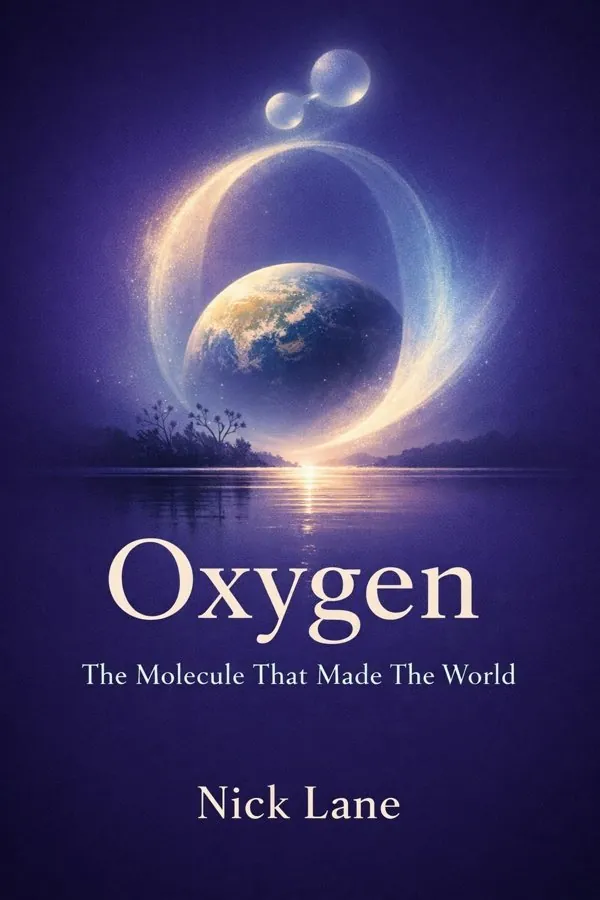
Oxygen: The Molecule That Made The World: Summary & Key Insights
by Nick Lane
 10 min9 chaptersAudio available
Key Takeaways from Oxygen: The Molecule That Made The World
Imagine living on a planet where the very air that sustains you today would have been a lethal poison.
One of the book’s most striking insights is that life did not merely adapt to Earth’s environment; it actively transformed it in ways that changed the future of evolution.
The modern world of animals, plants, and fungi depends on an energy breakthrough so familiar that we rarely notice its miracle.
Buried inside nearly every complex cell is evidence of one of evolution’s most improbable partnerships.
The most important truth about oxygen is also the most paradoxical: it is both the making of complex life and a constant threat to it.
What Is Oxygen: The Molecule That Made The World About?
Oxygen: The Molecule That Made The World by Nick Lane is a life_science book spanning 4 pages. Oxygen feels ordinary because it is everywhere in modern life, yet Nick Lane shows that it is one of the most revolutionary substances in Earth’s history. In Oxygen: The Molecule That Made The World, he traces how this reactive gas transformed a hostile young planet, enabled the rise of complex organisms, and still shapes our health, aging, fertility, disease, and death. What seems like a simple chemical turns out to be the hidden force behind some of biology’s biggest turning points. Lane’s argument is especially compelling because he writes from deep scientific expertise. A biochemist and leading thinker in evolutionary bioenergetics, he connects geology, cell biology, medicine, and evolution into one coherent story. He explains not just what oxygen does, but why its strange dual nature matters: oxygen gives organisms immense energetic power, yet it also damages cells from within. That tension lies at the heart of life itself. This is a book about far more than respiration. It is about why complex life exists, why bodies age, why sex evolved the way it did, and why every breath is both a gift and a risk.
This FizzRead summary covers all 9 key chapters of Oxygen: The Molecule That Made The World in approximately 10 minutes, distilling the most important ideas, arguments, and takeaways from Nick Lane's work. Also available as an audio summary and Key Quotes Podcast.
Oxygen: The Molecule That Made The World
Oxygen feels ordinary because it is everywhere in modern life, yet Nick Lane shows that it is one of the most revolutionary substances in Earth’s history. In Oxygen: The Molecule That Made The World, he traces how this reactive gas transformed a hostile young planet, enabled the rise of complex organisms, and still shapes our health, aging, fertility, disease, and death. What seems like a simple chemical turns out to be the hidden force behind some of biology’s biggest turning points.
Lane’s argument is especially compelling because he writes from deep scientific expertise. A biochemist and leading thinker in evolutionary bioenergetics, he connects geology, cell biology, medicine, and evolution into one coherent story. He explains not just what oxygen does, but why its strange dual nature matters: oxygen gives organisms immense energetic power, yet it also damages cells from within. That tension lies at the heart of life itself.
This is a book about far more than respiration. It is about why complex life exists, why bodies age, why sex evolved the way it did, and why every breath is both a gift and a risk.
Who Should Read Oxygen: The Molecule That Made The World?
This book is perfect for anyone interested in life_science and looking to gain actionable insights in a short read. Whether you're a student, professional, or lifelong learner, the key ideas from Oxygen: The Molecule That Made The World by Nick Lane will help you think differently.
- ✓Readers who enjoy life_science and want practical takeaways
- ✓Professionals looking to apply new ideas to their work and life
- ✓Anyone who wants the core insights of Oxygen: The Molecule That Made The World in just 10 minutes
Want the full summary?
Get instant access to this book summary and 100K+ more with Fizz Moment.
Get Free SummaryAvailable on App Store • Free to download
Key Chapters
Imagine living on a planet where the very air that sustains you today would have been a lethal poison. Lane begins by reminding us that early Earth was nothing like the modern world. Its atmosphere was rich in methane, carbon dioxide, ammonia, and volcanic gases, while free oxygen was nearly absent. The first life forms evolved in this chemically harsh environment and, for a long time, had no use for oxygen at all. In fact, for many ancient microbes, oxygen was a dangerous toxin.
The great turning point came with photosynthetic bacteria, especially cyanobacteria, which began splitting water and releasing oxygen as waste. At first, that oxygen did not accumulate in the air. It reacted with dissolved iron in the oceans and with exposed rocks, slowly changing the chemistry of the planet. Only after those sinks became saturated did oxygen start building up in the atmosphere in what scientists call the Great Oxidation Event.
This was not a gentle upgrade to Earth’s systems. It was a planetary revolution. Entire ecosystems based on oxygen-free chemistry were pushed to the margins. Yet this upheaval also opened the door to new biological possibilities, including more efficient energy extraction and eventually complex multicellular life.
A practical way to think about this idea is to see planetary habitability as a living process, not a fixed background. Earth’s atmosphere was not simply given; it was co-created by life and geology over immense spans of time. That perspective matters today in climate science and astrobiology, where researchers ask how life might reshape other worlds.
Actionable takeaway: When thinking about life on Earth, stop treating the atmosphere as a static backdrop and start seeing it as an evolving product of life itself.
One of the book’s most striking insights is that life did not merely adapt to Earth’s environment; it actively transformed it in ways that changed the future of evolution. Oxygen is the clearest example. Once photosynthetic organisms began releasing it, they altered the oceans, the rocks, and eventually the sky. In other words, biology became a geological force.
Lane uses this to challenge a simplistic view of evolution as organisms merely responding to external pressures. Instead, organisms often create the very environments that later shape their descendants. Cyanobacteria did not “intend” to make complex life possible, but their metabolism changed the planet so profoundly that entirely new forms of life could later emerge.
This feedback loop between life and environment helps explain why evolutionary history can include dramatic thresholds. The rise of oxygen did not just add another resource. It changed what bodies could do, how much energy cells could generate, and how large and complex organisms could become. It also reshaped nutrient cycles and climate, influencing the pace and direction of evolution.
You can apply this idea beyond deep time. Forests alter rainfall patterns. Marine plankton influence carbon cycling. Human industry is now transforming atmospheric chemistry at a speed unmatched in natural history. Lane’s broader point is that life and environment are inseparable systems, each continually remaking the other.
This perspective also sharpens how we think about responsibility. If life can alter a planet for billions of years, then intelligent life can do so even faster and more destructively. Understanding oxygen’s history gives us a model for how biological activity can irreversibly redirect planetary conditions.
Actionable takeaway: Look for feedback loops in nature and society; the most important changes often come when living systems begin reshaping the environments that shape them.
The modern world of animals, plants, and fungi depends on an energy breakthrough so familiar that we rarely notice its miracle. Lane explains that oxygen-based respiration allowed cells to extract far more energy from food than earlier anaerobic pathways ever could. That energetic advantage is one of the key reasons complex life became possible.
Inside our cells, mitochondria act as miniature power stations. They use oxygen at the end of an electron transport chain to help convert nutrients into ATP, the universal energy currency of life. Compared with fermentation or other oxygen-free forms of metabolism, this process is vastly more efficient. That extra energy does not just make organisms stronger; it allows for larger genomes, complex internal structures, nerve cells, muscles, active movement, and the coordination required for multicellular life.
Lane’s deeper point is that biological complexity is constrained by energy. It is not enough for evolution to invent new features in theory. Organisms need the power budget to build and maintain them. Oxygen made that budget dramatically larger. This helps explain why bacteria remained relatively simple for so long and why the emergence of more complex cells marked such a profound evolutionary step.
In practical terms, the same principle holds in everyday biology. Tissues with high energy demands, such as the brain and heart, are especially dependent on oxygen delivery. Problems with circulation or mitochondrial function quickly lead to dysfunction because these systems operate near the limits of energy need.
Thinking in energetic terms can also improve how we understand fitness, fatigue, and disease. Performance is not just about anatomy; it is about whether cells can generate enough energy safely and continuously.
Actionable takeaway: When studying health or evolution, ask first where the energy comes from and what limits its use; complexity always has a metabolic price.
Buried inside nearly every complex cell is evidence of one of evolution’s most improbable partnerships. Lane highlights mitochondria not as ordinary cell components but as descendants of ancient bacteria that took up residence inside another cell. This symbiosis changed the history of life because it merged two lineages into a new kind of organism: the eukaryotic cell.
Why does this matter in a book about oxygen? Because mitochondria specialize in oxygen-based respiration. Their bacterial ancestry helps explain both their power and their risks. They brought with them an extraordinary capacity to generate energy, making larger and more complex cells feasible. But they also retained some independence, including their own small genomes, and they produce reactive byproducts as part of respiration.
Lane uses mitochondria to show that complexity did not arise gradually through simple accumulation of traits. Instead, one rare event may have provided the energetic foundation for everything from algae to humans. Without mitochondria, cells may never have had enough surplus energy to support internal compartments, dynamic skeletons, and elaborate gene regulation.
This idea also has practical relevance in modern medicine. Mitochondrial dysfunction is implicated in fatigue syndromes, metabolic disorders, neurodegeneration, infertility, and aging. The way we exercise, eat, sleep, and recover can all affect mitochondrial performance, even if only indirectly.
The lesson is humbling: our lives depend on a molecular alliance forged billions of years ago. Every heartbeat, thought, and movement is powered by these ancient endosymbiotic descendants.
Actionable takeaway: Treat cellular energy as a central pillar of health, and pay attention to habits that support mitochondrial function, including sleep, physical activity, and metabolic balance.
The most important truth about oxygen is also the most paradoxical: it is both the making of complex life and a constant threat to it. Lane emphasizes that oxygen’s extraordinary usefulness comes from its reactivity. Because it accepts electrons so readily, it enables highly efficient respiration. But for the same reason, it can also participate in damaging reactions that attack proteins, lipids, and DNA.
Cells live by managing this danger. During normal respiration, a small fraction of oxygen is converted into reactive oxygen species, often called free radicals. These molecules can damage cellular components if not neutralized. Organisms therefore evolved antioxidant defenses, repair mechanisms, and quality-control systems to keep oxidative damage within tolerable limits.
This is not simply a story of biological wear and tear. Controlled oxidative chemistry is also useful. Immune cells use reactive molecules to kill pathogens. Signaling pathways rely on carefully regulated redox changes. In other words, oxygen is not an enemy invading life from outside. It is a volatile partner that must be handled with precision.
A practical example is exercise. Physical activity increases oxygen consumption and can temporarily raise oxidative stress. Yet over time, moderate training strengthens the body’s antioxidant systems and mitochondrial efficiency. Too little challenge weakens resilience; too much can overwhelm recovery. The same balance appears in inflammation, immunity, and cellular repair.
Lane’s broader lesson is that biology often works through managed risk rather than perfect safety. Life advances not by eliminating danger but by harnessing it.
Actionable takeaway: Don’t think in terms of “oxygen is good” or “free radicals are bad”; focus on balance, adaptation, and the body’s ability to regulate stress effectively.
Aging feels like a mystery because it unfolds everywhere in the body, yet Lane argues that part of the answer may lie in a specific and intimate place: the mitochondria. Because these organelles handle oxygen directly in respiration, they are major sites of reactive oxygen production. Over time, the molecular damage associated with that process may impair mitochondrial function, reduce energy output, and contribute to aging-related decline.
The idea is powerful because it links energy, damage, and longevity in one framework. If mitochondria are gradually compromised, tissues that rely heavily on energy, such as muscles, nerves, and the brain, may become especially vulnerable. The body can repair much of this damage, but repair is never perfect. The gradual accumulation of errors may help explain why aging is universal even though evolution selects so effectively for survival during reproductive years.
Lane does not present aging as a single-cause phenomenon. Rather, oxidative stress interacts with genetics, repair systems, metabolism, and life history. Some species invest more in maintenance; others reproduce quickly and age faster. What matters is the trade-off between energy production and long-term durability.
In practical terms, this helps explain why lifestyle affects aging without completely controlling it. Exercise, sleep, calorie balance, toxin exposure, and chronic inflammation all influence mitochondrial burden and repair capacity. None can abolish aging, but they can alter the pace and quality of decline.
The takeaway is sobering but useful: the same oxygen chemistry that powers youth may also drive senescence. Longevity depends less on escaping biology than on reducing unnecessary damage while supporting repair.
Actionable takeaway: Support long-term cellular resilience through consistent sleep, movement, and metabolic health rather than chasing miracle anti-aging shortcuts.
Many diseases make more sense once you see them through oxygen’s double-edged role. Lane shows that oxygen is not merely involved in respiration; it also shapes inflammation, immunity, tissue injury, and susceptibility to chronic disease. Health depends on maintaining oxygen supply and redox balance across different tissues, each with distinct vulnerabilities.
Too little oxygen, or hypoxia, can damage organs quickly, which is why strokes, heart attacks, and respiratory illnesses are so dangerous. But too much oxidative activity can be harmful as well. Inflammation often involves reactive oxygen molecules deployed by immune cells against microbes. This is useful in the short term, yet if misdirected or prolonged it can injure the body’s own tissues. Cancer, neurodegeneration, cardiovascular disease, and some forms of metabolic dysfunction all involve, in different ways, breakdowns in oxidative balance.
Lane’s framework is valuable because it avoids simplistic thinking. Antioxidants are not magic bullets, and oxygen itself is not the villain. Disease often emerges when tightly regulated systems lose coordination: oxygen delivery becomes uneven, mitochondria malfunction, inflammation persists, or repair processes fall behind damage.
You can see this in everyday medicine. Patients with poor circulation experience tissue stress because oxygen cannot reach cells efficiently. Smokers expose the lungs and blood vessels to both direct toxins and chronic oxidative burden. Intensive care medicine must carefully manage oxygen delivery because both deficiency and excess can be dangerous.
The larger insight is that life depends on precision. The right amount of oxygen, in the right place, at the right time, is essential. Problems arise not from oxygen alone but from dysregulation.
Actionable takeaway: Think of disease prevention as protecting the body’s regulatory systems, especially circulation, inflammation control, and metabolic health, rather than targeting oxygen in isolation.
Some of the most surprising parts of Lane’s argument connect oxygen not just to metabolism but to major features of life history, including sex and death. His broader evolutionary claim is that once organisms gained access to greater energy through oxygen respiration, they could evolve more complex bodies and reproductive strategies. But complexity always came with trade-offs.
Sexual reproduction, for example, is costly and inefficient compared with simple cloning, yet it offers a way to reshuffle genes and preserve adaptability in changing environments. Lane links such transitions to the energetic and genetic possibilities opened by complex cells. Likewise, programmed cell death, which sounds self-destructive, is indispensable in multicellular organisms. Cells must sometimes die for the organism to live: in embryo development, immune defense, and cancer prevention.
Oxygen sits behind these trade-offs because it powers the sophisticated regulation needed for multicellular life while also creating stresses that make regulation necessary. A complex body cannot survive if every cell behaves as an autonomous microbe. It needs cooperation, specialization, and mechanisms for eliminating damaged or dangerous cells.
In practical terms, this idea helps explain why biology is full of compromises rather than perfect solutions. The immune system can protect or overreact. Cell division enables growth but also cancer. Reproduction spreads genes but diverts resources from maintenance. We are built from negotiated balances, not optimal designs.
Lane’s contribution is to tie these balances back to cellular energetics and oxygen chemistry. Once life stepped into the oxygen-rich world, it gained the power for complexity and inherited the burdens of managing it.
Actionable takeaway: When biological systems seem wasteful or contradictory, look for the trade-off they solve; evolution usually preserves compromises, not ideals.
Every breath is a private act with a planetary history. One of the book’s most memorable achievements is making respiration feel both intimate and cosmic. The oxygen entering your lungs was made possible by ancient microbes, geological transformations, and evolutionary innovations extending back billions of years. To breathe is to participate in a story much older than humanity.
Lane uses this perspective to dissolve the boundary between personal biology and Earth history. The atmosphere is not separate from the body; it continues through it. Lungs, blood, mitochondria, and planetary oxygen cycles form one connected chain. This is why environmental disruption matters so deeply. Changes in air quality, climate, and ecosystems are not external “nature issues.” They affect the very chemistry that sustains metabolism and health.
There is also a philosophical application here. Oxygen reminds us that life is built from interdependence. We depend on photosynthetic organisms, ocean chemistry, evolutionary accidents, and ecological stability. Even our most basic bodily functions are collaborative achievements distributed across species and eras.
This way of thinking can change everyday awareness. Breathing exercises become more than wellness rituals; they highlight the centrality of oxygen exchange. Environmental stewardship becomes more than abstract ethics; it becomes respect for the systems that maintain habitability. Science itself becomes richer when we connect cellular events to planetary processes.
Lane’s final gift is wonder. He makes the invisible visible. The air around us is not empty space but the outcome of life’s deepest revolutions.
Actionable takeaway: Use breathing as a reminder that your body is inseparable from Earth’s living systems, and let that awareness inform both your health habits and environmental choices.
All Chapters in Oxygen: The Molecule That Made The World
About the Author
Nick Lane is a British biochemist, author, and professor at University College London, widely known for his work on evolutionary biochemistry and the role of energy in life. His research focuses on bioenergetics, mitochondria, and the biochemical foundations of major evolutionary transitions, including the origin of complex cells. Lane has become one of the most influential science writers of his generation by combining rigorous scholarship with vivid, accessible storytelling. In addition to Oxygen: The Molecule That Made The World, he is the author of acclaimed books such as Power, Sex, Suicide, Life Ascending, and The Vital Question. His writing consistently explores how deep chemical and energetic processes shape evolution, aging, and the structure of living systems.
Get This Summary in Your Preferred Format
Read or listen to the Oxygen: The Molecule That Made The World summary by Nick Lane anytime, anywhere. FizzRead offers multiple formats so you can learn on your terms — all free.
Available formats: App · Audio · PDF · EPUB — All included free with FizzRead
Download Oxygen: The Molecule That Made The World PDF and EPUB Summary
Key Quotes from Oxygen: The Molecule That Made The World
“Imagine living on a planet where the very air that sustains you today would have been a lethal poison.”
“One of the book’s most striking insights is that life did not merely adapt to Earth’s environment; it actively transformed it in ways that changed the future of evolution.”
“The modern world of animals, plants, and fungi depends on an energy breakthrough so familiar that we rarely notice its miracle.”
“Buried inside nearly every complex cell is evidence of one of evolution’s most improbable partnerships.”
“The most important truth about oxygen is also the most paradoxical: it is both the making of complex life and a constant threat to it.”
Frequently Asked Questions about Oxygen: The Molecule That Made The World
Oxygen: The Molecule That Made The World by Nick Lane is a life_science book that explores key ideas across 9 chapters. Oxygen feels ordinary because it is everywhere in modern life, yet Nick Lane shows that it is one of the most revolutionary substances in Earth’s history. In Oxygen: The Molecule That Made The World, he traces how this reactive gas transformed a hostile young planet, enabled the rise of complex organisms, and still shapes our health, aging, fertility, disease, and death. What seems like a simple chemical turns out to be the hidden force behind some of biology’s biggest turning points. Lane’s argument is especially compelling because he writes from deep scientific expertise. A biochemist and leading thinker in evolutionary bioenergetics, he connects geology, cell biology, medicine, and evolution into one coherent story. He explains not just what oxygen does, but why its strange dual nature matters: oxygen gives organisms immense energetic power, yet it also damages cells from within. That tension lies at the heart of life itself. This is a book about far more than respiration. It is about why complex life exists, why bodies age, why sex evolved the way it did, and why every breath is both a gift and a risk.
More by Nick Lane
You Might Also Like
The Selfish Gene
Richard Dawkins
10 min
Awakenings
Oliver Sacks
10 min
Parasite Rex: Inside the Bizarre World of Nature's Most Dangerous Creatures
Carl Zimmer
10 min
The Atlas of Life on Earth
Various
10 min
The Book of Humans: The Story of How We Became Us
Adam Rutherford
10 min
The Horse
Wendy Williams
10 minBrowse by Category
Ready to read Oxygen: The Molecule That Made The World?
Get the full summary and 100K+ more books with Fizz Moment.