
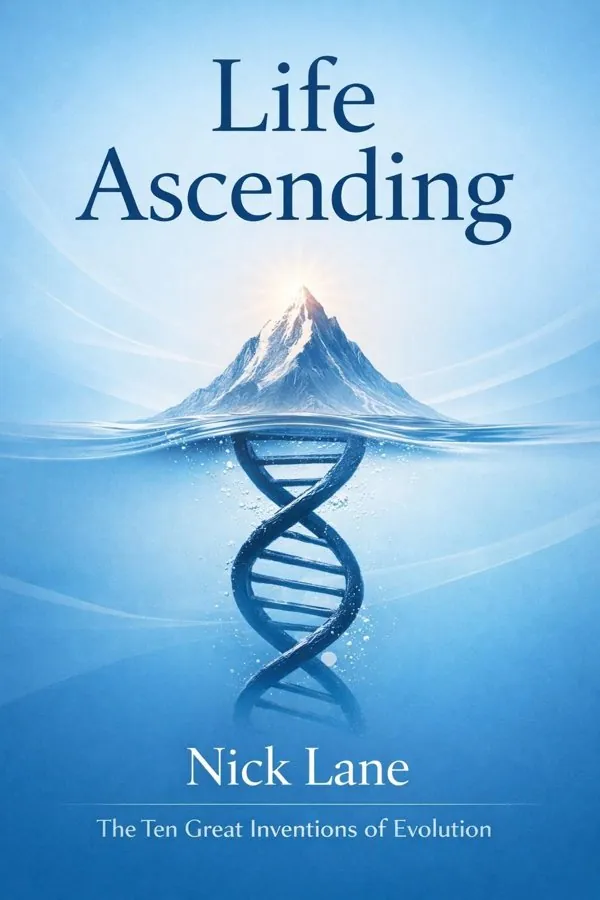
Life Ascending: The Ten Great Inventions of Evolution: Summary & Key Insights
by Nick Lane
 10 min10 chaptersAudio available
Key Takeaways from Life Ascending: The Ten Great Inventions of Evolution
The most astonishing fact about life may be that it emerged from nonliving matter without any guiding hand.
Information is powerful, but only if it can endure.
Few inventions have been as world-changing as the ability to capture sunlight and turn it into stored chemical energy.
The leap from simple cells to complex cells may be the single most important event in the history of life after life itself began.
Sex is one of evolution’s most puzzling inventions because it seems so inefficient.
What Is Life Ascending: The Ten Great Inventions of Evolution About?
Life Ascending: The Ten Great Inventions of Evolution by Nick Lane is a life_science book spanning 10 pages. Life on Earth did not become complex all at once. It advanced through a series of extraordinary breakthroughs: innovations that transformed simple chemistry into cells, cells into organisms, and organisms into conscious beings capable of wondering where they came from. In Life Ascending, biochemist Nick Lane explores ten of these turning points, including the origins of life, DNA, photosynthesis, sex, movement, vision, warm-bloodedness, consciousness, and death. Rather than treating evolution as a random parade of creatures, Lane shows it as a history of problem-solving at the molecular level. What makes this book so powerful is its ability to connect the smallest scale of biology with the largest questions of existence. Lane explains how energy, chemistry, and natural selection interact to produce the living world we know, and he does so with unusual clarity, imagination, and scientific rigor. As a leading researcher in evolutionary biochemistry, Lane brings authority to topics that often seem speculative or abstract. The result is a rare science book: intellectually ambitious, deeply grounded in evidence, and accessible to curious readers who want to understand not just what life is, but how it became possible.
This FizzRead summary covers all 10 key chapters of Life Ascending: The Ten Great Inventions of Evolution in approximately 10 minutes, distilling the most important ideas, arguments, and takeaways from Nick Lane's work. Also available as an audio summary and Key Quotes Podcast.
Life Ascending: The Ten Great Inventions of Evolution
Life on Earth did not become complex all at once. It advanced through a series of extraordinary breakthroughs: innovations that transformed simple chemistry into cells, cells into organisms, and organisms into conscious beings capable of wondering where they came from. In Life Ascending, biochemist Nick Lane explores ten of these turning points, including the origins of life, DNA, photosynthesis, sex, movement, vision, warm-bloodedness, consciousness, and death. Rather than treating evolution as a random parade of creatures, Lane shows it as a history of problem-solving at the molecular level.
What makes this book so powerful is its ability to connect the smallest scale of biology with the largest questions of existence. Lane explains how energy, chemistry, and natural selection interact to produce the living world we know, and he does so with unusual clarity, imagination, and scientific rigor. As a leading researcher in evolutionary biochemistry, Lane brings authority to topics that often seem speculative or abstract. The result is a rare science book: intellectually ambitious, deeply grounded in evidence, and accessible to curious readers who want to understand not just what life is, but how it became possible.
Who Should Read Life Ascending: The Ten Great Inventions of Evolution?
This book is perfect for anyone interested in life_science and looking to gain actionable insights in a short read. Whether you're a student, professional, or lifelong learner, the key ideas from Life Ascending: The Ten Great Inventions of Evolution by Nick Lane will help you think differently.
- ✓Readers who enjoy life_science and want practical takeaways
- ✓Professionals looking to apply new ideas to their work and life
- ✓Anyone who wants the core insights of Life Ascending: The Ten Great Inventions of Evolution in just 10 minutes
Want the full summary?
Get instant access to this book summary and 100K+ more with Fizz Moment.
Get Free SummaryAvailable on App Store • Free to download
Key Chapters
The most astonishing fact about life may be that it emerged from nonliving matter without any guiding hand. Lane argues that the origin of life is best understood not as a miraculous accident, but as a natural outcome of planetary chemistry under the right conditions. Early Earth was full of energy gradients, reactive minerals, volcanic activity, and oceans rich in dissolved compounds. In places such as alkaline hydrothermal vents, chemical reactions could have been organized and sustained long enough to create primitive metabolic cycles. Before genes, before cells, there may have been energy-harvesting systems that laid the groundwork for biological order.
This idea reverses a common intuition. Many people imagine life beginning with a self-replicating molecule that somehow appeared first. Lane instead emphasizes that metabolism and compartmentalization may have come before sophisticated heredity. Tiny mineral chambers in vents could have acted like natural reactors, concentrating chemicals and maintaining proton gradients similar to those used by modern cells. That continuity matters: it suggests life did not reinvent chemistry, but inherited and refined it.
The practical value of this perspective is broad. It informs the search for life on other planets, especially worlds with water, rock, and energy disequilibria. It also reframes biology as a branch of geochemistry, reminding us that life is rooted in physical laws. Rather than asking only, “How did a molecule copy itself?” we ask, “What environments make increasing complexity possible?”
Actionable takeaway: When thinking about complex systems, start by identifying the energy source and the environment that stabilizes useful reactions; origins often depend less on isolated parts than on the conditions that make organization possible.
Information is powerful, but only if it can endure. One of evolution’s most transformative inventions was the shift from a more versatile but fragile molecular world toward the stable information storage system we know as DNA. Lane explains that RNA likely came first because it can both carry information and catalyze reactions. Yet RNA is chemically unstable and poorly suited for preserving complex hereditary instructions over long stretches of time. DNA, by contrast, is more durable, more repairable, and better designed for reliable transmission.
This transition changed the scale of what life could become. With DNA as a long-term archive, organisms could accumulate larger genomes, preserve useful innovations, and build more intricate developmental programs. DNA made heredity less vulnerable to immediate chemical disruption. But Lane’s point is not that DNA appeared as a perfect solution from the beginning. Rather, evolution gradually favored a division of labor: DNA for storage, RNA for messaging and regulation, proteins for most catalytic work. That separation improved efficiency and resilience.
We see the importance of this architecture everywhere in modern biology. Medical genetics, forensic science, ancestry testing, and biotechnology all depend on DNA’s relative stability. Even the success of viruses often hinges on whether they use RNA for speed and flexibility or DNA for persistence and fidelity. The transition also offers a lesson in design: systems scale when they stop asking one component to do everything.
Actionable takeaway: In your own work, separate storage, communication, and execution functions whenever possible. Robust systems, biological or organizational, become more reliable when information is preserved securely and used through specialized channels.
Few inventions have been as world-changing as the ability to capture sunlight and turn it into stored chemical energy. Lane shows that photosynthesis was not merely a clever metabolic trick; it transformed Earth itself. Early photosynthetic organisms learned to harness light, but the most revolutionary development was oxygenic photosynthesis, which split water and released oxygen as a byproduct. What began as a microbial innovation eventually altered the chemistry of oceans, rocks, and air, enabling entirely new forms of life.
This was both a gift and a catastrophe. Oxygen is highly reactive, and for many early organisms it was toxic. Yet that same reactivity made possible high-energy metabolism through respiration. The rise of oxygen opened the door to larger, more active, more complex organisms because aerobic respiration yields far more usable energy than anaerobic pathways. In that sense, photosynthesis did not simply feed life; it expanded life’s energetic budget.
The consequences remain visible today. Every breath we take depends on ancient microbial inventions. Forests, algae, and crops continue to convert sunlight into the chemical basis of food webs. Climate science also turns on this process, because photosynthesis affects atmospheric carbon dioxide and global carbon cycling. Agriculture, ecosystem stability, and planetary habitability all rest on this deep evolutionary breakthrough.
Lane helps us see that major innovations often change the environment so profoundly that they create opportunities no one could have predicted. The innovators do not just adapt to the world; they remake it.
Actionable takeaway: Pay attention to changes that alter the surrounding system, not just local efficiency. The biggest breakthroughs are often those that create new environments in which further complexity can flourish.
The leap from simple cells to complex cells may be the single most important event in the history of life after life itself began. Lane argues that eukaryotic cells—the kind that make up plants, animals, fungi, and us—became possible through a rare merger between different microbes. Most crucially, one cell incorporated another that eventually became the mitochondrion, the energy-producing organelle found in nearly all complex life. This was not a minor upgrade. It changed the economics of evolution.
Simple cells are astonishingly successful, but they are constrained by energy. Their bioenergetic machinery sits mainly on their outer membrane, limiting how much power they can generate relative to their size. Mitochondria solved this by bringing vast internal membrane surface area into the cell, massively increasing energy availability. According to Lane, that surplus allowed genomes to expand, gene regulation to become more sophisticated, and internal cellular structures to evolve. Complexity required power.
This argument has enormous explanatory force. It helps explain why bacteria remained bacteria for billions of years while complex multicellular life appeared only after the rise of eukaryotes. It also highlights symbiosis as a creative evolutionary force, not merely competition. We are, in a literal sense, partnerships built from ancient alliances.
In practical terms, this perspective matters for medicine and aging research because mitochondria influence metabolism, fertility, disease, and cellular decline. It also matters conceptually: innovation often comes not from optimizing within a fixed boundary, but from integrating with something previously external.
Actionable takeaway: When growth seems capped, look for structural bottlenecks in energy or capacity. Lasting complexity usually requires a new power source, not just better use of old resources.
Sex is one of evolution’s most puzzling inventions because it seems so inefficient. Why would organisms give up the simplicity of cloning themselves and instead invest in finding mates, mixing genes, and producing offspring that inherit only half of each parent’s genome? Lane explores this apparent paradox and shows that sex persists because its costs are outweighed by long-term benefits, especially in changing environments. By reshuffling genes, sex generates variation and helps populations respond to parasites, diseases, and shifting ecological pressures.
The logic is subtle. Asexual reproduction can be highly effective in the short term because successful genomes are copied intact. But that very stability can become a weakness. Harmful mutations may accumulate, and populations may struggle to keep pace with rapidly evolving threats. Sexual reproduction, through recombination, allows beneficial mutations from different lineages to come together while helping purge damaging ones. In a world full of biological arms races, variation is a survival strategy.
This has practical implications well beyond evolutionary theory. Plant breeders rely on genetic recombination to create resilient crops. Conservation biologists worry about inbreeding because reduced diversity can leave populations vulnerable. Human health research also reflects the same principle: diversity in immune-system genes helps populations resist pathogens.
Lane’s treatment of sex reminds us that what looks inefficient at the individual level may be powerful at the population level. Evolution is not always about immediate economy; it is often about preserving room to adapt.
Actionable takeaway: Do not optimize so aggressively for short-term efficiency that you eliminate variation. In uncertain environments, diversity is not wasteful; it is a form of strategic resilience.
Life changed dramatically when organisms stopped being mostly passive and began moving through the world with purpose. Lane treats movement as a profound evolutionary invention because it transformed how living things obtained food, escaped danger, found mates, and explored new habitats. Even the earliest forms of cellular motion required intricate molecular machinery. In larger organisms, movement drove the evolution of muscles, skeletons, coordination systems, and energy-intensive behavior.
The significance of movement lies in agency. A rooted organism must wait for opportunities or threats to arrive; a mobile organism can seek, avoid, pursue, and choose. This shift reshaped ecosystems. Predators and prey entered escalating cycles of adaptation. Sensory systems became more valuable because motion requires information. Metabolism accelerated because movement demands energy. In this sense, movement was not an isolated trait but a catalyst for whole suites of innovations.
Examples are everywhere. The bacterial flagellum allows microbes to navigate chemical gradients. In animals, locomotion ranges from the undulations of worms to the precision of birds in flight and humans in sport. Rehabilitation medicine, robotics, and biomechanics all study versions of the same question evolution solved repeatedly: how does a system convert stored energy into controlled action?
Lane’s broader lesson is that mobility changes the relationship between organism and environment. Instead of merely adapting to local conditions, organisms can interact dynamically with multiple settings and opportunities.
Actionable takeaway: Expand your range of options before trying to optimize outcomes. Systems that can move, explore, and respond dynamically gain advantages that static efficiency alone can never provide.
Vision feels so natural to us that we forget how extraordinary it is. Lane presents sight as one of evolution’s great inventions because it converts light into actionable knowledge about the world. The eye did not appear fully formed; it evolved through many incremental improvements, from light-sensitive molecules to directional sensing to image-forming organs. At each step, even a slight enhancement in perception could improve survival.
What makes sight especially important is the way it amplifies the value of movement and decision-making. An organism that can see can anticipate rather than merely react. It can detect predators at a distance, identify food, navigate terrain, and coordinate complex behavior. Vision therefore fueled ecological escalation. Once some organisms could see better, others benefited from camouflage, speed, mimicry, or sharper visual systems of their own. The result was an arms race of information processing.
Lane’s discussion also highlights a central evolutionary principle: complex organs can arise through cumulative selection when intermediate stages are useful. This matters because the eye is often wrongly treated as an example of irreducible complexity. In reality, nature builds sophistication through workable transitions, not sudden perfection.
Modern applications are easy to see. Computer vision, imaging technologies, ophthalmology, and neuroscience all depend on understanding how visual systems encode and interpret information. Even in daily life, vision teaches us that better decisions depend on better sensing.
Actionable takeaway: Improve the quality of the information you receive before trying to improve your decisions. Clearer perception often creates larger gains than faster action.
To maintain a constant internal temperature is energetically expensive, yet birds and mammals repeatedly demonstrate why the cost can be worth paying. Lane treats hot blood, or endothermy, as a major evolutionary innovation because it freed organisms from the narrow constraints of ambient temperature. Instead of activity rising and falling mainly with environmental warmth, endothermic animals could sustain movement, forage, hunt, and care for offspring across broader conditions and longer periods.
The trade-off is severe. Warm-blooded animals must consume far more energy than cold-blooded animals of similar size. But the payoff is reliability. Their enzymes operate in relatively stable conditions, their muscles remain responsive, and their behavior becomes less hostage to weather. This energetic surplus supports endurance, parental investment, and often larger brains. In ecological terms, endothermy expanded where and when animals could live actively.
The idea has practical echoes in human life. Sports physiology, nutrition, infant care, and metabolic medicine all reflect the costs and benefits of temperature regulation. Fever itself reveals how tightly physiology and temperature are linked. At a broader level, endothermy illustrates a recurring pattern in evolution: high ongoing costs can be justified if they buy flexibility, speed, and consistency in uncertain environments.
Lane also reminds us that major adaptations are rarely free. Every gain imposes a burden somewhere else, and success often depends on managing that burden well.
Actionable takeaway: Evaluate costly systems by the stability and responsiveness they create, not just by their immediate expense. Sometimes the right investment is the one that keeps performance dependable under changing conditions.
Consciousness is often treated as biology’s final mystery, something too subjective for evolutionary explanation. Lane approaches it more groundedly. He does not claim to solve consciousness completely, but he shows how mental life can be understood as an outgrowth of increasingly complex nervous systems built to coordinate movement, sensation, memory, and prediction. Consciousness, in this view, did not descend from nowhere; it emerged because organisms that integrated information about their bodies and surroundings could act more effectively in real time.
This perspective matters because it anchors mind in function. Brains evolved not for abstract thought alone, but for controlling bodies in the world. Perception, emotion, attention, and self-modeling all help organisms prioritize, simulate outcomes, and navigate social and physical environments. Human consciousness may be unusually reflective, but it still rests on ancient biological foundations.
Lane’s account encourages humility as well as wonder. Our inner life is not separate from evolution; it is one of evolution’s most elaborate products. This has implications for neuroscience, psychology, artificial intelligence, and philosophy. If consciousness depends on integrated processing tied to action and survival, then understanding it requires studying systems, not just isolated neurons or abstract concepts.
Practically, this lens can also deepen self-understanding. Many mental states are not defects of reason but evolved responses shaped by bodily needs, social pressures, and prediction under uncertainty.
Actionable takeaway: Treat thought as embodied and contextual rather than purely abstract. Better decisions often come from understanding the underlying signals—sensory, emotional, and social—that your mind is integrating.
Death seems like evolution’s failure, but Lane argues that it is also one of its great inventions. In multicellular life especially, death is not merely something that happens at the end; it is woven into development, maintenance, and renewal. Cells die in controlled ways to sculpt tissues, eliminate dangerous damage, and preserve the larger organism. At the level of individuals, mortality clears ecological space, accelerates selection, and allows adaptation across generations.
This idea is unsettling because we instinctively oppose death to life. Yet biology shows they are deeply entangled. Programmed cell death, or apoptosis, is essential for healthy development: fingers separate in embryos because cells between them die. Immune systems rely on destroying compromised cells. Cancer, in many ways, is what happens when cellular life escapes the rules that serve the organism. Even aging can be understood partly through trade-offs between early-life performance and long-term maintenance.
Lane’s treatment of death broadens the discussion beyond individual fate. Natural selection does not optimize indefinite survival; it optimizes reproductive success within real energetic constraints. Immortality at one level may block adaptability at another. Turnover, painful as it is, enables experimentation, replacement, and renewal.
In practical terms, this perspective informs medicine, especially cancer research, aging studies, and regenerative biology. It also offers a philosophical lesson: endings are often integral to larger systems of continuity.
Actionable takeaway: Do not evaluate a process only by what it preserves. In living systems and human institutions alike, timely removal, turnover, and pruning can be necessary conditions for long-term health.
All Chapters in Life Ascending: The Ten Great Inventions of Evolution
About the Author
Nick Lane is a British biochemist, author, and professor at University College London, where he researches evolutionary biochemistry and the origin of life. He is best known for exploring how energy, metabolism, and cellular structure shaped the course of evolution. Much of his work focuses on mitochondria, the energy-producing organelles that he argues were crucial to the rise of complex life. Lane has written several acclaimed science books, including Life Ascending, The Vital Question, and Transformer, and is widely praised for making difficult scientific ideas vivid and approachable without oversimplifying them. His writing stands out for combining rigorous biochemical reasoning with large existential questions about life, complexity, aging, and consciousness. He is one of the leading contemporary voices linking modern biology with the deepest questions of human curiosity.
Get This Summary in Your Preferred Format
Read or listen to the Life Ascending: The Ten Great Inventions of Evolution summary by Nick Lane anytime, anywhere. FizzRead offers multiple formats so you can learn on your terms — all free.
Available formats: App · Audio · PDF · EPUB — All included free with FizzRead
Download Life Ascending: The Ten Great Inventions of Evolution PDF and EPUB Summary
Key Quotes from Life Ascending: The Ten Great Inventions of Evolution
“The most astonishing fact about life may be that it emerged from nonliving matter without any guiding hand.”
“Information is powerful, but only if it can endure.”
“Few inventions have been as world-changing as the ability to capture sunlight and turn it into stored chemical energy.”
“The leap from simple cells to complex cells may be the single most important event in the history of life after life itself began.”
“Sex is one of evolution’s most puzzling inventions because it seems so inefficient.”
Frequently Asked Questions about Life Ascending: The Ten Great Inventions of Evolution
Life Ascending: The Ten Great Inventions of Evolution by Nick Lane is a life_science book that explores key ideas across 10 chapters. Life on Earth did not become complex all at once. It advanced through a series of extraordinary breakthroughs: innovations that transformed simple chemistry into cells, cells into organisms, and organisms into conscious beings capable of wondering where they came from. In Life Ascending, biochemist Nick Lane explores ten of these turning points, including the origins of life, DNA, photosynthesis, sex, movement, vision, warm-bloodedness, consciousness, and death. Rather than treating evolution as a random parade of creatures, Lane shows it as a history of problem-solving at the molecular level. What makes this book so powerful is its ability to connect the smallest scale of biology with the largest questions of existence. Lane explains how energy, chemistry, and natural selection interact to produce the living world we know, and he does so with unusual clarity, imagination, and scientific rigor. As a leading researcher in evolutionary biochemistry, Lane brings authority to topics that often seem speculative or abstract. The result is a rare science book: intellectually ambitious, deeply grounded in evidence, and accessible to curious readers who want to understand not just what life is, but how it became possible.
More by Nick Lane
You Might Also Like
The Selfish Gene
Richard Dawkins
10 min
Awakenings
Oliver Sacks
10 min
Parasite Rex: Inside the Bizarre World of Nature's Most Dangerous Creatures
Carl Zimmer
10 min
The Atlas of Life on Earth
Various
10 min
The Book of Humans: The Story of How We Became Us
Adam Rutherford
10 min
The Horse
Wendy Williams
10 minBrowse by Category
Ready to read Life Ascending: The Ten Great Inventions of Evolution?
Get the full summary and 100K+ more books with Fizz Moment.