
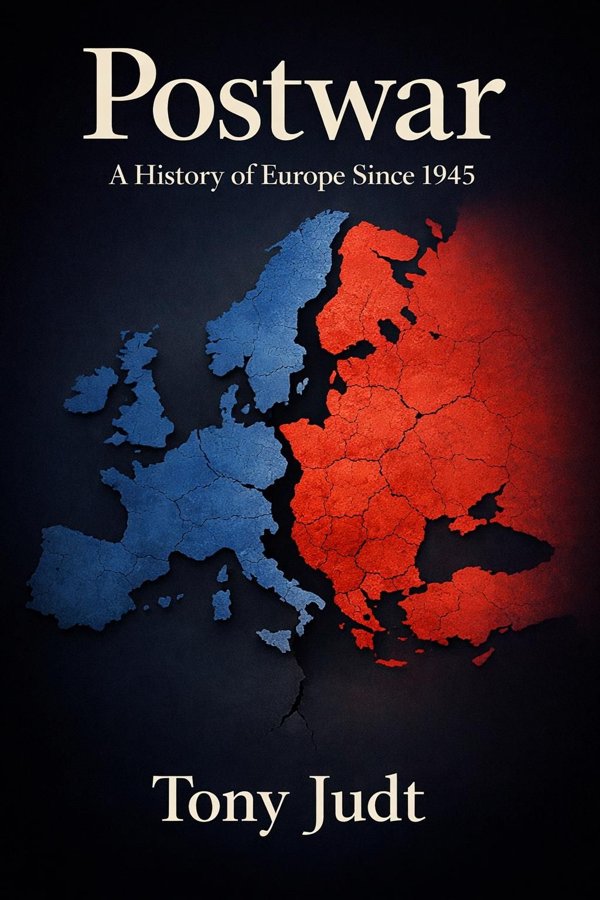
Postwar: A History of Europe Since 1945: Summary & Key Insights
by Tony Judt
 10 min9 chaptersAudio available
Key Takeaways from Postwar: A History of Europe Since 1945
A continent can survive military defeat more easily than moral collapse.
Europe’s postwar future was not discovered; it was imposed through power.
Prosperity after catastrophe can be a political achievement, not just an economic outcome.
What nations remember immediately after tragedy is often less revealing than what they choose to forget.
Revolutions are not always made in streets; sometimes they arrive in kitchens, highways, and supermarkets.
What Is Postwar: A History of Europe Since 1945 About?
Postwar: A History of Europe Since 1945 by Tony Judt is a world_history book spanning 4 pages. Europe after 1945 was not merely rebuilding cities, economies, and governments; it was rebuilding meaning. In Postwar: A History of Europe Since 1945, Tony Judt delivers a sweeping, deeply human account of how a devastated continent emerged from war, genocide, occupation, and ideological division to become one of the modern world’s most prosperous, self-reflective, and politically integrated regions. This is not just a chronology of events. It is a history of memory, welfare, power, identity, and the uneasy compromises that made peace possible. Judt shows how Europe’s postwar order rested on difficult bargains: forgetting as much as remembering, dependence on American power, acceptance of welfare capitalism in the West, and coercive stability in the East. He follows the story through reconstruction, the Cold War, decolonization, student revolt, economic crisis, the collapse of communism, and the uncertain promise of European integration. The book matters because Europe’s postwar experience shaped the political vocabulary of the present: democracy, social solidarity, nationalism, migration, and supranational cooperation. Judt, one of the most respected historians of modern Europe, writes with unusual range, moral seriousness, and analytical clarity, making this a landmark work for understanding both Europe’s past and today’s tensions.
This FizzRead summary covers all 9 key chapters of Postwar: A History of Europe Since 1945 in approximately 10 minutes, distilling the most important ideas, arguments, and takeaways from Tony Judt's work. Also available as an audio summary and Key Quotes Podcast.
Postwar: A History of Europe Since 1945
Europe after 1945 was not merely rebuilding cities, economies, and governments; it was rebuilding meaning. In Postwar: A History of Europe Since 1945, Tony Judt delivers a sweeping, deeply human account of how a devastated continent emerged from war, genocide, occupation, and ideological division to become one of the modern world’s most prosperous, self-reflective, and politically integrated regions. This is not just a chronology of events. It is a history of memory, welfare, power, identity, and the uneasy compromises that made peace possible.
Judt shows how Europe’s postwar order rested on difficult bargains: forgetting as much as remembering, dependence on American power, acceptance of welfare capitalism in the West, and coercive stability in the East. He follows the story through reconstruction, the Cold War, decolonization, student revolt, economic crisis, the collapse of communism, and the uncertain promise of European integration.
The book matters because Europe’s postwar experience shaped the political vocabulary of the present: democracy, social solidarity, nationalism, migration, and supranational cooperation. Judt, one of the most respected historians of modern Europe, writes with unusual range, moral seriousness, and analytical clarity, making this a landmark work for understanding both Europe’s past and today’s tensions.
Who Should Read Postwar: A History of Europe Since 1945?
This book is perfect for anyone interested in world_history and looking to gain actionable insights in a short read. Whether you're a student, professional, or lifelong learner, the key ideas from Postwar: A History of Europe Since 1945 by Tony Judt will help you think differently.
- ✓Readers who enjoy world_history and want practical takeaways
- ✓Professionals looking to apply new ideas to their work and life
- ✓Anyone who wants the core insights of Postwar: A History of Europe Since 1945 in just 10 minutes
Want the full summary?
Get instant access to this book summary and 100K+ more with Fizz Moment.
Get Free SummaryAvailable on App Store • Free to download
Key Chapters
A continent can survive military defeat more easily than moral collapse. Judt begins with Europe in 1945 as a landscape of wreckage: bombed cities, broken transport networks, food shortages, and millions of refugees, prisoners, and displaced persons moving across shattered borders. Yet the physical devastation was only part of the crisis. Europe also faced the aftershock of collaboration, genocide, ethnic cleansing, and the collapse of political legitimacy. Institutions had failed, elites had been compromised, and ordinary citizens had to live with memories they often preferred not to confront.
Judt’s insight is that reconstruction was never just about rebuilding roads, factories, and parliaments. It required creating a workable story about the recent past. Many countries emphasized resistance and national suffering while minimizing collaboration or complicity. This selective memory helped stabilize fragile societies, even if it distorted truth. France celebrated resistance, Austria presented itself as Hitler’s first victim, and much of Eastern Europe buried complex wartime realities beneath new official narratives.
This matters beyond history. Societies recovering from trauma often need both truth and order, but these goals do not always arrive together. Postwar Europe suggests that political recovery may begin with imperfect narratives, though unresolved moral debts eventually return. We can see similar dynamics in countries emerging from civil conflict or authoritarian rule today, where the pressure to move forward competes with demands for justice.
Actionable takeaway: When evaluating any society after crisis, ask not only how it rebuilds institutions, but also what stories it tells to make rebuilding possible.
Europe’s postwar future was not discovered; it was imposed through power. In Judt’s account, the late 1940s transformed a temporarily occupied continent into two rival political civilizations. In Western Europe, the Marshall Plan, American military protection, and the containment of communist parties helped anchor parliamentary democracy and market economies. In Eastern Europe, Soviet influence hardened into direct domination, producing one-party states, planned economies, censorship, and political terror.
Judt emphasizes that this division was not only geopolitical. It shaped daily life, social expectations, and moral imagination. Western Europeans increasingly associated freedom with consumption, mobility, and welfare protections. Eastern Europeans lived under regimes that promised equality and modernization but enforced obedience through surveillance and coercion. Berlin became the symbolic fault line of the continent, and the Iron Curtain turned internal European differences into a global ideological confrontation.
Yet Judt avoids simple binaries. Western Europe’s stability rested heavily on American power, and Eastern Europe did industrialize, educate, and urbanize large populations. At the same time, communist legitimacy remained fragile because it was tied less to consent than to control. Examples from Hungary in 1956, Czechoslovakia in 1968, and Poland across multiple decades show that Soviet order had to be repeatedly defended against society itself.
For modern readers, the lesson is that political systems are sustained not just by laws or slogans but by external alliances, economic performance, and everyday credibility. When one of these weakens, ideological certainty can collapse quickly.
Actionable takeaway: To understand any divided region, examine how great-power influence, economic structures, and lived experience combine to create durable political identities.
Prosperity after catastrophe can be a political achievement, not just an economic outcome. One of Judt’s central themes is that Western Europe’s postwar success depended on the construction of welfare states that reduced insecurity and broadened citizenship. Governments expanded public housing, health care, education, pensions, transport, and labor protections. These policies were not simply acts of generosity. They were strategic responses to depression, war, and social division. Political leaders had learned that democracies could fail when inequality, unemployment, and fear became unbearable.
Judt shows that the postwar settlement blended capitalism with social responsibility. Christian democrats, social democrats, trade unions, and business interests often accepted compromise because the memory of the 1930s remained vivid. In Britain, the National Health Service became a symbol of social citizenship. In Scandinavia, welfare institutions deepened trust and equality. In West Germany, the social market economy combined growth with stability and helped rehabilitate a country with a discredited past.
The broader point is that welfare states did more than raise living standards. They gave ordinary citizens a practical reason to believe in democratic institutions. Material security encouraged moderation, and inclusion made political extremism less appealing. Even where these systems were bureaucratic or expensive, they helped define Europe’s postwar identity.
The idea remains relevant in any debate about public policy. Judt reminds us that social spending is not only a budget question; it is also a question of legitimacy, belonging, and long-term stability. Economies are sustained by confidence, and confidence often depends on visible protections.
Actionable takeaway: When judging a political order, look at how well it converts abstract rights into everyday security for ordinary people.
What nations remember immediately after tragedy is often less revealing than what they choose to forget. Judt argues that postwar Europe initially depended on strategic amnesia. Countries focused on rebuilding and downplayed painful questions about collaboration, anti-Semitism, wartime opportunism, and the Holocaust’s place in national history. This silence was not uniform, but it was widespread. It allowed societies to create unity, spare themselves public shame, and move toward economic recovery.
Over time, however, suppressed memory returned with force. By the 1960s and especially after the 1970s, a younger generation began challenging official myths. Trials, archives, films, memoirs, and public debates reopened the moral record. Germany confronted Nazism more thoroughly than most, though only after years of reluctance. France slowly reconsidered Vichy. Across the continent, the Holocaust moved from the margins of public consciousness to the center of European moral identity.
Judt’s treatment of memory is one of the book’s most powerful contributions. He shows that history is not only what happened but what later generations decide must be acknowledged. The Europe that emerged by the late twentieth century increasingly grounded its legitimacy in remembrance, human rights, and the rejection of totalitarian politics. Commemoration became a civic practice, not just a scholarly one.
This has practical value today. Organizations, governments, and communities often postpone difficult truths in the name of stability. Judt suggests that delay may be understandable, but evasion is rarely permanent. Sooner or later, legitimacy requires honest reckoning.
Actionable takeaway: In public life and private institutions alike, treat unresolved memory as a future crisis in waiting, and create deliberate spaces for truth before silence hardens into denial.
Revolutions are not always made in streets; sometimes they arrive in kitchens, highways, and supermarkets. Judt describes how Western Europe between the 1950s and early 1970s underwent an extraordinary social transformation. Rising wages, mass consumer goods, automobile ownership, television, suburbanization, tourism, and expanded education changed daily experience more deeply than many formal political events. A continent once defined by scarcity increasingly became one of abundance.
This prosperity altered class relations, family life, and expectations of government. Rural populations moved into cities, women entered public life in new ways, and the children of workers gained access to universities. Cultural boundaries softened as music, film, and fashion moved across borders. Yet growth also produced tensions. Traditional authority weakened, religion declined in public influence, and younger generations challenged paternalism in schools, workplaces, and politics.
Judt does not romanticize the era. Economic growth masked inequalities, relied on guest labor and immigrant workforces, and often excluded women from full equality. But he insists that postwar affluence remade the social foundations of democracy. Citizens who had more education, mobility, and confidence became less willing to defer automatically to elites. The result was a more open society, though also a more contentious one.
For readers today, this reminds us that economic change reshapes values as much as budgets. Housing patterns, media consumption, and transport systems influence how people imagine freedom and community. Public policy can quietly transform culture by altering ordinary routines.
Actionable takeaway: To understand political change, study how shifts in everyday life—work, housing, mobility, media, and education—redefine what people believe they deserve.
A stable society can still be deeply dissatisfied beneath the surface. Judt treats the protests and unrest of the 1960s, especially around 1968, as a warning that postwar success had not solved every problem. In Western Europe, students and intellectuals rebelled against hierarchy, consumer conformism, colonial legacies, and the technocratic style of government. In Eastern Europe, dissent took different forms but often aimed at recovering socialism from bureaucracy and repression, as seen most dramatically in Prague Spring.
The striking point is that both halves of Europe faced crises of legitimacy, though for different reasons. In the West, young people attacked systems that were prosperous yet spiritually narrow and politically stale. In the East, reformers challenged systems that claimed to govern in the people’s name while denying basic freedoms. Judt shows that 1968 was less a unified revolution than a continent-wide exposure of generational tension, institutional rigidity, and unmet democratic aspirations.
The long-term effects were significant even where immediate victories were limited. Universities changed, social norms liberalized, feminist and environmental politics gained strength, and deference to authority weakened. The protests also revealed how much modern politics depends on representation that feels authentic rather than merely efficient.
This pattern remains familiar. Periods of material progress can coexist with anger if institutions appear closed, moral language feels stale, or younger generations see hypocrisy in official values. Performance alone does not guarantee legitimacy.
Actionable takeaway: When institutions seem stable, pay attention to voices dismissed as cultural or generational noise; they often reveal structural weaknesses before elites recognize them.
Authoritarian systems often look durable right until they stop. Judt explains that communist Eastern Europe survived for decades not because it inspired lasting enthusiasm, but because it combined coercion, administrative control, external Soviet backing, and the exhaustion of societies with limited room to organize resistance. Regimes offered employment, education, and predictability, but they also produced shortages, censorship, corruption, and a pervasive gap between official language and lived reality.
One of Judt’s recurring insights is that communist rule generated cynicism more than belief. Citizens learned to perform loyalty while privately distrusting the system. The state became omnipresent yet morally hollow. This is why moments of rupture mattered so much. The Hungarian uprising, the Prague reforms, and especially the Polish labor and dissident movements showed that beneath apparent passivity, alternative moral communities survived—in churches, unions, samizdat networks, and informal circles of trust.
Judt pays special attention to the importance of dissidents such as Vaclav Havel and to movements like Solidarity. Their power did not come from military strength but from moral exposure: they described the system truthfully. Once Soviet willingness to intervene weakened under Gorbachev, regimes that had long depended on fear and inertia suddenly discovered how little genuine support they possessed.
This has broad relevance. Institutions that demand public conformity while privately generating contempt can persist longer than outsiders expect. But if they lose coercive capacity or ideological confidence, collapse can be rapid and cascading.
Actionable takeaway: To assess the health of any regime, ask whether compliance reflects belief, dependence, or fear—and what happens if fear recedes.
The fall of communism solved one historic problem while exposing many others. Judt treats 1989 as a triumphant turning point, but not as a neat conclusion. Across Eastern Europe, communist regimes unraveled with astonishing speed. Borders opened, parties collapsed, dissidents became leaders, and the Berlin Wall fell as the symbol of a divided century. Yet liberation from Soviet domination did not automatically produce functioning democracies, fair markets, or coherent national identities.
Judt stresses the difficulty of transition. Planned economies had to be privatized, legal systems rebuilt, currencies stabilized, and civil society revived. Citizens who expected freedom to bring immediate prosperity often met unemployment, corruption, and social dislocation instead. Meanwhile, the collapse of imperial constraints released older national tensions, nowhere more tragically than in the Yugoslav wars. The dream of a peaceful post-ideological Europe was real, but it was incomplete.
At the same time, 1989 changed the moral geography of the continent. Eastern Europeans reclaimed their place in Europe not just as a market or security zone but as a civilizational aspiration. Joining NATO and the European Union became markers of return, stability, and recognition. Yet Judt warns against sentimental triumphalism. The post-1989 order brought uneven gains and left unresolved questions about memory, justice, and inequality.
For contemporary readers, the lesson is clear: regime change is only the opening of history, not its conclusion. Removing oppression is easier than building trusted institutions.
Actionable takeaway: Whenever a political system falls, distinguish between liberation, transition, and consolidation; each requires different expectations, skills, and forms of patience.
One of the most radical changes in modern history began as a technical solution to familiar dangers. Judt presents European integration not as idealistic abstraction but as a pragmatic response to war, nationalism, and economic vulnerability. Starting with coal and steel cooperation, then widening through common institutions and shared rules, integration bound former rivals into routines of negotiation that made war between major Western European states increasingly unthinkable.
The achievement was extraordinary precisely because it seemed so dull. Bureaucrats, treaties, courts, and regulatory harmonization rarely inspire passion, yet they created a framework in which sovereignty was pooled without being fully erased. France and Germany moved from recurring conflict to structured partnership. Smaller states gained security through institutions. Economic integration expanded markets, mobility, and standards of living. Over time, Europe became a distinctive political experiment: neither a nation-state nor a simple alliance.
Judt also highlights the limits. Integration often advanced through elite consensus rather than popular enthusiasm. It depended on growth, American security guarantees, and a shared fear of past catastrophe. As memories of war faded, the European project became harder to justify emotionally. Questions of identity, democratic distance, migration, and uneven development began to test the union’s legitimacy.
Still, Judt’s larger point remains powerful: peace can be built through institutions that make cooperation habitual and conflict costly. The architecture may seem unromantic, but its historical significance is immense.
Actionable takeaway: Do not underestimate quiet institutional design; durable peace often rests less on inspiring speeches than on repeated, enforceable habits of cooperation.
All Chapters in Postwar: A History of Europe Since 1945
About the Author
Tony Judt (1948–2010) was a British historian, essayist, and public intellectual renowned for his writings on modern Europe, political ideas, and the moral responsibilities of public life. Educated at King’s College, Cambridge, he taught at several major universities before joining New York University, where he founded and directed the Remarque Institute. Judt became known for combining archival knowledge, wide historical range, and elegant prose with a rare willingness to confront uncomfortable political truths. His work often explored socialism, postwar Europe, memory, and the legacy of twentieth-century ideologies. Postwar remains his best-known book, widely praised as a landmark history of Europe after 1945. Beyond academia, Judt was admired for his essays on contemporary politics, democracy, and social justice.
Get This Summary in Your Preferred Format
Read or listen to the Postwar: A History of Europe Since 1945 summary by Tony Judt anytime, anywhere. FizzRead offers multiple formats so you can learn on your terms — all free.
Available formats: App · Audio · PDF · EPUB — All included free with FizzRead
Download Postwar: A History of Europe Since 1945 PDF and EPUB Summary
Key Quotes from Postwar: A History of Europe Since 1945
“A continent can survive military defeat more easily than moral collapse.”
“Europe’s postwar future was not discovered; it was imposed through power.”
“Prosperity after catastrophe can be a political achievement, not just an economic outcome.”
“What nations remember immediately after tragedy is often less revealing than what they choose to forget.”
“Revolutions are not always made in streets; sometimes they arrive in kitchens, highways, and supermarkets.”
Frequently Asked Questions about Postwar: A History of Europe Since 1945
Postwar: A History of Europe Since 1945 by Tony Judt is a world_history book that explores key ideas across 9 chapters. Europe after 1945 was not merely rebuilding cities, economies, and governments; it was rebuilding meaning. In Postwar: A History of Europe Since 1945, Tony Judt delivers a sweeping, deeply human account of how a devastated continent emerged from war, genocide, occupation, and ideological division to become one of the modern world’s most prosperous, self-reflective, and politically integrated regions. This is not just a chronology of events. It is a history of memory, welfare, power, identity, and the uneasy compromises that made peace possible. Judt shows how Europe’s postwar order rested on difficult bargains: forgetting as much as remembering, dependence on American power, acceptance of welfare capitalism in the West, and coercive stability in the East. He follows the story through reconstruction, the Cold War, decolonization, student revolt, economic crisis, the collapse of communism, and the uncertain promise of European integration. The book matters because Europe’s postwar experience shaped the political vocabulary of the present: democracy, social solidarity, nationalism, migration, and supranational cooperation. Judt, one of the most respected historians of modern Europe, writes with unusual range, moral seriousness, and analytical clarity, making this a landmark work for understanding both Europe’s past and today’s tensions.
You Might Also Like
The Age of Capital
Eric Hobsbawm
10 min
The Gulag Archipelago
Aleksandr Solzhenitsyn
10 min
Jerusalem: The Biography
Simon Sebag Montefiore
10 min
The Anglo-Saxons
James Campbell
10 min
The Boer War
Thomas Pakenham
10 min
The Industrial Revolutionaries: The Making of the Modern World 1776–1914
Gavin Weightman
10 minBrowse by Category
Ready to read Postwar: A History of Europe Since 1945?
Get the full summary and 100K+ more books with Fizz Moment.