
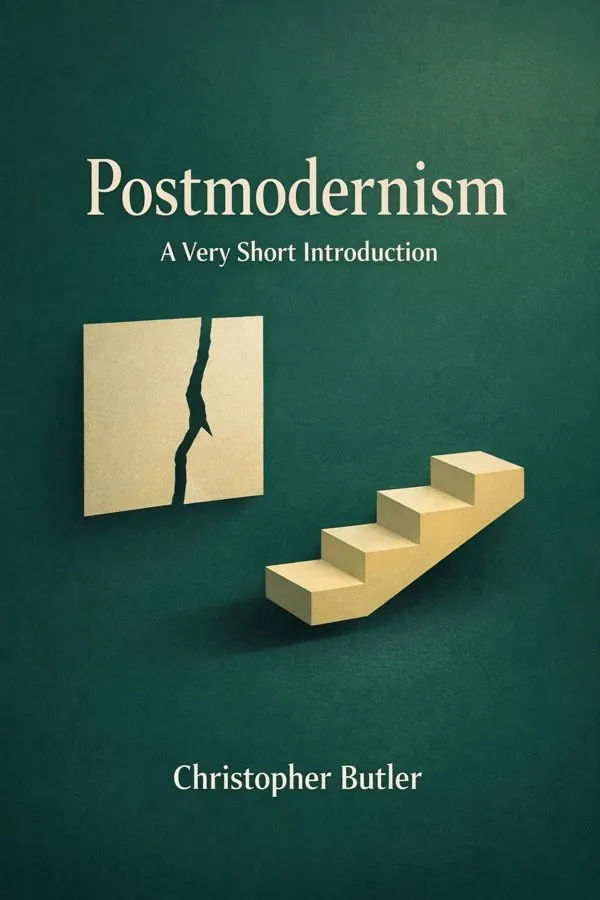
Postmodernism: A Very Short Introduction: Summary & Key Insights
 10 min6 chaptersAudio available
What Is Postmodernism: A Very Short Introduction About?
Postmodernism: A Very Short Introduction by Christopher Butler is a civilization book spanning 6 pages. This concise introduction explores the complex and often controversial concept of postmodernism, examining its origins, key thinkers, and influence on art, literature, philosophy, and culture. Christopher Butler provides a clear overview of how postmodernism challenges traditional ideas of truth, meaning, and progress, offering readers a critical understanding of its intellectual and cultural significance.
This FizzRead summary covers all 6 key chapters of Postmodernism: A Very Short Introduction in approximately 10 minutes, distilling the most important ideas, arguments, and takeaways from Christopher Butler's work. Also available as an audio summary and Key Quotes Podcast.
Postmodernism: A Very Short Introduction
This concise introduction explores the complex and often controversial concept of postmodernism, examining its origins, key thinkers, and influence on art, literature, philosophy, and culture. Christopher Butler provides a clear overview of how postmodernism challenges traditional ideas of truth, meaning, and progress, offering readers a critical understanding of its intellectual and cultural significance.
Who Should Read Postmodernism: A Very Short Introduction?
This book is perfect for anyone interested in civilization and looking to gain actionable insights in a short read. Whether you're a student, professional, or lifelong learner, the key ideas from Postmodernism: A Very Short Introduction by Christopher Butler will help you think differently.
- ✓Readers who enjoy civilization and want practical takeaways
- ✓Professionals looking to apply new ideas to their work and life
- ✓Anyone who wants the core insights of Postmodernism: A Very Short Introduction in just 10 minutes
Want the full summary?
Get instant access to this book summary and 100K+ more with Fizz Moment.
Get Free SummaryAvailable on App Store • Free to download
Key Chapters
To grasp postmodernism, we must first revisit modernism. Modernism marked a confidence in human reason and progress, a belief that through art, science, and thought, humanity could achieve self-understanding and mastery over nature. It was the legacy of the Enlightenment—the age of rationality, objectivity, and universal ideals. Modernist artists and writers like Joyce, Picasso, and Le Corbusier felt driven to innovate, to break with tradition and forge pure, autonomous forms that reflected truth through abstraction.
Postmodernism emerged as a counter-reaction to this faith in order and progress. The horrors of twentieth-century wars, the collapse of utopian ideologies, and the recognition of cultural pluralism eroded trust in grand narratives. No longer could one universal vision of progress be sustained. Postmodernism, therefore, developed as a form of skepticism toward modernism’s claims of coherence. Instead of assuming that reality could be objectively represented, postmodern thinkers proposed that knowledge was always mediated, context-bound, and dependent on language and culture.
In this sense, postmodernism did not simply overthrow modernism—it began as its internal critique. Modernism’s self-consciousness paved the way for postmodern self-irony. Modernists had already questioned realism; postmodernists went further, dismantling the notion of any stable truth or authorial mastery. By tracing these transformations, you see how the grand confidence of modernist architecture, the moral earnestness of modernist literature, and the rational ambitions of Enlightenment thought collapsed into the playful, pluralistic, and skeptical spirit that defines our present cultural moment.
Every intellectual movement stands on philosophical ground, and postmodernism is no exception. Its roots reach deep into nineteenth- and twentieth-century thought. Nietzsche’s critique of truth and morality opened the door to a radical form of skepticism: his assertion that 'there are no facts, only interpretations' questioned the very idea of objective knowledge. Heidegger extended this by shifting philosophy’s focus from the knowing subject to 'being' itself, arguing that our understanding is always historically situated. Wittgenstein, in his later philosophy, showed how meaning depends on language use—there is no private language or absolute reference outside social practice.
These thinkers collectively undermined the Enlightenment’s universalism. If meaning is contingent, then truth becomes a matter of interpretation, and philosophy itself becomes a linguistic and historical enterprise rather than a search for eternal principles. Postmodern philosophers took these insights and radicalized them. Through Derrida’s deconstruction, we see how language continuously slips between meanings; through Foucault’s archaeology of knowledge, we learn that discourse determines what can be known and said in any epoch. They challenge us to see knowledge not as neutral but as embedded in systems of power.
This philosophical shift has profound consequences. It calls into question every discipline that once claimed autonomy and objectivity. If meaning is unstable, then texts, beliefs, and institutions reveal themselves as products of historical contingency. In my book, I encourage readers not to see this as nihilism but as liberation: understanding how deeply our knowledge is entwined with perspective helps us think more responsibly about our cultural and intellectual commitments.
+ 4 more chapters — available in the FizzRead app
All Chapters in Postmodernism: A Very Short Introduction
About the Author
Christopher Butler is Professor Emeritus of English Language and Literature at the University of Oxford and a Fellow of University College, Oxford. He is known for his work on modernism, postmodernism, and literary theory, and has authored several influential books on twentieth-century literature and culture.
Get This Summary in Your Preferred Format
Read or listen to the Postmodernism: A Very Short Introduction summary by Christopher Butler anytime, anywhere. FizzRead offers multiple formats so you can learn on your terms — all free.
Available formats: App · Audio · PDF · EPUB — All included free with FizzRead
Download Postmodernism: A Very Short Introduction PDF and EPUB Summary
Key Quotes from Postmodernism: A Very Short Introduction
“To grasp postmodernism, we must first revisit modernism.”
“Every intellectual movement stands on philosophical ground, and postmodernism is no exception.”
Frequently Asked Questions about Postmodernism: A Very Short Introduction
Postmodernism: A Very Short Introduction by Christopher Butler is a civilization book that explores key ideas across 6 chapters. This concise introduction explores the complex and often controversial concept of postmodernism, examining its origins, key thinkers, and influence on art, literature, philosophy, and culture. Christopher Butler provides a clear overview of how postmodernism challenges traditional ideas of truth, meaning, and progress, offering readers a critical understanding of its intellectual and cultural significance.
More by Christopher Butler
You Might Also Like
The Structure of Scientific Revolutions
Thomas S. Kuhn
10 min
Genius
Harold Bloom
10 min
A Cultural History of the Medieval Age
Various Editors
10 min
A History of God: The 4,000-Year Quest of Judaism, Christianity and Islam
Karen Armstrong
10 min
A History of the World in 10½ Chapters
Julian Barnes
10 min
A Short History of Progress
Ronald Wright
10 minBrowse by Category
Ready to read Postmodernism: A Very Short Introduction?
Get the full summary and 100K+ more books with Fizz Moment.