
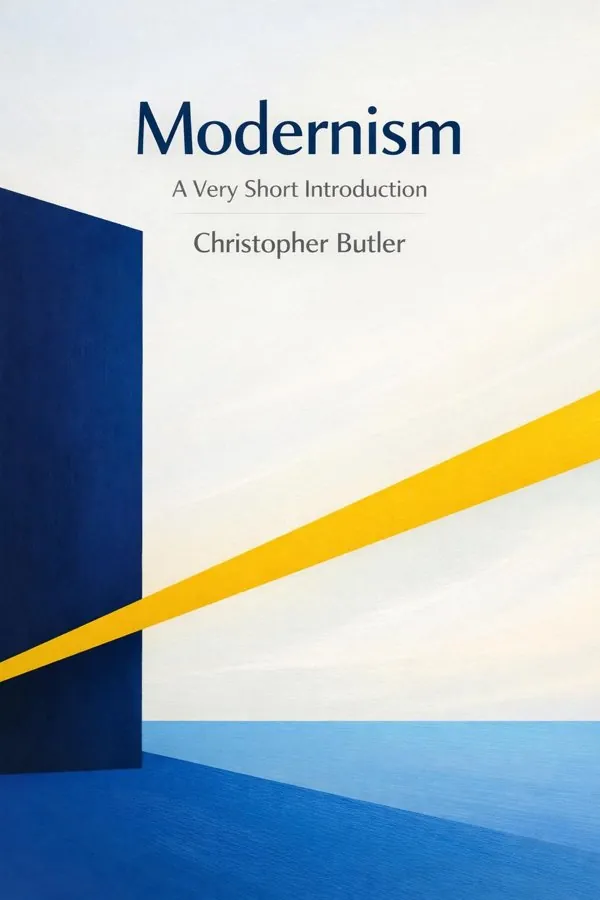
Modernism: A Very Short Introduction: Summary & Key Insights
 10 min9 chaptersAudio available
Key Takeaways from Modernism: A Very Short Introduction
Every artistic revolution begins when old forms no longer feel adequate to lived experience.
Sometimes art becomes more truthful precisely by becoming less literal.
The most dramatic frontier in modernist literature was not the outer world but the mind.
Modernist art asks a radical question: what if seeing is not passive reception but active construction?
When harmony itself begins to feel inherited rather than inevitable, music enters a modernist phase.
What Is Modernism: A Very Short Introduction About?
Modernism: A Very Short Introduction by Christopher Butler is a civilization book spanning 9 pages. What happens when artists, writers, composers, and architects stop trusting inherited forms and begin reinventing how reality itself can be represented? In Modernism: A Very Short Introduction, Christopher Butler offers a clear, elegant guide to one of the most influential cultural movements of the twentieth century. Rather than treating Modernism as a vague label for difficult art, Butler explains it as a response to dramatic historical change: industrialization, urban life, new technologies, world war, psychoanalysis, and shifting ideas about truth, perception, and identity. Across literature, painting, music, and architecture, he shows how modernists broke with convention in order to capture a world that no longer felt stable, unified, or easily knowable. The book matters because Modernism still shapes how we read novels, look at buildings, listen to music, and understand the role of art in a fractured age. Butler is an especially trustworthy guide: a distinguished Oxford scholar of literature and aesthetics, he combines intellectual range with unusual clarity, helping readers see both the bold ambitions and the tensions within Modernism itself.
This FizzRead summary covers all 9 key chapters of Modernism: A Very Short Introduction in approximately 10 minutes, distilling the most important ideas, arguments, and takeaways from Christopher Butler's work. Also available as an audio summary and Key Quotes Podcast.
Modernism: A Very Short Introduction
What happens when artists, writers, composers, and architects stop trusting inherited forms and begin reinventing how reality itself can be represented? In Modernism: A Very Short Introduction, Christopher Butler offers a clear, elegant guide to one of the most influential cultural movements of the twentieth century. Rather than treating Modernism as a vague label for difficult art, Butler explains it as a response to dramatic historical change: industrialization, urban life, new technologies, world war, psychoanalysis, and shifting ideas about truth, perception, and identity. Across literature, painting, music, and architecture, he shows how modernists broke with convention in order to capture a world that no longer felt stable, unified, or easily knowable. The book matters because Modernism still shapes how we read novels, look at buildings, listen to music, and understand the role of art in a fractured age. Butler is an especially trustworthy guide: a distinguished Oxford scholar of literature and aesthetics, he combines intellectual range with unusual clarity, helping readers see both the bold ambitions and the tensions within Modernism itself.
Who Should Read Modernism: A Very Short Introduction?
This book is perfect for anyone interested in civilization and looking to gain actionable insights in a short read. Whether you're a student, professional, or lifelong learner, the key ideas from Modernism: A Very Short Introduction by Christopher Butler will help you think differently.
- ✓Readers who enjoy civilization and want practical takeaways
- ✓Professionals looking to apply new ideas to their work and life
- ✓Anyone who wants the core insights of Modernism: A Very Short Introduction in just 10 minutes
Want the full summary?
Get instant access to this book summary and 100K+ more with Fizz Moment.
Get Free SummaryAvailable on App Store • Free to download
Key Chapters
Every artistic revolution begins when old forms no longer feel adequate to lived experience. Butler shows that Modernism emerged from the upheavals of late nineteenth- and early twentieth-century Europe, when industrialization, urban growth, mass media, scientific discovery, and political instability transformed everyday life. The pace of change was so intense that inherited artistic conventions, especially those grounded in realism, seemed unable to capture the fragmentation and uncertainty of the modern world. Trains, factories, electric light, telephones, and crowded cities altered how people experienced time, space, and social identity. At the same time, thinkers such as Nietzsche, Freud, and Einstein challenged accepted ideas about morality, consciousness, and reality itself.
Modernism was not simply a style; it was a response to this crisis of representation. Artists and writers sensed that familiar forms carried assumptions about order, coherence, and stable meaning that no longer matched modern experience. A Victorian realist novel, for instance, might imply a unified social world and a reliable narrator, but modern life increasingly felt broken, subjective, and disorienting. The modernist impulse was therefore both negative and creative: it rejected exhausted conventions while seeking new forms equal to new realities.
You can see this in many fields. In literature, stream of consciousness replaced straightforward narration. In painting, perspective gave way to fragmentation and abstraction. In architecture, ornament yielded to functional clarity. These shifts were not random experiments but attempts to speak truthfully in changed conditions.
Actionable takeaway: when encountering a modernist work, begin by asking what historical pressures made older forms seem insufficient. That question turns difficulty into insight.
Sometimes art becomes more truthful precisely by becoming less literal. One of Butler’s central insights is that Modernism defined itself through a decisive break with realism. Traditional realism aimed to represent the external world convincingly, as if art were a transparent window onto reality. Modernists doubted that such transparency was possible. They believed perception is filtered, language is unstable, memory is selective, and consciousness is fractured. As a result, art should not pretend to offer simple, objective representation.
This break produced some of Modernism’s most recognizable features: abstraction, fragmentation, ambiguity, collage, irony, and self-reflexivity. A modernist painting may flatten space or distort the figure. A poem may abandon smooth narrative logic for juxtaposed images and shifting voices. A novel may present inner impressions rather than external description. These techniques can feel difficult, but Butler insists they are purposeful. They are methods for showing that reality is not neatly ordered and that our access to it is always mediated.
Consider Picasso’s fractured portraits, which present multiple perspectives at once, or T. S. Eliot’s The Waste Land, which assembles voices and references into a shattered cultural mosaic. Neither work is “realistic” in the old sense, yet both communicate something profound about modern consciousness: divided, overloaded, and searching for meaning amid cultural debris.
This insight is still useful today. Contemporary media, from nonlinear film editing to experimental design and even app interfaces, often rely on fragmentation and layered perception. Modernism helped teach us how to read these forms.
Actionable takeaway: instead of asking whether a modernist work looks realistic, ask what kind of truth its distortions are trying to reveal.
The most dramatic frontier in modernist literature was not the outer world but the mind. Butler explains that many modernist writers shifted attention from public action to subjective experience, exploring how thought, memory, sensation, and time actually unfold within consciousness. This move transformed narrative form. Rather than relying on linear plots and authoritative narrators, writers such as James Joyce, Virginia Woolf, Marcel Proust, and Dorothy Richardson developed techniques that mimic the rhythms of perception itself: interruption, association, repetition, and temporal layering.
Stream of consciousness is the most famous example, but the deeper point is broader. Modernist literature questions whether reality can ever be presented from a single, stable viewpoint. A person walking down a street is not merely moving through space; they are also drifting through memory, fantasy, fear, and private interpretation. Modernist novels try to render this density. In Mrs Dalloway, one day contains entire lives of remembrance and emotional resonance. In Ulysses, the ordinary becomes epic through minute attention to language and awareness.
This inward turn also changes how readers participate. Instead of passively receiving a tidy story, readers must assemble meaning from fragments, patterns, symbols, and shifting points of view. That demand can be challenging, but it also makes reading more active and intimate. It invites us to notice how consciousness itself constructs the world.
Beyond literature, this idea has practical relevance for anyone interested in storytelling, psychology, or self-understanding. Journaling, memoir writing, and reflective practices all draw on the recognition that inner life is nonlinear and layered.
Actionable takeaway: when reading modernist fiction, track patterns of thought, memory, and repetition rather than expecting a straightforward plot to carry all the meaning.
Modernist art asks a radical question: what if seeing is not passive reception but active construction? Butler presents modernist painting as a sustained challenge to the assumption that art should imitate visual appearances. Instead, artists began investigating how perception works, how objects can be broken into planes, how color can carry emotional force, and how a painting can acknowledge itself as a made object rather than an illusionistic window.
Impressionism had already loosened the grip of strict representation by emphasizing light and fleeting sensation. Modernism pushed much further. Cézanne reorganized nature into structural relations. Cubists such as Picasso and Braque fragmented objects into simultaneous viewpoints, implying that no single perspective is complete. Kandinsky and Mondrian moved toward abstraction, arguing that line, color, and form could express realities deeper than visible surfaces. Surrealists explored dream imagery and the unconscious, while Dadaists attacked artistic conventions altogether.
These developments matter because they reshaped visual literacy. Once art no longer had to copy appearances, it could analyze, distort, simplify, or invent. A chair in a cubist work is not just a chair; it becomes a way of thinking about space. A nonrepresentational canvas can still communicate tension, harmony, movement, or spiritual aspiration. Today’s graphic design, advertising, film language, and digital interfaces all inherit this freedom to prioritize structure, sensation, and concept over literal depiction.
For viewers, the practical challenge is to stop asking only “What is it a picture of?” and start asking “How is it asking me to see?” That shift opens up works that might otherwise seem obscure.
Actionable takeaway: when looking at modernist art, focus on composition, color, perspective, and process before searching for a simple subject or message.
When harmony itself begins to feel inherited rather than inevitable, music enters a modernist phase. Butler shows that modernist music, like modernist literature and art, grew from dissatisfaction with familiar forms. Composers challenged the tonal systems, rhythmic expectations, and formal balances that had governed much Western music. The result was not chaos for its own sake, but a search for fresh ways to organize sound in a transformed cultural world.
Figures such as Debussy, Stravinsky, Schoenberg, and Bartók expanded the possibilities of musical language. Debussy loosened harmonic direction, creating atmosphere and ambiguity rather than conventional resolution. Stravinsky shocked audiences with rhythmic violence and primitive energy, especially in The Rite of Spring. Schoenberg moved toward atonality and later twelve-tone technique, refusing the gravitational pull of traditional key structures. These developments often seemed difficult because listeners were accustomed to musical narratives built around return, resolution, and hierarchy.
Butler’s broader point is that modernist music teaches us to listen differently. Instead of expecting melody to carry the whole experience, we attend to texture, dissonance, rhythm, silence, pattern, and surprise. This expanded listening remains important today, from film scores and jazz to electronic music and experimental composition. Once we accept that musical meaning can emerge from tension rather than comfort, entire sound worlds become accessible.
In practical terms, modernist music rewards repeated listening. What feels strange at first often reveals intricate structure and emotional force over time. The ear, like the eye, can be educated.
Actionable takeaway: approach modernist music by listening for texture, rhythm, and pattern rather than waiting for familiar harmony to make everything feel immediately comfortable.
Buildings do not merely shelter us; they express a civilization’s deepest assumptions about order, beauty, and human life. Butler presents modernist architecture as one of the clearest embodiments of the movement’s desire to begin again. Rejecting excessive ornament and historical imitation, modernist architects sought forms suited to modern materials, technologies, and social needs. Steel, glass, and reinforced concrete made new structures possible, while urbanization and mass housing created new practical demands.
The modernist slogan that form should follow function captures part of this ethos, though Butler suggests the movement was more nuanced than a simple worship of utility. Architects such as Le Corbusier, Walter Gropius, and Mies van der Rohe pursued clarity, efficiency, open space, and honest use of materials. They believed architecture could help shape a rational, healthier, more egalitarian society. The clean lines of the Bauhaus, the stripped surfaces of international modernism, and the ideal of the house as a “machine for living” all reflect confidence in design as social intervention.
Yet modernist architecture also reveals tensions within the movement. Functional purity could become austere. Universal solutions sometimes ignored local culture, climate, and human variation. Tower blocks inspired by utopian planning did not always produce humane communities. Butler’s account is therefore balanced: modernist architecture was visionary, transformative, and often necessary, but it also exposed the risks of abstraction when detached from lived experience.
Today, debates about minimalism, sustainable design, and public space still draw on modernist questions. What should buildings prioritize: beauty, efficiency, identity, community, or adaptability?
Actionable takeaway: when evaluating a building, ask how its design balances function, material honesty, and human experience rather than judging it by decoration alone.
Modernism did not emerge from art alone; it was energized by new ways of thinking about mind, truth, and reality. Butler emphasizes that philosophical and psychological developments were crucial to the movement’s forms and ambitions. If Freud suggests that the self is not transparent to itself, then art can no longer assume a coherent, rational subject. If Nietzsche questions inherited morality and absolute truth, then culture becomes a site of contest rather than certainty. If Bergson rethinks time as lived duration rather than clock measurement, then narrative and form may need to represent fluid experience differently.
These ideas helped modernists see consciousness as layered, unstable, and often driven by forces beneath awareness. Dream, desire, memory, and association became legitimate artistic material. Surrealism drew heavily on psychoanalysis. Novelists experimented with subjective time. Poets and painters explored symbolism, myth, and irrationality as alternatives to straightforward representation.
Equally important is the philosophical skepticism toward fixed meanings and stable foundations. Modernist works often dramatize uncertainty rather than resolving it. This does not mean they are empty; it means they ask readers and viewers to live with complexity. A fragmented poem, a nonlinear novel, or an abstract painting may be enacting a philosophical claim: that reality is not immediately available in simple, transparent form.
This remains relevant well beyond art history. Our own lives are shaped by unconscious bias, shifting identity, and conflicting interpretations. Modernism anticipates many contemporary conversations about subjectivity and perception.
Actionable takeaway: when a modernist work feels ambiguous, consider which philosophical or psychological assumptions it may be questioning instead of treating obscurity as mere difficulty.
Art never develops in a political vacuum, and Butler is careful to show that Modernism’s relation to politics was powerful but deeply conflicted. On one hand, modernists often rebelled against bourgeois complacency, outdated institutions, and inherited cultural hierarchies. Their formal experiments could express liberation, critique, and a search for new social possibilities. On the other hand, some modernist works appeared elitist, obscure, or detached from mass politics, while certain modernist ideals of order and total redesign could sit uncomfortably close to authoritarian impulses.
The catastrophe of World War I was especially important. It shattered faith in progress, reason, and European civilization, intensifying modernist disillusionment. Works like The Waste Land register cultural collapse and spiritual exhaustion. Yet political responses varied widely. Some artists aligned with revolutionary movements, believing radical art should accompany radical social change. Others retreated into aesthetic autonomy, defending art’s independence from propaganda. Still others became entangled with nationalism, reaction, or ideological myth.
This tension makes Modernism historically fascinating. It is neither simply progressive nor simply detached. It can be democratic in its challenge to convention, but exclusive in its demands on the audience. It can oppose bourgeois norms, yet still rely on elite institutions. Butler’s strength lies in refusing simplistic labels and showing how aesthetic innovation interacts with social crisis.
For contemporary readers, this is highly practical. We still ask whether art should resist power, serve movements, remain autonomous, or speak accessibly to broad publics. Modernism gives no easy answer, but it sharpens the question.
Actionable takeaway: when evaluating modernist art politically, look at both its content and its form, since innovation itself can carry social and ideological meaning.
No movement escapes the consequences of its own success. Butler shows that Modernism eventually became self-questioning, institutionalized, and vulnerable to critique. What began as rebellion could harden into orthodoxy. Experimental methods once felt shocking, then entered museums, universities, and cultural prestige systems. This created the conditions for both internal self-critique and the emergence of postmodernism.
Modernism had always carried tensions: the desire for radical novelty alongside a longing for order; the rejection of tradition alongside frequent dependence on myth and cultural memory; the celebration of innovation alongside fears of social breakdown. Later thinkers and artists exposed these contradictions. Postmodernism challenged modernist seriousness, purity, and grand claims by embracing play, irony, hybridity, and skepticism toward universal narratives. Yet Butler suggests postmodernism does not simply erase Modernism. It grows from it, often by exaggerating tendencies already present within it.
Modernism’s legacy is therefore immense. Contemporary literature still uses fractured narration and interiority. Visual culture relies on abstraction, collage, and design minimalism. Architecture continues to debate functionalism and universal form. Even our expectations of originality, experimentation, and artistic self-awareness are modernist inheritances.
Perhaps the most enduring lesson is that artistic forms are historical tools, not eternal truths. When circumstances change, art must renegotiate how it means. Modernism dramatized that process with unmatched intensity.
Actionable takeaway: treat Modernism not as a closed historical period but as an ongoing set of questions about form, meaning, and innovation that still shape contemporary culture.
All Chapters in Modernism: A Very Short Introduction
About the Author
Christopher Butler (1940–2020) was a British literary scholar, critic, and academic best known for his work on modern literature and aesthetics. He served as Professor of English Language and Literature at the University of Oxford and was widely respected for combining rigorous scholarship with unusual clarity of expression. Butler wrote on subjects including Modernism, postmodernism, critical theory, and the relationship between literature, philosophy, and the arts. His work often helped general readers and students navigate intellectually demanding movements without reducing their complexity. That balance is one of his great strengths as an author. In Modernism: A Very Short Introduction, Butler brings together literary criticism, art history, music, architecture, and cultural thought to explain a major twentieth-century movement with precision, breadth, and accessibility.
Get This Summary in Your Preferred Format
Read or listen to the Modernism: A Very Short Introduction summary by Christopher Butler anytime, anywhere. FizzRead offers multiple formats so you can learn on your terms — all free.
Available formats: App · Audio · PDF · EPUB — All included free with FizzRead
Download Modernism: A Very Short Introduction PDF and EPUB Summary
Key Quotes from Modernism: A Very Short Introduction
“Every artistic revolution begins when old forms no longer feel adequate to lived experience.”
“Sometimes art becomes more truthful precisely by becoming less literal.”
“The most dramatic frontier in modernist literature was not the outer world but the mind.”
“Modernist art asks a radical question: what if seeing is not passive reception but active construction?”
“When harmony itself begins to feel inherited rather than inevitable, music enters a modernist phase.”
Frequently Asked Questions about Modernism: A Very Short Introduction
Modernism: A Very Short Introduction by Christopher Butler is a civilization book that explores key ideas across 9 chapters. What happens when artists, writers, composers, and architects stop trusting inherited forms and begin reinventing how reality itself can be represented? In Modernism: A Very Short Introduction, Christopher Butler offers a clear, elegant guide to one of the most influential cultural movements of the twentieth century. Rather than treating Modernism as a vague label for difficult art, Butler explains it as a response to dramatic historical change: industrialization, urban life, new technologies, world war, psychoanalysis, and shifting ideas about truth, perception, and identity. Across literature, painting, music, and architecture, he shows how modernists broke with convention in order to capture a world that no longer felt stable, unified, or easily knowable. The book matters because Modernism still shapes how we read novels, look at buildings, listen to music, and understand the role of art in a fractured age. Butler is an especially trustworthy guide: a distinguished Oxford scholar of literature and aesthetics, he combines intellectual range with unusual clarity, helping readers see both the bold ambitions and the tensions within Modernism itself.
More by Christopher Butler
You Might Also Like
The Structure of Scientific Revolutions
Thomas S. Kuhn
10 min
Genius
Harold Bloom
10 min
A Cultural History of the Medieval Age
Various Editors
10 min
A History of God: The 4,000-Year Quest of Judaism, Christianity and Islam
Karen Armstrong
10 min
A History of the World in 10½ Chapters
Julian Barnes
10 min
A Short History of Progress
Ronald Wright
10 minBrowse by Category
Ready to read Modernism: A Very Short Introduction?
Get the full summary and 100K+ more books with Fizz Moment.