
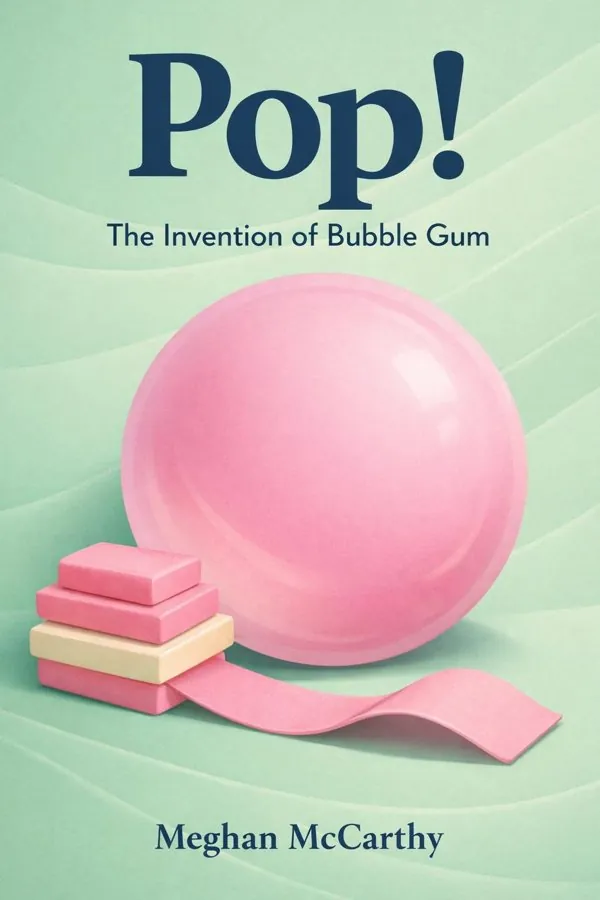
Pop!: The Invention of Bubble Gum: Summary & Key Insights
 10 min9 chaptersAudio available
Key Takeaways from Pop!: The Invention of Bubble Gum
Every invention has a prehistory, and bubble gum is no exception.
Some of the most important breakthroughs come from people who are not supposed to make them.
Failure is often just an unfinished version of success.
A great idea is not enough unless it works in the real world.
Sometimes a product succeeds because it feels different before anyone even tries it.
What Is Pop!: The Invention of Bubble Gum About?
Pop!: The Invention of Bubble Gum by Meghan McCarthy is a education book spanning 5 pages. What if one of the most recognizable treats in American childhood was created not by a scientist in a laboratory, but by an accountant experimenting after work? Pop!: The Invention of Bubble Gum tells the lively true story of how Walter Diemer, an employee at the Fleer company, accidentally invented bubble gum in 1928. Through energetic language, playful illustrations, and carefully researched historical detail, Meghan McCarthy transforms a small business mishap into a fascinating lesson about creativity, persistence, and innovation. This book matters because it shows young readers that invention is not always the result of a grand plan. Sometimes it begins with curiosity, trial and error, and the willingness to keep testing ideas when others have given up. McCarthy also places Diemer’s breakthrough in a broader cultural context, helping readers understand how a simple product became a lasting part of everyday life and popular culture. Meghan McCarthy is especially well suited to tell this story. Known for turning real historical episodes into engaging nonfiction picture books, she combines humor, visual flair, and factual accuracy in a way that makes history feel immediate, surprising, and fun.
This FizzRead summary covers all 9 key chapters of Pop!: The Invention of Bubble Gum in approximately 10 minutes, distilling the most important ideas, arguments, and takeaways from Meghan McCarthy's work. Also available as an audio summary and Key Quotes Podcast.
Pop!: The Invention of Bubble Gum
What if one of the most recognizable treats in American childhood was created not by a scientist in a laboratory, but by an accountant experimenting after work? Pop!: The Invention of Bubble Gum tells the lively true story of how Walter Diemer, an employee at the Fleer company, accidentally invented bubble gum in 1928. Through energetic language, playful illustrations, and carefully researched historical detail, Meghan McCarthy transforms a small business mishap into a fascinating lesson about creativity, persistence, and innovation.
This book matters because it shows young readers that invention is not always the result of a grand plan. Sometimes it begins with curiosity, trial and error, and the willingness to keep testing ideas when others have given up. McCarthy also places Diemer’s breakthrough in a broader cultural context, helping readers understand how a simple product became a lasting part of everyday life and popular culture.
Meghan McCarthy is especially well suited to tell this story. Known for turning real historical episodes into engaging nonfiction picture books, she combines humor, visual flair, and factual accuracy in a way that makes history feel immediate, surprising, and fun.
Who Should Read Pop!: The Invention of Bubble Gum?
This book is perfect for anyone interested in education and looking to gain actionable insights in a short read. Whether you're a student, professional, or lifelong learner, the key ideas from Pop!: The Invention of Bubble Gum by Meghan McCarthy will help you think differently.
- ✓Readers who enjoy education and want practical takeaways
- ✓Professionals looking to apply new ideas to their work and life
- ✓Anyone who wants the core insights of Pop!: The Invention of Bubble Gum in just 10 minutes
Want the full summary?
Get instant access to this book summary and 100K+ more with Fizz Moment.
Get Free SummaryAvailable on App Store • Free to download
Key Chapters
Every invention has a prehistory, and bubble gum is no exception. Before anyone imagined blowing bright, elastic bubbles, people were already chewing natural substances for pleasure. Ancient cultures used tree sap, resin, and other sticky materials as a kind of early gum. Over time, chewing moved from a simple habit to a commercial product, especially in the United States, where manufacturers began experimenting with ways to make gum softer, sweeter, and easier to sell.
Pop!: The Invention of Bubble Gum helps readers see that Walter Diemer did not invent chewing gum itself. Instead, he entered a long tradition of product development. By the late nineteenth and early twentieth centuries, gum companies were already producing and marketing chewing gum to a mass audience. Yet ordinary chewing gum had limitations: it could be chewed, flavored, and enjoyed, but it could not do the playful thing that would later define bubble gum. That missing feature mattered because invention often comes from noticing not just what a product does well, but what people wish it could do.
This historical setup is valuable because it teaches children how innovation usually works. New products rarely appear out of thin air. They evolve from older ideas, unmet desires, and repeated attempts to improve what already exists. In classrooms, this insight can spark great discussion: what everyday object around us might still be waiting for its “bubble gum moment”? A backpack, pencil, lunch container, or app might all be improved if someone notices what users really want.
The practical lesson is simple: study the ordinary before chasing the extraordinary. If you want to invent something new, first understand what already exists, what people like about it, and what feels missing. Start by asking: what is this product almost able to do?
Some of the most important breakthroughs come from people who are not supposed to make them. One of the most inspiring parts of this story is that Walter Diemer was not a trained chemist, engineer, or famous inventor. He was an accountant at the Fleer company. His regular work involved numbers, records, and business tasks, not laboratory research. Yet his curiosity led him to experiment with gum recipes anyway.
That fact changes how we think about innovation. Pop! suggests that creativity is not limited to experts with official titles. Diemer worked in an environment where gum formulas existed, and he became interested in trying to improve them. His success did not come from credentials alone; it came from attention, willingness to play with materials, and a mindset open to discovery. This is a powerful message for young readers, who may assume only adults with advanced training can create something meaningful.
The story also highlights the importance of cross-disciplinary thinking. Diemer’s distance from formal product development may actually have helped him. Because he was not trapped by expectations, he could experiment more freely. In modern life, this same principle appears when a teacher develops a clever classroom system, a nurse improves patient communication, or a teenager creates a useful digital tool without being a professional programmer. Sometimes seeing a problem from a fresh angle matters more than having the “correct” job title.
For parents and educators, Diemer’s example is a reminder to value curiosity wherever it appears. A child who tinkers, asks unusual questions, or mixes ideas from different subjects is practicing the same habit that fuels invention.
Actionable takeaway: do not disqualify yourself from solving a problem just because it is “not your field.” If something interests you, learn, test, and explore anyway.
Failure is often just an unfinished version of success. In Pop!, Walter Diemer’s invention emerges through experimentation rather than instant brilliance. He worked with existing gum ingredients, trying combinations until he found a formula that behaved differently from standard chewing gum. Many attempts did not work. Some mixtures were too sticky, too brittle, or otherwise unsuitable. But that slow, imperfect process was the real engine of discovery.
This matters because children often see finished products without seeing the messy path behind them. Bubble gum looks effortless when you unwrap it, chew it, and blow a bubble. McCarthy pulls back the curtain and shows that invention involves repeated testing. That is an important educational message, especially for students who become discouraged when they do not succeed immediately. The story normalizes trial and error as a necessary part of making anything new.
The idea applies far beyond candy. A student writing a story may need several drafts before the plot works. A class doing a science project may need to rebuild a model after it collapses. A small business might test different packaging before customers respond positively. What looks like “mistakes” may actually be useful feedback. Diemer’s persistence shows that every unsuccessful trial can teach you what not to do next time.
Teachers can use this book to introduce the concept of prototyping. Instead of aiming for a perfect first result, students can be encouraged to test, revise, and improve. Keep a notebook of what worked and what failed. That habit turns disappointment into data.
Actionable takeaway: when an attempt does not work, ask one productive question before giving up: what did this try teach me that I can use in the next version?
A great idea is not enough unless it works in the real world. Bubble gum required a formula different from ordinary chewing gum because it needed unusual physical properties. To make bubbles, the gum had to stretch without tearing, hold air, and remain soft enough to manipulate in the mouth. It could not simply taste good; it had to perform.
This is one of the most educational aspects of Pop!, because it gently introduces children to materials science without using heavy technical language. McCarthy shows that products are shaped by practical demands. The invention succeeded not because Diemer imagined bubbles, but because he developed a gum mixture capable of creating them consistently. That distinction is crucial. Innovation lives at the intersection of imagination and function.
The story also reveals how constraints sharpen creativity. Diemer did not have unlimited ingredients or endless resources. He worked with what was available and refined the formula until it became both fun and manufacturable. That challenge mirrors many real-life situations. A student designing a bridge from straws must think about flexibility and strength. A cook adapting a recipe must work with available ingredients. A software designer has to make an app not only interesting but easy to use.
Another memorable detail is the color: the gum became pink largely because that dye was available. This shows that even iconic features may arise from practical circumstance rather than grand design. Invention is often shaped by what is on hand.
Actionable takeaway: when building or creating something, ask not just “Is this exciting?” but also “Does this actually do what users need it to do, under real conditions?”
Sometimes a product succeeds because it feels different before anyone even tries it. Bubble gum’s now-famous pink color is one of the most delightful details in this story. According to the book, the gum ended up pink simply because that was the coloring available at the time. Yet what began as a practical choice became a defining part of the product’s identity.
This detail offers a larger lesson about branding and perception. People do not experience inventions only through usefulness; they also respond to appearance, mood, and memory. Pink made bubble gum look cheerful, playful, and distinctive. It visually separated bubble gum from ordinary chewing gum, helping create the sense that this was not just another candy but a new kind of fun.
McCarthy’s treatment of this moment is especially effective for young readers because it demonstrates how small decisions can shape culture. A color choice, package design, or catchy name can influence whether people notice, remember, and talk about a product. In business terms, this is the beginning of brand recognition. In classroom terms, it is a wonderful example of how art, design, and marketing connect to invention.
Children can apply this lesson in their own projects. If they create a poster, science fair model, or homemade product, presentation matters. A clear title, memorable image, or appealing color scheme can help communicate the idea more effectively. This does not mean style is more important than substance, but it does mean people often meet an idea through its surface first.
Actionable takeaway: when sharing an idea, pay attention to how it looks and feels to others. Ask yourself: what simple design choice could make this more memorable, inviting, or joyful?
An invention becomes meaningful when it leaves the worktable and enters everyday life. In Pop!, Walter Diemer did not stop after making a successful experimental gum. The real turning point came when people tried it and responded with excitement. Readers learn that the gum was first tested in stores, where customers could chew it and discover the thrill of blowing bubbles. That public reaction helped transform a curious formula into a marketable product.
This moment teaches an essential principle: users complete the invention process. A creator may think a product is wonderful, but real success depends on how others experience it. Bubble gum was not important merely because it was chemically different. It mattered because people found it fun, novel, and worth buying again. This distinction is valuable in school and in life. A class presentation is not finished when the slides are made; it is finished when the audience understands. A toy design is not successful because the maker likes it; it succeeds when children actually enjoy using it.
The birth of Dubble Bubble also shows how naming and rollout matter. Once the product had a public identity and a clear way to be sold, it could spread beyond a local experiment. That shift from invention to distribution is often overlooked, yet it is crucial. Many good ideas fail because they are never effectively introduced to the people who might love them.
For young creators, this means feedback is not a threat but a resource. Let others try what you made. Observe what confuses them, delights them, or makes them return for more.
Actionable takeaway: whenever you create something, test it with real users early. Watch their reactions and use what you learn to improve the final version.
When a playful product catches on, it can become bigger than itself. Bubble gum did more than give people something sweet to chew; it became a symbol of fun, youth, and American popular culture. Pop! traces how Dubble Bubble moved from a company invention to a recognizable cultural object, tied to stores, advertising, childhood rituals, and the simple delight of trying to blow the biggest bubble.
This part of the story matters because it helps readers understand that even small inventions can have broad social effects. Bubble gum influenced habits, language, imagery, and shared experiences. It became part of schoolyards, family outings, and popular memory. The product’s success also reflects how twentieth-century America embraced mass-produced goods that were not merely useful but entertaining. Bubble gum was not a necessity. Its appeal came from pleasure, novelty, and social play.
McCarthy’s book gives children an accessible entry point into understanding consumer culture. Why do certain products become icons while others disappear? Usually it is a mix of timing, emotional appeal, visibility, and repeatability. Bubble gum was easy to enjoy, easy to share, and easy to demonstrate. A child blowing a bubble became an advertisement without realizing it.
Today, we can see similar patterns in viral toys, snacks, and apps. Products become cultural phenomena when they invite participation and storytelling. People do not just consume them; they perform them.
Actionable takeaway: when evaluating why an idea succeeds, look beyond function. Ask how it fits into people’s identities, routines, and shared experiences. Cultural impact often matters as much as practical value.
Work roles may define responsibilities, but they do not have to limit imagination. One of the book’s strongest underlying messages is that creativity can appear anywhere, even in places that seem routine. Walter Diemer’s day job as an accountant might sound ordinary, yet his story proves that inventive thinking can thrive inside structured environments.
This lesson is especially meaningful for children who may already be sorting people into categories: artists draw, scientists experiment, accountants count, and inventors invent. Pop! quietly breaks those categories apart. Real life is more fluid. People bring curiosity to all kinds of jobs, and sometimes the most interesting contributions happen when someone goes beyond the narrow expectations of a role.
This idea also speaks to adults. Organizations often overlook innovation because they expect it only from certain departments. But useful ideas can come from receptionists who notice customer confusion, warehouse workers who spot inefficiencies, teachers who rethink routines, or parents who redesign household systems. Innovation grows when people are encouraged to ask, “Could this be better?” regardless of rank or title.
In education, this insight can help students see every subject as connected. Math skills, observation, communication, and persistence all played a role in Diemer’s success. The story suggests that curiosity is not a separate talent but a habit of mind that can travel across tasks.
Actionable takeaway: whatever your current role is, identify one small process, object, or routine around you and ask how it might be improved. Innovation often begins with noticing what everyone else has stopped seeing.
Facts are important, but stories are what make people care about them. Meghan McCarthy’s achievement in Pop! is not only that she shares true historical information, but that she shapes it into a narrative full of surprise, humor, and momentum. Instead of presenting bubble gum as a dry timeline of dates and names, she builds suspense around experiments, accidents, public reactions, and the odd charm of an accountant changing snack history.
This approach matters because it models how nonfiction can be both accurate and engaging. For many young readers, history can feel distant when it is taught only as isolated information. McCarthy shows that the past is full of human choices, unexpected events, and lively personalities. When readers connect emotionally to a story, they retain the information more easily and think more deeply about its meaning.
The book’s visual style reinforces this effect. Illustrations help clarify sequence, emphasize humor, and make abstract processes feel concrete. That combination of words and images is particularly effective in educational nonfiction, where comprehension grows when multiple forms of communication support each other.
This lesson extends into classrooms and everyday communication. Whether explaining a science concept, presenting a historical event, or pitching an idea, storytelling can increase attention and understanding. A beginning, conflict, turning point, and outcome give structure to information.
Actionable takeaway: the next time you need to explain something factual, do not start with data alone. Start with a person, a problem, or a surprising moment. Turning information into a story makes it easier for others to remember and value.
All Chapters in Pop!: The Invention of Bubble Gum
About the Author
Meghan McCarthy is an American author and illustrator best known for children’s books that bring true stories, historical figures, and unusual inventions to life. Her work often blends carefully researched nonfiction with a playful tone, expressive illustrations, and a strong sense of humor, making complex or little-known topics accessible to young readers. McCarthy has written and illustrated a number of acclaimed picture books, many of which focus on real events from American history and culture. She has a gift for finding the surprising human stories behind everyday objects and famous moments. In Pop!: The Invention of Bubble Gum, she uses that talent to transform the history of bubble gum into an entertaining and educational story about curiosity, experimentation, and imagination.
Get This Summary in Your Preferred Format
Read or listen to the Pop!: The Invention of Bubble Gum summary by Meghan McCarthy anytime, anywhere. FizzRead offers multiple formats so you can learn on your terms — all free.
Available formats: App · Audio · PDF · EPUB — All included free with FizzRead
Download Pop!: The Invention of Bubble Gum PDF and EPUB Summary
Key Quotes from Pop!: The Invention of Bubble Gum
“Every invention has a prehistory, and bubble gum is no exception.”
“Some of the most important breakthroughs come from people who are not supposed to make them.”
“Failure is often just an unfinished version of success.”
“A great idea is not enough unless it works in the real world.”
“Sometimes a product succeeds because it feels different before anyone even tries it.”
Frequently Asked Questions about Pop!: The Invention of Bubble Gum
Pop!: The Invention of Bubble Gum by Meghan McCarthy is a education book that explores key ideas across 9 chapters. What if one of the most recognizable treats in American childhood was created not by a scientist in a laboratory, but by an accountant experimenting after work? Pop!: The Invention of Bubble Gum tells the lively true story of how Walter Diemer, an employee at the Fleer company, accidentally invented bubble gum in 1928. Through energetic language, playful illustrations, and carefully researched historical detail, Meghan McCarthy transforms a small business mishap into a fascinating lesson about creativity, persistence, and innovation. This book matters because it shows young readers that invention is not always the result of a grand plan. Sometimes it begins with curiosity, trial and error, and the willingness to keep testing ideas when others have given up. McCarthy also places Diemer’s breakthrough in a broader cultural context, helping readers understand how a simple product became a lasting part of everyday life and popular culture. Meghan McCarthy is especially well suited to tell this story. Known for turning real historical episodes into engaging nonfiction picture books, she combines humor, visual flair, and factual accuracy in a way that makes history feel immediate, surprising, and fun.
You Might Also Like

Bedtime Biography: Florence Nightingale
Isabel Thomas
10 min
Introduction To Museum Studies
Howard H. Hoyt
10 min
A Mind for Numbers: How to Excel at Math and Science (Even If You Flunked Algebra)
Barbara Oakley
10 min
AI for Educators: Learning Strategies, Teacher Empowerment, and the Future of Education
Matt Miller
10 min
Animation For Beginners
Morr Meroz
10 min
Artificial Intelligence for Learning
Donald Clark
10 minBrowse by Category
Ready to read Pop!: The Invention of Bubble Gum?
Get the full summary and 100K+ more books with Fizz Moment.