
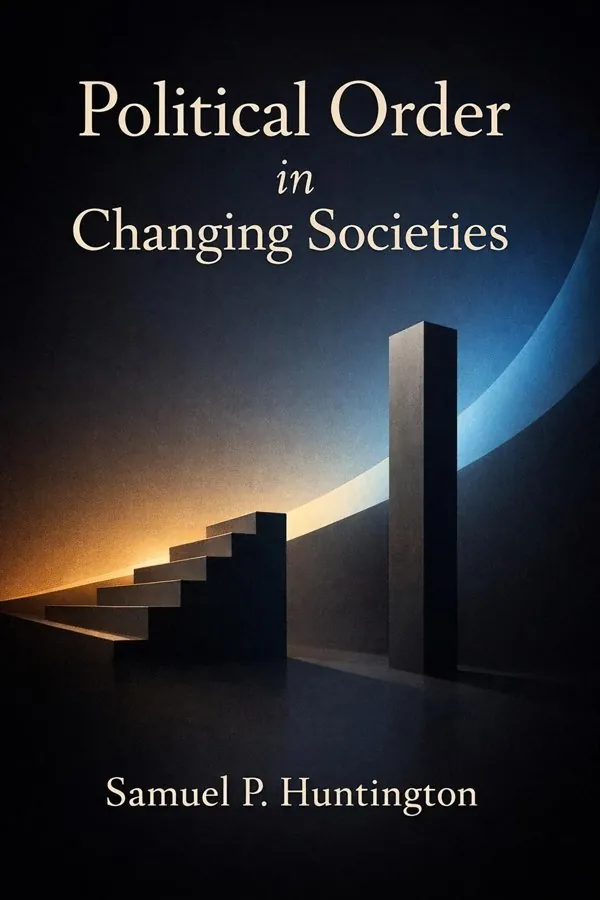
Political Order in Changing Societies: Summary & Key Insights
 10 min9 chaptersAudio available
Key Takeaways from Political Order in Changing Societies
A society does not collapse simply because people demand more; it collapses when institutions cannot process those demands.
One of Huntington’s boldest claims is that modernization often generates instability before it generates order.
Strong politics is not merely about charismatic leaders or inspiring constitutions; it is about institutionalization.
Political inclusion is desirable, but Huntington insists that inclusion without organization can be explosive.
Social energy is not enough to build a nation.
What Is Political Order in Changing Societies About?
Political Order in Changing Societies by Samuel P. Huntington is a politics book spanning 11 pages. Why do societies that are becoming richer, more educated, and more politically aware so often become less stable rather than more democratic? In Political Order in Changing Societies, Samuel P. Huntington tackles that unsettling question with one of the most influential and controversial arguments in modern political science. Rejecting the optimistic belief that modernization naturally leads to freedom and order, Huntington argues that rapid social change can produce disorder when political institutions are too weak to absorb new demands. In his view, the central problem of developing nations is not simply poverty or lack of elections, but the gap between rising participation and insufficient institutional capacity. This book matters because it shifts attention from ideals to structures: parties, bureaucracies, legal systems, and armies that can channel conflict before it explodes into violence or corruption. Huntington’s analysis remains essential for understanding failed states, coups, revolutions, populist surges, and institutional erosion in both developing and advanced countries. As a leading Harvard political scientist and one of the most debated thinkers of the twentieth century, Huntington brings historical breadth, comparative rigor, and provocative clarity to a question that still shapes global politics.
This FizzRead summary covers all 9 key chapters of Political Order in Changing Societies in approximately 10 minutes, distilling the most important ideas, arguments, and takeaways from Samuel P. Huntington's work. Also available as an audio summary and Key Quotes Podcast.
Political Order in Changing Societies
Why do societies that are becoming richer, more educated, and more politically aware so often become less stable rather than more democratic? In Political Order in Changing Societies, Samuel P. Huntington tackles that unsettling question with one of the most influential and controversial arguments in modern political science. Rejecting the optimistic belief that modernization naturally leads to freedom and order, Huntington argues that rapid social change can produce disorder when political institutions are too weak to absorb new demands. In his view, the central problem of developing nations is not simply poverty or lack of elections, but the gap between rising participation and insufficient institutional capacity.
This book matters because it shifts attention from ideals to structures: parties, bureaucracies, legal systems, and armies that can channel conflict before it explodes into violence or corruption. Huntington’s analysis remains essential for understanding failed states, coups, revolutions, populist surges, and institutional erosion in both developing and advanced countries. As a leading Harvard political scientist and one of the most debated thinkers of the twentieth century, Huntington brings historical breadth, comparative rigor, and provocative clarity to a question that still shapes global politics.
Who Should Read Political Order in Changing Societies?
This book is perfect for anyone interested in politics and looking to gain actionable insights in a short read. Whether you're a student, professional, or lifelong learner, the key ideas from Political Order in Changing Societies by Samuel P. Huntington will help you think differently.
- ✓Readers who enjoy politics and want practical takeaways
- ✓Professionals looking to apply new ideas to their work and life
- ✓Anyone who wants the core insights of Political Order in Changing Societies in just 10 minutes
Want the full summary?
Get instant access to this book summary and 100K+ more with Fizz Moment.
Get Free SummaryAvailable on App Store • Free to download
Key Chapters
A society does not collapse simply because people demand more; it collapses when institutions cannot process those demands. That is the core of Huntington’s concept of political decay. He argues that political decay occurs when existing institutions lose adaptability, coherence, autonomy, or complexity while social forces become more active and organized. The result is not healthy pluralism but instability: corruption spreads, violence rises, and public authority weakens.
This idea challenged the comforting assumption that movement, participation, and modernization are inherently progressive. For Huntington, growth can be destabilizing if not matched by political development. A rapidly urbanizing country, for example, may produce millions of newly mobilized citizens who expect jobs, justice, and representation. If parties are weak, the civil service is politicized, and courts lack legitimacy, those expectations turn into unrest. Instead of stable democracy, the country may experience patronage politics, coups, or authoritarian backlash.
The concept also applies beyond newly independent states. In any system, institutions can decay when they become rigid, personalistic, or captured by narrow interests. When legislatures cannot legislate, parties stop aggregating interests, and executives govern through improvisation, order erodes even if formal constitutional structures remain intact.
Huntington’s point is not that change is bad. It is that change without organization is dangerous. Political order depends less on how many demands exist than on whether there are trusted mechanisms to handle them. If there are not, energy turns into disruption rather than progress.
Actionable takeaway: When assessing a country’s stability, look first at the strength of its institutions, not just its elections, growth rates, or protest movements.
One of Huntington’s boldest claims is that modernization often generates instability before it generates order. Mid-twentieth-century modernization theory suggested that economic growth, literacy, urbanization, and mass communication would naturally produce liberal democracy. Huntington rejects that linear optimism. In his view, modernization transforms society faster than politics can adjust, creating pressure that weak institutions are unable to contain.
As people become more educated and connected, they develop new expectations. They want inclusion, mobility, dignity, and influence. Rural migrants arrive in cities; students become politicized; new media spread awareness of inequality. These changes do not merely expand opportunity. They also multiply demands on the state. If those demands outpace institutional capacity, modernization becomes a force of disorder.
Consider a country experiencing rapid industrial growth. Its economy expands, universities multiply, and newspapers flourish. Yet if its party system remains elitist, local government corrupt, and bureaucracy underdeveloped, newly mobilized groups may find no legitimate path to power. Political frustration then spills into demonstrations, populist movements, factionalism, or military intervention.
Huntington’s framework helps explain why some rapidly developing countries become turbulent rather than stable. It also warns against measuring political progress through economic indicators alone. Growth is important, but growth without institutions can sharpen conflict. A richer society may actually become harder to govern if authority has not been institutionalized.
The broader lesson is sobering: modernization changes the social map, but it does not tell us how to govern the new terrain. Political development is a separate achievement, not an automatic side effect of economic advance.
Actionable takeaway: Do not assume that rising GDP, education, or connectivity signal political health; ask whether institutions are evolving at the same pace as society.
Strong politics is not merely about charismatic leaders or inspiring constitutions; it is about institutionalization. Huntington defines institutionalization as the process by which political organizations and procedures acquire value and stability. The more adaptable, complex, autonomous, and coherent an institution becomes, the more effectively it can manage conflict and maintain order.
This is the book’s governing standard. A highly institutionalized political system can absorb new groups, settle disputes, and survive leadership change. A weakly institutionalized system depends on personalities, patronage, and improvisation. It may appear effective in calm periods, but it breaks under stress. Huntington therefore shifts attention away from regime labels like democratic or authoritarian and toward the capacity of institutions themselves.
Political parties are a prime example. In stable systems, parties recruit leaders, aggregate interests, discipline conflict, and connect citizens to the state. In unstable systems, parties may be little more than electoral vehicles for ambitious individuals. The same applies to bureaucracies, courts, legislatures, and military organizations. Institutions matter because they transform private demands into public order.
Institutionalization also requires time. It cannot be manufactured overnight through constitutional drafting or foreign aid templates. Rules must become predictable, organizations must develop routines, and citizens must come to trust that politics will continue beyond any single leader.
This idea remains highly relevant. States emerging from conflict often rush toward elections while neglecting civil service reform, party development, or local administrative capacity. Huntington warns that without institutional depth, formal democracy may become unstable performance rather than durable governance.
Actionable takeaway: Evaluate political systems by asking how stable, impersonal, and resilient their institutions are, especially when leadership changes or crises arise.
Political inclusion is desirable, but Huntington insists that inclusion without organization can be explosive. His argument is not anti-participation; it is anti-mismatch. When more people enter politics than institutions can represent, educate, and discipline, the result is often instability rather than empowerment.
Mass participation expands when literacy rises, media spreads, economic aspirations grow, and traditional hierarchies weaken. Citizens begin to expect a voice in decisions that affect their lives. That is a historic transformation, but it creates pressure on governments. If parties are fragmented, legislatures ineffective, and administrative systems weak, the political system cannot absorb the influx. The public enters politics faster than politics becomes capable of handling the public.
This imbalance can produce populism, street politics, clientelism, and personalized rule. Leaders bypass institutions and appeal directly to crowds. Citizens who lack reliable channels for influence may rely on demonstrations, factions, ethnic mobilization, or patronage networks. Instead of broadening citizenship, rapid participation can actually erode the rule-bound structures needed to sustain it.
The practical significance is enormous. International reform programs often focus on voter turnout, civil society activation, or constitutional opening. Huntington would ask a harder question: are there institutions capable of processing increased participation? Without party organization, administrative competence, and legal predictability, inclusion may deepen instability.
The same logic appears in organizations beyond states. A company that invites broad employee input without decision rules may become paralyzed. A university that expands governance without clear procedures may invite conflict. Participation works best when institutions can channel it.
Actionable takeaway: Support broader participation only alongside investments in parties, public administration, legal systems, and other structures that can turn demands into decisions.
Revolutions do not arise simply because people are poor or angry. Huntington argues that revolutionary situations become likely when political institutions are too weak to contain new social forces and too inflexible to reform themselves. Revolution, in this sense, is less a spontaneous eruption than a symptom of institutional failure.
As societies modernize, new classes and groups seek entry into political life. If the existing order excludes them while lacking the capacity to repress effectively or reform credibly, the system enters a zone of danger. Elites lose authority, opposition becomes radicalized, and the state’s organizational weakness invites confrontation. Revolutions become possible where neither adaptation nor control is sufficient.
This helps explain why some highly unequal societies do not experience revolution, while others do. Poverty alone is not decisive. What matters is the relationship between social change and political institutions. A rigid regime with shallow roots, personalistic rule, and little administrative depth may appear strong until sudden crisis reveals its fragility.
Huntington also sees revolution as organizationally demanding. Successful revolutionaries often triumph not because their grievances are deepest, but because their movements are more disciplined than the regimes they challenge. Revolutionary parties, guerrilla organizations, and ideological cadres can outperform decaying states whose institutions are hollow.
For policymakers, this perspective suggests that preventing revolution is not mainly about rhetorical reform or short-term repression. It is about building institutions capable of adaptation, representation, and enforcement. Systems that can incorporate emerging groups are less likely to face total breakdown.
Actionable takeaway: To understand revolutionary risk, examine whether a state can reform, govern, and maintain legitimacy under pressure, not just whether social discontent exists.
When armies dominate politics, Huntington argues, the real story is often not military strength alone but civilian weakness. Coups and military interventions typically occur where civilian institutions such as parties, legislatures, courts, and bureaucracies are too fragmented or discredited to govern effectively. In these settings, the military appears as one of the few organized, disciplined institutions in society.
This does not mean military rule is desirable or stable. Huntington is clear that armies are structured for command, hierarchy, and security, not for broad-based political representation. Yet in weakly institutionalized systems, officers may see intervention as necessary to restore order, or civilian factions may invite them in to settle political deadlock. The military becomes a political actor because other institutions fail to perform their roles.
His analysis adds nuance to debates about coups. Rather than moralizing alone, he asks what structural conditions make military intervention possible. A country with professional armed forces but strong parties and legitimate civilian authority is less coup-prone than one with polarized elites, weak administration, and politicized patronage networks.
The lesson extends beyond classic coups. Even in formally civilian systems, security institutions can gain outsize influence when governments appear incapable of managing violence, corruption, or territorial fragmentation. The problem is rarely solved by simply denouncing the military. It requires strengthening civilian institutions so that governance no longer depends on barracks discipline.
Huntington’s broader contribution is to show that political order cannot be built on emergency substitutes forever. If civilian institutions remain weak, military intervention may recur in cycles.
Actionable takeaway: To reduce military intrusion into politics, focus less on rhetoric about civilian supremacy and more on building competent, legitimate civilian institutions.
One of Huntington’s most valuable insights is that political development has no single formula. By comparing societies across regions and eras, he shows that order can emerge through different sequences, institutions, and historical struggles. What matters is not whether a country copies a model, but whether it develops organizations capable of governing social change.
This comparative perspective allows Huntington to challenge simplistic assumptions. Some countries institutionalized parties before mass participation expanded; others built bureaucracies first; still others relied on monarchies, revolutionary movements, or nationalist organizations to create cohesion. The path varied, but successful cases generally developed political institutions robust enough to channel conflict before social pressures overwhelmed them.
He also warns against reading advanced democracies as if their stability were natural. Stable systems are historical achievements produced by long periods of conflict, adaptation, and institution-building. Their current order cannot be transplanted instantly into countries with different social structures and political legacies. This is why imitation often disappoints. Constitutions may be copied, but institutional habits cannot be imported overnight.
Huntington’s reflections on the United States reinforce this point. American political order did not arise solely from democratic ideals; it also depended on federal arrangements, party development, legal consolidation, and the gradual expansion of participation. History mattered. Sequence mattered. Institutions mattered.
For readers today, the comparative method remains a powerful antidote to ideological shortcuts. It encourages analysts to ask not whether a society resembles an ideal type, but what specific institutional trajectory its conditions require.
Actionable takeaway: Compare political systems historically and contextually; avoid assuming that one country’s institutional path can simply be copied by another.
Huntington’s book is diagnostic, but it is also strategic. If the central problem is the gap between mobilization and institutionalization, then political development requires deliberate efforts to close that gap. States must build institutions that are not only efficient, but legitimate, adaptable, and capable of integrating new groups into political life.
This means reform priorities should focus on organization before symbolism. Elections matter, but so do party systems that aggregate interests rather than fragment them. Constitutions matter, but so do bureaucracies that can implement policy consistently. Anti-corruption slogans matter, but so do courts and civil services that reduce reliance on patronage. Political order depends on routines, incentives, and capacities that survive changes in leadership.
Huntington does not offer a simplistic blueprint, and that is part of his value. He recognizes trade-offs. Strong institutions may initially require centralization, disciplined parties, or limits on immediate participation. These ideas remain controversial, especially when they seem to subordinate liberty to order. Yet his deeper point is that freedom itself becomes fragile when institutions are too weak to sustain it.
The practical application is clear in state-building, democratic transitions, and governance reform. Policymakers often pursue visible milestones such as elections, decentralization, or constitutional rewrites without equal attention to implementation capacity. Huntington would insist that order is not anti-democratic; it is a precondition for stable democratic practice.
Ultimately, the book asks readers to think like institution-builders rather than event-watchers. Political change is not secured by moments of enthusiasm alone. It requires structures that endure when enthusiasm fades.
Actionable takeaway: Prioritize reforms that strengthen durable institutions capable of managing conflict, implementing decisions, and incorporating new participants over time.
All Chapters in Political Order in Changing Societies
About the Author
Samuel P. Huntington (1927–2008) was one of the most influential American political scientists of the twentieth century. A longtime professor at Harvard University, he wrote widely on political development, civil-military relations, democratization, national identity, and global conflict. His work combined broad historical comparison with bold theoretical claims, often shaping debate far beyond academia. Huntington first gained major recognition with The Soldier and the State, a landmark study of military professionalism, and later became widely known for Political Order in Changing Societies and The Clash of Civilizations. He also served in advisory roles connected to U.S. policy and public affairs. Admired for his analytical force and criticized for the controversy of some of his conclusions, Huntington remains a central figure in modern political thought.
Get This Summary in Your Preferred Format
Read or listen to the Political Order in Changing Societies summary by Samuel P. Huntington anytime, anywhere. FizzRead offers multiple formats so you can learn on your terms — all free.
Available formats: App · Audio · PDF · EPUB — All included free with FizzRead
Download Political Order in Changing Societies PDF and EPUB Summary
Key Quotes from Political Order in Changing Societies
“A society does not collapse simply because people demand more; it collapses when institutions cannot process those demands.”
“One of Huntington’s boldest claims is that modernization often generates instability before it generates order.”
“Strong politics is not merely about charismatic leaders or inspiring constitutions; it is about institutionalization.”
“Political inclusion is desirable, but Huntington insists that inclusion without organization can be explosive.”
“Social energy is not enough to build a nation.”
Frequently Asked Questions about Political Order in Changing Societies
Political Order in Changing Societies by Samuel P. Huntington is a politics book that explores key ideas across 9 chapters. Why do societies that are becoming richer, more educated, and more politically aware so often become less stable rather than more democratic? In Political Order in Changing Societies, Samuel P. Huntington tackles that unsettling question with one of the most influential and controversial arguments in modern political science. Rejecting the optimistic belief that modernization naturally leads to freedom and order, Huntington argues that rapid social change can produce disorder when political institutions are too weak to absorb new demands. In his view, the central problem of developing nations is not simply poverty or lack of elections, but the gap between rising participation and insufficient institutional capacity. This book matters because it shifts attention from ideals to structures: parties, bureaucracies, legal systems, and armies that can channel conflict before it explodes into violence or corruption. Huntington’s analysis remains essential for understanding failed states, coups, revolutions, populist surges, and institutional erosion in both developing and advanced countries. As a leading Harvard political scientist and one of the most debated thinkers of the twentieth century, Huntington brings historical breadth, comparative rigor, and provocative clarity to a question that still shapes global politics.
More by Samuel P. Huntington
The Clash of Civilizations and the Remaking of World Order
Samuel P. Huntington
10 min
The Crisis of Democracy: Report on the Governability of Democracies to the Trilateral Commission
Michel Crozier, Samuel P. Huntington, Joji Watanuki
10 min
Culture Matters: How Values Shape Human Progress
Lawrence E. Harrison, Samuel P. Huntington
10 minYou Might Also Like
Antifa: The Anti-Fascist Handbook
Mark Bray
10 min
Attack from Within: How Disinformation Is Sabotaging America
Barbara McQuade
10 min
Coercion, Capital, and European States, AD 990–1992
Charles Tilly
10 min
Digital Democracy: Concepts, Methodologies, Tools, and Applications
Various Authors
10 min
Fascism
Stanley G. Payne
10 min
Fire And Fury: Inside The Trump White House
Michael Wolff
10 minBrowse by Category
Ready to read Political Order in Changing Societies?
Get the full summary and 100K+ more books with Fizz Moment.