
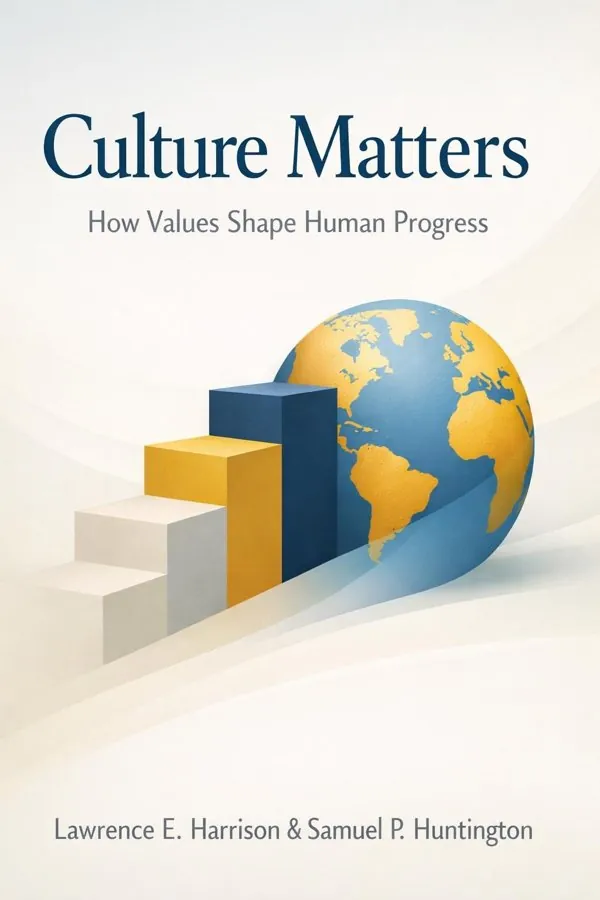
Culture Matters: How Values Shape Human Progress: Summary & Key Insights
by Lawrence E. Harrison, Samuel P. Huntington
 10 min9 chaptersAudio available
What Is Culture Matters: How Values Shape Human Progress About?
Culture Matters: How Values Shape Human Progress by Lawrence E. Harrison, Samuel P. Huntington is a sociology book spanning 9 pages. This collection of essays explores how cultural values influence economic and political development across nations. Edited by Lawrence E. Harrison and Samuel P. Huntington, the book brings together leading scholars who argue that culture—rather than geography, politics, or economics alone—plays a decisive role in shaping human progress and institutional success.
This FizzRead summary covers all 9 key chapters of Culture Matters: How Values Shape Human Progress in approximately 10 minutes, distilling the most important ideas, arguments, and takeaways from Lawrence E. Harrison, Samuel P. Huntington's work. Also available as an audio summary and Key Quotes Podcast.
Culture Matters: How Values Shape Human Progress
This collection of essays explores how cultural values influence economic and political development across nations. Edited by Lawrence E. Harrison and Samuel P. Huntington, the book brings together leading scholars who argue that culture—rather than geography, politics, or economics alone—plays a decisive role in shaping human progress and institutional success.
Who Should Read Culture Matters: How Values Shape Human Progress?
This book is perfect for anyone interested in sociology and looking to gain actionable insights in a short read. Whether you're a student, professional, or lifelong learner, the key ideas from Culture Matters: How Values Shape Human Progress by Lawrence E. Harrison, Samuel P. Huntington will help you think differently.
- ✓Readers who enjoy sociology and want practical takeaways
- ✓Professionals looking to apply new ideas to their work and life
- ✓Anyone who wants the core insights of Culture Matters: How Values Shape Human Progress in just 10 minutes
Want the full summary?
Get instant access to this book summary and 100K+ more with Fizz Moment.
Get Free SummaryAvailable on App Store • Free to download
Key Chapters
For much of the twentieth century, theories of development revolved around tangible factors—capital accumulation, industrialization, bureaucratic efficiency. From modernization theory to dependency theory, culture was often treated as peripheral, an artifact of tradition that modernization would inevitably erase. We believed this view was dangerously incomplete.
In the opening chapters, we trace the intellectual history of the debate between cultural determinism and structural or economic explanations. Max Weber’s *The Protestant Ethic and the Spirit of Capitalism* serves as a cornerstone, spanning the gap between moral dispositions and economic outcomes. The Weberian insight—that certain religious values foster rationality, discipline, and deferred gratification—resonates deeply with our thesis.
Through comparative analysis, the essays show that while structural conditions may set the stage, cultural scripts direct the performance. Latin America’s history, for instance, has been shaped by a hierarchical, authoritarian legacy inherited from Iberian Catholicism, emphasizing dependence and loyalty over initiative. Contrast this with Northern Europe or North America, where Protestant traditions cultivated self-reliance and individual responsibility—cultural traits that underpin democratic governance and entrepreneurialism.
From Toynbee to Huntington’s own *Clash of Civilizations*, the enduring question has been whether civilizations possess inherent trajectories—whether certain cultural matrices are more adaptive to modern challenges. In this book, we demonstrate that culture does not act alone or magically determine outcomes; rather, it interacts dynamically with institutions and economic frameworks. But without a supportive cultural foundation, institutions remain hollow.
As the reader, you will see how this historical conversation reshapes modern development thought. When economists ignore culture, they prescribe remedies that fail. Infrastructure can be built, foreign aid can flow, but without values that sustain accountability, honesty, and diligence, progress falters. Culture, therefore, is not a decorative layer of identity—it is the architecture of behavior.
In short, understanding history through the prism of values allows us to reinterpret global inequalities not merely as resource gaps but as reflection of moral frameworks that govern societies. That is the paradigm shift *Culture Matters* invites you to embrace.
+ 7 more chapters — available in the FizzRead app
All Chapters in Culture Matters: How Values Shape Human Progress
About the Authors
Lawrence E. Harrison was an American author and development expert known for his work on the role of culture in economic progress. Samuel P. Huntington was an American political scientist best known for his analyses of political order, modernization, and cultural identity in global politics.
Get This Summary in Your Preferred Format
Read or listen to the Culture Matters: How Values Shape Human Progress summary by Lawrence E. Harrison, Samuel P. Huntington anytime, anywhere. FizzRead offers multiple formats so you can learn on your terms — all free.
Available formats: App · Audio · PDF · EPUB — All included free with FizzRead
Download Culture Matters: How Values Shape Human Progress PDF and EPUB Summary
Key Quotes from Culture Matters: How Values Shape Human Progress
“For much of the twentieth century, theories of development revolved around tangible factors—capital accumulation, industrialization, bureaucratic efficiency.”
“The next major section of our work reveals how religion and ethical systems mold the pathways of economic development.”
Frequently Asked Questions about Culture Matters: How Values Shape Human Progress
Culture Matters: How Values Shape Human Progress by Lawrence E. Harrison, Samuel P. Huntington is a sociology book that explores key ideas across 9 chapters. This collection of essays explores how cultural values influence economic and political development across nations. Edited by Lawrence E. Harrison and Samuel P. Huntington, the book brings together leading scholars who argue that culture—rather than geography, politics, or economics alone—plays a decisive role in shaping human progress and institutional success.
You Might Also Like

Between the World and Me
Ta-Nehisi Coates
10 min
Half the Sky
Nicholas D. Kristof, Sheryl WuDunn
10 min
Men Explain Things To Me
Rebecca Solnit
10 min
Rational Ritual
Michael Suk-Young Chwe
10 min
The New Jim Crow
Michelle Alexander
10 min
Beyond Culture
Edward T. Hall
10 minBrowse by Category
Ready to read Culture Matters: How Values Shape Human Progress?
Get the full summary and 100K+ more books with Fizz Moment.