
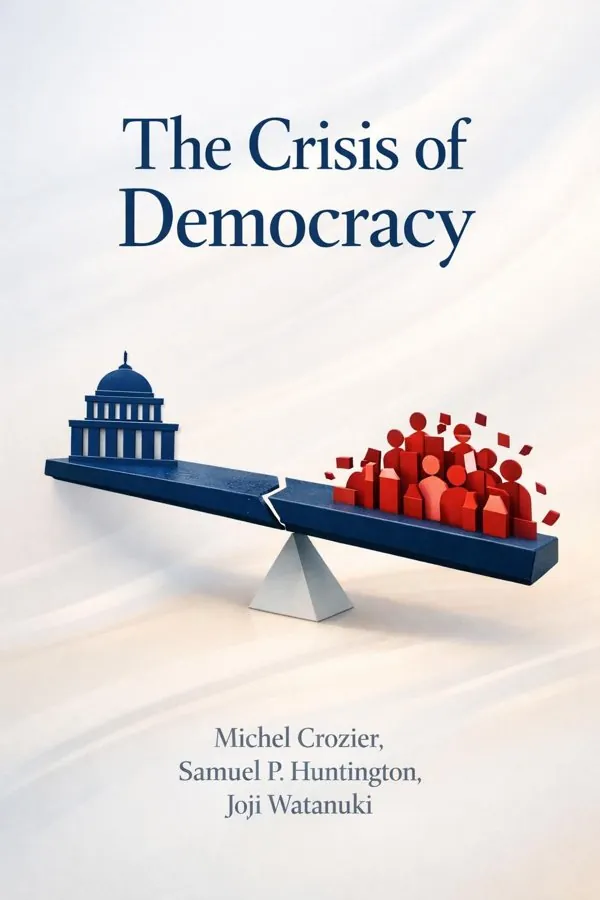
The Crisis of Democracy: Report on the Governability of Democracies to the Trilateral Commission: Summary & Key Insights
by Michel Crozier, Samuel P. Huntington, Joji Watanuki
 10 min12 chaptersAudio available
What Is The Crisis of Democracy: Report on the Governability of Democracies to the Trilateral Commission About?
The Crisis of Democracy: Report on the Governability of Democracies to the Trilateral Commission by Michel Crozier, Samuel P. Huntington, Joji Watanuki is a politics book spanning 12 pages. This report, commissioned by the Trilateral Commission in 1975, examines the challenges facing democratic governments in North America, Western Europe, and Japan. The authors argue that democracies were experiencing a 'governability crisis' due to an overload of demands on government institutions, declining authority, and growing public disillusionment. The study explores the balance between participation and governability, suggesting that excessive democratization can weaken effective governance.
This FizzRead summary covers all 12 key chapters of The Crisis of Democracy: Report on the Governability of Democracies to the Trilateral Commission in approximately 10 minutes, distilling the most important ideas, arguments, and takeaways from Michel Crozier, Samuel P. Huntington, Joji Watanuki's work. Also available as an audio summary and Key Quotes Podcast.
The Crisis of Democracy: Report on the Governability of Democracies to the Trilateral Commission
This report, commissioned by the Trilateral Commission in 1975, examines the challenges facing democratic governments in North America, Western Europe, and Japan. The authors argue that democracies were experiencing a 'governability crisis' due to an overload of demands on government institutions, declining authority, and growing public disillusionment. The study explores the balance between participation and governability, suggesting that excessive democratization can weaken effective governance.
Who Should Read The Crisis of Democracy: Report on the Governability of Democracies to the Trilateral Commission?
This book is perfect for anyone interested in politics and looking to gain actionable insights in a short read. Whether you're a student, professional, or lifelong learner, the key ideas from The Crisis of Democracy: Report on the Governability of Democracies to the Trilateral Commission by Michel Crozier, Samuel P. Huntington, Joji Watanuki will help you think differently.
- ✓Readers who enjoy politics and want practical takeaways
- ✓Professionals looking to apply new ideas to their work and life
- ✓Anyone who wants the core insights of The Crisis of Democracy: Report on the Governability of Democracies to the Trilateral Commission in just 10 minutes
Want the full summary?
Get instant access to this book summary and 100K+ more with Fizz Moment.
Get Free SummaryAvailable on App Store • Free to download
Key Chapters
In analyzing what we called the 'crisis of democracy,' we found that governability—the capacity of democratic systems to make and implement decisions—was eroding. The perception of crisis did not arise from tyranny, corruption, or authoritarian threat; rather, it came from democracy's own internal dynamics. The expanding participation that had once strengthened legitimacy was now overwhelming institutions.
In the years following World War II, the democratic world experienced a remarkable transformation. Economic growth, education, and mass media formed citizens who were more politically conscious and assertive. Yet government remained bound by bureaucratic procedures and cautious leadership. This gap widened as people began to expect the state to deliver not only stability but justice, growth, welfare, and equality—all simultaneously. The result was what we termed 'demand overload': too many claims, too little capacity.
A democracy can survive dissent, and even chaos, but it cannot govern effectively when every decision provokes protest and when authority itself becomes suspect. The crisis of democracy, therefore, was not a failure of ideals but of manageability—the erosion of the balance between popular control and institutional strength.
In postwar decades, societies across the Trilateral region underwent broad democratization. The United States saw civil rights movements, student protests, and a surge of citizen activism; Europe experienced new waves of unionization and social movements; Japan, rising from wartime defeat, embraced modernization and middle-class participation. We celebrated these advances, but we were also aware that political systems had not adjusted their mechanisms of decision-making to match the breadth of engagement.
The political culture of deference faded. Citizens now believed that every opinion deserved expression and every cause deserved an audience. Governments were judged not by their capacity for order but by their responsiveness. Thus, while participation deepened democracy in spirit, it strained its capacity in practice. As the bureaucratic state expanded to meet public expectations, it became both ubiquitous and mistrusted—a paradox that lay at the heart of our analysis.
+ 10 more chapters — available in the FizzRead app
All Chapters in The Crisis of Democracy: Report on the Governability of Democracies to the Trilateral Commission
About the Authors
Michel Crozier was a French sociologist known for his work on bureaucracy and organizational theory. Samuel P. Huntington was an American political scientist recognized for his influential theories on political order and civilizational conflict. Joji Watanuki was a Japanese political scientist specializing in comparative politics and governance.
Get This Summary in Your Preferred Format
Read or listen to the The Crisis of Democracy: Report on the Governability of Democracies to the Trilateral Commission summary by Michel Crozier, Samuel P. Huntington, Joji Watanuki anytime, anywhere. FizzRead offers multiple formats so you can learn on your terms — all free.
Available formats: App · Audio · PDF · EPUB — All included free with FizzRead
Download The Crisis of Democracy: Report on the Governability of Democracies to the Trilateral Commission PDF and EPUB Summary
Key Quotes from The Crisis of Democracy: Report on the Governability of Democracies to the Trilateral Commission
“In analyzing what we called the 'crisis of democracy,' we found that governability—the capacity of democratic systems to make and implement decisions—was eroding.”
“In postwar decades, societies across the Trilateral region underwent broad democratization.”
Frequently Asked Questions about The Crisis of Democracy: Report on the Governability of Democracies to the Trilateral Commission
The Crisis of Democracy: Report on the Governability of Democracies to the Trilateral Commission by Michel Crozier, Samuel P. Huntington, Joji Watanuki is a politics book that explores key ideas across 12 chapters. This report, commissioned by the Trilateral Commission in 1975, examines the challenges facing democratic governments in North America, Western Europe, and Japan. The authors argue that democracies were experiencing a 'governability crisis' due to an overload of demands on government institutions, declining authority, and growing public disillusionment. The study explores the balance between participation and governability, suggesting that excessive democratization can weaken effective governance.
You Might Also Like
Antifa: The Anti-Fascist Handbook
Mark Bray
10 min
Attack from Within: How Disinformation Is Sabotaging America
Barbara McQuade
10 min
Coercion, Capital, and European States, AD 990–1992
Charles Tilly
10 min
Digital Democracy: Concepts, Methodologies, Tools, and Applications
Various Authors
10 min
Fascism
Stanley G. Payne
10 min
Fire And Fury: Inside The Trump White House
Michael Wolff
10 minBrowse by Category
Ready to read The Crisis of Democracy: Report on the Governability of Democracies to the Trilateral Commission?
Get the full summary and 100K+ more books with Fizz Moment.