
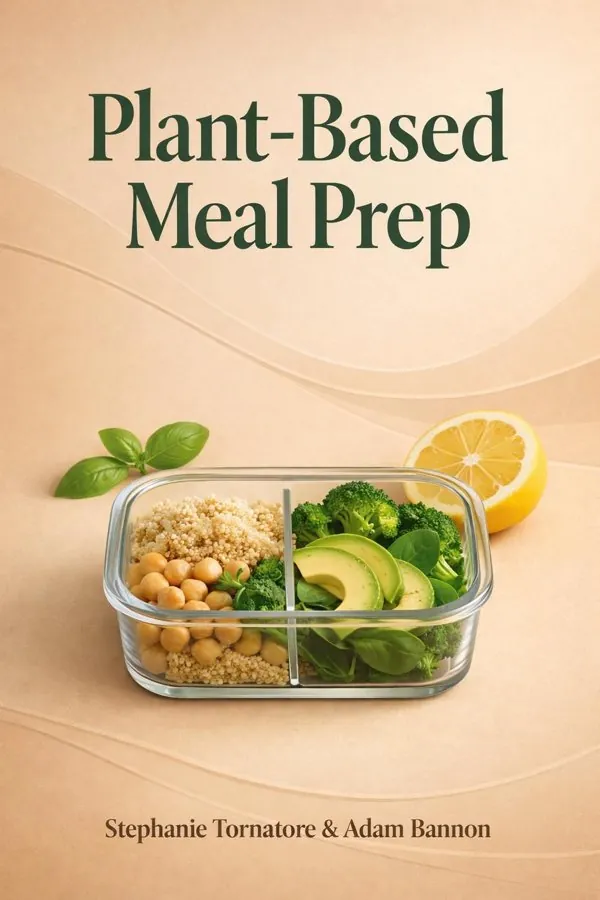
Plant-Based Meal Prep: Practical Weekly Plans: Summary & Key Insights
by Stephanie Tornatore, Adam Bannon
 10 min9 chaptersAudio available
Key Takeaways from Plant-Based Meal Prep: Practical Weekly Plans
The most sustainable dietary changes begin not with what you remove, but with what you add.
Willpower is unreliable, but systems are dependable.
Healthy eating is easier when your environment quietly pushes you in the right direction.
Preparation without planning is just random effort.
The smartest meal prep does not produce seven identical containers; it creates building blocks.
What Is Plant-Based Meal Prep: Practical Weekly Plans About?
Plant-Based Meal Prep: Practical Weekly Plans by Stephanie Tornatore, Adam Bannon is a nutrition book spanning 5 pages. Plant-based eating often sounds simple in theory and overwhelming in practice. Most people do not struggle because vegetables are unavailable or recipes are impossible; they struggle because daily life is busy, decision fatigue is real, and healthy intentions fade when dinner is unplanned. In Plant-Based Meal Prep: Practical Weekly Plans, Stephanie Tornatore and Adam Bannon tackle that exact gap between aspiration and execution. Their book is not just a collection of vegan recipes. It is a practical system for turning whole-food, plant-based eating into an organized weekly routine that saves time, reduces stress, and makes nutritious meals far more realistic. The book matters because it speaks to everyday constraints: limited time, crowded schedules, tight budgets, and the need for meals that actually keep you satisfied. Rather than asking readers to cook from scratch three times a day, the authors show how to shop strategically, batch-cook core ingredients, and assemble balanced meals throughout the week. Drawing on their experience creating approachable plant-based content for a broad audience, Tornatore and Bannon present a method that feels flexible instead of rigid. The result is a guide for anyone who wants to eat more plants without making food preparation a full-time job.
This FizzRead summary covers all 9 key chapters of Plant-Based Meal Prep: Practical Weekly Plans in approximately 10 minutes, distilling the most important ideas, arguments, and takeaways from Stephanie Tornatore, Adam Bannon's work. Also available as an audio summary and Key Quotes Podcast.
Plant-Based Meal Prep: Practical Weekly Plans
Plant-based eating often sounds simple in theory and overwhelming in practice. Most people do not struggle because vegetables are unavailable or recipes are impossible; they struggle because daily life is busy, decision fatigue is real, and healthy intentions fade when dinner is unplanned. In Plant-Based Meal Prep: Practical Weekly Plans, Stephanie Tornatore and Adam Bannon tackle that exact gap between aspiration and execution. Their book is not just a collection of vegan recipes. It is a practical system for turning whole-food, plant-based eating into an organized weekly routine that saves time, reduces stress, and makes nutritious meals far more realistic.
The book matters because it speaks to everyday constraints: limited time, crowded schedules, tight budgets, and the need for meals that actually keep you satisfied. Rather than asking readers to cook from scratch three times a day, the authors show how to shop strategically, batch-cook core ingredients, and assemble balanced meals throughout the week. Drawing on their experience creating approachable plant-based content for a broad audience, Tornatore and Bannon present a method that feels flexible instead of rigid. The result is a guide for anyone who wants to eat more plants without making food preparation a full-time job.
Who Should Read Plant-Based Meal Prep: Practical Weekly Plans?
This book is perfect for anyone interested in nutrition and looking to gain actionable insights in a short read. Whether you're a student, professional, or lifelong learner, the key ideas from Plant-Based Meal Prep: Practical Weekly Plans by Stephanie Tornatore, Adam Bannon will help you think differently.
- ✓Readers who enjoy nutrition and want practical takeaways
- ✓Professionals looking to apply new ideas to their work and life
- ✓Anyone who wants the core insights of Plant-Based Meal Prep: Practical Weekly Plans in just 10 minutes
Want the full summary?
Get instant access to this book summary and 100K+ more with Fizz Moment.
Get Free SummaryAvailable on App Store • Free to download
Key Chapters
The most sustainable dietary changes begin not with what you remove, but with what you add. That is one of the clearest ideas running through Plant-Based Meal Prep: Practical Weekly Plans. Tornatore and Bannon frame plant-based eating as an abundant way of living built around beans, lentils, whole grains, vegetables, fruits, nuts, seeds, herbs, and flavor-packed sauces. This matters because many people approach vegan or vegetarian eating as a series of prohibitions. The result is often disappointment, hunger, or the feeling that every meal is missing something. The authors instead encourage readers to see plant-based eating as a practical expansion of the plate.
They also connect this mindset to nutrition. A well-planned plant-based routine naturally increases fiber, micronutrients, and variety while reducing dependence on heavily processed convenience foods. But the book is careful not to present a fantasy. Healthy eating does not happen by accident. Without structure, even the best intentions can lead to skipped meals, takeout, or repetitive food choices. That is where meal prep becomes essential. By preparing ingredients in advance, readers create a bridge between nutritional goals and actual behavior.
A simple example is building meals around a grain, a protein, a vegetable, and a sauce. Cook quinoa, roast sweet potatoes, season black beans, and blend a tahini dressing on Sunday, and suddenly lunches and dinners throughout the week become fast and satisfying. The emphasis is not on perfection. It is on creating an environment where the healthy choice becomes the easy choice.
Actionable takeaway: stop thinking of plant-based eating as restriction and start designing each week around four or five nourishing staples you can combine in multiple ways.
Willpower is unreliable, but systems are dependable. One of the book’s strongest practical insights is that meal prep is less about cooking and more about removing friction. Most people already know that vegetables, legumes, and whole grains are good for them. The real problem appears at 7 p.m. after a long day, when hunger, stress, and limited energy make convenience the deciding factor. Tornatore and Bannon argue that weekly preparation solves this by front-loading decisions.
Meal prep reduces what psychologists often call decision fatigue. Instead of repeatedly asking what to eat, what to buy, and what to cook, you answer those questions once at the beginning of the week. This shift saves mental energy as much as it saves time. It also creates consistency. A bowl of prepped brown rice, baked tofu, chopped vegetables, and peanut sauce is much more likely to become dinner if it only takes five minutes to assemble.
The authors show that prep does not require spending an entire Sunday in the kitchen. It can be modular. You might cook two grains, one or two proteins, roast a tray of vegetables, wash greens, and prepare a few sauces or snacks. That gives enough flexibility to make burrito bowls, salads, wraps, stir-fries, and breakfasts without repeating the exact same meal every day. The system works because it separates preparation from assembly.
This idea also helps beginners. You do not need culinary mastery. You need a repeatable structure that supports your future self. If weekdays are hectic, your weekend plan should acknowledge that reality rather than ignore it.
Actionable takeaway: choose one set time each week to make food decisions in advance, then prepare versatile components so weekday meals require as little thought as possible.
Healthy eating is easier when your environment quietly pushes you in the right direction. Plant-Based Meal Prep: Practical Weekly Plans makes the case that a successful routine begins before you even cook your first recipe. The kitchen itself matters. A reasonably stocked pantry, a few reliable tools, and visible organization can reduce the friction that causes people to abandon good intentions.
Tornatore and Bannon do not insist on expensive gadgets. Their approach is refreshingly practical. Core equipment might include a sharp knife, cutting board, sheet pans, pots, a blender or food processor if available, and sturdy storage containers. These basics support the entire system: chopping vegetables quickly, roasting ingredients in batches, blending dressings, and storing meals safely. When your tools are functional and easy to access, prep becomes less intimidating.
The pantry is equally important. Shelf-stable staples such as oats, rice, quinoa, canned beans, lentils, pasta, nuts, seeds, spices, and broths act like nutritional insurance. If fresh produce runs low, a well-stocked pantry still allows wholesome meals. A can of chickpeas, a jar of tahini, and some whole-grain wraps can become lunch in minutes. Frozen vegetables and fruit also play an important supporting role. They add convenience, reduce food waste, and help maintain consistency when shopping time is limited.
The broader lesson is environmental design. If wholesome ingredients are visible, organized, and ready to use, your cooking habits improve almost automatically. If your fridge is chaotic and your pantry is empty, even the best meal plan collapses.
Actionable takeaway: build a simple plant-based kitchen foundation this week by stocking ten staple ingredients and organizing your tools so prepping healthy meals feels easier than ordering takeout.
Preparation without planning is just random effort. A major contribution of this book is its insistence that meal prep starts with a written plan, not with aimless cooking. Tornatore and Bannon encourage readers to think through the week ahead: work schedules, social events, exercise, travel, and energy levels. This makes the process realistic rather than idealized.
The planning method is straightforward. First, determine how many breakfasts, lunches, dinners, and snacks you actually need. Next, choose a small set of recipes or meal components that overlap in ingredients. Then build a grocery list from that plan. This sequence sounds obvious, but it solves several common problems at once. It reduces wasted food, controls spending, and prevents overcommitting to recipes you will never have time to make.
Ingredient overlap is especially powerful. If spinach appears in smoothies, salads, and pasta, it is more likely to get used. If roasted chickpeas serve as a snack one day and a salad topper the next, prep becomes efficient. The same principle applies to sauces, grains, and vegetables. One batch of cooked farro can support grain bowls, soup add-ins, and side dishes.
The authors also emphasize flexibility. A plan should guide you, not trap you. If Wednesday gets chaotic, a prepped freezer meal or leftover grain bowl can substitute for the original dinner plan. This realistic attitude makes the system sustainable over time. The purpose of planning is not control for its own sake. It is to reduce stress while preserving nourishment.
Actionable takeaway: before your next grocery trip, map out your real week on paper and choose meals with overlapping ingredients so your prep effort creates maximum variety and minimal waste.
The smartest meal prep does not produce seven identical containers; it creates building blocks. One of the book’s most useful ideas is that batch cooking works best when you prepare flexible components instead of locking yourself into a single finished meal. This modular approach keeps food interesting while still saving time.
Tornatore and Bannon show how a few batches of staple foods can become many distinct meals. Cook a pot of brown rice and one of lentils. Roast broccoli, cauliflower, and sweet potatoes. Bake tofu or prepare a bean mixture. Make a creamy dressing and a tomato-based sauce. With those pieces in place, you can create a grain bowl one day, tacos the next, a salad with warm toppings the day after, and a soup or wrap later in the week. The ingredients stay familiar, but the eating experience changes.
This approach also solves one of the biggest objections to meal prep: boredom. People often quit because they imagine eating the same lunch five days in a row. Modular prep offers variety through assembly, seasonings, and sauces. The same chickpeas can taste Mediterranean with lemon and herbs, smoky with paprika and cumin, or comfort-focused in a curry. Batch cooking therefore saves time without sacrificing enjoyment.
It is also budget-friendly. Buying grains, legumes, and produce in practical quantities lowers cost per meal. Cooking in batches uses oven and stove time more efficiently than preparing every meal from scratch.
Actionable takeaway: during your next prep session, cook at least one grain, one protein, two vegetables, and one sauce separately so you can mix and match meals instead of repeating one recipe all week.
Eating more plants is beneficial, but eating only low-calorie vegetables is not a sustainable strategy. An important theme in the book is that good plant-based meal prep must satisfy hunger, support energy, and provide balanced nutrition. Tornatore and Bannon help readers move beyond the stereotype of sparse salads by emphasizing complete meals built from several nutritional pillars.
A practical plant-based plate often includes a source of complex carbohydrates, a meaningful protein source, healthy fats, and plenty of produce. Whole grains like oats, quinoa, brown rice, and whole-wheat pasta provide steady energy. Legumes such as lentils, beans, peas, and soy foods contribute protein and fiber. Nuts, seeds, avocado, and dressings based on tahini or nut butter improve flavor and satiety. Fruits and vegetables add volume, color, texture, and micronutrients.
This combination matters because satiety drives adherence. If your lunch is not filling, you are more likely to snack impulsively or abandon your plan later in the day. For example, a balanced lunch might include quinoa, roasted vegetables, chickpeas, pumpkin seeds, and lemon-tahini dressing. Breakfast could be overnight oats with chia seeds, berries, and almond butter. Snacks might feature hummus with cut vegetables or energy bites made with oats and dates.
The book’s larger message is that nutrition and convenience are not opposites. When meals are planned intentionally, plant-based eating can feel both deeply nourishing and highly practical.
Actionable takeaway: use a simple meal-building formula this week by pairing every plant-based meal with a grain or starch, a protein-rich ingredient, colorful produce, and a source of healthy fat.
Meal prep only works if prepared food remains appealing when you are ready to eat it. That is why the book pays careful attention to storage, shelf life, and reheating. Many people assume the difficult part is cooking, but preserving texture and flavor is often what determines whether prepped meals are actually eaten.
Tornatore and Bannon encourage separating ingredients when necessary. Wet items can make salads soggy, sauces can soften roasted vegetables, and crunchy toppings lose their appeal if stored improperly. A modular system helps here too: grains in one container, roasted vegetables in another, dressing in a jar, and greens kept dry until serving. Clear containers also make it easier to see what is available, which reduces forgotten leftovers and food waste.
Reheating deserves strategy as well. Some foods revive best in a skillet or oven, while others work fine in the microwave. Adding a splash of water or broth to grains can restore moisture. Fresh herbs, lemon juice, toasted seeds, or a spoonful of sauce can make leftovers taste intentionally refreshed rather than tired. Freezing is another underused tool. Soups, stews, veggie burgers, and cooked grains often freeze well and create backup meals for chaotic days.
At a deeper level, good storage is habit preservation. When your food keeps well, your effort compounds across the week. When it spoils or turns unpleasant, motivation drops quickly.
Actionable takeaway: improve your next prep cycle by storing components separately, labeling what should be eaten first, and identifying one or two freezer-friendly meals to keep as an emergency option.
Lasting health habits are rarely built through intensity; they are built through repetition. One of the most realistic strengths of Plant-Based Meal Prep: Practical Weekly Plans is that it treats meal prep not as a challenge to conquer once, but as a rhythm to refine over time. Tornatore and Bannon understand that people do not need a perfect food week. They need a system they can return to again and again.
This perspective removes pressure. If one week only allows a partial prep session, that still counts. Washing greens, cooking one pot of lentils, and making overnight oats is far better than abandoning the routine because you cannot execute an ideal plan. The authors encourage adaptability, which is essential for long-term success. Life changes. Schedules shift. Tastes evolve. A useful meal prep system bends without breaking.
Over time, repetition produces confidence. You begin to learn which meals keep well, which recipes your household actually enjoys, and which shopping staples save you on rushed evenings. Your prep sessions become faster because decisions become familiar. You also gain a better sense of portioning, timing, and ingredient overlap. What begins as effort gradually becomes identity: you become someone who keeps nourishing food available.
This is particularly important for readers transitioning into a more plant-centered lifestyle. The book does not demand immediate perfection or rigid purity. It offers a practical method for making better choices more often, which is how real change happens.
Actionable takeaway: define a minimum viable meal prep routine you can sustain every week, even when life is busy, and let consistency matter more than perfection.
A diet is only useful if it fits ordinary life. Another valuable idea in the book is that convenience is not the enemy of health; in many cases, it is the missing ingredient. Tornatore and Bannon write for people with jobs, families, fluctuating energy, and limited time. Their approach makes plant-based eating more inclusive by showing that healthy food does not require gourmet skills, endless shopping trips, or hours of daily cooking.
This matters because nutrition advice often assumes resources that many readers do not have. The book counters that by relying on accessible staples, repeatable methods, and realistic weekly planning. Convenience can mean canned beans instead of soaking dried ones, frozen vegetables instead of only fresh produce, or a simple sauce that transforms leftovers into a new meal. These choices are not shortcuts in a negative sense. They are strategic tools that increase the odds of following through.
The authors also demonstrate how structure can lower costs and reduce waste. Planning meals around shared ingredients, prepping snacks in advance, and using leftovers intentionally all help households eat well without constantly improvising. For example, leftover roasted vegetables can move into a pasta dish, a wrap, or a breakfast hash. A batch of hummus can support snacks, sandwiches, and grain bowls.
By honoring convenience, the book expands who can realistically succeed with plant-based eating. It invites readers to build a system around their actual lives rather than an imagined ideal.
Actionable takeaway: identify two convenience tools you often overlook, such as canned legumes or frozen produce, and use them deliberately to make your plant-based routine easier to maintain.
All Chapters in Plant-Based Meal Prep: Practical Weekly Plans
About the Authors
Stephanie Tornatore and Adam Bannon are plant-based recipe developers and wellness creators best known for making healthy eating feel approachable, practical, and enjoyable. Through their online content, including their widely recognized healthy living platform, they have helped a broad audience discover simple vegan meals, meal-prep strategies, and sustainable lifestyle habits. Their work emphasizes whole-food ingredients, realistic routines, and solutions for everyday challenges like limited time, budget concerns, and cooking fatigue. Rather than treating plant-based eating as a rigid ideal, they present it as a flexible and accessible way to support energy, health, and consistency. In Plant-Based Meal Prep: Practical Weekly Plans, they bring that same reader-friendly philosophy to a structured system for weekly planning and preparation.
Get This Summary in Your Preferred Format
Read or listen to the Plant-Based Meal Prep: Practical Weekly Plans summary by Stephanie Tornatore, Adam Bannon anytime, anywhere. FizzRead offers multiple formats so you can learn on your terms — all free.
Available formats: App · Audio · PDF · EPUB — All included free with FizzRead
Download Plant-Based Meal Prep: Practical Weekly Plans PDF and EPUB Summary
Key Quotes from Plant-Based Meal Prep: Practical Weekly Plans
“The most sustainable dietary changes begin not with what you remove, but with what you add.”
“Willpower is unreliable, but systems are dependable.”
“Healthy eating is easier when your environment quietly pushes you in the right direction.”
“Preparation without planning is just random effort.”
“The smartest meal prep does not produce seven identical containers; it creates building blocks.”
Frequently Asked Questions about Plant-Based Meal Prep: Practical Weekly Plans
Plant-Based Meal Prep: Practical Weekly Plans by Stephanie Tornatore, Adam Bannon is a nutrition book that explores key ideas across 9 chapters. Plant-based eating often sounds simple in theory and overwhelming in practice. Most people do not struggle because vegetables are unavailable or recipes are impossible; they struggle because daily life is busy, decision fatigue is real, and healthy intentions fade when dinner is unplanned. In Plant-Based Meal Prep: Practical Weekly Plans, Stephanie Tornatore and Adam Bannon tackle that exact gap between aspiration and execution. Their book is not just a collection of vegan recipes. It is a practical system for turning whole-food, plant-based eating into an organized weekly routine that saves time, reduces stress, and makes nutritious meals far more realistic. The book matters because it speaks to everyday constraints: limited time, crowded schedules, tight budgets, and the need for meals that actually keep you satisfied. Rather than asking readers to cook from scratch three times a day, the authors show how to shop strategically, batch-cook core ingredients, and assemble balanced meals throughout the week. Drawing on their experience creating approachable plant-based content for a broad audience, Tornatore and Bannon present a method that feels flexible instead of rigid. The result is a guide for anyone who wants to eat more plants without making food preparation a full-time job.
You Might Also Like
Eating by the Seasons Cookbook: Seasonal Produce-Focused Recipes
Clare Foster
10 min
From Crook to Cook: Platinum Recipes from Tha Boss Dogg's Kitchen
Snoop Dogg with Ryan Ford
10 min
Juicing for Beginners: The Essential Guide to Juicing Recipes and Juicing for Weight Loss
Rockridge Press
10 min
The Food Therapist: Break Bad Habits, Eat with Intention, and Indulge Without Worry
Shira Lenchewski
10 min
The Mediterranean Diet Meal Plan: A 4-Week Meal Plan for Optimal Health and Weight Loss
Various Contributors
10 min
The Well Plated Cookbook: Simple, Wholesome Recipes for Everyday Meals
Erin Clarke
10 minBrowse by Category
Ready to read Plant-Based Meal Prep: Practical Weekly Plans?
Get the full summary and 100K+ more books with Fizz Moment.