
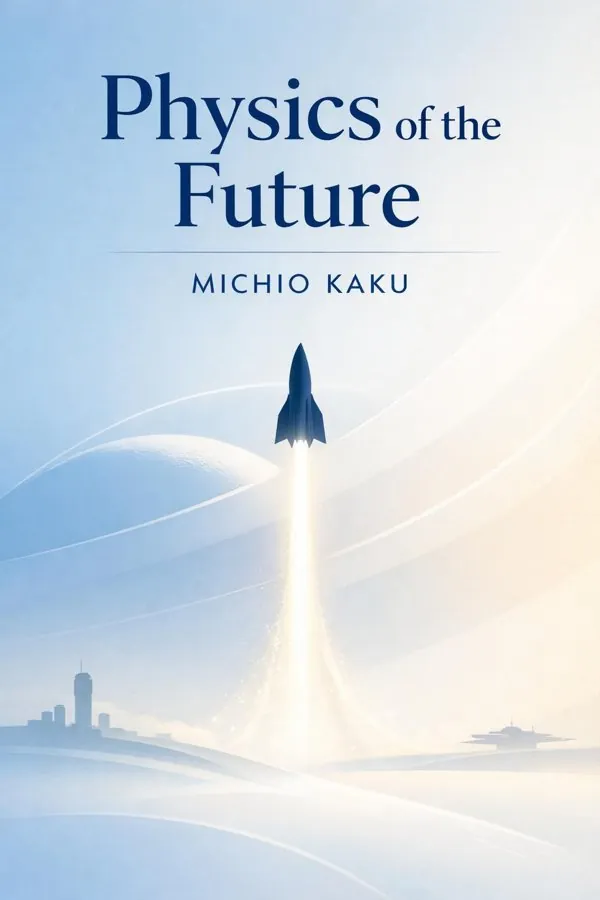
Physics of the Future: How Science Will Shape Human Destiny and Our Daily Lives by the Year 2100: Summary & Key Insights
by Michio Kaku
 10 min9 chaptersAudio available
What Is Physics of the Future: How Science Will Shape Human Destiny and Our Daily Lives by the Year 2100 About?
Physics of the Future: How Science Will Shape Human Destiny and Our Daily Lives by the Year 2100 by Michio Kaku is a popular_sci book spanning 9 pages. In this visionary work, theoretical physicist Michio Kaku explores how cutting-edge scientific advances will transform our lives by the year 2100. Drawing on interviews with over 300 of the world’s top scientists, Kaku forecasts developments in artificial intelligence, nanotechnology, biotechnology, and space travel, offering a compelling glimpse into the future of humanity.
This FizzRead summary covers all 9 key chapters of Physics of the Future: How Science Will Shape Human Destiny and Our Daily Lives by the Year 2100 in approximately 10 minutes, distilling the most important ideas, arguments, and takeaways from Michio Kaku's work. Also available as an audio summary and Key Quotes Podcast.
Physics of the Future: How Science Will Shape Human Destiny and Our Daily Lives by the Year 2100
In this visionary work, theoretical physicist Michio Kaku explores how cutting-edge scientific advances will transform our lives by the year 2100. Drawing on interviews with over 300 of the world’s top scientists, Kaku forecasts developments in artificial intelligence, nanotechnology, biotechnology, and space travel, offering a compelling glimpse into the future of humanity.
Who Should Read Physics of the Future: How Science Will Shape Human Destiny and Our Daily Lives by the Year 2100?
This book is perfect for anyone interested in popular_sci and looking to gain actionable insights in a short read. Whether you're a student, professional, or lifelong learner, the key ideas from Physics of the Future: How Science Will Shape Human Destiny and Our Daily Lives by the Year 2100 by Michio Kaku will help you think differently.
- ✓Readers who enjoy popular_sci and want practical takeaways
- ✓Professionals looking to apply new ideas to their work and life
- ✓Anyone who wants the core insights of Physics of the Future: How Science Will Shape Human Destiny and Our Daily Lives by the Year 2100 in just 10 minutes
Want the full summary?
Get instant access to this book summary and 100K+ more with Fizz Moment.
Get Free SummaryAvailable on App Store • Free to download
Key Chapters
Computers are the engines of modern civilization, and their evolution follows an exponential curve that shows no signs of slowing down. When I spoke with pioneers in the computing industry, one theme became overwhelmingly clear: miniaturization and integration are transforming machines into invisible extensions of the human environment. Moore’s Law, which predicts that computing power doubles approximately every two years, has held remarkably true, though even that may become obsolete when quantum computing arrives.
In the future, computation will escape the bounds of screens and keyboards. Imagine rooms with intelligent walls, cars that converse, and clothing that monitors your health—all possible because computers will shrink to microscopic levels and weave themselves into everyday objects. The concept of ubiquitous computing—where processors are seamlessly embedded everywhere—will make our environment alive with intelligence.
As we approach the limits of silicon technology, the next frontier is quantum computation, exploiting the strange properties of atoms themselves. Where classical computers operate in ones and zeros, quantum computers will manipulate qubits that can exist in multiple states simultaneously. That promises near-infinite parallel processing, unlocking solutions to problems—from protein folding to cryptography—that are impossible today.
By 2100, the line between human and machine cognition may blur. Artificial brains composed of neural networks modeled on biological ones will execute tasks once thought to require creativity and emotion. Yet even in this digital awakening, I remain convinced that taste, judgment, and empathy—the qualities that define our humanity—will continue to guide the technology we create.
Artificial intelligence will be to the 21st century what electricity was to the 19th—a force that permeates every aspect of life. When I interviewed leading roboticists, what struck me most was the steady climb from basic mechanical automation to systems capable of learning, adapting, and even feeling. AI today recognizes faces, translates languages, and diagnoses diseases. Tomorrow, it will reason, create, and understand the emotional subtleties behind human decision-making.
Robots will move beyond factories to homes, hospitals, and cities. They will care for the elderly, perform surgery with molecular precision, and explore environments lethal to humans. But with this comes a deep philosophical question: what does consciousness mean? Many researchers believe we are approaching the era of machines that simulate awareness. Whether that awareness is genuine or a sophisticated imitation remains a question for neuroscience and philosophy alike.
The social implications are immense. Employment will shift as automation assumes routine labor, forcing societies to reimagine economic value around creativity, empathy, and design. Ethical standards must evolve just as rapidly—defining the boundaries of machine autonomy and human agency. Humanity will need not fear AI but guide it wisely, ensuring that intelligence—artificial or biological—serves life rather than replaces it.
+ 7 more chapters — available in the FizzRead app
All Chapters in Physics of the Future: How Science Will Shape Human Destiny and Our Daily Lives by the Year 2100
About the Author
Michio Kaku is an American theoretical physicist, futurist, and popular science communicator. He is a professor of theoretical physics at the City College of New York and the CUNY Graduate Center, known for his work on string theory and for making complex scientific ideas accessible to the public through his books and media appearances.
Get This Summary in Your Preferred Format
Read or listen to the Physics of the Future: How Science Will Shape Human Destiny and Our Daily Lives by the Year 2100 summary by Michio Kaku anytime, anywhere. FizzRead offers multiple formats so you can learn on your terms — all free.
Available formats: App · Audio · PDF · EPUB — All included free with FizzRead
Download Physics of the Future: How Science Will Shape Human Destiny and Our Daily Lives by the Year 2100 PDF and EPUB Summary
Key Quotes from Physics of the Future: How Science Will Shape Human Destiny and Our Daily Lives by the Year 2100
“Computers are the engines of modern civilization, and their evolution follows an exponential curve that shows no signs of slowing down.”
“Artificial intelligence will be to the 21st century what electricity was to the 19th—a force that permeates every aspect of life.”
Frequently Asked Questions about Physics of the Future: How Science Will Shape Human Destiny and Our Daily Lives by the Year 2100
Physics of the Future: How Science Will Shape Human Destiny and Our Daily Lives by the Year 2100 by Michio Kaku is a popular_sci book that explores key ideas across 9 chapters. In this visionary work, theoretical physicist Michio Kaku explores how cutting-edge scientific advances will transform our lives by the year 2100. Drawing on interviews with over 300 of the world’s top scientists, Kaku forecasts developments in artificial intelligence, nanotechnology, biotechnology, and space travel, offering a compelling glimpse into the future of humanity.
More by Michio Kaku

Quantum Supremacy: How the Quantum Computer Revolution Will Change Everything
Michio Kaku
10 min
The Future of Humanity: Terraforming Mars, Interstellar Travel, Immortality, and Our Destiny Beyond Earth
Michio Kaku
10 min
The God Equation: The Quest for a Theory of Everything
Michio Kaku
10 min
Physics of the Impossible: A Scientific Exploration into the World of Phasers, Force Fields, Teleportation, and Time Travel
Michio Kaku
10 minYou Might Also Like

Structures: Or Why Things Don"t Fall Down
J.E. Gordon
10 min
The Road to Wigan Pier
George Orwell
10 min
Bonk: The Curious Coupling of Science and Sex
Mary Roach
10 min
First Bite: How We Learn to Eat
Bee Wilson
10 min
In Pursuit Of The Unknown: 17 Equations That Changed The World
Ian Stewart
10 min
Napoleon's Buttons: 17 Molecules That Changed History
Penny Le Couteur and Jay Burreson
10 minBrowse by Category
Ready to read Physics of the Future: How Science Will Shape Human Destiny and Our Daily Lives by the Year 2100?
Get the full summary and 100K+ more books with Fizz Moment.