
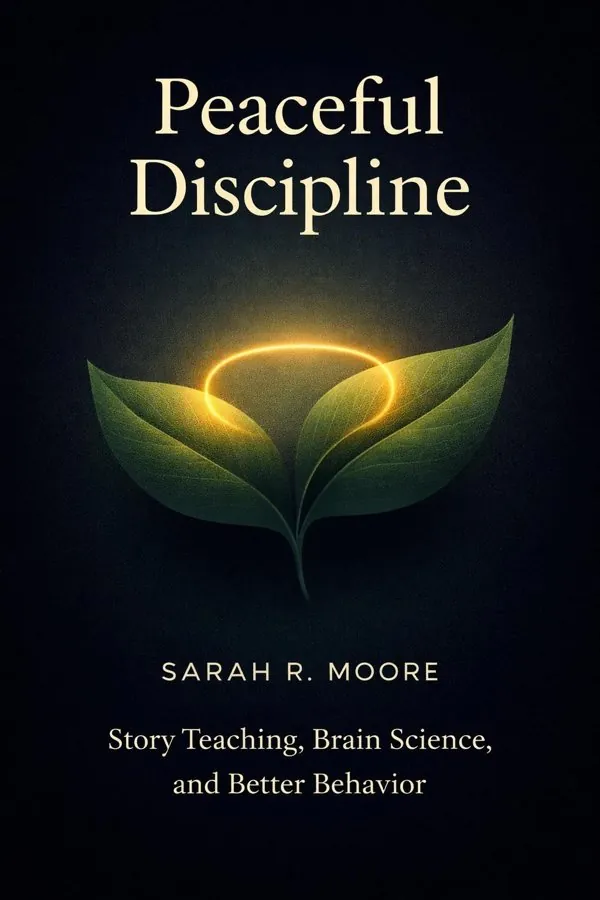
Peaceful Discipline: Story Teaching, Brain Science, and Better Behavior: Summary & Key Insights
 10 min9 chaptersAudio available
Key Takeaways from Peaceful Discipline: Story Teaching, Brain Science, and Better Behavior
What if the behavior that frustrates us most is not a sign of bad character, but a sign of an overwhelmed nervous system?
Children often resist lectures, but they lean toward stories.
Many adults assume children behave well only when they fear consequences or chase rewards.
A calm child is rarely created by a calmer command; more often, calm is borrowed from a regulated adult.
Kind parenting without boundaries becomes confusion, but boundaries without kindness become fear.
What Is Peaceful Discipline: Story Teaching, Brain Science, and Better Behavior About?
Peaceful Discipline: Story Teaching, Brain Science, and Better Behavior by Sarah R. Moore is a parenting book spanning 7 pages. Peaceful Discipline offers a refreshing alternative to the punishment-heavy models many parents inherited but no longer want to repeat. In this practical and compassionate guide, Sarah R. Moore combines brain science, emotional development, and the power of storytelling to show that children do not learn best through fear, shame, or control. They learn through connection, safety, and repeated experiences of being understood while still being guided. Rather than asking, “How do I stop this behavior?” Moore invites caregivers to ask, “What is this behavior communicating, and how can I teach more effectively?” That shift matters. It changes discipline from a reaction to a relationship-based process rooted in development, regulation, and trust. Moore explains how children’s brains mature over time, why dysregulation often looks like defiance, and how calm boundaries can coexist with deep empathy. She also offers concrete tools parents can use in daily life, from storytelling and co-regulation to repair after conflict. As a certified Master Trainer in conscious parenting and founder of Dandelion Seeds Positive Parenting, Moore brings both expertise and warmth, making this book especially valuable for parents seeking a gentler, science-informed path to better behavior.
This FizzRead summary covers all 9 key chapters of Peaceful Discipline: Story Teaching, Brain Science, and Better Behavior in approximately 10 minutes, distilling the most important ideas, arguments, and takeaways from Sarah R. Moore's work. Also available as an audio summary and Key Quotes Podcast.
Peaceful Discipline: Story Teaching, Brain Science, and Better Behavior
Peaceful Discipline offers a refreshing alternative to the punishment-heavy models many parents inherited but no longer want to repeat. In this practical and compassionate guide, Sarah R. Moore combines brain science, emotional development, and the power of storytelling to show that children do not learn best through fear, shame, or control. They learn through connection, safety, and repeated experiences of being understood while still being guided. Rather than asking, “How do I stop this behavior?” Moore invites caregivers to ask, “What is this behavior communicating, and how can I teach more effectively?”
That shift matters. It changes discipline from a reaction to a relationship-based process rooted in development, regulation, and trust. Moore explains how children’s brains mature over time, why dysregulation often looks like defiance, and how calm boundaries can coexist with deep empathy. She also offers concrete tools parents can use in daily life, from storytelling and co-regulation to repair after conflict. As a certified Master Trainer in conscious parenting and founder of Dandelion Seeds Positive Parenting, Moore brings both expertise and warmth, making this book especially valuable for parents seeking a gentler, science-informed path to better behavior.
Who Should Read Peaceful Discipline: Story Teaching, Brain Science, and Better Behavior?
This book is perfect for anyone interested in parenting and looking to gain actionable insights in a short read. Whether you're a student, professional, or lifelong learner, the key ideas from Peaceful Discipline: Story Teaching, Brain Science, and Better Behavior by Sarah R. Moore will help you think differently.
- ✓Readers who enjoy parenting and want practical takeaways
- ✓Professionals looking to apply new ideas to their work and life
- ✓Anyone who wants the core insights of Peaceful Discipline: Story Teaching, Brain Science, and Better Behavior in just 10 minutes
Want the full summary?
Get instant access to this book summary and 100K+ more with Fizz Moment.
Get Free SummaryAvailable on App Store • Free to download
Key Chapters
What if the behavior that frustrates us most is not a sign of bad character, but a sign of an overwhelmed nervous system? That is one of the most liberating ideas in Peaceful Discipline. Sarah R. Moore argues that discipline becomes far more effective when adults understand how children’s brains develop. Young children do not consistently access logic, impulse control, or emotional regulation the way adults expect them to. Their brains are still under construction, especially the areas responsible for planning, perspective-taking, and self-control.
This means that many behaviors adults label as disrespectful, manipulative, or defiant are better understood as developmental and stress-based. A child who hits, yells, lies, or refuses may be operating from a survival response rather than making a calculated moral choice. Moore encourages parents to shift from blame to curiosity. Instead of asking, “How do I make this stop?” she suggests asking, “What skills are missing, and what support does my child need right now?”
Brain science does not excuse harmful behavior, but it changes how we respond to it. If a child is dysregulated, lectures and punishments usually fail because the child’s brain is not in a state to absorb teaching. Calm presence, emotional safety, and simple guidance work better. For example, a child melting down at bedtime may need fewer words, more soothing, and a predictable routine rather than a threat. A preschooler who grabs toys may need coaching in turn-taking, not a shame-filled reprimand.
The practical implication is powerful: teach the skill beneath the behavior. Build routines, lower stress, use fewer words during meltdowns, and save problem-solving for calm moments. Actionable takeaway: when challenging behavior appears, pause and ask, “Is this disobedience, or is this dysregulation?” Let that answer shape your next response.
Children often resist lectures, but they lean toward stories. Moore highlights storytelling as one of the most effective and humane ways to teach behavior, emotional understanding, and problem-solving. Stories lower defensiveness. They allow children to explore hard topics indirectly, which makes lessons easier to receive. Instead of telling a child, “You were unkind,” a parent might tell a story about a little fox who grabbed a friend’s toy and later learned how to make things right.
This works because stories organize experience in a way the brain remembers. A narrative gives children images, emotions, consequences, and choices without making them feel cornered. Story teaching can be used proactively before a difficult event, such as starting school or visiting the doctor, or reflectively after a conflict, such as hitting a sibling or refusing to leave the park. By hearing a familiar challenge through another character, children can process feelings safely and begin to imagine better responses.
Moore’s approach also respects the child’s dignity. Direct correction can sometimes trigger shame, especially in sensitive children. Stories create emotional distance while still offering guidance. Parents can use made-up stories, family stories, books, puppets, drawings, or even quick car-ride narratives. The key is to keep them simple, relatable, and connected to a value or skill the child is learning.
For example, if a child struggles with transitions, a parent might tell a recurring story about a character whose body feels upset when play ends but who discovers a goodbye ritual that helps. Over time, the child begins to internalize both the emotional truth and the coping strategy.
Actionable takeaway: choose one recurring challenge this week and create a short, gentle story that names the feeling, models the struggle, and offers one realistic next step.
Many adults assume children behave well only when they fear consequences or chase rewards. Moore challenges that assumption directly. She argues that both punishment and reward systems can distract from the deeper goal of discipline: teaching internal skills and values. Punishment may stop behavior temporarily, but it often does so by triggering fear, resentment, or secrecy. Rewards may create compliance, but they can also reduce intrinsic motivation and teach children to ask, “What do I get?” instead of, “What is the right thing to do?”
Peaceful discipline does not mean permissiveness. It means replacing control-based strategies with connection, guidance, and natural teaching. When a child spills milk after roughhousing at the table, the response is not shame or a sticker chart. It is calm accountability: “Milk spilled. Let’s clean it up together. Food stays on the table.” When a child hits, the response is not necessarily a punitive timeout or loss of unrelated privileges. It may be immediate protection, regulation support, and later teaching around anger, boundaries, and repair.
Connection changes the emotional climate in which learning happens. A child who feels safe with an adult is more open to correction, more willing to tell the truth, and more able to recover from mistakes. Moore emphasizes that cooperation grows from relationship, not domination. This may look like getting at eye level, validating emotion without approving behavior, offering limited choices, and involving children in solutions.
Of course, this approach takes patience. Punishment often feels faster. But quick control is not the same as deep learning. The goal is not obedient children at any cost; it is emotionally healthy children who gradually develop empathy, responsibility, and self-regulation.
Actionable takeaway: the next time you feel tempted to punish or bribe, ask yourself, “What skill or value am I trying to teach?” Then choose a response that teaches it directly.
A calm child is rarely created by a calmer command; more often, calm is borrowed from a regulated adult. One of Moore’s core ideas is co-regulation, the process by which children learn emotional regulation through the steady presence of a trusted caregiver. Before children can consistently soothe themselves, they need repeated experiences of being soothed with someone else. This is not weakness. It is how the nervous system develops.
When a child is crying, yelling, kicking, or collapsing, adults often feel pressure to stop the behavior quickly. But if the child is flooded, reasoning will not land. Co-regulation means first helping the child return to a state where learning is possible. That may involve a soft tone, fewer words, physical closeness if welcomed, slow breathing, a drink of water, sensory support, or simply staying near without adding more threat.
Moore is careful to distinguish co-regulation from rescuing or permitting harmful behavior. Parents can be both compassionate and firm. “I won’t let you hit” can be said while gently blocking blows and staying emotionally anchored. A child can be deeply upset and still experience a boundary. In fact, boundaries feel safer when they are delivered without anger or humiliation.
Over time, children internalize what adults model. A child repeatedly met with presence instead of panic begins to develop language for feelings, awareness of body signals, and strategies for calming down. Daily routines can strengthen this process: naming emotions at neutral times, practicing breathing when calm, using comfort corners, and talking afterward about what helped.
Actionable takeaway: during the next meltdown, focus less on stopping the emotion and more on lending regulation. Slow your own breathing, reduce language, and become the calm you want your child to borrow.
Kind parenting without boundaries becomes confusion, but boundaries without kindness become fear. Moore’s approach sits firmly between those extremes. Peaceful discipline requires adults to hold limits clearly while preserving connection. Children need to know that all feelings are acceptable, but not all behaviors are. They also need to experience what happens after mistakes: not humiliation, but repair.
Clear boundaries reduce anxiety. When adults are inconsistent, children often test limits more because the edges of safety feel unclear. Moore encourages parents to be direct, calm, and predictable. Instead of issuing repeated warnings, say what will happen and follow through respectfully. “Markers stay on paper. If they go on the wall again, I’ll put them away.” If the wall gets marked, the adult acts without drama. This teaches cause and effect without turning the situation into a power struggle.
Cooperation grows when children feel included rather than controlled. That might mean offering choices within a boundary, using routines instead of repeated commands, or inviting problem-solving after conflicts. If mornings are chaotic, a parent and child can create a visual checklist together. If siblings argue over turns, families can practice scripts and use timers before tempers flare.
Repair is equally central. Everyone ruptures relationships, including parents. A child who hurts someone can be guided to notice impact and participate in making things right. A parent who yells can apologize without collapsing authority. Repair teaches accountability, empathy, and resilience. It shows children that relationships are not destroyed by mistakes when honesty and care are present.
Actionable takeaway: identify one recurring conflict and strengthen both the limit and the repair process. State the boundary clearly ahead of time, then teach one simple way to reconnect after mistakes.
The hardest part of discipline is often not the child’s behavior but the adult’s reaction to it. Moore emphasizes that peaceful discipline begins with parental self-awareness. Children’s behavior can trigger old wounds, unrealistic expectations, sensory overwhelm, or fears about how we are being judged. Without noticing those reactions, parents may respond from reactivity rather than intention.
Mindfulness, in this context, is not about becoming perfectly calm or spiritually detached. It is about learning to pause long enough to recognize what is happening inside us. Maybe a child’s whining activates an adult’s stress because they grew up in a home where needs were ignored. Maybe defiance feels intolerable because obedience was highly valued in their family of origin. When adults understand their own triggers, they gain more freedom to choose responses aligned with their values.
Moore encourages simple practices: noticing body tension, taking a breath before speaking, using grounding phrases, stepping away safely when needed, and reflecting after difficult moments instead of drowning in guilt. She also normalizes imperfection. Peaceful discipline is not performance. It is repairable, evolving practice.
This inner work matters because children absorb not only what parents say but how parents handle frustration, conflict, and emotion. A caregiver who can say, “I’m feeling overwhelmed, so I’m going to breathe before I answer,” is teaching emotional intelligence in real time. Families benefit when parents care for their own nervous systems through sleep, support, realistic expectations, and self-compassion.
Actionable takeaway: pick one pause practice for the week, such as one deep breath, a hand on your chest, or a phrase like “My child is having a hard time, not giving me a hard time,” and use it before correcting behavior.
A parenting philosophy only matters if it works in ordinary life: mornings, mealtimes, car rides, sibling fights, public meltdowns, and bedtime resistance. Moore grounds her ideas in everyday application, showing that peaceful discipline is not reserved for ideal moments. It is built through repeated, imperfect practice during the exact situations families face every day.
In daily life, prevention matters as much as response. Many behavior struggles improve when adults adjust the environment rather than intensify correction. Hungry children need snacks before errands. Tired children need simpler expectations. Busy mornings need visual routines instead of shouted reminders. Overstimulated children need transition warnings, not sudden demands. Peaceful discipline asks parents to think like teachers and guides: what structure will support success before problems begin?
It also emphasizes rhythm and predictability. Repeated routines reduce decision fatigue and power struggles. A child who knows the bedtime sequence or cleanup ritual is less likely to resist every step. When conflict does occur, parents can rely on familiar scripts: connect, set the limit, support regulation, and revisit later. This consistency creates security.
Moore also reminds readers to measure growth realistically. Better behavior is rarely a straight line. A child may improve in one setting and struggle in another. Progress may look like shorter meltdowns, quicker recovery, more honest communication, or one extra second before impulsive action. These small shifts matter because they signal developing skills.
Actionable takeaway: choose one daily flashpoint and redesign it with peaceful discipline in mind. Simplify the environment, build a predictable routine, and decide in advance how you will connect and guide when resistance appears.
One of the most transformative mindset shifts in the book is the idea that behavior communicates unmet needs, lagging skills, or internal stress. When adults interpret every difficult behavior as disrespect or badness, they respond with moral outrage. When they see behavior as communication, they respond with investigation and teaching.
This does not mean every need should be granted or every action accepted. It means the adult looks beneath the surface. A child refusing homework may be anxious, perfectionistic, tired, or confused. A child clowning at dinner may be seeking connection after a long day. A child who suddenly becomes aggressive may be overstimulated, jealous, hungry, or dysregulated by a recent change. The visible behavior is real, but it is not the whole story.
Moore’s framework helps parents separate the child from the behavior. “You’re a good kid having a hard moment” is very different from “You’re being bad.” That distinction preserves dignity and supports accountability. Once the message beneath the behavior becomes clearer, adults can intervene more effectively. Maybe the solution is skill-building, maybe it is rest, maybe it is structure, maybe it is one-on-one connection, and often it is some combination.
This perspective also reduces unnecessary power struggles. Instead of trying to win, parents can try to understand. Curiosity-based questions asked later in a calm moment, careful observation of patterns, and attention to basic needs can reveal surprising causes. When children feel seen accurately, they are more likely to cooperate and less likely to escalate.
Actionable takeaway: the next time a behavior repeats, write down what happened before, during, and after. Look for patterns in fatigue, hunger, transitions, sensory input, or connection needs before deciding how to address it.
It is easy to mistake immediate obedience for successful parenting, but Moore invites readers to think in decades rather than moments. The real aim of discipline is not simply getting children to comply today. It is helping them become adults who can regulate themselves, think ethically, communicate honestly, and stay connected in relationships. Short-term control can undermine those long-term goals when it relies on fear, shame, or domination.
Children raised under harsh discipline may appear compliant in front of authority while becoming secretive, anxious, or disconnected underneath. By contrast, peaceful discipline invests in inner development. It nurtures self-awareness, empathy, problem-solving, and trust. These qualities take longer to build, and they rarely look as neat as forced obedience. A child allowed to express emotion respectfully may seem more difficult in the moment than one who has learned to suppress it. But in the long run, emotional honesty paired with guidance is healthier than silent fear.
Moore encourages parents to evaluate strategies by asking what they teach over time. Does this consequence build responsibility or resentment? Does this interaction increase trust or distance? Does this correction support moral understanding or merely submission? These questions keep discipline aligned with the kind of relationship and character parents hope to cultivate.
This long-view approach is especially important in adolescence and beyond. Children who have experienced respectful guidance are often more likely to come to parents with hard truths, accept influence, and recover from mistakes without collapsing into shame. They have learned that discipline is about growth, not humiliation.
Actionable takeaway: in your next conflict, ask one future-focused question: “What response today best supports the kind of person and relationship I hope to build five or ten years from now?”
All Chapters in Peaceful Discipline: Story Teaching, Brain Science, and Better Behavior
About the Author
Sarah R. Moore is a certified Master Trainer in conscious parenting, an educator, and the founder of Dandelion Seeds Positive Parenting. Through her teaching, writing, and speaking, she helps parents and caregivers move away from fear-based discipline and toward approaches rooted in connection, emotional safety, and child development. Moore’s work draws on neuroscience, attachment, and practical family dynamics, making complex ideas accessible for everyday parenting. She is especially known for her emphasis on gentle discipline, co-regulation, empathy, and respectful boundaries. In Peaceful Discipline, she brings together her professional expertise and compassionate voice to show how children can be guided effectively without shame or punishment. Her approach appeals to families seeking a more intentional, relationship-centered way to raise emotionally healthy, cooperative children.
Get This Summary in Your Preferred Format
Read or listen to the Peaceful Discipline: Story Teaching, Brain Science, and Better Behavior summary by Sarah R. Moore anytime, anywhere. FizzRead offers multiple formats so you can learn on your terms — all free.
Available formats: App · Audio · PDF · EPUB — All included free with FizzRead
Download Peaceful Discipline: Story Teaching, Brain Science, and Better Behavior PDF and EPUB Summary
Key Quotes from Peaceful Discipline: Story Teaching, Brain Science, and Better Behavior
“What if the behavior that frustrates us most is not a sign of bad character, but a sign of an overwhelmed nervous system?”
“Children often resist lectures, but they lean toward stories.”
“Many adults assume children behave well only when they fear consequences or chase rewards.”
“A calm child is rarely created by a calmer command; more often, calm is borrowed from a regulated adult.”
“Kind parenting without boundaries becomes confusion, but boundaries without kindness become fear.”
Frequently Asked Questions about Peaceful Discipline: Story Teaching, Brain Science, and Better Behavior
Peaceful Discipline: Story Teaching, Brain Science, and Better Behavior by Sarah R. Moore is a parenting book that explores key ideas across 9 chapters. Peaceful Discipline offers a refreshing alternative to the punishment-heavy models many parents inherited but no longer want to repeat. In this practical and compassionate guide, Sarah R. Moore combines brain science, emotional development, and the power of storytelling to show that children do not learn best through fear, shame, or control. They learn through connection, safety, and repeated experiences of being understood while still being guided. Rather than asking, “How do I stop this behavior?” Moore invites caregivers to ask, “What is this behavior communicating, and how can I teach more effectively?” That shift matters. It changes discipline from a reaction to a relationship-based process rooted in development, regulation, and trust. Moore explains how children’s brains mature over time, why dysregulation often looks like defiance, and how calm boundaries can coexist with deep empathy. She also offers concrete tools parents can use in daily life, from storytelling and co-regulation to repair after conflict. As a certified Master Trainer in conscious parenting and founder of Dandelion Seeds Positive Parenting, Moore brings both expertise and warmth, making this book especially valuable for parents seeking a gentler, science-informed path to better behavior.
You Might Also Like
Never Enough
Jennifer Breheny Wallace
10 min
Bluey: Sleepytime
Joe Brumm
10 min
In My Heart: A Book of Feelings
Jo Witek
10 min
Love From The Crayons
Drew Daywalt, Oliver Jeffers
10 min
Pete The Cat: Big Easter Adventure
James Dean, Kimberly Dean
10 min
Smart Money Smart Kids: Raising the Next Generation to Win with Money
Dave Ramsey, Rachel Cruze
10 minBrowse by Category
Ready to read Peaceful Discipline: Story Teaching, Brain Science, and Better Behavior?
Get the full summary and 100K+ more books with Fizz Moment.