
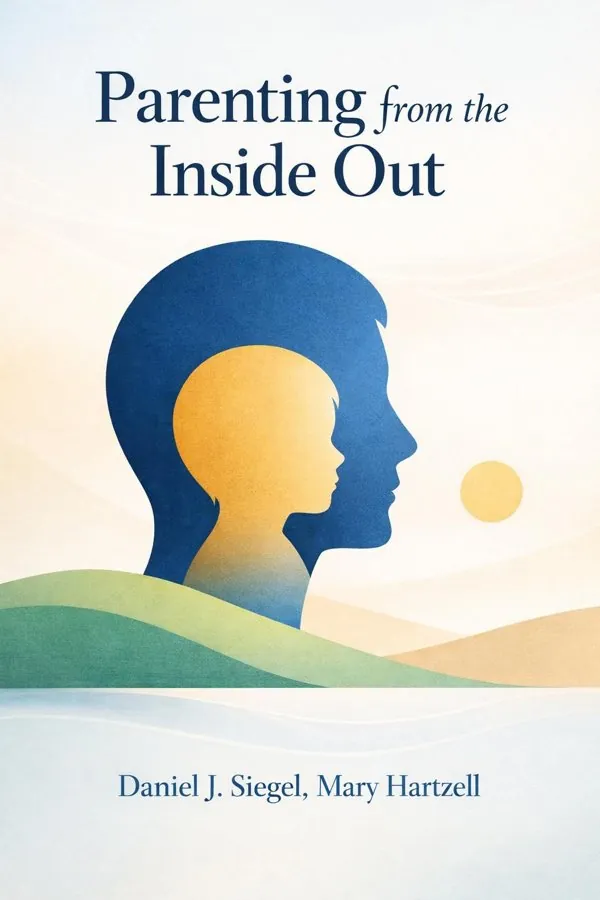
Parenting from the Inside Out: How a Deeper Self-Understanding Can Help You Raise Children Who Thrive: Summary & Key Insights
by Daniel J. Siegel, Mary Hartzell
 10 min10 chaptersAudio available
What Is Parenting from the Inside Out: How a Deeper Self-Understanding Can Help You Raise Children Who Thrive About?
Parenting from the Inside Out: How a Deeper Self-Understanding Can Help You Raise Children Who Thrive by Daniel J. Siegel, Mary Hartzell is a parenting book spanning 10 pages. In this groundbreaking book, Daniel J. Siegel, M.D., and early childhood expert Mary Hartzell, M.Ed., explore how understanding our own childhood experiences can help us become more effective and compassionate parents. Drawing on cutting-edge research in neuroscience and attachment theory, the authors show how self-awareness and emotional insight can transform the parent-child relationship, fostering resilience, empathy, and secure attachment in children.
This FizzRead summary covers all 10 key chapters of Parenting from the Inside Out: How a Deeper Self-Understanding Can Help You Raise Children Who Thrive in approximately 10 minutes, distilling the most important ideas, arguments, and takeaways from Daniel J. Siegel, Mary Hartzell's work. Also available as an audio summary and Key Quotes Podcast.
Parenting from the Inside Out: How a Deeper Self-Understanding Can Help You Raise Children Who Thrive
In this groundbreaking book, Daniel J. Siegel, M.D., and early childhood expert Mary Hartzell, M.Ed., explore how understanding our own childhood experiences can help us become more effective and compassionate parents. Drawing on cutting-edge research in neuroscience and attachment theory, the authors show how self-awareness and emotional insight can transform the parent-child relationship, fostering resilience, empathy, and secure attachment in children.
Who Should Read Parenting from the Inside Out: How a Deeper Self-Understanding Can Help You Raise Children Who Thrive?
This book is perfect for anyone interested in parenting and looking to gain actionable insights in a short read. Whether you're a student, professional, or lifelong learner, the key ideas from Parenting from the Inside Out: How a Deeper Self-Understanding Can Help You Raise Children Who Thrive by Daniel J. Siegel, Mary Hartzell will help you think differently.
- ✓Readers who enjoy parenting and want practical takeaways
- ✓Professionals looking to apply new ideas to their work and life
- ✓Anyone who wants the core insights of Parenting from the Inside Out: How a Deeper Self-Understanding Can Help You Raise Children Who Thrive in just 10 minutes
Want the full summary?
Get instant access to this book summary and 100K+ more with Fizz Moment.
Get Free SummaryAvailable on App Store • Free to download
Key Chapters
To understand how we can raise children who thrive, we must first look at what science tells us about the mind. The brain is not a static organ; it is a living, growing network of relationships. Every encounter, every emotion, and every moment of connection shapes its architecture. In early life especially, the experiences children have with caregivers influence how neural circuits form—how emotions are regulated, how stress is managed, and how empathy develops.
In neuroscience, we’ve learned that integration is key. The brain consists of various regions responsible for logic, emotion, memory, and perception. When these regions function harmoniously, the result is mental health and well-being. When they operate in disconnection, emotional chaos or rigidity can arise. Parenting plays a vital role in guiding this process of integration in the child, because our interactions—our tone, presence, and responsiveness—literally wire their brains for connection.
Attachment theory complements this biological perspective by showing how children build internal 'working models' of relationships. A child who experiences consistent warmth and safety learns that relationships are trustworthy and that emotions can be soothed. Conversely, unpredictable or neglectful experiences can lead to patterns of avoidance, anxiety, or disorganization. These models don’t just stay in childhood; they shape how we love, communicate, and parent as adults.
As you begin to grasp this science, a new awareness emerges: the past does not have to define the future. The mind is plastic, meaning it can change and reorganize itself at any stage. By understanding the mind’s structure—and your role in shaping it—you unlock the possibility of healing old patterns and fostering emotional integration in yourself and your child.
Our memories are not merely stories we recall—they are emotional maps that guide our present reactions. There are two primary forms of memory: explicit and implicit. Explicit memories are conscious; we know we are remembering. Implicit memories, by contrast, operate beneath awareness. They are the emotional imprints left by experience, shaping how we feel and behave without our realizing it.
In parenting, implicit memories are often triggered in moments of stress or conflict. You might find yourself snapping in anger or withdrawing in fear, and wonder afterward, 'Where did that come from?' These are echoes of your own early experiences—times when you felt unsafe, unseen, or disconnected. They surface automatically, guiding behavior unless brought into awareness.
The process of reflective parenting begins by recognizing these triggers and gently exploring their origins. If your child’s tantrum leaves you feeling powerless, ask yourself: what past experiences might be resonating in this moment? When we make implicit memories explicit—when we bring them to consciousness—we can integrate them into our life story. This integration allows us to respond to our children from a place of choice rather than compulsion.
Memory, then, is not simply about recall; it’s about meaning. Making sense of the past gives form and coherence to the mind. In understanding our own emotional history, we create new possibilities—not only for ourselves but also for our children, who learn from our modeled self-awareness and emotional regulation.
+ 8 more chapters — available in the FizzRead app
All Chapters in Parenting from the Inside Out: How a Deeper Self-Understanding Can Help You Raise Children Who Thrive
About the Authors
Daniel J. Siegel, M.D., is a clinical professor of psychiatry at the UCLA School of Medicine and executive director of the Mindsight Institute. He is known for his pioneering work in interpersonal neurobiology. Mary Hartzell, M.Ed., is a child development specialist and director of the First Presbyterian Nursery School in Santa Monica, California.
Get This Summary in Your Preferred Format
Read or listen to the Parenting from the Inside Out: How a Deeper Self-Understanding Can Help You Raise Children Who Thrive summary by Daniel J. Siegel, Mary Hartzell anytime, anywhere. FizzRead offers multiple formats so you can learn on your terms — all free.
Available formats: App · Audio · PDF · EPUB — All included free with FizzRead
Download Parenting from the Inside Out: How a Deeper Self-Understanding Can Help You Raise Children Who Thrive PDF and EPUB Summary
Key Quotes from Parenting from the Inside Out: How a Deeper Self-Understanding Can Help You Raise Children Who Thrive
“To understand how we can raise children who thrive, we must first look at what science tells us about the mind.”
“Our memories are not merely stories we recall—they are emotional maps that guide our present reactions.”
Frequently Asked Questions about Parenting from the Inside Out: How a Deeper Self-Understanding Can Help You Raise Children Who Thrive
Parenting from the Inside Out: How a Deeper Self-Understanding Can Help You Raise Children Who Thrive by Daniel J. Siegel, Mary Hartzell is a parenting book that explores key ideas across 10 chapters. In this groundbreaking book, Daniel J. Siegel, M.D., and early childhood expert Mary Hartzell, M.Ed., explore how understanding our own childhood experiences can help us become more effective and compassionate parents. Drawing on cutting-edge research in neuroscience and attachment theory, the authors show how self-awareness and emotional insight can transform the parent-child relationship, fostering resilience, empathy, and secure attachment in children.
You Might Also Like
Never Enough
Jennifer Breheny Wallace
10 min
Bluey: Sleepytime
Joe Brumm
10 min
In My Heart: A Book of Feelings
Jo Witek
10 min
Love From The Crayons
Drew Daywalt, Oliver Jeffers
10 min
Pete The Cat: Big Easter Adventure
James Dean, Kimberly Dean
10 min
Smart Money Smart Kids: Raising the Next Generation to Win with Money
Dave Ramsey, Rachel Cruze
10 minBrowse by Category
Ready to read Parenting from the Inside Out: How a Deeper Self-Understanding Can Help You Raise Children Who Thrive?
Get the full summary and 100K+ more books with Fizz Moment.