
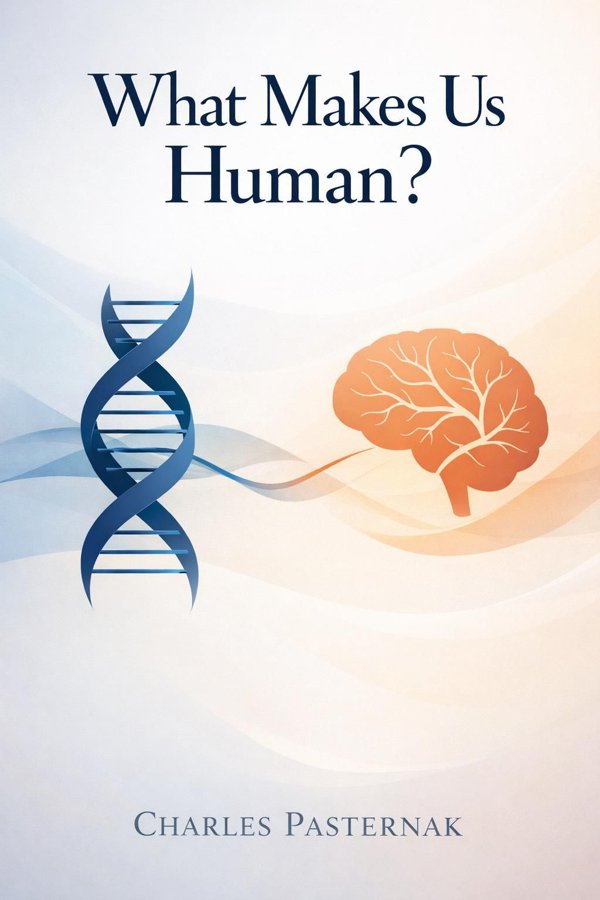
What Makes Us Human?: Summary & Key Insights
 10 min9 chaptersAudio available
Key Takeaways from What Makes Us Human?
One of the book’s most powerful insights is that being human is not as self-evident as it first appears.
A striking theme in the book is that biology provides the foundation for human life without fully determining what any human being becomes.
If there is one capacity that dramatically expands human possibility, it is language.
Human life is not defined only by what we do, but by how we experience what we do.
A profound argument running through the book is that human beings evolve not only biologically but culturally.
What Is What Makes Us Human? About?
What Makes Us Human? by Charles Pasternak is a life_science book. What does it really mean to be human? Is our humanity rooted in biology, in consciousness, in language, in moral choice, or in the stories we tell about ourselves? In What Makes Us Human?, Charles Pasternak takes on these questions with the curiosity of a scientist and the reach of a humanist. Rather than offering a simplistic answer, he explores the many layers that shape human identity, from genes and brains to culture, memory, creativity, and ethical responsibility. The result is a rich and accessible investigation into the traits that make our species distinctive while also revealing how deeply connected we are to the rest of life. Pasternak writes with authority because he brings scientific training into conversation with broader philosophical reflection. He does not treat humanity as a fixed essence but as an evolving combination of capacities and relationships. That makes this book especially valuable today, when advances in genetics, neuroscience, and artificial intelligence are forcing us to rethink old assumptions about human uniqueness. For readers interested in life science, psychology, philosophy, or simply the enduring puzzle of who we are, this book offers a thoughtful guide to one of the biggest questions we can ask.
This FizzRead summary covers all 9 key chapters of What Makes Us Human? in approximately 10 minutes, distilling the most important ideas, arguments, and takeaways from Charles Pasternak's work. Also available as an audio summary and Key Quotes Podcast.
What Makes Us Human?
What does it really mean to be human? Is our humanity rooted in biology, in consciousness, in language, in moral choice, or in the stories we tell about ourselves? In What Makes Us Human?, Charles Pasternak takes on these questions with the curiosity of a scientist and the reach of a humanist. Rather than offering a simplistic answer, he explores the many layers that shape human identity, from genes and brains to culture, memory, creativity, and ethical responsibility. The result is a rich and accessible investigation into the traits that make our species distinctive while also revealing how deeply connected we are to the rest of life.
Pasternak writes with authority because he brings scientific training into conversation with broader philosophical reflection. He does not treat humanity as a fixed essence but as an evolving combination of capacities and relationships. That makes this book especially valuable today, when advances in genetics, neuroscience, and artificial intelligence are forcing us to rethink old assumptions about human uniqueness. For readers interested in life science, psychology, philosophy, or simply the enduring puzzle of who we are, this book offers a thoughtful guide to one of the biggest questions we can ask.
Who Should Read What Makes Us Human??
This book is perfect for anyone interested in life_science and looking to gain actionable insights in a short read. Whether you're a student, professional, or lifelong learner, the key ideas from What Makes Us Human? by Charles Pasternak will help you think differently.
- ✓Readers who enjoy life_science and want practical takeaways
- ✓Professionals looking to apply new ideas to their work and life
- ✓Anyone who wants the core insights of What Makes Us Human? in just 10 minutes
Want the full summary?
Get instant access to this book summary and 100K+ more with Fizz Moment.
Get Free SummaryAvailable on App Store • Free to download
Key Chapters
One of the book’s most powerful insights is that being human is not as self-evident as it first appears. We often assume we know what humans are because we are human, yet the closer we look, the harder it becomes to define a single feature that separates us completely from other animals. Charles Pasternak uses this tension to frame the entire discussion: humanity is not one trait but a cluster of biological, mental, social, and moral capacities that overlap and reinforce one another.
This matters because many traits once believed to be uniquely human have turned out to exist in some form elsewhere in nature. Animals communicate, cooperate, grieve, solve problems, and in some cases even use tools or show signs of self-awareness. If no single ability provides a clean dividing line, then the human story must be understood as a matter of degree, complexity, and combination. Pasternak encourages readers to think of humanity less as a badge and more as a layered process shaped by evolution and culture.
In practical terms, this perspective changes how we discuss intelligence, personhood, and ethics. It can affect how we treat animals, how we define developmental differences among humans, and how we think about technologies that imitate thought or language. Instead of asking, “What one thing makes us human?” we can ask, “What collection of capacities allows human life to take the form it does?”
Actionable takeaway: When discussing human uniqueness, avoid relying on one absolute definition. Try listing the biological, cognitive, emotional, and social capacities that together create human life, and notice how this broader view deepens understanding.
A striking theme in the book is that biology provides the foundation for human life without fully determining what any human being becomes. Our genes influence our bodies, brains, vulnerabilities, and potentials, yet they do not operate like a rigid script. Pasternak shows that the human organism is better understood as a dynamic system in which heredity interacts continuously with environment, development, chance, and experience.
This idea is crucial for avoiding both genetic determinism and naive optimism. On one side, it is misleading to imagine that every human trait can be read directly from DNA. On the other, it is equally wrong to pretend biology does not matter. Human capacities for language, symbolic thought, emotional bonding, and learning depend on evolved structures. But whether those capacities flourish depends heavily on nutrition, education, social care, stress, and culture.
You can see this in ordinary life. A child may be born with strong cognitive potential, but without safety, stimulation, and encouragement that potential may remain underdeveloped. Similarly, inherited tendencies toward anxiety, aggression, or illness do not guarantee a fixed outcome; context matters enormously. This balanced view of biology helps us think more wisely about parenting, medicine, schooling, and social policy.
Pasternak’s point is not that genes are unimportant, but that human beings are open-ended creatures. Biology gives us a framework; life fills it in. Recognizing that complexity also encourages humility. We are neither fully self-made nor fully predetermined.
Actionable takeaway: In your own life, replace all-or-nothing thinking about talent and personality with a gene-plus-environment mindset. Ask not only what predispositions exist, but also what conditions can help the best possibilities emerge.
If there is one capacity that dramatically expands human possibility, it is language. Pasternak treats language not merely as a communication tool but as a system that transforms thought itself. Through language, humans do more than signal immediate needs. We name abstractions, describe imagined futures, preserve the past, coordinate large groups, and build shared worlds of meaning.
Language allows human beings to move beyond the here and now. We can discuss justice, infinity, memory, law, beauty, and death. We can make plans that stretch across decades and construct institutions that outlive individuals. Even more importantly, language makes cultural inheritance possible. Each generation does not need to start from zero; knowledge, rituals, stories, and values can be transmitted, questioned, and revised.
This idea has practical significance in education and everyday relationships. The words available to us shape the distinctions we can make. A person who can articulate emotions clearly is often better able to regulate them. A society with richer public language for ethics, science, and citizenship is better equipped to solve collective problems. Likewise, misunderstanding, manipulation, or the narrowing of language can weaken human connection.
Pasternak’s broader implication is that language is both a biological achievement and a cultural engine. It emerges from evolved human capacities, but once present, it accelerates human development in ways biology alone could never achieve.
Actionable takeaway: Strengthen your humanity by strengthening your language. Read widely, expand your vocabulary for ideas and emotions, and practice expressing complex thoughts clearly. Better language leads to better thinking, better relationships, and better judgment.
Human life is not defined only by what we do, but by how we experience what we do. Pasternak explores consciousness as one of the most mysterious and central features of being human. Consciousness includes awareness of the world, awareness of the self, and the ability to reflect on thoughts, emotions, and choices. It turns behavior into experience and existence into something inwardly lived.
What makes this especially important is that human consciousness appears unusually layered. We do not simply react; we often know that we are reacting. We can observe our own fear, question our own motives, revisit old memories, imagine future selves, and worry about meanings that have no immediate survival value. This reflexive awareness gives rise to art, religion, guilt, aspiration, and existential anxiety.
In practical life, consciousness is deeply linked to attention. Much of modern living fragments awareness through distraction, speed, and overload. Pasternak’s discussion indirectly points to a modern challenge: if reflective awareness is central to humanity, then a life lived in constant distraction may diminish one of our most distinctive capacities. Practices such as journaling, meditation, therapy, serious conversation, and quiet reading all strengthen the ability to witness and organize inner life.
The book does not reduce consciousness to a simple mechanism, nor does it treat it as detached from biology. Instead, it presents consciousness as a phenomenon grounded in the living brain yet still full of unanswered questions. That mystery is part of what makes the human condition so compelling.
Actionable takeaway: Protect time for reflection each day. Even ten minutes of undistracted thinking, writing, or silence can strengthen self-awareness and help you live more deliberately rather than reactively.
A profound argument running through the book is that human beings evolve not only biologically but culturally. Unlike other organisms, we inherit far more than genes. We inherit languages, customs, technologies, institutions, stories, skills, and moral expectations. This accumulated cultural inheritance allows humans to adapt at a speed that biology alone cannot match.
Pasternak shows that culture is not an optional extra added to a finished human nature. It is part of how human nature operates. Our biological capacities for learning, imitation, cooperation, and symbolic communication make culture possible, and culture in turn reshapes behavior, identity, and opportunity. A human infant is born unfinished in a way that makes long learning possible. That extended developmental period is not a flaw; it is one of the sources of human flexibility.
You can see this clearly in daily life. A child raised in one society learns one set of manners, beliefs, and social roles; in another setting, the same biological organism could become a very different kind of adult. Tools, literacy, law, and scientific method all change what humans can do and even how they think. In that sense, culture acts like a second inheritance system.
This insight has major implications for social responsibility. If culture shapes human possibilities, then schools, families, media, and political institutions matter enormously. They are not just accessories around human nature; they help form it.
Actionable takeaway: Treat your cultural environment as a developmental force. Be intentional about the books, communities, media, and traditions you engage with, because they are actively shaping how you think, feel, and act.
Humans do not live by survival alone. Pasternak highlights creativity as a defining feature of our species, not because other animals never innovate, but because humans turn imagination into enduring symbolic worlds. We make music, myths, mathematics, paintings, rituals, architecture, and scientific theories. These creations go far beyond immediate utility. They help us search for meaning, identity, beauty, and order.
Creativity matters because it reveals the unusual range of human cognition. We can combine memory with imagination, skill with symbolism, and private feeling with public form. A song can express grief, a novel can build empathy, and a scientific model can uncover hidden structure in nature. These are not isolated achievements of a gifted few; they grow from capacities widespread across the species, even if displayed unevenly.
In practical life, creativity is not limited to art galleries or research labs. It appears in problem-solving at work, in new ways of teaching a child, in adapting to illness, in designing communities, and in finding language for difficult experiences. Creativity helps humans cope with uncertainty by generating alternatives. It is one reason our species can transform environments and social systems so dramatically.
Pasternak’s view suggests that creativity is central to human flourishing because it turns raw existence into interpreted existence. We do not simply inhabit the world; we remake it mentally and materially.
Actionable takeaway: Make room for regular creative practice, however modest. Write, sketch, build, compose, cook, or brainstorm. Creative habits strengthen flexibility, deepen self-understanding, and remind you that being human includes making meaning, not just managing tasks.
To be human is to know, at least partially, that one exists and will one day cease to exist. Pasternak treats self-awareness as both a gift and a burden. It gives us identity, memory, ambition, responsibility, and the ability to shape a life story. But it also exposes us to anxiety, regret, shame, and fear of death. Human beings are unusual not simply because they live, but because they interpret their lives.
This self-interpretive capacity is visible in how people ask, “Who am I?” and “What should I do with my life?” Other animals may remember, anticipate, and react, but humans construct biographies. We organize experience into narrative. We compare who we are with who we hoped to be. That gap between actual self and imagined self can motivate growth, but it can also produce suffering.
The practical implications are significant. Much of mental and emotional life involves managing self-awareness wisely. Excessive self-focus can become rumination, while too little reflection can lead to drift and avoidance. Healthy development often involves learning how to build a coherent identity without becoming trapped by perfectionism or social comparison. Therapy, philosophy, spiritual practice, and honest friendship can all help individuals carry the burden of selfhood more skillfully.
Pasternak’s insight is that self-awareness is inseparable from freedom. Because we can examine ourselves, we can revise ourselves. But that freedom is never effortless.
Actionable takeaway: Periodically review the story you are telling about your life. Ask whether it is accurate, useful, and compassionate. Revising your self-narrative can open space for wiser choices and greater resilience.
A final major lesson of the book is that recognizing what is distinctive about humans should not lead to arrogance. Pasternak resists both extremes: the claim that humans are just like every other animal in every respect, and the claim that humans stand outside nature altogether. His more balanced view is that humans are indeed unusual, but our uniqueness is continuous with the evolutionary processes that produced all life.
This perspective has ethical and intellectual importance. It encourages wonder without domination. If human capacities such as language, morality, symbolic thought, and culture are remarkable, then they bring responsibility as well as privilege. Our intelligence has given us extraordinary power over ecosystems, other species, and even our own biology. The relevant question is not simply what we can do, but what we ought to do.
In everyday terms, humility means acknowledging our dependence on the natural world, our kinship with other organisms, and the limits of our knowledge. It also means resisting the temptation to equate intelligence with worth. A society that prizes only productivity, rationality, or technological mastery may lose sight of care, vulnerability, and interdependence, all of which are also deeply human.
Pasternak’s broader contribution is to reframe human exceptionalism. We are exceptional not because we are exempt from nature, but because nature in us has become capable of reflection, responsibility, and self-transformation.
Actionable takeaway: Pair admiration for human achievements with habits of humility. Learn about animal behavior, ecological systems, and the limits of scientific certainty, and let that knowledge guide more responsible choices toward other beings and the planet.
All Chapters in What Makes Us Human?
About the Author
Charles Pasternak is a scientist and writer whose work bridges biology and the broader questions of human identity, meaning, and ethics. Known for making complex ideas accessible to general readers, he writes with a perspective shaped by scientific training as well as an interest in philosophy and culture. His approach often highlights the way discoveries in genetics, evolution, and neuroscience influence how we understand ourselves. In What Makes Us Human?, Pasternak brings these strengths together in a thoughtful examination of the traits that define human life. He is particularly effective at showing that science does not eliminate wonder or moral reflection, but can deepen both. His work appeals to readers who want intellectually serious discussions of life science without losing sight of the human questions behind the facts.
Get This Summary in Your Preferred Format
Read or listen to the What Makes Us Human? summary by Charles Pasternak anytime, anywhere. FizzRead offers multiple formats so you can learn on your terms — all free.
Available formats: App · Audio · PDF · EPUB — All included free with FizzRead
Download What Makes Us Human? PDF and EPUB Summary
Key Quotes from What Makes Us Human?
“One of the book’s most powerful insights is that being human is not as self-evident as it first appears.”
“A striking theme in the book is that biology provides the foundation for human life without fully determining what any human being becomes.”
“If there is one capacity that dramatically expands human possibility, it is language.”
“Human life is not defined only by what we do, but by how we experience what we do.”
“A profound argument running through the book is that human beings evolve not only biologically but culturally.”
Frequently Asked Questions about What Makes Us Human?
What Makes Us Human? by Charles Pasternak is a life_science book that explores key ideas across 9 chapters. What does it really mean to be human? Is our humanity rooted in biology, in consciousness, in language, in moral choice, or in the stories we tell about ourselves? In What Makes Us Human?, Charles Pasternak takes on these questions with the curiosity of a scientist and the reach of a humanist. Rather than offering a simplistic answer, he explores the many layers that shape human identity, from genes and brains to culture, memory, creativity, and ethical responsibility. The result is a rich and accessible investigation into the traits that make our species distinctive while also revealing how deeply connected we are to the rest of life. Pasternak writes with authority because he brings scientific training into conversation with broader philosophical reflection. He does not treat humanity as a fixed essence but as an evolving combination of capacities and relationships. That makes this book especially valuable today, when advances in genetics, neuroscience, and artificial intelligence are forcing us to rethink old assumptions about human uniqueness. For readers interested in life science, psychology, philosophy, or simply the enduring puzzle of who we are, this book offers a thoughtful guide to one of the biggest questions we can ask.
You Might Also Like
The Selfish Gene
Richard Dawkins
10 min
Awakenings
Oliver Sacks
10 min
Parasite Rex: Inside the Bizarre World of Nature's Most Dangerous Creatures
Carl Zimmer
10 min
The Atlas of Life on Earth
Various
10 min
The Book of Humans: The Story of How We Became Us
Adam Rutherford
10 min
The Horse
Wendy Williams
10 minBrowse by Category
Ready to read What Makes Us Human??
Get the full summary and 100K+ more books with Fizz Moment.