
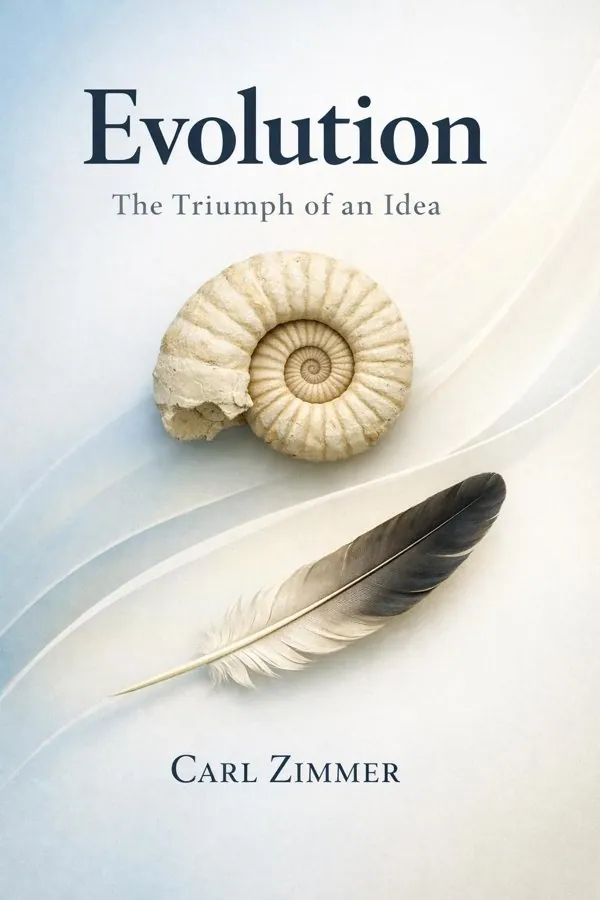
Evolution: The Triumph of an Idea: Summary & Key Insights
by Carl Zimmer
 10 min5 chaptersAudio available
What Is Evolution: The Triumph of an Idea About?
Evolution: The Triumph of an Idea by Carl Zimmer is a popular_sci book spanning 5 pages. This companion volume to the PBS documentary series 'Evolution' explores the history and impact of evolutionary theory, tracing its development from Charles Darwin’s groundbreaking work to modern scientific discoveries. Zimmer presents the triumph of evolutionary thought as one of humanity’s greatest intellectual achievements, weaving together biology, genetics, and paleontology to show how evolution shapes life on Earth.
This FizzRead summary covers all 5 key chapters of Evolution: The Triumph of an Idea in approximately 10 minutes, distilling the most important ideas, arguments, and takeaways from Carl Zimmer's work. Also available as an audio summary and Key Quotes Podcast.
Evolution: The Triumph of an Idea
This companion volume to the PBS documentary series 'Evolution' explores the history and impact of evolutionary theory, tracing its development from Charles Darwin’s groundbreaking work to modern scientific discoveries. Zimmer presents the triumph of evolutionary thought as one of humanity’s greatest intellectual achievements, weaving together biology, genetics, and paleontology to show how evolution shapes life on Earth.
Who Should Read Evolution: The Triumph of an Idea?
This book is perfect for anyone interested in popular_sci and looking to gain actionable insights in a short read. Whether you're a student, professional, or lifelong learner, the key ideas from Evolution: The Triumph of an Idea by Carl Zimmer will help you think differently.
- ✓Readers who enjoy popular_sci and want practical takeaways
- ✓Professionals looking to apply new ideas to their work and life
- ✓Anyone who wants the core insights of Evolution: The Triumph of an Idea in just 10 minutes
Want the full summary?
Get instant access to this book summary and 100K+ more with Fizz Moment.
Get Free SummaryAvailable on App Store • Free to download
Key Chapters
Before Darwin, the natural world seemed static and purposefully arranged. Life was thought to be fixed — unchanging since its creation. From Aristotle to the theologians of the nineteenth century, most believed that species existed as immutable forms. Yet, cracks in this worldview began to appear. Observers like Lamarck suggested that life might change over time, though his proposed mechanisms were flawed. The philosophical and scientific climate of Europe was ripe for something radical, and in the midst of that intellectual ferment stood Charles Darwin.
Darwin’s voyage aboard the HMS *Beagle* was, in hindsight, both a physical and philosophical expedition. The islands of the Galápagos became his living laboratories. He observed finches whose varied beaks echoed their distinct diets and habitats. He noticed subtle patterns that hinted that species might not be isolated creations but dynamic results of natural processes. In his notebooks, he wrote words that would alter history: 'One species does change into another.'
But discovery was not revelation overnight. Darwin spent decades refining his ideas, testing them against evidence, grappling with doubt. The concept of natural selection — that the forces of nature, not divine design, mold the evolution of species — crystallized gradually. When *On the Origin of Species* was published in 1859, the shock was seismic. The scientific community was divided, the public enchanted or appalled. Yet for all the controversy, Darwin’s work had lit a fuse.
The heart of Darwin’s argument lay in simple clarity: variation exists within species; nature selects advantageous traits; and through generations, these selections accumulate into change. Life, therefore, does not merely adapt — it evolves. Evolution was no longer philosophical speculation; it was observable fact, wrapped in the elegant logic of natural selection.
The early twentieth century brought a crucial bridge between Darwin’s vision and the mechanisms he could only infer. With the rediscovery of Gregor Mendel’s work on genetics, evolution gained a molecular foundation. Mendel’s peas revealed that inheritance was not a blend but a transmission of discrete units — genes. The very patterns Darwin had described now had a quantifiable mechanism.
Through the collaboration of biologists, mathematicians, and geneticists, the modern synthesis emerged. Figures like Theodosius Dobzhansky and Julian Huxley unified Darwinian theory with Mendelian genetics, constructing a robust explanation for how natural selection acts upon genetic variation. Evolution was no longer just the shifting of species over time; it was the interplay of alleles, mutations, and environmental pressures.
For me, this synthesis represents the triumph mentioned in the book’s title. It exemplifies science’s ability to connect the grand with the microscopic. Every adaptation, from a bird’s wing to a bacterium’s resistance, stems from genetic narratives unfolding across generations. The fossil record corroborates these changes, and genetic evidence reinforces them. Together, they tell a coherent story: the evolution of life as a unity of history and mechanism.
The modern synthesis transformed biology into a single, interconnected discipline. It anchored fields like population genetics, paleontology, and ecology within a common evolutionary framework. In understanding genes, we gained a tool to trace ancestry, decipher adaptation, and comprehend the continuity of life’s story.
+ 3 more chapters — available in the FizzRead app
All Chapters in Evolution: The Triumph of an Idea
About the Author
Carl Zimmer is an American science writer and journalist known for his books and articles on biology and evolution. He contributes regularly to The New York Times and has authored several acclaimed works that make complex scientific ideas accessible to general readers.
Get This Summary in Your Preferred Format
Read or listen to the Evolution: The Triumph of an Idea summary by Carl Zimmer anytime, anywhere. FizzRead offers multiple formats so you can learn on your terms — all free.
Available formats: App · Audio · PDF · EPUB — All included free with FizzRead
Download Evolution: The Triumph of an Idea PDF and EPUB Summary
Key Quotes from Evolution: The Triumph of an Idea
“Before Darwin, the natural world seemed static and purposefully arranged.”
“The early twentieth century brought a crucial bridge between Darwin’s vision and the mechanisms he could only infer.”
Frequently Asked Questions about Evolution: The Triumph of an Idea
Evolution: The Triumph of an Idea by Carl Zimmer is a popular_sci book that explores key ideas across 5 chapters. This companion volume to the PBS documentary series 'Evolution' explores the history and impact of evolutionary theory, tracing its development from Charles Darwin’s groundbreaking work to modern scientific discoveries. Zimmer presents the triumph of evolutionary thought as one of humanity’s greatest intellectual achievements, weaving together biology, genetics, and paleontology to show how evolution shapes life on Earth.
More by Carl Zimmer

Parasite Rex: Inside the Bizarre World of Nature's Most Dangerous Creatures
Carl Zimmer
10 min
Soul Made Flesh: The Discovery of the Brain—and How It Changed the World
Carl Zimmer
10 min
She Has Her Mother’s Laugh: The Powers, Perversions, and Potential of Heredity
Carl Zimmer
10 min
The Tangled Bank: An Introduction to Evolution
Carl Zimmer
10 minYou Might Also Like

Structures: Or Why Things Don"t Fall Down
J.E. Gordon
10 min
The Road to Wigan Pier
George Orwell
10 min
Bonk: The Curious Coupling of Science and Sex
Mary Roach
10 min
First Bite: How We Learn to Eat
Bee Wilson
10 min
In Pursuit Of The Unknown: 17 Equations That Changed The World
Ian Stewart
10 min
Napoleon's Buttons: 17 Molecules That Changed History
Penny Le Couteur and Jay Burreson
10 minBrowse by Category
Ready to read Evolution: The Triumph of an Idea?
Get the full summary and 100K+ more books with Fizz Moment.