
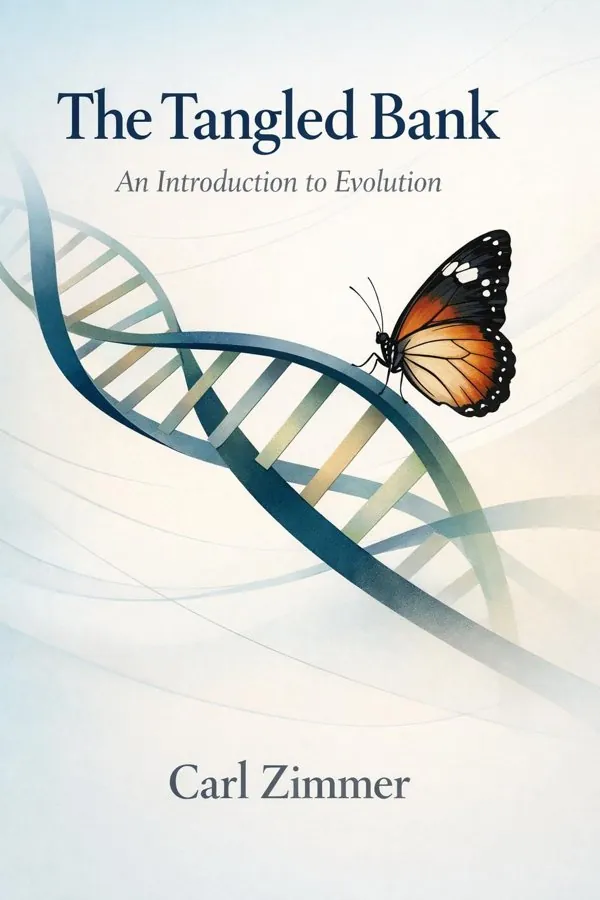
The Tangled Bank: An Introduction to Evolution: Summary & Key Insights
by Carl Zimmer
 10 min7 chaptersAudio available
What Is The Tangled Bank: An Introduction to Evolution About?
The Tangled Bank: An Introduction to Evolution by Carl Zimmer is a life_science book spanning 7 pages. The Tangled Bank: An Introduction to Evolution is a comprehensive and accessible exploration of evolutionary biology written by science writer Carl Zimmer. The book introduces readers to the fundamental principles of evolution, from natural selection and genetic variation to the origins of species and the complexity of life. Zimmer uses vivid examples from nature and modern research to illustrate how evolutionary processes shape the living world, making the subject engaging for both students and general readers.
This FizzRead summary covers all 7 key chapters of The Tangled Bank: An Introduction to Evolution in approximately 10 minutes, distilling the most important ideas, arguments, and takeaways from Carl Zimmer's work. Also available as an audio summary and Key Quotes Podcast.
The Tangled Bank: An Introduction to Evolution
The Tangled Bank: An Introduction to Evolution is a comprehensive and accessible exploration of evolutionary biology written by science writer Carl Zimmer. The book introduces readers to the fundamental principles of evolution, from natural selection and genetic variation to the origins of species and the complexity of life. Zimmer uses vivid examples from nature and modern research to illustrate how evolutionary processes shape the living world, making the subject engaging for both students and general readers.
Who Should Read The Tangled Bank: An Introduction to Evolution?
This book is perfect for anyone interested in life_science and looking to gain actionable insights in a short read. Whether you're a student, professional, or lifelong learner, the key ideas from The Tangled Bank: An Introduction to Evolution by Carl Zimmer will help you think differently.
- ✓Readers who enjoy life_science and want practical takeaways
- ✓Professionals looking to apply new ideas to their work and life
- ✓Anyone who wants the core insights of The Tangled Bank: An Introduction to Evolution in just 10 minutes
Want the full summary?
Get instant access to this book summary and 100K+ more with Fizz Moment.
Get Free SummaryAvailable on App Store • Free to download
Key Chapters
We often forget that the idea of evolution—of life changing over time—did not spring fully formed from Darwin’s mind. Before him existed a long lineage of naturalists and philosophers who tried to make sense of the living world. Aristotle classified organisms according to their essential forms. In the 18th century, naturalists like Linnaeus gave us systems of naming and classifying, but they also struggled with the fixity of species. Fossils complicated their worldviews: bones of giant sloths and extinct reptiles hinted that life on Earth had changed, and catastrophists like Cuvier tried to reconcile these mysteries with divine intervention.
Then came Charles Darwin, whose voyage aboard the *Beagle* convinced him that variation within species was not incidental. Observing finches, tortoises, and other creatures adapted to local environments, Darwin realized that nature itself could perform a kind of selection—favoring individuals better suited to their surroundings. Together with Alfred Russel Wallace, he proposed natural selection as the mechanism by which species diverge over generations. *The Origin of Species* did not erase earlier ideas but wove them into a coherent framework: life evolves, not according to a preset plan, but through a continuous process of descent with modification.
In *The Tangled Bank*, I trace this intellectual trajectory to show how evolutionary thinking matured from speculation into empirical science. With the rediscovery of Mendel’s laws of inheritance around 1900, the Modern Synthesis united Darwin’s natural selection with the genetic mechanism that underpins variation. Evolutionary biology became not merely descriptive but predictive. Later in the 20th century, the molecular revolution allowed scientists to read evolution’s record directly in DNA, confirming patterns first glimpsed through fossils and anatomy. The story of evolutionary thought mirrors evolution itself: ideas adapt to new evidence, discarding the unfit and retaining what best explains the living world.
At the heart of evolution lies variation—the subtle differences between individuals upon which natural selection acts. Without variation, life would stagnate. Every time you look at the spectrum of human height, or at the diverse beaks of finches, you’re seeing evolution’s raw material. But what causes variation? Genes. Mutations arise spontaneously when DNA replicates, introducing new traits that may or may not affect an organism’s survival. Some are harmful, others neutral, and a precious few are advantageous.
In the book, I emphasize that natural selection is only one mechanism of evolution. The genetic shuffle of sexual reproduction ensures new combinations in every generation, while gene flow—organisms migrating and interbreeding—spreads change across populations. Genetic drift, the random fluctuation of gene frequencies, plays an especially powerful role in small populations, sometimes overwhelming selection itself. Evolution, then, is not just survival of the fittest; it is the result of numerous forces working together, sometimes harmoniously, sometimes in tension.
Consider the sickle-cell mutation in human hemoglobin. It can cause severe anemia when inherited from both parents, yet in regions plagued by malaria, carriers of a single copy enjoy partial resistance to the disease. This fine balance between cost and benefit illustrates how the environment defines what it means to be ‘fit.’ At every level—from DNA sequences to populations—evolutionary processes operate through both chance and necessity. The genes that code for your body shape, your metabolism, even your ability to digest milk, all bear the imprint of this ceaseless interplay. Through variation and selection, evolution sculpts the boundless diversity we observe today.
+ 5 more chapters — available in the FizzRead app
All Chapters in The Tangled Bank: An Introduction to Evolution
About the Author
Carl Zimmer is an American science writer, journalist, and author known for his works on evolution, genetics, and biology. He contributes regularly to The New York Times and has written several acclaimed books that make complex scientific topics accessible to a broad audience. Zimmer is also a lecturer at Yale University, where he teaches science communication.
Get This Summary in Your Preferred Format
Read or listen to the The Tangled Bank: An Introduction to Evolution summary by Carl Zimmer anytime, anywhere. FizzRead offers multiple formats so you can learn on your terms — all free.
Available formats: App · Audio · PDF · EPUB — All included free with FizzRead
Download The Tangled Bank: An Introduction to Evolution PDF and EPUB Summary
Key Quotes from The Tangled Bank: An Introduction to Evolution
“We often forget that the idea of evolution—of life changing over time—did not spring fully formed from Darwin’s mind.”
“At the heart of evolution lies variation—the subtle differences between individuals upon which natural selection acts.”
Frequently Asked Questions about The Tangled Bank: An Introduction to Evolution
The Tangled Bank: An Introduction to Evolution by Carl Zimmer is a life_science book that explores key ideas across 7 chapters. The Tangled Bank: An Introduction to Evolution is a comprehensive and accessible exploration of evolutionary biology written by science writer Carl Zimmer. The book introduces readers to the fundamental principles of evolution, from natural selection and genetic variation to the origins of species and the complexity of life. Zimmer uses vivid examples from nature and modern research to illustrate how evolutionary processes shape the living world, making the subject engaging for both students and general readers.
More by Carl Zimmer
Parasite Rex: Inside the Bizarre World of Nature's Most Dangerous Creatures
Carl Zimmer
10 min
Soul Made Flesh: The Discovery of the Brain—and How It Changed the World
Carl Zimmer
10 min
She Has Her Mother’s Laugh: The Powers, Perversions, and Potential of Heredity
Carl Zimmer
10 min
Evolution: The Triumph of an Idea
Carl Zimmer
10 minYou Might Also Like
The Selfish Gene
Richard Dawkins
10 min
Awakenings
Oliver Sacks
10 minParasite Rex: Inside the Bizarre World of Nature's Most Dangerous Creatures
Carl Zimmer
10 min
The Atlas of Life on Earth
Various
10 min
The Book of Humans: The Story of How We Became Us
Adam Rutherford
10 min
The Horse
Wendy Williams
10 minBrowse by Category
Ready to read The Tangled Bank: An Introduction to Evolution?
Get the full summary and 100K+ more books with Fizz Moment.