
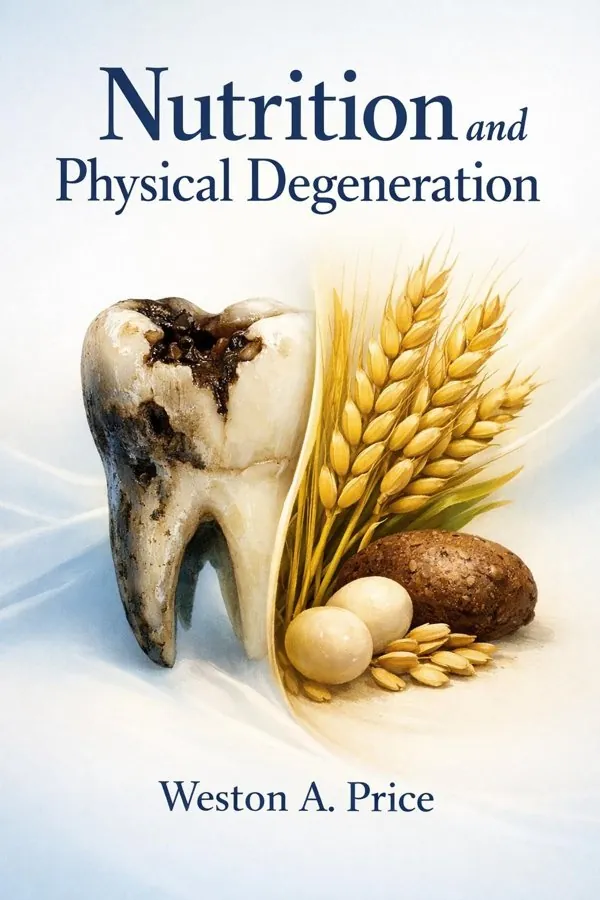
Nutrition and Physical Degeneration: A Comparison of Primitive and Modern Diets and Their Effects: Summary & Key Insights
 10 min13 chaptersAudio available
What Is Nutrition and Physical Degeneration: A Comparison of Primitive and Modern Diets and Their Effects About?
Nutrition and Physical Degeneration: A Comparison of Primitive and Modern Diets and Their Effects by Weston A. Price is a nutrition book spanning 13 pages. Nutrition and Physical Degeneration is a landmark study by dentist Weston A. Price, first published in 1939. The book documents Price’s global research into the relationship between traditional diets and the physical health of indigenous peoples. Through extensive fieldwork and photographic evidence, Price argues that modern processed foods contribute to dental decay, deformities, and degenerative diseases, while traditional diets rich in natural, unrefined foods promote robust health and strong physical development.
This FizzRead summary covers all 13 key chapters of Nutrition and Physical Degeneration: A Comparison of Primitive and Modern Diets and Their Effects in approximately 10 minutes, distilling the most important ideas, arguments, and takeaways from Weston A. Price's work. Also available as an audio summary and Key Quotes Podcast.
Nutrition and Physical Degeneration: A Comparison of Primitive and Modern Diets and Their Effects
Nutrition and Physical Degeneration is a landmark study by dentist Weston A. Price, first published in 1939. The book documents Price’s global research into the relationship between traditional diets and the physical health of indigenous peoples. Through extensive fieldwork and photographic evidence, Price argues that modern processed foods contribute to dental decay, deformities, and degenerative diseases, while traditional diets rich in natural, unrefined foods promote robust health and strong physical development.
Who Should Read Nutrition and Physical Degeneration: A Comparison of Primitive and Modern Diets and Their Effects?
This book is perfect for anyone interested in nutrition and looking to gain actionable insights in a short read. Whether you're a student, professional, or lifelong learner, the key ideas from Nutrition and Physical Degeneration: A Comparison of Primitive and Modern Diets and Their Effects by Weston A. Price will help you think differently.
- ✓Readers who enjoy nutrition and want practical takeaways
- ✓Professionals looking to apply new ideas to their work and life
- ✓Anyone who wants the core insights of Nutrition and Physical Degeneration: A Comparison of Primitive and Modern Diets and Their Effects in just 10 minutes
Want the full summary?
Get instant access to this book summary and 100K+ more with Fizz Moment.
Get Free SummaryAvailable on App Store • Free to download
Key Chapters
To answer my central question, I resolved not to theorize in isolation but to travel, observe, and measure. My work spanned every continent—from the Alps of Switzerland to the islands of the Pacific, from the frozen Arctic to the high plateaus of Peru. I examined hundreds of individuals and families within each community, measuring dental arches, recording the prevalence of caries, and photographing facial structures. I paid special attention to groups that were genetically similar but divided by a dietary boundary—those who remained faithful to ancestral foods and those who adopted Western provisions.
Dental decay became my scientific window into the body's overall nutritional state. A well-formed jaw and wide dental arch suggested balanced mineral and vitamin intake, while crowding or malformation revealed nutritional inadequacy during growth. My methods were clinical yet profoundly human, for I sought not only data but understanding of how people lived, hunted, cultivated, and prepared their foods. I catalogued the composition of their meals with precision—minerals, fats, proteins, and vitamins—and contrasted these against the nutrient-depleted profiles of refined flour and sugar.
Through this cross-cultural lens, I saw nature’s pattern repeated with relentless consistency: isolated peoples consuming whole, unrefined foods had superb dental health and strong, symmetrical faces; when modern foods invaded, decay and deformity followed. My research design aimed to preserve this clarity—the photographic plates and the numerical data together confirm the powerful, universal link between traditional nutrition and physical integrity.
Among the isolated valleys of Switzerland, I found children with radiant faces and broad smiles, their teeth aligned with near-perfect precision. Their diets were rich in whole rye, raw milk from grass-fed cows, cheese, and butter deeply yellow—the color of vitality. These villages were cut off from imported foods by snow-laden passes, and their physical endurance was remarkable. Dental caries were rare, and tuberculosis—a scourge of the modernized villages nearby—was almost nonexistent.
When modern roads reached these mountains and white flour, sugar, and canned goods became accessible, the transformation was tragically swift. I documented families in which one generation nourished on traditional foods showed vigorous health, while the next exhibited dental decay and narrowing of the facial structure. I realized that these Alps did not merely preserve a scenery; they preserved a living laboratory of human adaptation. The strength bred by these natural foods was not mystic but biochemical—an equilibrium of minerals, vitamins A and D, and the fat-soluble nutrients essential for growth and resistance.
My photos captured not only the beauty of these people but the quiet warning within their transition: even purity at altitude cannot save a body whose food has been refined beyond recognition.
+ 11 more chapters — available in the FizzRead app
All Chapters in Nutrition and Physical Degeneration: A Comparison of Primitive and Modern Diets and Their Effects
About the Author
Weston A. Price (1870–1948) was a Canadian-born dentist and researcher known for his pioneering work on the relationship between nutrition, dental health, and physical well-being. His studies of indigenous populations around the world led him to advocate for whole, unprocessed foods and to warn against the health effects of modern industrial diets.
Get This Summary in Your Preferred Format
Read or listen to the Nutrition and Physical Degeneration: A Comparison of Primitive and Modern Diets and Their Effects summary by Weston A. Price anytime, anywhere. FizzRead offers multiple formats so you can learn on your terms — all free.
Available formats: App · Audio · PDF · EPUB — All included free with FizzRead
Download Nutrition and Physical Degeneration: A Comparison of Primitive and Modern Diets and Their Effects PDF and EPUB Summary
Key Quotes from Nutrition and Physical Degeneration: A Comparison of Primitive and Modern Diets and Their Effects
“To answer my central question, I resolved not to theorize in isolation but to travel, observe, and measure.”
“Among the isolated valleys of Switzerland, I found children with radiant faces and broad smiles, their teeth aligned with near-perfect precision.”
Frequently Asked Questions about Nutrition and Physical Degeneration: A Comparison of Primitive and Modern Diets and Their Effects
Nutrition and Physical Degeneration: A Comparison of Primitive and Modern Diets and Their Effects by Weston A. Price is a nutrition book that explores key ideas across 13 chapters. Nutrition and Physical Degeneration is a landmark study by dentist Weston A. Price, first published in 1939. The book documents Price’s global research into the relationship between traditional diets and the physical health of indigenous peoples. Through extensive fieldwork and photographic evidence, Price argues that modern processed foods contribute to dental decay, deformities, and degenerative diseases, while traditional diets rich in natural, unrefined foods promote robust health and strong physical development.
You Might Also Like
Eating by the Seasons Cookbook: Seasonal Produce-Focused Recipes
Clare Foster
10 min
From Crook to Cook: Platinum Recipes from Tha Boss Dogg's Kitchen
Snoop Dogg with Ryan Ford
10 min
Juicing for Beginners: The Essential Guide to Juicing Recipes and Juicing for Weight Loss
Rockridge Press
10 min
The Food Therapist: Break Bad Habits, Eat with Intention, and Indulge Without Worry
Shira Lenchewski
10 min
The Mediterranean Diet Meal Plan: A 4-Week Meal Plan for Optimal Health and Weight Loss
Various Contributors
10 min
The Well Plated Cookbook: Simple, Wholesome Recipes for Everyday Meals
Erin Clarke
10 minBrowse by Category
Ready to read Nutrition and Physical Degeneration: A Comparison of Primitive and Modern Diets and Their Effects?
Get the full summary and 100K+ more books with Fizz Moment.