
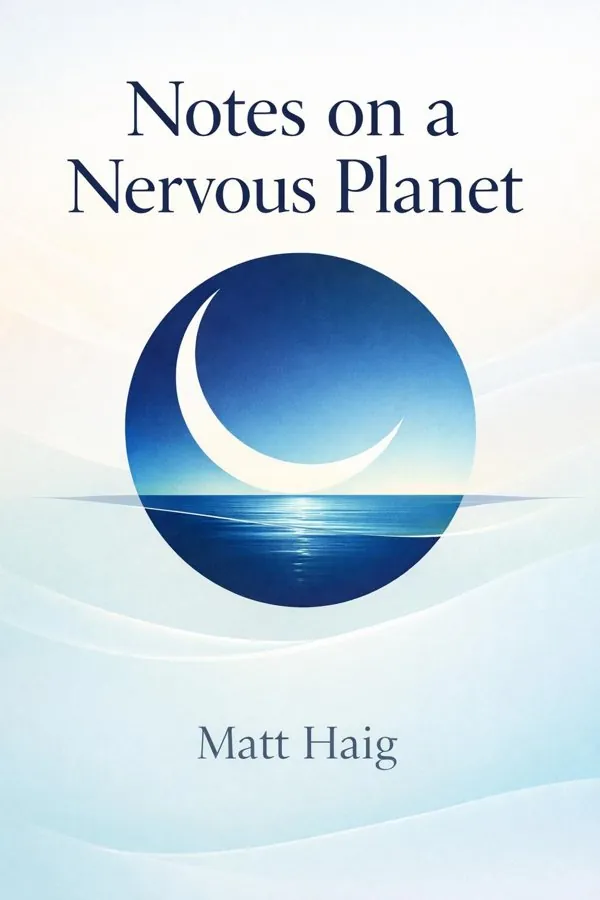
Notes on a Nervous Planet: Summary & Key Insights
by Matt Haig
 10 min9 chaptersAudio available
Key Takeaways from Notes on a Nervous Planet
The devices that promise connection often end up colonizing our attention.
The human nervous system did not evolve to absorb the suffering, outrage, danger, and opinion of the entire world every minute of the day.
Much of modern unhappiness comes from comparing our real lives to other people’s edited performances.
Modern life moves so quickly that many people mistake speed for importance.
A nervous culture often tries to soothe itself by buying things.
What Is Notes on a Nervous Planet About?
Notes on a Nervous Planet by Matt Haig is a mental_health book spanning 11 pages. Notes on a Nervous Planet is Matt Haig’s thoughtful, urgent exploration of what it means to live with a sensitive mind in an age designed to overstimulate it. Building on the deeply personal insights of Reasons to Stay Alive, Haig shifts the focus outward, asking how modern life itself contributes to anxiety, restlessness, comparison, and exhaustion. From social media and the nonstop news cycle to consumer culture, speed, and the pressure to always be available, he shows how the contemporary world can intensify mental strain even as it promises convenience and connection. What makes this book matter is its combination of vulnerability and clarity. Haig does not write as a detached expert diagnosing society from afar; he writes as someone who has personally experienced panic, depression, and the fragile work of recovery. That lived experience gives the book warmth, credibility, and emotional precision. At the same time, he offers practical reflections on slowing down, reclaiming attention, protecting peace, and choosing presence over noise. The result is both social commentary and survival guide: a compassionate book for anyone trying to remain human, calm, and hopeful on a nervous planet.
This FizzRead summary covers all 9 key chapters of Notes on a Nervous Planet in approximately 10 minutes, distilling the most important ideas, arguments, and takeaways from Matt Haig's work. Also available as an audio summary and Key Quotes Podcast.
Notes on a Nervous Planet
Notes on a Nervous Planet is Matt Haig’s thoughtful, urgent exploration of what it means to live with a sensitive mind in an age designed to overstimulate it. Building on the deeply personal insights of Reasons to Stay Alive, Haig shifts the focus outward, asking how modern life itself contributes to anxiety, restlessness, comparison, and exhaustion. From social media and the nonstop news cycle to consumer culture, speed, and the pressure to always be available, he shows how the contemporary world can intensify mental strain even as it promises convenience and connection.
What makes this book matter is its combination of vulnerability and clarity. Haig does not write as a detached expert diagnosing society from afar; he writes as someone who has personally experienced panic, depression, and the fragile work of recovery. That lived experience gives the book warmth, credibility, and emotional precision. At the same time, he offers practical reflections on slowing down, reclaiming attention, protecting peace, and choosing presence over noise. The result is both social commentary and survival guide: a compassionate book for anyone trying to remain human, calm, and hopeful on a nervous planet.
Who Should Read Notes on a Nervous Planet?
This book is perfect for anyone interested in mental_health and looking to gain actionable insights in a short read. Whether you're a student, professional, or lifelong learner, the key ideas from Notes on a Nervous Planet by Matt Haig will help you think differently.
- ✓Readers who enjoy mental_health and want practical takeaways
- ✓Professionals looking to apply new ideas to their work and life
- ✓Anyone who wants the core insights of Notes on a Nervous Planet in just 10 minutes
Want the full summary?
Get instant access to this book summary and 100K+ more with Fizz Moment.
Get Free SummaryAvailable on App Store • Free to download
Key Chapters
The devices that promise connection often end up colonizing our attention. Haig argues that smartphones, social media platforms, and constant notifications do more than distract us; they shape our emotional climate. Every vibration, headline, message, and update nudges the brain into a state of alertness. We become reactive rather than reflective, stimulated rather than settled. Over time, this low-grade agitation can start to feel normal, even though it leaves us mentally tired and emotionally frayed.
Haig’s point is not that technology is evil or that modern people should retreat from the digital world entirely. The problem is not the existence of tools but the way they are designed to keep us engaged, comparing, scrolling, checking, and refreshing. A phone can be useful, but it can also become an always-open doorway through which urgency enters our minds. We may begin the day intending to answer one email and suddenly find ourselves an hour later reading arguments, consuming bad news, and feeling worse without understanding why.
This insight becomes practical when we examine how we use technology rather than simply how much we use it. For example, turning off nonessential notifications, keeping phones out of the bedroom, setting designated times for checking social media, or taking one screen-free walk a day can interrupt the cycle of compulsive attention. Even small boundaries can restore a sense of agency.
Actionable takeaway: audit your digital habits for one day and remove one source of unnecessary interruption, especially a notification, app, or scrolling routine that regularly leaves you more anxious than informed.
The human nervous system did not evolve to absorb the suffering, outrage, danger, and opinion of the entire world every minute of the day. One of Haig’s central ideas is that modern anxiety is intensified by information overload. We live in a culture where news never pauses, commentary never ends, and every event becomes instantly accessible. This creates the illusion that being constantly informed is responsible, when in reality it can leave us overwhelmed, helpless, and perpetually braced for disaster.
Haig points out that the problem is not knowledge itself. It is the unfiltered volume, speed, and emotional charge of the information we consume. News platforms compete for attention, and attention is often captured most effectively through alarm. The result is a mind trained to expect threat. Even when we are physically safe, we may feel psychologically endangered because we are continually exposed to crisis narratives.
This helps explain why many people feel exhausted before the day has properly begun. A quick morning glance at headlines can flood the mind with war, catastrophe, political rage, and economic fear. The body responds as if all of it is immediate and actionable, even when very little of it is within our control.
A healthier approach is selective awareness. This could mean reading the news once a day from a trusted source, avoiding doomscrolling late at night, and asking whether a piece of information is useful, necessary, or merely activating. Staying informed does not require self-poisoning.
Actionable takeaway: create a personal news boundary, such as checking the news only once or twice daily from one reliable source and avoiding emotionally charged headline grazing throughout the day.
Much of modern unhappiness comes from comparing our real lives to other people’s edited performances. Haig explores how social media intensifies insecurity by presenting polished versions of beauty, success, relationships, productivity, and happiness. These images are not neutral. They train us to see ourselves as lacking. We start to measure our worth against impossible standards and wonder why our ordinary lives do not feel as radiant as everyone else’s highlights.
The illusion of perfection is damaging because it hides the truth of being human: everyone is vulnerable, incomplete, messy, and uncertain. Yet platforms reward appearance over honesty, branding over complexity, and certainty over doubt. This creates a culture where people feel pressure not only to live but to perform their lives continuously. Instead of asking, “How am I actually doing?” we start asking, “How do I look from the outside?”
Haig’s insight is liberating because it names comparison as a trap rather than a truth. The discomfort we feel may not be evidence that we are failing; it may be a predictable response to inhabiting an environment saturated with performance. Recognizing this can reduce shame and restore perspective.
Practically, readers can curate their feeds more intentionally, unfollow accounts that trigger self-criticism, and seek voices that feel real rather than aspirational. It also helps to remember that a filtered image cannot reveal debt, loneliness, grief, panic, or dissatisfaction. A picture is not a life.
Actionable takeaway: identify three online accounts that consistently make you feel inadequate and unfollow, mute, or replace them with sources that encourage realism, creativity, or genuine well-being.
Modern life moves so quickly that many people mistake speed for importance. Haig examines how a culture obsessed with efficiency, immediacy, and acceleration makes it difficult to feel grounded. Messages require instant replies. Work follows us home. Entertainment is available on demand. Shopping is frictionless. Transport is faster. Yet despite all these gains, many people feel more rushed, not less. The saved time is rarely returned to us as peace; it is usually filled with more demands.
This constant velocity has psychological consequences. When life becomes too fast, experience turns shallow. We skim instead of notice. We consume instead of absorb. We react instead of reflect. Even enjoyable activities can become infected by urgency, as though rest itself must be optimized. Haig suggests that anxiety is not only about fear; it can also emerge from a nervous system denied slowness.
His response is not laziness but intentional deceleration. Slowing down is a way of protecting consciousness from fragmentation. A meal eaten without scrolling, a walk without headphones, a conversation without glancing at the phone, or ten quiet minutes before sleep can begin to restore depth. Slowness is not an inefficiency; it is often the condition required for presence.
This idea is especially useful for people who feel guilty when they stop. Haig reminds us that not every moment must be productive to be valuable. Some of the most important human experiences, such as thinking, healing, listening, and loving, happen at a pace the modern world no longer respects.
Actionable takeaway: choose one daily activity to do more slowly and with full attention, whether drinking coffee, commuting, eating lunch, or taking an evening walk.
A nervous culture often tries to soothe itself by buying things. Haig explores the link between consumerism and mental unease, showing how modern economies depend on convincing people that they are incomplete and that completion lies one purchase away. Advertising rarely says, “You are enough.” Instead, it whispers that a better body, more stylish home, newer device, or different lifestyle will finally make life feel settled. The trouble is that desire constantly renews itself.
This matters because when identity becomes tied to consumption, self-worth becomes unstable. We begin to express ourselves less through values, relationships, and character, and more through brands, aesthetics, and status markers. The self becomes something to construct externally. That process can be exciting in brief moments, but it is a fragile basis for contentment because it depends on endless comparison and continual dissatisfaction.
Haig’s critique is not anti-pleasure or anti-material comfort. He is questioning the fantasy that external upgrades can fix internal unease. New things may delight us temporarily, but they cannot do the deeper work of meaning, belonging, or emotional regulation. In fact, the chase for them can increase anxiety by creating financial pressure and reinforcing the sense that who we are is never enough.
A practical response is to pause before purchasing and ask what need lies beneath the desire. Is it boredom, loneliness, insecurity, or stress? Sometimes the real need is rest, connection, or reassurance rather than another item. Spending can be conscious rather than compulsive.
Actionable takeaway: before your next nonessential purchase, wait 24 hours and ask whether you want the object itself or the feeling you hope it will provide.
One of Haig’s most powerful contributions is his insistence that mental health is not just a private issue happening inside isolated individuals. The environment matters. Culture matters. The pace, pressures, technologies, and expectations surrounding us all influence the way we feel. This does not mean personal responsibility disappears, but it does mean that distress should not always be interpreted as personal weakness. Sometimes anxiety is a reasonable response to an unreasonable context.
This perspective can be deeply relieving. Many people blame themselves for feeling scattered, overwhelmed, or inadequate, when in fact they are trying to function in conditions that reward overstimulation, comparison, and constant availability. If the world is too loud, sensitivity is not failure. If rest feels difficult, it may be because systems are built to monetize attention rather than preserve peace.
Haig balances this social view with practical compassion. We may not control the wider culture, but we can shape our immediate environment. That includes the media we consume, the routines we create, the expectations we accept, and the spaces we inhabit. A calmer life is often built through protective design: simpler mornings, fewer digital intrusions, supportive relationships, time outdoors, and realistic standards for work and productivity.
This framing also encourages empathy toward others. When we recognize how environmental stress affects mental health, we may judge less harshly and listen more carefully. Distress is not always pathology; sometimes it is information.
Actionable takeaway: identify one aspect of your environment that regularly heightens stress, such as clutter, noise, notifications, or overcommitment, and make one concrete change to reduce its impact this week.
Peace of mind rarely arrives by accident in a world engineered for stimulation. Haig emphasizes that calm must be actively protected through habits, boundaries, and rituals. Wanting to feel better is not enough if the structure of everyday life keeps feeding agitation. The modern mind needs intentional counterweights: sleep, rest, movement, reading, breathing space, and moments free from performance and input.
What makes Haig’s advice useful is its realism. He does not promise perfect serenity or suggest a single cure for anxiety. Instead, he offers a menu of stabilizing practices. These might include limiting social media, exercising regularly, reading fiction, meditating, going outside, journaling, listening to music, cooking, or simply doing one thing at a time. The value of these actions lies in their cumulative effect. They remind the body and mind that they are not under constant threat.
The broader lesson is that we often underestimate the emotional power of ordinary routines. A consistent bedtime, a morning without the phone, a daily walk, or a quiet cup of tea can become forms of resistance against chaos. These practices may appear small, but they teach the nervous system predictability and safety.
Readers can apply this idea by focusing less on dramatic transformation and more on repeatable habits. The goal is not to construct a flawless wellness lifestyle but to build a few reliable anchors that help when life feels too fast or too loud.
Actionable takeaway: choose two calming practices you can repeat daily for the next week, such as a ten-minute walk and a phone-free first half hour each morning.
An anxious mind often shrinks the world to screens, tasks, and self-conscious thought. Haig argues that nature helps reverse this contraction by returning us to something larger and slower than our worries. Trees do not demand that we optimize ourselves. Rivers do not ask for a response. The natural world offers rhythm without urgency and beauty without comparison. Even brief contact with it can soften the pressure created by digital and urban overstimulation.
The importance of physical presence extends beyond nature itself. Haig reminds readers that embodied life matters. We are not brains floating through information streams; we are living beings who need sunlight, movement, fresh air, touch, and sensory experience. Anxiety often intensifies when we become trapped in abstraction, overthinking, and mediated reality. Being physically present in a place can interrupt that spiral.
This does not require hiking in remote landscapes or abandoning city life. Presence can be practiced in ordinary ways: noticing the weather, feeling your feet on the ground, watering plants, walking through a local park, or sitting outside without doing anything productive. The aim is not to force transcendence but to reconnect with immediate reality.
Haig’s point is simple but profound: attention is healing when it moves from internal turbulence toward the external world. Looking at a tree, listening to birds, or feeling cold air on the skin can remind us that life exists beyond our thoughts.
Actionable takeaway: spend at least fifteen minutes outdoors each day this week without multitasking, and deliberately notice three physical details around you that you would normally ignore.
Beneath Haig’s observations about technology, speed, and overload lies a deeply human message: what steadies us is not perfection or control but connection, acceptance, and hope. Modern systems often push us toward isolation while pretending to connect us. We can be in touch with hundreds of people online and still feel unseen. Real connection, Haig suggests, comes from presence, honesty, and the willingness to be imperfect with others.
This is why conversations matter more than broadcasting, and why friendship can do more for mental health than self-optimization. To tell the truth about how we feel, to listen without rushing, to laugh in the same room, to share silence, to be known outside performance: these are antidotes to a nervous age. Human beings regulate one another. We calm down in the company of those who make us feel safe.
Acceptance is equally important. Haig does not present anxiety as something we conquer once and for all. Instead, he encourages a gentler stance toward the mind. Fighting every uncomfortable thought can deepen suffering; learning to notice feelings without becoming identical to them can create space. Acceptance is not surrender to misery. It is the recognition that inner weather changes and does not define our whole identity.
Hope, in this framework, is practical rather than sentimental. It is built through small choices: reaching out, resting, pausing, stepping outside, choosing perspective, continuing despite difficulty. The world may remain noisy, but we can still create islands of sanity within it.
Actionable takeaway: this week, replace one passive online interaction with one real act of connection, such as calling a friend, meeting someone for coffee, or honestly telling a trusted person how you are doing.
All Chapters in Notes on a Nervous Planet
About the Author
Matt Haig is a British author whose fiction and nonfiction have reached millions of readers worldwide. He is best known for writing with unusual honesty about mental health, time, identity, and the pressures of modern life. His memoir Reasons to Stay Alive became an international bestseller and established him as an important voice on anxiety and depression, drawing on his own lived experience. In fiction, he is widely recognized for novels such as The Midnight Library and How to Stop Time, which combine emotional depth with philosophical reflection. Haig’s work is valued for its accessibility, warmth, and ability to make difficult subjects feel both intimate and hopeful. Across genres, he consistently explores how people endure pain, search for meaning, and remain human in a restless world.
Get This Summary in Your Preferred Format
Read or listen to the Notes on a Nervous Planet summary by Matt Haig anytime, anywhere. FizzRead offers multiple formats so you can learn on your terms — all free.
Available formats: App · Audio · PDF · EPUB — All included free with FizzRead
Download Notes on a Nervous Planet PDF and EPUB Summary
Key Quotes from Notes on a Nervous Planet
“The devices that promise connection often end up colonizing our attention.”
“The human nervous system did not evolve to absorb the suffering, outrage, danger, and opinion of the entire world every minute of the day.”
“Much of modern unhappiness comes from comparing our real lives to other people’s edited performances.”
“Modern life moves so quickly that many people mistake speed for importance.”
“A nervous culture often tries to soothe itself by buying things.”
Frequently Asked Questions about Notes on a Nervous Planet
Notes on a Nervous Planet by Matt Haig is a mental_health book that explores key ideas across 9 chapters. Notes on a Nervous Planet is Matt Haig’s thoughtful, urgent exploration of what it means to live with a sensitive mind in an age designed to overstimulate it. Building on the deeply personal insights of Reasons to Stay Alive, Haig shifts the focus outward, asking how modern life itself contributes to anxiety, restlessness, comparison, and exhaustion. From social media and the nonstop news cycle to consumer culture, speed, and the pressure to always be available, he shows how the contemporary world can intensify mental strain even as it promises convenience and connection. What makes this book matter is its combination of vulnerability and clarity. Haig does not write as a detached expert diagnosing society from afar; he writes as someone who has personally experienced panic, depression, and the fragile work of recovery. That lived experience gives the book warmth, credibility, and emotional precision. At the same time, he offers practical reflections on slowing down, reclaiming attention, protecting peace, and choosing presence over noise. The result is both social commentary and survival guide: a compassionate book for anyone trying to remain human, calm, and hopeful on a nervous planet.
More by Matt Haig



You Might Also Like
Big Feelings: How to Be Okay When Things Are Not Okay
Liz Fosslien, Mollie West Duffy
10 min
Creative Arts Therapies Handbook: Art, Music and Dance Therapy Practices for Wellbeing
Susan I. Buchalter
10 min
Emotional First Aid: Healing Rejection, Guilt, Failure, and Other Everyday Hurts
Guy Winch
10 min
Lost Connections: Why You're Depressed and How to Find Hope
Johann Hari
10 min
No Time to Panic: How to Stop Worrying and Embrace Life
Matt Gutman
10 min
Overcoming Mobbing: A Recovery Guide for Workplace Aggression and Bullying
Maureen Duffy, Len Sperry
10 minBrowse by Category
Ready to read Notes on a Nervous Planet?
Get the full summary and 100K+ more books with Fizz Moment.