
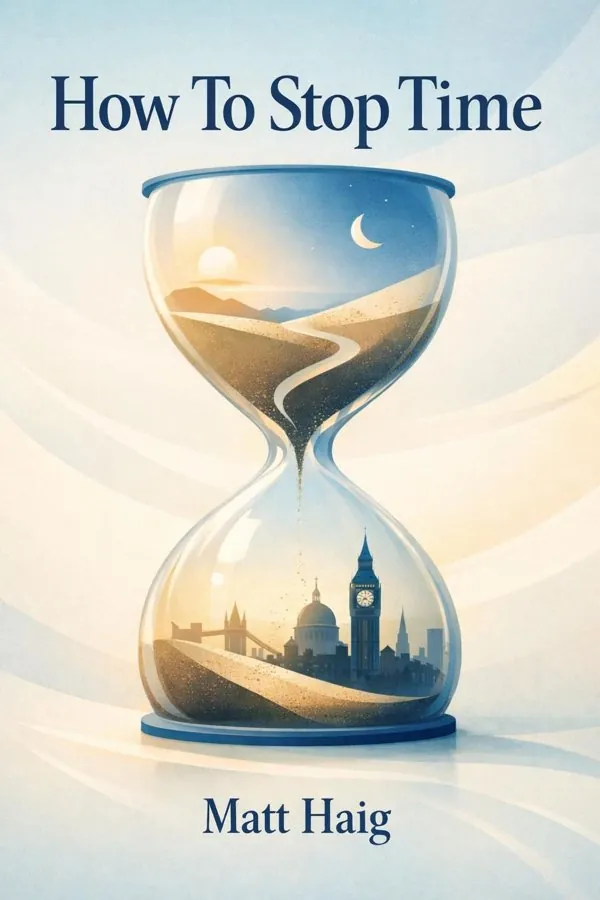
How To Stop Time: Summary & Key Insights
by Matt Haig
 10 min9 chaptersAudio available
Key Takeaways from How To Stop Time
A long life does not automatically become a rich life.
The past becomes more complicated when it is not a lesson but a memory.
When survival depends on secrecy, love begins to look dangerous.
The deepest form of loneliness is not being physically alone but being fundamentally unknown.
We often imagine memory as a gift, but the novel shows that memory can also be a burden.
What Is How To Stop Time About?
How To Stop Time by Matt Haig is a bestsellers book spanning 3 pages. What if you had all the time in the world, yet still felt life slipping through your fingers? In How To Stop Time, Matt Haig turns this haunting question into a deeply human novel about memory, loneliness, love, and the burden of endurance. The story follows Tom Hazard, a man who appears to be in his early forties but has lived for centuries due to a rare condition that makes him age extremely slowly. From Elizabethan England to present-day London, Tom has witnessed history firsthand, met famous figures, and survived losses that would break most people. Yet his greatest struggle is not staying alive. It is learning how to live. Haig uses Tom’s impossible lifespan to explore very real emotional truths: the pain of isolation, the temptation to detach from feeling, and the hope that meaning can still be found in the present moment. Known for blending philosophical reflection with accessible storytelling, Haig brings warmth, humor, and melancholy to a premise that could have been merely fantastical. The result is a novel that feels both expansive and intimate, asking readers not how to escape time, but how to be fully alive within it.
This FizzRead summary covers all 9 key chapters of How To Stop Time in approximately 10 minutes, distilling the most important ideas, arguments, and takeaways from Matt Haig's work. Also available as an audio summary and Key Quotes Podcast.
How To Stop Time
What if you had all the time in the world, yet still felt life slipping through your fingers? In How To Stop Time, Matt Haig turns this haunting question into a deeply human novel about memory, loneliness, love, and the burden of endurance. The story follows Tom Hazard, a man who appears to be in his early forties but has lived for centuries due to a rare condition that makes him age extremely slowly. From Elizabethan England to present-day London, Tom has witnessed history firsthand, met famous figures, and survived losses that would break most people. Yet his greatest struggle is not staying alive. It is learning how to live.
Haig uses Tom’s impossible lifespan to explore very real emotional truths: the pain of isolation, the temptation to detach from feeling, and the hope that meaning can still be found in the present moment. Known for blending philosophical reflection with accessible storytelling, Haig brings warmth, humor, and melancholy to a premise that could have been merely fantastical. The result is a novel that feels both expansive and intimate, asking readers not how to escape time, but how to be fully alive within it.
Who Should Read How To Stop Time?
This book is perfect for anyone interested in bestsellers and looking to gain actionable insights in a short read. Whether you're a student, professional, or lifelong learner, the key ideas from How To Stop Time by Matt Haig will help you think differently.
- ✓Readers who enjoy bestsellers and want practical takeaways
- ✓Professionals looking to apply new ideas to their work and life
- ✓Anyone who wants the core insights of How To Stop Time in just 10 minutes
Want the full summary?
Get instant access to this book summary and 100K+ more with Fizz Moment.
Get Free SummaryAvailable on App Store • Free to download
Key Chapters
A long life does not automatically become a rich life. That is the first unsettling truth at the center of Tom Hazard’s story. On the surface, Tom seems ordinary: a history teacher in London, quiet, intelligent, and self-contained. But his calm exterior hides an astonishing reality. Though he looks around forty-one, he has lived for centuries. He has survived plague years, wars, exile, changing identities, and the slow collapse of everyone he has ever loved. His rare condition, often called anageria in the novel, stretches his life but also distorts it.
This premise matters because Haig does not treat longevity as a glamorous superpower. Instead, he shows its emotional cost. Tom’s centuries of experience have not made him wise in a simple, triumphant way. They have made him cautious, lonely, and afraid of attachment. He has learned to disappear before anyone notices he is not aging. He has learned to avoid deep roots because roots lead to grief.
In practical terms, Tom’s life mirrors a more familiar human pattern: many people survive by becoming emotionally invisible. After loss, rejection, or trauma, it can feel safer to remain detached, competent, and unremarkable. Tom’s secret exaggerates that instinct, but the instinct itself is universal. We may not live for hundreds of years, but we often carry old selves and old wounds much longer than we admit.
As a reader, Tom’s condition invites reflection on your own relationship with time. Are you filling your days, or merely extending them? Are you protecting yourself from pain in ways that also block joy? The novel suggests that a long life without presence is just a prolonged absence.
Actionable takeaway: Ask yourself where you are choosing safety over aliveness, and identify one small way to become more present in your own life this week.
The past becomes more complicated when it is not a lesson but a memory. One of the novel’s great pleasures is how Tom moves through major historical eras not as a tourist but as a participant. He encounters Shakespeare, lives through Elizabethan England, sails dangerous seas, experiences social upheaval, and watches entire worlds disappear. Through Tom, history loses its polished textbook distance and becomes messy, intimate, and painful.
This approach gives the novel a powerful double effect. On one level, it offers the excitement of historical fiction: readers see famous periods and figures through fresh eyes. On another level, it exposes how romanticized our view of the past often is. Tom knows that every golden age is full of fear, disease, hunger, violence, and private heartbreak. Nostalgia, the book suggests, is often just selective memory.
That idea applies far beyond the novel. Many people idealize former versions of their lives: childhood, first love, a previous city, an earlier career, a supposedly simpler time. But Tom’s life reminds us that every era, including our own, contains both beauty and suffering. The human tendency to imagine that meaning exists elsewhere or before now can become a trap.
Haig also uses Tom’s historical perspective to show how human nature changes less than we think. Fashion, language, and technology evolve, yet fear, desire, hope, ambition, and loneliness remain strangely consistent. This gives the novel emotional continuity. Tom may belong to many centuries, but his struggles are recognizably our own.
For readers, this is an invitation to think differently about both history and memory. Instead of treating the past as sacred or superior, the novel encourages a more balanced view: the past matters, but it is not a place to live.
Actionable takeaway: The next time you catch yourself idealizing the past, write down one hardship from that period and one good thing about your present to restore perspective.
When survival depends on secrecy, love begins to look dangerous. That tension shapes Tom’s life inside the Albatross Society, a hidden network led by the controlling and enigmatic Hendrich. The Society exists to protect people like Tom, who age far more slowly than normal and must constantly reinvent themselves to avoid discovery. It provides forged identities, guidance, rules, and a sense of belonging. But like many systems built on fear, it offers safety at the price of freedom.
Hendrich’s central doctrine is simple: never fall in love, never stay too long, never attract attention. On one level, this advice is practical. Tom’s condition makes intimacy risky. Every attachment creates questions, and every question threatens exposure. But over time the rule becomes something larger. It is a philosophy of emotional retreat. Hendrich treats feeling as a weakness and connection as a liability.
Tom’s memories prove otherwise. His great love, Rose, and his longing for his daughter, Marion, are the forces that continue to define him across centuries. Love causes pain, yes, but it also gives shape and value to his life. Without it, endurance becomes empty repetition. The Society wants Tom to exist efficiently. His memories remind him that he wants more than existence.
This conflict resonates in everyday life. Many people remain in institutions, relationships, jobs, or belief systems that offer security but suppress emotional truth. We tell ourselves we are being realistic when, in fact, we are being ruled by fear. The Albatross Society becomes a metaphor for any structure that keeps people alive while preventing them from fully living.
Haig does not deny the usefulness of caution. He simply shows its limits. Protection is necessary, but when protection becomes your entire life strategy, it turns into a prison. Tom’s emotional awakening begins when he stops asking only, “How do I stay safe?” and starts asking, “What is safety for?”
Actionable takeaway: Notice one rule in your life that once protected you but may now be restricting you, and consider whether it still deserves your loyalty.
The deepest form of loneliness is not being physically alone but being fundamentally unknown. Tom Hazard embodies this kind of isolation. Because he cannot reveal who he truly is, every interaction contains distance. He changes names, countries, and professions, but the emotional pattern remains the same: he is always present, never fully seen. Over centuries, this creates a life of constant adaptation without real belonging.
Haig portrays loneliness not as melodrama but as accumulated erosion. Tom has learned to manage practical survival, yet he struggles with a more invisible hunger: the need for witness. Human beings want their memories shared, their fears understood, their identities confirmed by others. Tom’s condition denies him that ordinary validation. He carries too much history for casual conversation and too much secrecy for intimacy.
This makes the novel especially relevant in modern life. We live in an age of connection technologies and public visibility, yet many people still feel unknown. It is possible to be surrounded by messages, meetings, and acquaintances while hiding your grief, your history, or your real self. Tom’s centuries-long loneliness magnifies a common condition: the split between outward function and inward truth.
The novel also suggests that loneliness is sustained by habit. Tom tells himself he is protecting himself and others by staying detached. Sometimes that is true. But often he is repeating a script written by old pain. When emotional withdrawal becomes identity, loneliness begins to feel inevitable even when it is no longer necessary.
Readers can take from this a humane challenge. Relief from loneliness rarely comes through waiting passively to be understood. It begins with chosen vulnerability, however modest. A truthful conversation, a risk of openness, or a refusal to perform constant composure can interrupt long-standing isolation.
Actionable takeaway: Reach out to one person you trust and share something more honest than usual; small acts of truthful connection can weaken even very old loneliness.
We often imagine memory as a gift, but the novel shows that memory can also be a burden. Tom has not just lived for centuries; he has carried centuries inside him. His mind is crowded with eras, losses, faces, places, and identities. Some memories are beautiful, but many are painful, and all of them complicate his ability to remain grounded in the present. For Tom, memory is not a neat archive. It is a storm that keeps breaking into now.
This matters because memory shapes identity. Most people build a sense of self from a limited personal history. Tom must build his from an overwhelming abundance of past selves. He has been son, lover, fugitive, performer, traveler, father, and teacher across different ages. The question becomes not simply “What happened to me?” but “Which version of me is real?” Haig uses this tension to explore a deeply modern problem: many people feel fragmented by the roles they have played and the experiences they carry.
The novel also highlights the selectivity of memory. Even Tom, with all his longevity, does not remember everything clearly. Emotion distorts recall. Trauma hardens some images and erases others. This reminds us that memory is not pure truth; it is interpretation shaped by feeling. That insight is liberating. We are not required to live under the total authority of our past.
In practical life, people often allow one old event or identity to dominate how they understand themselves: a heartbreak, a failure, a success, a role once needed. Tom’s struggle suggests that survival requires remembering without becoming trapped by remembrance. The goal is not amnesia but proportion.
Haig ultimately points toward a healthier relationship with memory: honor it, learn from it, but do not confuse it with your only reality. The past informs you, yet it does not get to fully define your present choices.
Actionable takeaway: Identify one memory that still governs how you see yourself, and rewrite its meaning by asking what it taught you rather than what it took from you.
One of the novel’s quiet revelations is that the most remarkable thing in life may be its apparent unremarkableness. Tom has seen courts, battles, artists, rulers, and revolutions. He has lived through events that most people would consider astonishing. Yet what draws him in the present is not spectacle. It is ordinary life: teaching a class, walking London streets, hearing music, talking to another person who makes him feel less alone. After centuries of drama, normality begins to look sacred.
This reverses a common fantasy. Many readers approach stories of long life expecting grand historical adventure, and Haig delivers some of that. But he also undermines the assumption that meaning comes mainly from extraordinary experience. Tom’s exhaustion reveals that novelty alone does not satisfy. What nourishes him is routine infused with attention. A school day, a conversation, a quiet moment of connection can matter more than witnessing famous history.
This idea has practical force. Modern culture often trains people to chase big moments: major success, dramatic change, visible achievement, optimized experiences. Ordinary days are treated as waiting rooms for real life. How To Stop Time argues the opposite. Real life is mostly made of ordinary days, and the quality of those days depends on whether we inhabit them fully.
Tom’s renewed interest in simple human rhythms becomes part of his healing. Teaching history allows him not just to remember the past but to engage with the present. His role places him among young people, current conversations, and living time rather than abstract nostalgia. The ordinary world becomes the place where he can begin again.
For readers, the lesson is both comforting and demanding. Comforting, because meaning is available without grandeur. Demanding, because it asks for attention rather than fantasy. You do not need a more dramatic life before you can value it.
Actionable takeaway: Choose one everyday activity today—walking, eating, talking, working—and treat it as worthy of full attention instead of rushing through it.
Fear is useful, but it is a terrible architect for a life. Tom has survived for centuries because he has learned caution. He hides his age, limits intimacy, avoids scrutiny, and leaves before questions deepen. These habits are rational responses to real danger. Yet the novel carefully shows how survival strategies can outlive the situations that created them. What once protected Tom eventually begins to imprison him.
This is one of the book’s most psychologically precise insights. Human beings often continue acting from old fear long after circumstances have changed. A person once hurt in love avoids vulnerability. Someone punished for honesty becomes permanently guarded. A worker praised only for competence stops expressing need. These strategies can appear responsible, mature, or practical. But if they remain unexamined, they quietly shrink life.
Tom’s loyalty to fear is reinforced by Hendrich and the Albatross Society, which turn caution into doctrine. The problem is not that danger is imaginary; it is that fear is allowed to become absolute. Once fear becomes identity, possibility disappears. Tom stops asking what he wants and focuses only on what he must avoid.
Haig offers a nuanced alternative. Courage is not recklessness. Tom does not need to abandon prudence entirely. Instead, he must recognize that a meaningful life includes risk, especially emotional risk. To love, trust, tell the truth, or remain in one place long enough to matter always involves exposure. But avoiding exposure can become a slower form of self-erasure.
This insight is broadly applicable. If your decisions are consistently driven by the prevention of pain rather than the pursuit of meaning, you may be living under fear’s authority. The challenge is not to eliminate fear but to reduce its leadership role.
Actionable takeaway: Before your next important decision, ask two questions—“What am I afraid of?” and “What matters to me?”—and let the second answer influence the first.
To avoid love is to avoid the very thing that makes time meaningful. That is the emotional paradox at the heart of Tom’s journey. Because he outlives almost everyone, love exposes him to repeated grief. Every attachment carries an unbearable asymmetry: he stays, others age and die. It would be easy to conclude that detachment is wisdom. In fact, that is exactly what Hendrich encourages. But the novel insists that a pain-free life is not the same as a fulfilled one.
Tom’s memories of Rose and his enduring hope of finding Marion reveal that love is not incidental to his life story; it is the force that gives his centuries coherence. Without love, his experiences become disconnected episodes. With love, they gain emotional gravity. Haig makes an important distinction here: love does not rescue Tom from suffering. It makes suffering possible. Yet it also makes joy, tenderness, loyalty, longing, and purpose possible. The same openness that invites heartbreak also allows life to matter.
This message speaks directly to readers who have become emotionally cautious. After disappointment or loss, it is tempting to treat reduced feeling as maturity. The novel challenges that idea. Numbness can look stable from the outside, but it often conceals resignation. To care deeply is dangerous, but the refusal to care deeply is a different kind of wound.
Haig also shows that love is not limited to romance. Parental love, friendship, companionship, and human solidarity all count. What matters is the willingness to be moved by another person, to let your life be shaped by connection rather than defended from it.
The novel’s emotional wisdom lies in this balance: love will not stop time, defeat mortality, or guarantee happiness. It will, however, make your time feel lived instead of merely spent.
Actionable takeaway: Instead of asking whether caring is safe, ask whether emotional withdrawal is costing you more than vulnerability would.
After centuries of running from exposure and clinging to memory, Tom gradually discovers a simple but profound truth: the only time we can actually inhabit is now. This may sound obvious, yet the novel demonstrates how rarely people truly live by it. Tom is haunted by the past and anxious about what the future might take from him. His condition intensifies those tendencies, but they are familiar to almost everyone. We replay old pain, anticipate coming loss, and overlook the brief, living moment in front of us.
Haig’s title gains its deeper meaning here. How do you stop time? Not literally. You stop time by entering the present so fully that the usual rush of regret and anticipation loses its dominance. Tom cannot shorten his life or erase his history, but he can change his relationship to time by giving his attention to what is immediate, real, and alive.
This is not presented as a sentimental cure-all. Being present does not eliminate grief or complexity. Tom’s past still matters, and uncertainty remains. But presence becomes a form of freedom. It interrupts the tyranny of endless mental travel. It allows joy to register. It creates the conditions for intimacy, wonder, and choice.
In practical life, this lesson is especially valuable because busyness often masquerades as importance. People race through meals, conversations, work, leisure, and even rest while mentally elsewhere. The novel asks a harder question: what if a meaningful life depends less on having more time and more on noticing the time you already have?
Tom’s transformation points readers toward a gentler philosophy of living. You do not need to master time. You need to meet it. The present moment, however ordinary, is where life becomes available.
Actionable takeaway: Spend five minutes today without multitasking—just noticing your surroundings, breath, and thoughts—to practice the kind of presence the novel celebrates.
All Chapters in How To Stop Time
About the Author
Matt Haig is an English author and journalist celebrated for writing fiction and nonfiction that explores mental health, time, mortality, and the emotional complexity of ordinary life. His work often combines accessible prose, philosophical reflection, humor, and compassion, making difficult subjects feel intimate and readable. Haig has written bestselling books across genres, including The Humans, Reasons to Stay Alive, Notes on a Nervous Planet, The Midnight Library, and How To Stop Time. His nonfiction is especially known for its candid discussion of anxiety and depression, while his novels frequently use imaginative premises to examine deeply human concerns. Across his body of work, Haig has built a reputation as a thoughtful, empathetic writer whose stories encourage readers to value connection, hope, and the present moment.
Get This Summary in Your Preferred Format
Read or listen to the How To Stop Time summary by Matt Haig anytime, anywhere. FizzRead offers multiple formats so you can learn on your terms — all free.
Available formats: App · Audio · PDF · EPUB — All included free with FizzRead
Download How To Stop Time PDF and EPUB Summary
Key Quotes from How To Stop Time
“A long life does not automatically become a rich life.”
“The past becomes more complicated when it is not a lesson but a memory.”
“When survival depends on secrecy, love begins to look dangerous.”
“The deepest form of loneliness is not being physically alone but being fundamentally unknown.”
“We often imagine memory as a gift, but the novel shows that memory can also be a burden.”
Frequently Asked Questions about How To Stop Time
How To Stop Time by Matt Haig is a bestsellers book that explores key ideas across 9 chapters. What if you had all the time in the world, yet still felt life slipping through your fingers? In How To Stop Time, Matt Haig turns this haunting question into a deeply human novel about memory, loneliness, love, and the burden of endurance. The story follows Tom Hazard, a man who appears to be in his early forties but has lived for centuries due to a rare condition that makes him age extremely slowly. From Elizabethan England to present-day London, Tom has witnessed history firsthand, met famous figures, and survived losses that would break most people. Yet his greatest struggle is not staying alive. It is learning how to live. Haig uses Tom’s impossible lifespan to explore very real emotional truths: the pain of isolation, the temptation to detach from feeling, and the hope that meaning can still be found in the present moment. Known for blending philosophical reflection with accessible storytelling, Haig brings warmth, humor, and melancholy to a premise that could have been merely fantastical. The result is a novel that feels both expansive and intimate, asking readers not how to escape time, but how to be fully alive within it.
More by Matt Haig

You Might Also Like
The Godfather
Mario Puzo
10 min
The Handmaid's Tale
Margaret Atwood
10 min
The Hunger Games
Suzanne Collins
10 min
The Nightingale
Kristin Hannah
10 min
The Seven Husbands of Evelyn Hugo
Taylor Jenkins Reid
10 min
Backwater Justice
Fern Michaels
10 minBrowse by Category
Ready to read How To Stop Time?
Get the full summary and 100K+ more books with Fizz Moment.