
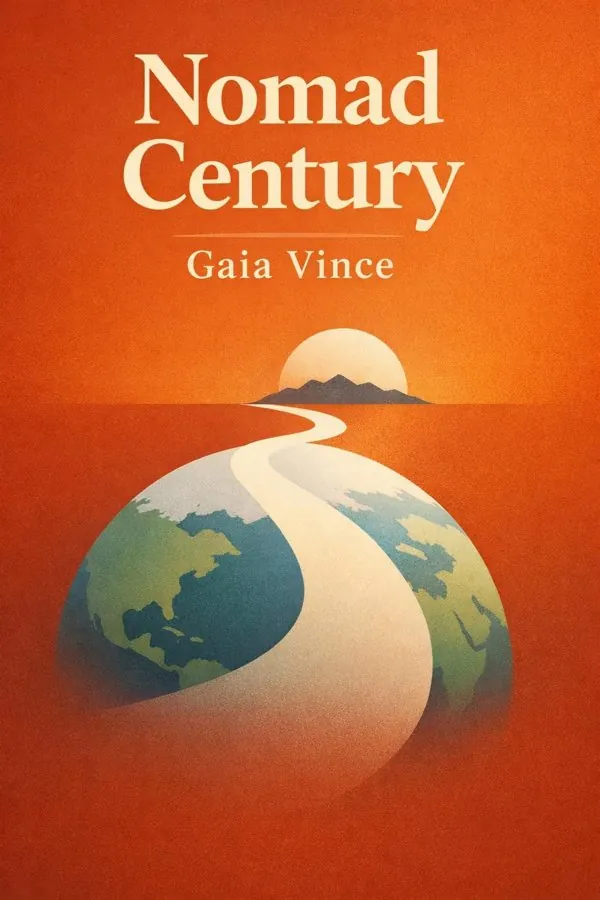
Nomad Century: How Climate Migration Will Reshape Our World: Summary & Key Insights
by Gaia Vince
 10 min10 chaptersAudio available
What Is Nomad Century: How Climate Migration Will Reshape Our World About?
Nomad Century: How Climate Migration Will Reshape Our World by Gaia Vince is a environment book spanning 10 pages. Nomad Century explores how climate change will force billions of people to migrate and how humanity can adapt to this unprecedented transformation. Gaia Vince argues that mass migration, if managed wisely, could lead to a more equitable and sustainable global society. The book combines scientific research, policy analysis, and human stories to envision a future shaped by mobility and resilience.
This FizzRead summary covers all 10 key chapters of Nomad Century: How Climate Migration Will Reshape Our World in approximately 10 minutes, distilling the most important ideas, arguments, and takeaways from Gaia Vince's work. Also available as an audio summary and Key Quotes Podcast.
Nomad Century: How Climate Migration Will Reshape Our World
Nomad Century explores how climate change will force billions of people to migrate and how humanity can adapt to this unprecedented transformation. Gaia Vince argues that mass migration, if managed wisely, could lead to a more equitable and sustainable global society. The book combines scientific research, policy analysis, and human stories to envision a future shaped by mobility and resilience.
Who Should Read Nomad Century: How Climate Migration Will Reshape Our World?
This book is perfect for anyone interested in environment and looking to gain actionable insights in a short read. Whether you're a student, professional, or lifelong learner, the key ideas from Nomad Century: How Climate Migration Will Reshape Our World by Gaia Vince will help you think differently.
- ✓Readers who enjoy environment and want practical takeaways
- ✓Professionals looking to apply new ideas to their work and life
- ✓Anyone who wants the core insights of Nomad Century: How Climate Migration Will Reshape Our World in just 10 minutes
Want the full summary?
Get instant access to this book summary and 100K+ more with Fizz Moment.
Get Free SummaryAvailable on App Store • Free to download
Key Chapters
Climate change is reshaping the habitable zones of the planet. According to the data I explore in *Nomad Century*, areas near the equator are rapidly approaching conditions that threaten human endurance. Heatwaves exceeding 40°C for weeks on end, collapsing crop yields, and seawater intrusion into fertile river deltas are not abstract predictions—they are realities unfolding now.
Scientific modeling reveals that by 2070, places home to more than three billion people could face temperatures considered physiologically unsafe for outdoor work or even survival. Combined with sea-level rise threatening major coastal megacities—from Mumbai to Jakarta, Lagos to Miami—the outcome is inevitable: people will move. Our task is no longer to prevent this movement but to prepare for it.
When I studied climate data from the Intergovernmental Panel on Climate Change (IPCC) and conversations with field researchers, a pattern emerged: the habitable world is shrinking southward and expanding northward. The poles, once inhospitable, are becoming viable. This geographic reshaping will reorder political and economic systems. The question becomes, how do we make this transformation humane?
Understanding the crisis means accepting its physical boundaries. The physics doesn’t negotiate; the only variable still malleable is how we respond collectively. If we fail to plan, chaos will follow. But if we anticipate, cooperate, and use migration as adaptation, then this crisis can catalyze a more balanced global future.
In the book, I trace plausible patterns of human movement across continents. We will see large-scale outflows from the tropics and low-lying coasts toward cooler zones—northern Europe, Canada, Siberia, and the Southern Cone of South America. Imagine entire agricultural systems uprooted and reformatted; imagine nations reconceived as shared territories of survival rather than isolated fortresses.
Migration will not be a uniform flow but a mosaic of millions of decisions—families leaving homes flooded by rising seas, workers seeking reliable rains, health systems relocating as disease zones shift. The models I analyze suggest that by the end of this century, billions could be on the move. And yet, instead of fearing this scale, I urge that we prepare to harness it.
Remote regions that today seem marginal—Arctic frontiers or northern forests—could become new centers of human activity. This redistribution might actually alleviate overcrowding in vulnerable megacities. Migration, if guided ethically, can be the mechanism through which humanity rebalances its footprint across Earth’s changing environments. The tragedy lies not in movement, but in resistance to it—when political borders trap those whose homes no longer sustain life.
+ 8 more chapters — available in the FizzRead app
All Chapters in Nomad Century: How Climate Migration Will Reshape Our World
About the Author
Gaia Vince is a British science journalist, broadcaster, and author. She has written for publications such as Nature, New Scientist, and The Guardian, and her work focuses on the intersection of science, environment, and society. Vince won the Royal Society Science Book Prize for her previous book, Adventures in the Anthropocene.
Get This Summary in Your Preferred Format
Read or listen to the Nomad Century: How Climate Migration Will Reshape Our World summary by Gaia Vince anytime, anywhere. FizzRead offers multiple formats so you can learn on your terms — all free.
Available formats: App · Audio · PDF · EPUB — All included free with FizzRead
Download Nomad Century: How Climate Migration Will Reshape Our World PDF and EPUB Summary
Key Quotes from Nomad Century: How Climate Migration Will Reshape Our World
“Climate change is reshaping the habitable zones of the planet.”
“In the book, I trace plausible patterns of human movement across continents.”
Frequently Asked Questions about Nomad Century: How Climate Migration Will Reshape Our World
Nomad Century: How Climate Migration Will Reshape Our World by Gaia Vince is a environment book that explores key ideas across 10 chapters. Nomad Century explores how climate change will force billions of people to migrate and how humanity can adapt to this unprecedented transformation. Gaia Vince argues that mass migration, if managed wisely, could lead to a more equitable and sustainable global society. The book combines scientific research, policy analysis, and human stories to envision a future shaped by mobility and resilience.
More by Gaia Vince
You Might Also Like

A Life on Our Planet: My Witness Statement and a Vision for the Future
David Attenborough
10 min
A Sky Full Of Birds
Matt Merritt
10 min
Carbon Zero: Imagining Cities That Can Save the Planet
Alex Steffen
10 min
Eaarth: Making a Life on a Tough New Planet
Bill McKibben
10 min
The Social Contract and Environmental Governance
Various Editors
10 min
The Wild Places
Robert Macfarlane
10 minBrowse by Category
Ready to read Nomad Century: How Climate Migration Will Reshape Our World?
Get the full summary and 100K+ more books with Fizz Moment.