
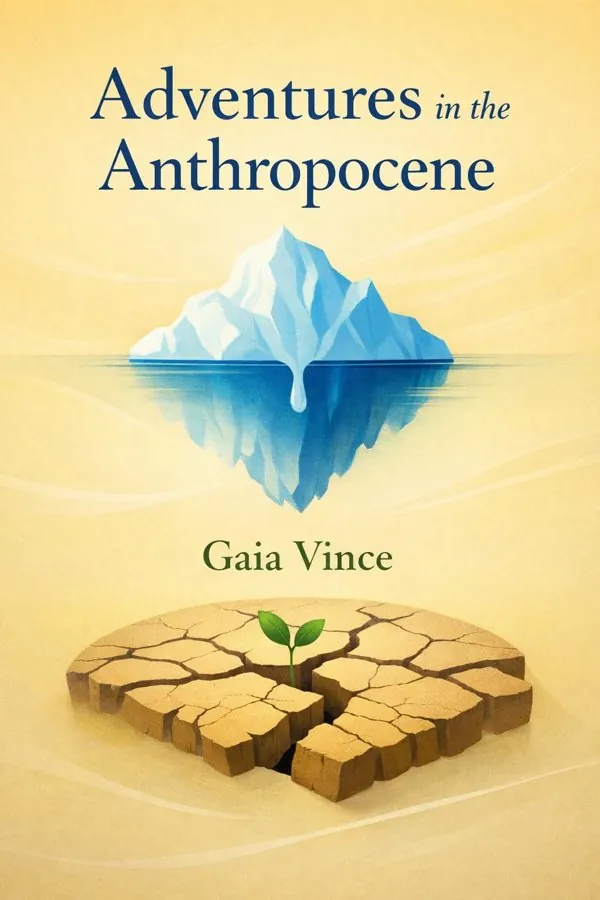
Adventures in the Anthropocene: A Journey to the Heart of the Planet We Made: Summary & Key Insights
by Gaia Vince
 10 min6 chaptersAudio available
What Is Adventures in the Anthropocene: A Journey to the Heart of the Planet We Made About?
Adventures in the Anthropocene: A Journey to the Heart of the Planet We Made by Gaia Vince is a environment book spanning 6 pages. In this book, science journalist Gaia Vince travels across the world to explore how humans have transformed the Earth in the Anthropocene epoch. She documents communities adapting to climate change, environmental degradation, and technological transformation, offering a vivid portrait of humanity’s impact and resilience.
This FizzRead summary covers all 6 key chapters of Adventures in the Anthropocene: A Journey to the Heart of the Planet We Made in approximately 10 minutes, distilling the most important ideas, arguments, and takeaways from Gaia Vince's work. Also available as an audio summary and Key Quotes Podcast.
Adventures in the Anthropocene: A Journey to the Heart of the Planet We Made
In this book, science journalist Gaia Vince travels across the world to explore how humans have transformed the Earth in the Anthropocene epoch. She documents communities adapting to climate change, environmental degradation, and technological transformation, offering a vivid portrait of humanity’s impact and resilience.
Who Should Read Adventures in the Anthropocene: A Journey to the Heart of the Planet We Made?
This book is perfect for anyone interested in environment and looking to gain actionable insights in a short read. Whether you're a student, professional, or lifelong learner, the key ideas from Adventures in the Anthropocene: A Journey to the Heart of the Planet We Made by Gaia Vince will help you think differently.
- ✓Readers who enjoy environment and want practical takeaways
- ✓Professionals looking to apply new ideas to their work and life
- ✓Anyone who wants the core insights of Adventures in the Anthropocene: A Journey to the Heart of the Planet We Made in just 10 minutes
Want the full summary?
Get instant access to this book summary and 100K+ more with Fizz Moment.
Get Free SummaryAvailable on App Store • Free to download
Key Chapters
We often imagine geological forces as enormous, slow, and impersonal: continents drifting, mountains rising, volcanoes exploding. Yet today, Homo sapiens has joined that geologic chorus. Our cities rival coral reefs in scale, our mines tunnel deeper than rivers carve, and our fertilizers alter the nitrogen cycle more profoundly than all the planet’s soils combined. When I first investigated this idea, scientists were still debating whether the Anthropocene should be formally recognized as a new epoch. But the evidence, written in the sediments and CO₂ concentrations, was already overwhelming.
Standing on the edge of a copper mine in South America or staring at the glowing skyline of Mumbai, I felt an uncanny realization: humans have become the planet’s most influential geomorphic agent. The sediments of the future will show our plastic, our concrete, our bones mingled with silicon chips. The Holocene, that gentle interglacial cradle that nurtured civilization, is gone. We are now in a self-made epoch, both creators and destroyers.
This transformation is not purely destructive—it is also profoundly creative. The Anthropocene is proof of humanity’s extraordinary capacity to innovate and to leave our mark, for better or worse. We have built systems that feed billions and technologies that bridge continents. The tragedy lies not in our capability, but in our blindness to its consequences. My journey began with a simple conviction: if we can become a geological force, we can also become a restorative one. But to do so, we must first confront the scale of what we’ve already changed.
In the Himalayas, the sight of disappearing glaciers is both majestic and terrifying. For centuries, the mountain ice acted as a natural reservoir, releasing water through the seasons. Now, as glaciers retreat at unprecedented rates, communities downstream face uncertainty: floods when too much meltwater comes at once, droughts when the frozen reserves vanish. In Nepal, I met families redefining their relationship with water, building ingenious channels and simple early-warning systems to adapt. Their resourcefulness spoke of both fragility and resilience.
Further south, in Bangladesh, life is a perpetual negotiation with water. Here, millions live in the delta where rivers and tides clash, creating land that rises and falls with every storm. The people I encountered were not naively enduring this reality—they were innovating around it. Floating schools, amphibious houses, and community savings schemes offered living proof that adaptation need not be a desperate reaction. It can be a creative, organized response. The delta, rather than a symbol of helplessness, became to me a microcosm of the Anthropocene itself—restless, inventive, and determined to persist.
This adaptability carries a quiet dignity. It reveals something profound about the human condition: that even when nature’s script changes completely, we keep rewriting our lines. The Himalayas and Bangladesh are not isolated tragedies—they are our collective laboratory for survival in a volatile world.
+ 4 more chapters — available in the FizzRead app
All Chapters in Adventures in the Anthropocene: A Journey to the Heart of the Planet We Made
About the Author
Gaia Vince is a British science writer, broadcaster, and journalist. She has worked for Nature, New Scientist, and BBC, and her work focuses on environmental science, climate change, and human adaptation. She won the Royal Society Science Book Prize for this book in 2015.
Get This Summary in Your Preferred Format
Read or listen to the Adventures in the Anthropocene: A Journey to the Heart of the Planet We Made summary by Gaia Vince anytime, anywhere. FizzRead offers multiple formats so you can learn on your terms — all free.
Available formats: App · Audio · PDF · EPUB — All included free with FizzRead
Download Adventures in the Anthropocene: A Journey to the Heart of the Planet We Made PDF and EPUB Summary
Key Quotes from Adventures in the Anthropocene: A Journey to the Heart of the Planet We Made
“We often imagine geological forces as enormous, slow, and impersonal: continents drifting, mountains rising, volcanoes exploding.”
“In the Himalayas, the sight of disappearing glaciers is both majestic and terrifying.”
Frequently Asked Questions about Adventures in the Anthropocene: A Journey to the Heart of the Planet We Made
Adventures in the Anthropocene: A Journey to the Heart of the Planet We Made by Gaia Vince is a environment book that explores key ideas across 6 chapters. In this book, science journalist Gaia Vince travels across the world to explore how humans have transformed the Earth in the Anthropocene epoch. She documents communities adapting to climate change, environmental degradation, and technological transformation, offering a vivid portrait of humanity’s impact and resilience.
More by Gaia Vince
You Might Also Like
A Life on Our Planet: My Witness Statement and a Vision for the Future
David Attenborough
10 min
A Sky Full Of Birds
Matt Merritt
10 min
Carbon Zero: Imagining Cities That Can Save the Planet
Alex Steffen
10 min
Eaarth: Making a Life on a Tough New Planet
Bill McKibben
10 min
The Social Contract and Environmental Governance
Various Editors
10 min
The Wild Places
Robert Macfarlane
10 minBrowse by Category
Ready to read Adventures in the Anthropocene: A Journey to the Heart of the Planet We Made?
Get the full summary and 100K+ more books with Fizz Moment.