
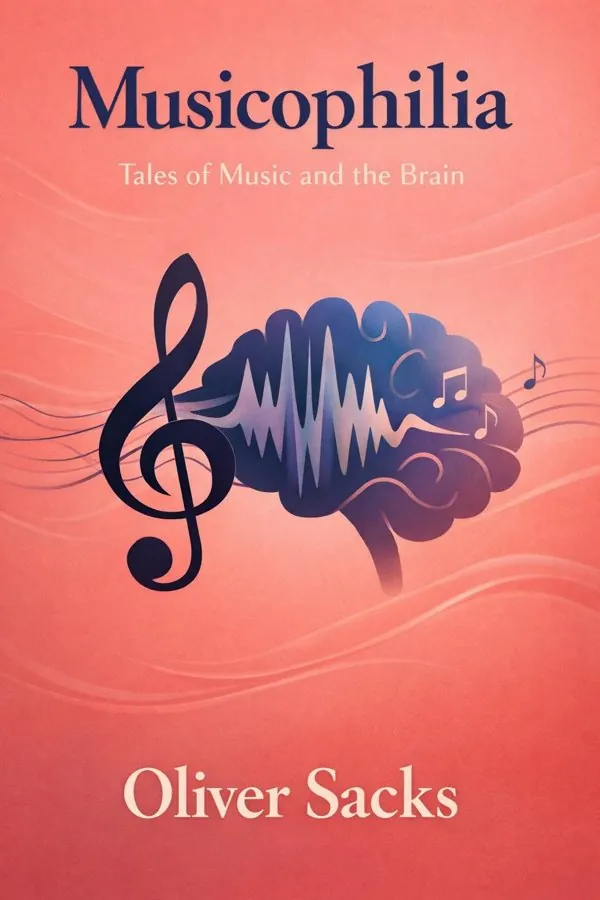
Musicophilia: Tales of Music and the Brain: Summary & Key Insights
by Oliver Sacks
 10 min9 chaptersAudio available
Key Takeaways from Musicophilia: Tales of Music and the Brain
Music is usually described as entertainment, but in some brains it arrives as a neurological storm.
We often assume music is universally accessible, yet for some people its basic structure never fully forms.
Few things reveal music’s power more clearly than its ability to call back a vanished past.
When movement breaks down, music can become a kind of external nervous system.
Music can move us to tears without making a single explicit statement.
What Is Musicophilia: Tales of Music and the Brain About?
Musicophilia: Tales of Music and the Brain by Oliver Sacks is a popular_sci book spanning 9 pages. Why does a melody unlock memories that seem otherwise lost? How can rhythm help a frozen body move again, or a song echo in the mind with such force that it feels physically real? In Musicophilia, neurologist Oliver Sacks investigates these questions through a series of vivid case studies showing how deeply music is woven into the human nervous system. Drawing on decades of clinical work, Sacks explores musical hallucinations, amusia, rhythmic disorders, synesthesia, savant abilities, dementia, and the remarkable ways music shapes identity, memory, and emotion. His great gift is to combine scientific curiosity with unusual compassion: patients are never reduced to symptoms, but presented as whole people whose lives are altered by music in surprising ways. The book matters because it reveals that music is not a cultural luxury or decorative art form; it is a force that can organize movement, awaken feeling, summon the past, and sometimes expose the brain’s hidden architecture. For readers interested in neuroscience, psychology, medicine, or simply the mystery of being human, Musicophilia offers an unforgettable tour of the musical mind.
This FizzRead summary covers all 9 key chapters of Musicophilia: Tales of Music and the Brain in approximately 10 minutes, distilling the most important ideas, arguments, and takeaways from Oliver Sacks's work. Also available as an audio summary and Key Quotes Podcast.
Musicophilia: Tales of Music and the Brain
Why does a melody unlock memories that seem otherwise lost? How can rhythm help a frozen body move again, or a song echo in the mind with such force that it feels physically real? In Musicophilia, neurologist Oliver Sacks investigates these questions through a series of vivid case studies showing how deeply music is woven into the human nervous system. Drawing on decades of clinical work, Sacks explores musical hallucinations, amusia, rhythmic disorders, synesthesia, savant abilities, dementia, and the remarkable ways music shapes identity, memory, and emotion. His great gift is to combine scientific curiosity with unusual compassion: patients are never reduced to symptoms, but presented as whole people whose lives are altered by music in surprising ways. The book matters because it reveals that music is not a cultural luxury or decorative art form; it is a force that can organize movement, awaken feeling, summon the past, and sometimes expose the brain’s hidden architecture. For readers interested in neuroscience, psychology, medicine, or simply the mystery of being human, Musicophilia offers an unforgettable tour of the musical mind.
Who Should Read Musicophilia: Tales of Music and the Brain?
This book is perfect for anyone interested in popular_sci and looking to gain actionable insights in a short read. Whether you're a student, professional, or lifelong learner, the key ideas from Musicophilia: Tales of Music and the Brain by Oliver Sacks will help you think differently.
- ✓Readers who enjoy popular_sci and want practical takeaways
- ✓Professionals looking to apply new ideas to their work and life
- ✓Anyone who wants the core insights of Musicophilia: Tales of Music and the Brain in just 10 minutes
Want the full summary?
Get instant access to this book summary and 100K+ more with Fizz Moment.
Get Free SummaryAvailable on App Store • Free to download
Key Chapters
Music is usually described as entertainment, but in some brains it arrives as a neurological storm. Sacks opens by showing that music can appear not only as something we choose to hear, but as something the brain generates on its own. Certain patients experience musical hallucinations in which songs, hymns, or orchestral passages play internally with extraordinary clarity. Others suffer musical seizures, where bursts of melody are linked to abnormal electrical activity in the brain. These experiences are not signs of madness so much as evidence that musical circuits can misfire, overactivate, or release stored patterns independently of external sound.
Sacks is careful to distinguish musical hallucinations from ordinary earworms. A catchy tune stuck in your head is common and usually mild; a hallucination can be relentless, intrusive, and emotionally confusing. It may occur in people with hearing loss, neurological damage, epilepsy, or sensory deprivation. In such cases, the brain seems to compensate for missing input by creating its own. The phenomenon resembles phantom limb pain or visual hallucinations in blindness: when expected signals disappear, the nervous system may fill the silence.
This idea changes how we think about music. It suggests that the brain is prepared for music at a deep level, storing and replaying it with astonishing fidelity. It also shows why clinicians must listen carefully to patients whose symptoms seem bizarre. What sounds strange may reveal a lawful, even meaningful, brain process.
In everyday life, this chapter invites us to respect persistent internal music rather than dismissing it casually. If musical experiences become distressing, repetitive, or linked to hearing changes, they deserve medical attention. Actionable takeaway: notice the difference between normal mental replay and intrusive musical perception, and treat unusual changes in hearing or internal sound as important signals worth discussing with a professional.
We often assume music is universally accessible, yet for some people its basic structure never fully forms. Sacks explores disorders that disrupt musical perception, from amusia to rhythm blindness, showing that the ability to hear music meaningfully depends on specialized brain systems. A person with amusia may hear notes but fail to recognize melody, pitch relationships, or even whether a familiar song is being sung correctly. Another may understand melody yet struggle to follow tempo or beat. These deficits reveal that music is not a single faculty but a network of distinct capacities.
This matters because it challenges romantic ideas about talent and taste. Someone who seems uninterested in music may not be indifferent at all; they may perceive it in a fragmented or distorted way. Conversely, a person can lose musical abilities after stroke, injury, or disease while remaining fully articulate in language. The separation between music and speech, though incomplete, is striking. Sacks shows that musical breakdowns can be highly selective: a trained musician may preserve technical memory but lose emotional responsiveness, or retain rhythmic skill while losing pitch discrimination.
Practical examples make the point vivid. In education, recognizing musical processing differences can prevent unfair judgments about ability. In rehabilitation, specific deficits can be assessed rather than assuming all musical function rises or falls together. Even in ordinary listening, the chapter encourages humility: what sounds obvious to one brain may be inaccessible to another.
Actionable takeaway: avoid assuming everyone hears music the way you do. If a child or adult struggles unusually with melody, rhythm, or tuning, consider that a perceptual difference—not laziness or lack of taste—may be involved, and seek informed evaluation or adapted musical instruction.
Few things reveal music’s power more clearly than its ability to call back a vanished past. Sacks describes patients with dementia, amnesia, or neurological injury who appear detached from time and self, yet become vividly present when they hear songs tied to earlier life. Music can recover not just information but atmosphere: a person may not recall names or recent events, but a hymn, folk tune, or dance song can restore emotional continuity and awaken recognition. In these moments, memory is not retrieved as a dry fact. It returns as lived experience.
Sacks shows that musical memory often remains resilient even when other forms of memory decay. This may be because music is widely distributed across the brain, involving rhythm, emotion, motor planning, expectation, and autobiographical association. A familiar song becomes a densely encoded pattern. It is not merely remembered; it is embodied. That helps explain why patients can sing lyrics they could not speak, or why those with severe dementia become animated, attentive, and emotionally connected during musical sessions.
The applications are immediate. Caregivers can use personalized playlists to reduce agitation, encourage social interaction, and create moments of recognition. Families can reconnect with loved ones through songs from adolescence, religious practice, or cultural traditions. Therapists can use singing to support speech recovery and orientation.
But Sacks also offers a caution: music is powerful because it touches deep memory, so it must be chosen thoughtfully. Songs can soothe, but they can also stir grief or confusion if they evoke painful associations.
Actionable takeaway: build a personal or family “memory playlist” of meaningful songs, especially for aging relatives, and use it intentionally to foster comfort, communication, and a sense of identity.
When movement breaks down, music can become a kind of external nervous system. One of Sacks’s most fascinating themes is the bond between rhythm and motion. Patients with Parkinson’s disease, Tourette syndrome, or other movement disorders may struggle to initiate or coordinate action in ordinary circumstances, yet a strong beat can help them walk, dance, or perform complex sequences with surprising fluency. Rhythm provides structure where internal timing has become unreliable.
This is not simply motivational. Sacks shows that musical rhythm can entrain the body, giving it a patterned scaffold for action. A patient who freezes while trying to cross a room may move steadily when a march begins. A person whose gestures are disorganized may become coherent while playing or responding to music. The brain seems able to recruit auditory timing circuits to support motor systems that are faltering. In effect, music can bypass or compensate for impaired pathways.
The implications extend beyond neurology clinics. Physical therapists use metronomes and rhythmic cues in gait training. Athletes rely on tempo for pacing and coordination. Even healthy people often find that work, walking, or exercise improves when synchronized to sound. Rhythm helps regulate effort, expectation, and momentum.
Still, Sacks never claims that music is magic. Its effects may be temporary, variable, and highly individual. Some rhythms liberate; others overstimulate. The art lies in matching pattern, tempo, and context to the person.
Actionable takeaway: if movement feels hesitant, uncoordinated, or effortful—whether in exercise, rehabilitation, or daily routine—experiment with steady rhythmic cues such as clapping, counting, a metronome, or carefully chosen music to create more reliable motion.
Music can move us to tears without making a single explicit statement. Sacks examines this mystery by showing that emotional response to music is not a superficial add-on but a central feature of how the brain processes sound. A melody can create tension, release, longing, triumph, dread, or peace through pattern alone. Even people with language impairment or cognitive decline may remain intensely responsive to these emotional contours. Music speaks where explanation fails.
What makes this especially compelling is that musical emotion is both universal and personal. Certain features—tempo, loudness, harmonic tension, rhythmic drive—reliably shape mood across many listeners. Yet individual history gives songs their deepest force. A wartime ballad, a lullaby, a religious chant, or a dance tune can carry entire emotional worlds because it has been woven into life events. Sacks repeatedly shows that patients may not fully understand what is happening to them cognitively, but they can still be reached affectively through music.
This has practical value in settings where ordinary communication is limited. Music can reduce isolation in dementia care, support emotional regulation in mental health treatment, and provide comfort in illness. It can also expose vulnerability: because music accesses feeling so directly, it may overwhelm or unsettle as easily as it consoles.
For everyday readers, Sacks offers a more refined understanding of why playlists matter. We do not listen only for pleasure. We use music to intensify, discharge, contain, or reorganize feeling.
Actionable takeaway: become more deliberate about the emotional role of music in your life. Instead of listening passively, create different playlists for calming, focusing, grieving, energizing, or reflecting, and notice how specific musical features alter your state.
Some people do not merely hear music—they see colors, shapes, textures, or movements when notes unfold. In Sacks’s discussion of musical imagery and synesthesia, music becomes a window into the brain’s astonishing capacity to link one sensory domain with another. Synesthetes may experience a key signature as blue, a trumpet line as angular, or a chord progression as spatial architecture. Others have extraordinarily vivid inner hearing, able to imagine entire compositions in detail without any external performance. These cases blur the boundary between perception and imagination.
Sacks does not treat such experiences as curiosities alone. They show that the brain is an associative organ, constantly integrating pattern across systems. Musical thought may recruit visual, spatial, motor, and emotional networks all at once. This helps explain why composers can “hear” music internally before writing it down, why conductors can follow complex scores mentally, and why listeners often describe music in visual or tactile language. Metaphor may be closer to mechanism than we think.
The chapter also reminds us that imagination is not secondary to perception. Rehearsing a melody internally can strengthen memory, improve performance, and deepen attention. Students can benefit from silent practice; listeners can enrich experience by noticing what images or movements music evokes in them.
In a culture that often privileges measurable output, Sacks restores value to interior experience. The mind’s private concert hall is not an illusion of lesser importance but a core part of musical life.
Actionable takeaway: after listening to a piece of music, pause and describe the images, colors, shapes, or bodily sensations it evokes. This simple habit can sharpen attention, deepen memory, and reveal your own unique mode of musical perception.
Identity is often imagined as something stable and inward, but Sacks shows how deeply it depends on rhythm, memory, habit, and repeated forms of expression. Music can preserve or restore a sense of self when disease, injury, or age begins to erode continuity. A person with dementia who seems absent may become recognizably themselves while singing a beloved song. Someone with autism may find in music a reliable structure for communication. A performer who loses ordinary conversation after brain injury may still retain a musical persona of remarkable coherence.
What music preserves is not just information about the self but style, temperament, and relation to others. A favorite repertoire encodes values, background, generation, faith, rebellion, longing. The songs we know by heart are often social biographies. Through them, people recover not merely memory but belonging. Sacks’s case studies repeatedly show that music can anchor individuals whose neurological conditions otherwise fragment experience.
This has practical applications in families, schools, and care environments. Asking “What music matters to this person?” may reveal more than asking abstract questions about preference. Shared singing can reduce social distance. Familiar music can support transitions and routines. Personal musical history can guide compassionate care better than generic entertainment.
Sacks’s larger point is profoundly humane: identity is not stored in a single brain region waiting to be damaged. It is enacted through patterns, relationships, and forms of expression, and music is one of the strongest of those forms.
Actionable takeaway: treat musical preferences as part of personal identity. Whether caring for a loved one or understanding yourself, make a record of meaningful songs, artists, and rituals, because they may become powerful anchors in times of stress or cognitive change.
Music can heal, but not in the simplistic way popular culture sometimes suggests. Sacks presents case after case in which music reduces suffering, restores function, or opens communication where medicine alone cannot reach. Yet he is equally clear that music is not a universal cure. Its power lies in specificity: the right sound, rhythm, memory, or musical relationship can transform a person’s state, but effects depend on diagnosis, context, and individual history.
This balanced view is one of the book’s greatest strengths. Music therapy is not mystical background ambiance. It can involve rhythm for gait training, singing for speech recovery, familiar songs for dementia care, improvisation for emotional contact, or structured listening for mood regulation. In each case, music works because it engages existing neural capacities—timing, memory, anticipation, affect, motor coordination—and recruits them in purposeful ways. The therapist’s skill lies in careful observation and adaptation.
Sacks also warns against reducing music to mere utility. Music heals partly because it is meaningful, not because it is a mechanical tool. A song matters when it carries history, beauty, agency, or connection. That is why personalized musical interventions often outperform generic ones.
For readers, the practical lesson is wide-ranging. Music can support concentration, recovery, social bonding, grief processing, and resilience. But it should be applied experimentally and reflectively rather than as a one-size-fits-all solution.
Actionable takeaway: use music as a deliberate support, not a vague remedy. Identify a specific need—calming anxiety, improving exercise, aiding memory, easing loneliness—and test particular songs or rhythms, adjusting based on actual response rather than assumption.
All Chapters in Musicophilia: Tales of Music and the Brain
About the Author
Oliver Sacks (1933–2015) was a British neurologist, essayist, and bestselling author celebrated for bringing the mysteries of the brain to a wide audience. Educated at Oxford and later based in the United States, he combined clinical expertise with an unusually literary approach to medicine. His books, including Awakenings, The Man Who Mistook His Wife for a Hat, An Anthropologist on Mars, and Musicophilia, used case histories to explore neurological disorders while preserving the individuality and dignity of his patients. Sacks wrote with empathy, curiosity, and clarity, making complex science accessible without stripping it of wonder. He remains one of the most influential medical writers of the modern era.
Get This Summary in Your Preferred Format
Read or listen to the Musicophilia: Tales of Music and the Brain summary by Oliver Sacks anytime, anywhere. FizzRead offers multiple formats so you can learn on your terms — all free.
Available formats: App · Audio · PDF · EPUB — All included free with FizzRead
Download Musicophilia: Tales of Music and the Brain PDF and EPUB Summary
Key Quotes from Musicophilia: Tales of Music and the Brain
“Music is usually described as entertainment, but in some brains it arrives as a neurological storm.”
“We often assume music is universally accessible, yet for some people its basic structure never fully forms.”
“Few things reveal music’s power more clearly than its ability to call back a vanished past.”
“When movement breaks down, music can become a kind of external nervous system.”
“Music can move us to tears without making a single explicit statement.”
Frequently Asked Questions about Musicophilia: Tales of Music and the Brain
Musicophilia: Tales of Music and the Brain by Oliver Sacks is a popular_sci book that explores key ideas across 9 chapters. Why does a melody unlock memories that seem otherwise lost? How can rhythm help a frozen body move again, or a song echo in the mind with such force that it feels physically real? In Musicophilia, neurologist Oliver Sacks investigates these questions through a series of vivid case studies showing how deeply music is woven into the human nervous system. Drawing on decades of clinical work, Sacks explores musical hallucinations, amusia, rhythmic disorders, synesthesia, savant abilities, dementia, and the remarkable ways music shapes identity, memory, and emotion. His great gift is to combine scientific curiosity with unusual compassion: patients are never reduced to symptoms, but presented as whole people whose lives are altered by music in surprising ways. The book matters because it reveals that music is not a cultural luxury or decorative art form; it is a force that can organize movement, awaken feeling, summon the past, and sometimes expose the brain’s hidden architecture. For readers interested in neuroscience, psychology, medicine, or simply the mystery of being human, Musicophilia offers an unforgettable tour of the musical mind.
More by Oliver Sacks


You Might Also Like

Structures: Or Why Things Don"t Fall Down
J.E. Gordon
10 min
The Road to Wigan Pier
George Orwell
10 min
Bonk: The Curious Coupling of Science and Sex
Mary Roach
10 min
First Bite: How We Learn to Eat
Bee Wilson
10 min
In Pursuit Of The Unknown: 17 Equations That Changed The World
Ian Stewart
10 min
Napoleon's Buttons: 17 Molecules That Changed History
Penny Le Couteur and Jay Burreson
10 minBrowse by Category
Ready to read Musicophilia: Tales of Music and the Brain?
Get the full summary and 100K+ more books with Fizz Moment.