
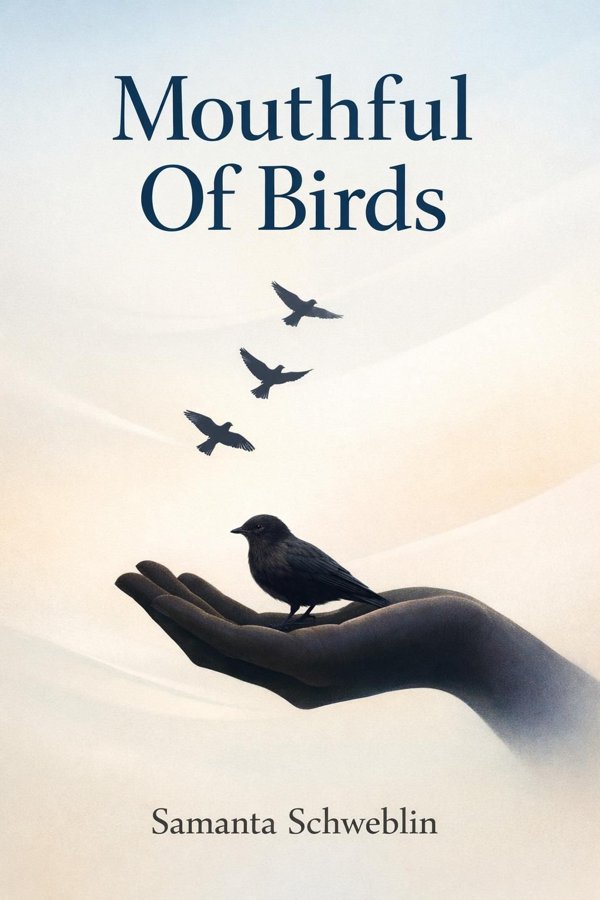
Mouthful Of Birds (Spanish Edition): Summary & Key Insights
 10 min10 chaptersAudio available
Key Takeaways from Mouthful Of Birds (Spanish Edition)
The most disturbing stories are often the ones that begin in perfect normality.
When a character changes in an inexplicable way, the change is rarely the real subject.
Affection does not cancel fear; sometimes it deepens it.
What cannot be said shapes these stories as strongly as what is spoken aloud.
Social norms often appear natural until they are pushed to their limit.
What Is Mouthful Of Birds (Spanish Edition) About?
Mouthful Of Birds (Spanish Edition) by Samanta Schweblin is a bestsellers book spanning 10 pages. Mouthful Of Birds (Spanish Edition) is a haunting collection of short stories by Argentine writer Samanta Schweblin, a master of literary unease. Across these twenty stories, Schweblin turns ordinary scenes—a family meal, a neighborhood visit, a trip, a conversation—into sites of dread, absurdity, and uncanny revelation. Her characters are often not heroic or extraordinary people; they are parents, children, spouses, travelers, and workers whose realities begin to tilt in subtle but devastating ways. What makes the collection so powerful is not shock for its own sake, but the precision with which Schweblin exposes hidden fears inside everyday life: fear of losing control, fear of misunderstanding those we love, fear of bodies changing, fear of social rules becoming grotesque. Schweblin is uniquely qualified to guide readers into this territory. Internationally celebrated for works such as Fever Dream and Little Eyes, she has built a reputation for combining psychological realism with surreal disruption. This collection matters because it captures a distinctly modern anxiety: the sense that beneath normal life, something incomprehensible is always waiting. It is a book that unsettles, lingers, and invites repeated reading.
This FizzRead summary covers all 10 key chapters of Mouthful Of Birds (Spanish Edition) in approximately 10 minutes, distilling the most important ideas, arguments, and takeaways from Samanta Schweblin's work. Also available as an audio summary and Key Quotes Podcast.
Mouthful Of Birds (Spanish Edition)
Mouthful Of Birds (Spanish Edition) is a haunting collection of short stories by Argentine writer Samanta Schweblin, a master of literary unease. Across these twenty stories, Schweblin turns ordinary scenes—a family meal, a neighborhood visit, a trip, a conversation—into sites of dread, absurdity, and uncanny revelation. Her characters are often not heroic or extraordinary people; they are parents, children, spouses, travelers, and workers whose realities begin to tilt in subtle but devastating ways. What makes the collection so powerful is not shock for its own sake, but the precision with which Schweblin exposes hidden fears inside everyday life: fear of losing control, fear of misunderstanding those we love, fear of bodies changing, fear of social rules becoming grotesque. Schweblin is uniquely qualified to guide readers into this territory. Internationally celebrated for works such as Fever Dream and Little Eyes, she has built a reputation for combining psychological realism with surreal disruption. This collection matters because it captures a distinctly modern anxiety: the sense that beneath normal life, something incomprehensible is always waiting. It is a book that unsettles, lingers, and invites repeated reading.
Who Should Read Mouthful Of Birds (Spanish Edition)?
This book is perfect for anyone interested in bestsellers and looking to gain actionable insights in a short read. Whether you're a student, professional, or lifelong learner, the key ideas from Mouthful Of Birds (Spanish Edition) by Samanta Schweblin will help you think differently.
- ✓Readers who enjoy bestsellers and want practical takeaways
- ✓Professionals looking to apply new ideas to their work and life
- ✓Anyone who wants the core insights of Mouthful Of Birds (Spanish Edition) in just 10 minutes
Want the full summary?
Get instant access to this book summary and 100K+ more with Fizz Moment.
Get Free SummaryAvailable on App Store • Free to download
Key Chapters
The most disturbing stories are often the ones that begin in perfect normality. One of Schweblin’s great strengths in Mouthful Of Birds is her refusal to announce the bizarre too early. She starts with recognizable rhythms: someone visits family, a couple argues, a person travels, a child behaves strangely. The prose is controlled and observant, which makes the eventual rupture feel even more powerful. Instead of building fantasy worlds from scratch, Schweblin sabotages the world we already know.
This technique matters because it reflects how fear often works in real life. Catastrophe rarely arrives with dramatic music. It slips into routine. A conversation suddenly feels wrong. A familiar behavior takes on a monstrous shape. A harmless situation reveals an abyss beneath it. In Schweblin’s stories, the surreal is not an escape from reality but an intensification of it. The ordinary setting becomes the stage where hidden anxieties finally show themselves.
Readers can apply this insight beyond literature. The collection trains us to notice how much of daily life depends on fragile assumptions: that families are stable, that language communicates clearly, that social rules make sense, that bodies behave predictably. When those assumptions wobble, our sense of reality shifts with them. In this way, Schweblin’s fiction sharpens perception. It encourages us to look at the familiar more carefully and ask what tensions it may be concealing.
Actionable takeaway: Pay attention to the moments in your own life that seem ordinary but feel slightly off; those moments often reveal deeper truths about fear, desire, and control.
Affection does not cancel fear; sometimes it deepens it. One of the most memorable features of Mouthful Of Birds is its treatment of family life as a place where tenderness and terror coexist. Parents and children, husbands and wives, siblings and relatives all appear in relationships shaped by obligation, misunderstanding, guilt, and dependence. The family in Schweblin’s fiction is not a safe refuge from chaos. It is often the very place where chaos acquires its most intimate form.
What makes these stories so effective is that the emotional logic remains recognizable even when the events turn surreal. A parent may be horrified by a child’s inexplicable behavior, but beneath the horror lies a familiar question: how well can we ever know the people we love? A spouse may face absurd circumstances, yet the deeper conflict concerns resentment, silence, or emotional distance that was already present. The uncanny event does not create the fracture; it reveals it.
This is why the collection feels so resonant. Many readers recognize the experience of performing family roles while privately feeling confusion, exhaustion, or alienation. Schweblin shows how love can contain domination, how care can hide denial, and how proximity can magnify mystery. Families are expected to interpret one another correctly, yet they often fail at the moments that matter most.
Practically, this invites reflection on the assumptions we carry into intimate relationships. We may believe that closeness guarantees understanding, but Schweblin insists otherwise. Love requires attention, curiosity, and humility because the people nearest to us remain partially unknowable.
Actionable takeaway: In your closest relationships, replace certainty with genuine inquiry; ask better questions and make room for the possibility that love does not automatically equal understanding.
What cannot be said shapes these stories as strongly as what is spoken aloud. Schweblin is exceptionally skilled at building tension through conversational gaps, evasions, half-explanations, and failed attempts at communication. In Mouthful Of Birds, dialogue rarely resolves uncertainty. Instead, words circle around what matters, exposing the limits of language when people confront the bizarre, the shameful, or the emotionally unbearable.
This breakdown of communication is central to the book’s atmosphere. Characters often know that something is wrong, but they cannot articulate it in a way that restores order. Others hear the words but miss the meaning. The result is a world in which misunderstanding becomes existential rather than merely social. Silence is not empty; it is charged with fear, denial, and power.
This insight extends beyond literature. In daily life, people frequently communicate indirectly, especially around grief, conflict, illness, desire, or family tension. We soften, deflect, joke, or remain quiet because direct speech feels dangerous. Schweblin dramatizes the consequences of that reluctance. Her stories suggest that unspoken realities do not disappear; they become more distorted, more haunting, and harder to contain.
For readers, this makes the collection a lesson in listening. Not every truth arrives as a clear statement. Tone, omission, repetition, and discomfort often reveal more than explicit explanation. Whether in work, relationships, or self-understanding, communication requires sensitivity to what is being withheld as much as to what is being declared.
Actionable takeaway: The next time a conversation feels incomplete, pay attention to hesitation, avoidance, and emotional tone; often the most important meaning lies in what no one is fully able to say.
Social norms often appear natural until they are pushed to their limit. In Mouthful Of Birds, Schweblin repeatedly places men and women inside situations that expose the strangeness of expected gender behavior. Duties, performances, and assumptions about masculinity and femininity do not disappear in these stories; they become exaggerated, unstable, and sometimes grotesque. By bending reality, Schweblin reveals how reality itself is already full of absurd scripts.
Her stories are not didactic manifestos, but they are acutely aware of power. Women are often expected to nurture, tolerate, interpret, or endure. Men are often expected to control, dismiss, or remain emotionally legible only in limited ways. When a surreal event interrupts ordinary life, these roles are tested. Characters may cling to familiar identities even as those identities stop making sense. The result can be darkly funny, deeply sad, or terrifying.
This matters because readers can recognize how social expectations shape perception before anyone speaks. A strange child may be viewed differently depending on whether the mother or father responds. A crisis may expose who is allowed vulnerability and who is required to maintain composure. Schweblin does not preach these dynamics; she stages them, allowing their irrationality to emerge naturally.
The practical application is reflection. Many interpersonal conflicts are not only personal but structural. We inherit scripts for marriage, parenting, desire, authority, and care. When those scripts fail, we often blame individuals instead of questioning the role itself. Schweblin’s fiction urges us to examine the architecture beneath behavior.
Actionable takeaway: When a relationship feels trapped in repetition, ask which gendered assumptions are silently organizing expectations, and consider what would change if those scripts were questioned.
Animals in Schweblin’s fiction are never merely decorative. In Mouthful Of Birds, they function as mirrors, disturbances, and reminders that human beings are not as rational or civilized as they prefer to believe. Whether animals appear directly or are evoked through bodily instinct, appetite, territory, and fear, they blur the line between culture and nature. They remind readers that beneath social rules lies a more primitive layer of behavior.
This is one reason the collection feels so physically unsettling. The body in these stories is not a passive container for thought. It hungers, recoils, decays, desires, and reacts before language can catch up. Animal imagery intensifies this effect by showing how thin the barrier is between human self-image and instinctive survival. Characters may try to maintain dignity or normality, but something raw keeps pressing through.
The practical power of this idea lies in its honesty. Modern life encourages people to treat themselves as orderly, coherent, and self-controlled. Yet stress, desire, fear, jealousy, and grief often reveal behavior that feels almost animal in its immediacy. Schweblin does not romanticize instinct, but she refuses to let readers ignore it. She shows that denial of our embodied nature can make us less self-aware, not more civilized.
For readers, the stories become opportunities to think about what is repressed in everyday conduct. Why do certain reactions feel embarrassing? Why do appetite, aggression, or vulnerability seem threatening? Schweblin suggests that what we call monstrous may simply be the human animal surfacing in a context that forbids acknowledgment.
Actionable takeaway: Notice your bodily reactions before you explain them away; instinct often reveals truths about boundaries, fear, and desire that the conscious mind tries to hide.
People often imagine travel as expansion, freedom, or discovery, but Schweblin is more interested in what movement destabilizes. In Mouthful Of Birds, journeys, waiting rooms, roads, stations, hotels, and transitional spaces become psychological laboratories. Away from fixed routines, characters lose the structures that usually confirm who they are. The result is not liberation alone but vulnerability. In between places, identity loosens.
This fascination with liminal space gives the collection much of its eerie momentum. A person in transit is already partially dislocated: detached from home, uncertain of destination, dependent on systems and strangers. Schweblin exploits that condition brilliantly. The unfamiliar environment does not simply contain danger; it amplifies the character’s inability to interpret what is happening. The world feels less stable because the self is less anchored.
Readers can connect this to many modern experiences that are not literal travel. Career changes, divorce, immigration, adolescence, illness, and grief all produce liminality. You are no longer who you were, but not yet someone new. In such states, small disruptions feel enormous because the normal coordinates are gone. Schweblin captures that emotional geography with remarkable economy.
Her stories also challenge the fantasy that movement automatically produces clarity. Sometimes distance from home does not reveal truth; it reveals how much uncertainty was already there. Transitional spaces strip away routine and expose the fragile rituals that make life feel coherent.
Actionable takeaway: When you find yourself in a transitional period, resist the urge to force immediate certainty; instead, treat disorientation as information about what old structures no longer fit.
The most chilling violence in Mouthful Of Birds is not always spectacular. Schweblin understands that harm often enters quietly—through habit, neglect, bureaucracy, emotional coldness, social indifference, or a single irrational act that breaks the surface of routine. Her stories repeatedly suggest that normality is not the opposite of violence. It is often the condition that makes violence harder to detect until it is too late.
This is what gives the collection its moral force. Readers are not simply frightened by strange events; they are confronted with the fragility of the systems that make ordinary life feel secure. A family meal, a neighborhood exchange, a domestic arrangement, or a public setting can suddenly reveal hidden menace. The point is not that the world is always catastrophic, but that catastrophe often depends on structures we have stopped noticing.
In practical terms, Schweblin’s fiction trains attention toward subtle forms of threat. Emotional cruelty, social exclusion, coercive care, and numbed spectatorship can be as destabilizing as overt brutality. Her characters are often trapped not only by events but by the inability of others to recognize danger in time. That dynamic feels especially contemporary in a world where people grow used to low-level crisis.
The stories encourage ethical alertness. What appears harmless may rest on someone else’s fear or erasure. What passes for normal may contain deeply unequal power. Schweblin never turns this into a lecture. Instead, she allows readers to feel how quickly everyday order can convert into dread.
Actionable takeaway: Reexamine situations you instinctively label normal and ask who feels safe within them, who does not, and what kinds of harm familiarity may be hiding.
Many stories are forgotten because they explain themselves too completely. Schweblin does the opposite. In Mouthful Of Birds, ambiguity is not a decorative literary trick; it is the engine of the book’s afterlife in the reader’s mind. She leaves motives partially obscured, events only partly interpretable, and endings unresolved enough to keep generating thought. The result is not confusion for its own sake but a disciplined openness that respects the complexity of fear and perception.
This ambiguity works because Schweblin gives readers enough concrete detail to stay emotionally invested while refusing to provide the kind of closure that would neutralize the story’s tension. We know what characters experience, but not always how to classify it. Is the event supernatural, psychological, symbolic, or social? Often the answer is productively all at once. That uncertainty mimics the way real crises are lived before they are explained.
For readers, the practical lesson is that not everything valuable can be reduced to a single interpretation. Modern habits of reading often push us to decode quickly, summarize neatly, and move on. Schweblin resists that impulse. She asks for tolerance of uncertainty, for attention to mood, pattern, and implication. In return, she offers a richer, more participatory reading experience.
This is also why the collection rewards rereading. Once the demand for simple explanation fades, different emotional and symbolic layers become visible. Ambiguity becomes a method of depth rather than obscurity.
Actionable takeaway: Instead of forcing a final interpretation, sit with the questions a story leaves behind; unresolved meaning can be a sign that the work is engaging reality at a deeper level.
At the heart of Mouthful Of Birds lies a profound loneliness. Even when characters are surrounded by family, neighbors, or strangers, they often remain fundamentally isolated inside private perceptions that no one else can fully access. Schweblin’s minimalist style intensifies this effect. She uses clean, precise language rather than elaborate explanation, allowing emptiness, repetition, and emotional distance to shape the reading experience. The spare surface makes the isolation feel sharper.
This final movement toward a kind of minimalist realism is one of the collection’s quiet achievements. After all the uncanny events, what lingers is not simply strangeness but the recognition that reality itself can feel unshareable. People inhabit different versions of the same moment. They fail to bridge the gap. The surreal elements heighten this truth, but they do not replace it. The deepest terror may be that our inner lives remain inaccessible even to those closest to us.
This idea resonates strongly in contemporary life, where connection is constant yet understanding is often shallow. People can report, perform, and signal emotion endlessly while still feeling unseen. Schweblin captures a more intimate version of that condition: the inability to communicate the thing that matters most before it hardens into estrangement.
For readers, the collection offers a paradoxical comfort. By depicting radical isolation so clearly, it creates recognition. The stories say that disconnection is not a personal failure alone; it is part of the human condition. Seeing that condition honestly can become its own form of clarity.
Actionable takeaway: Make space for slower, more attentive forms of connection, because being physically present or verbally active is not the same as truly entering another person’s reality.
All Chapters in Mouthful Of Birds (Spanish Edition)
About the Author
Samanta Schweblin is an Argentine writer born in Buenos Aires in 1978 and widely regarded as one of the most important contemporary authors writing in Spanish. She is celebrated for fiction that combines precision, psychological tension, and surreal disruption, often turning ordinary situations into deeply unsettling experiences. Her work has been translated into more than twenty languages and has received significant international recognition, including the Casa de las Américas Prize and shortlist honors connected to the International Booker Prize. Schweblin is best known for books such as Fever Dream, Little Eyes, and Mouthful Of Birds. Across novels and short stories alike, she has developed a distinctive literary voice—economical, haunting, and emotionally exact—that has earned her a devoted global readership and a central place in contemporary world literature.
Get This Summary in Your Preferred Format
Read or listen to the Mouthful Of Birds (Spanish Edition) summary by Samanta Schweblin anytime, anywhere. FizzRead offers multiple formats so you can learn on your terms — all free.
Available formats: App · Audio · PDF · EPUB — All included free with FizzRead
Download Mouthful Of Birds (Spanish Edition) PDF and EPUB Summary
Key Quotes from Mouthful Of Birds (Spanish Edition)
“The most disturbing stories are often the ones that begin in perfect normality.”
“When a character changes in an inexplicable way, the change is rarely the real subject.”
“Affection does not cancel fear; sometimes it deepens it.”
“What cannot be said shapes these stories as strongly as what is spoken aloud.”
“Social norms often appear natural until they are pushed to their limit.”
Frequently Asked Questions about Mouthful Of Birds (Spanish Edition)
Mouthful Of Birds (Spanish Edition) by Samanta Schweblin is a bestsellers book that explores key ideas across 10 chapters. Mouthful Of Birds (Spanish Edition) is a haunting collection of short stories by Argentine writer Samanta Schweblin, a master of literary unease. Across these twenty stories, Schweblin turns ordinary scenes—a family meal, a neighborhood visit, a trip, a conversation—into sites of dread, absurdity, and uncanny revelation. Her characters are often not heroic or extraordinary people; they are parents, children, spouses, travelers, and workers whose realities begin to tilt in subtle but devastating ways. What makes the collection so powerful is not shock for its own sake, but the precision with which Schweblin exposes hidden fears inside everyday life: fear of losing control, fear of misunderstanding those we love, fear of bodies changing, fear of social rules becoming grotesque. Schweblin is uniquely qualified to guide readers into this territory. Internationally celebrated for works such as Fever Dream and Little Eyes, she has built a reputation for combining psychological realism with surreal disruption. This collection matters because it captures a distinctly modern anxiety: the sense that beneath normal life, something incomprehensible is always waiting. It is a book that unsettles, lingers, and invites repeated reading.
More by Samanta Schweblin
You Might Also Like

The Godfather
Mario Puzo
10 min
The Handmaid's Tale
Margaret Atwood
10 min
The Hunger Games
Suzanne Collins
10 min
The Nightingale
Kristin Hannah
10 min
The Seven Husbands of Evelyn Hugo
Taylor Jenkins Reid
10 min
Backwater Justice
Fern Michaels
10 minBrowse by Category
Ready to read Mouthful Of Birds (Spanish Edition)?
Get the full summary and 100K+ more books with Fizz Moment.