
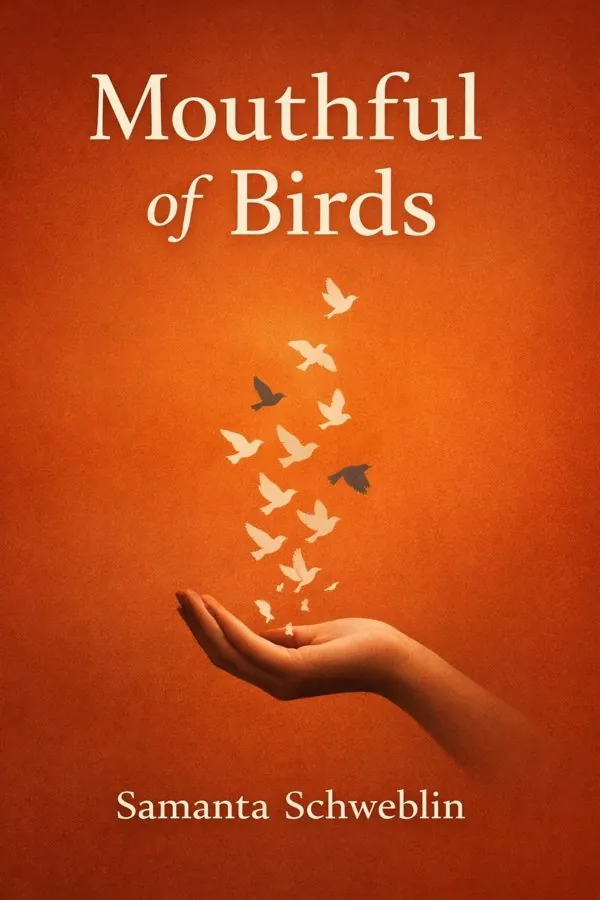
Mouthful of Birds: Summary & Key Insights
 10 min8 chaptersAudio available
Key Takeaways from Mouthful of Birds
A familiar room can feel more frightening than a haunted house when the rules of daily life suddenly stop making sense.
The family is often imagined as a place of protection, but Schweblin shows how easily it can become a site of confusion, coercion, and quiet terror.
Clear answers can comfort us, which is precisely why Schweblin withholds them.
Nothing feels more personal than the body, which is why bodily strangeness in Schweblin’s stories carries such force.
People become easier to control when they are unsure of what they are seeing, feeling, or allowed to question.
What Is Mouthful of Birds About?
Mouthful of Birds by Samanta Schweblin is a bestsellers book. What if the most frightening things in life were not monsters, curses, or ghosts, but the quiet distortions hidden inside everyday families, routines, and desires? Mouthful of Birds by Samanta Schweblin is a striking collection of short stories that turns ordinary situations into scenes of deep unease. In these stories, parents, children, spouses, neighbors, and strangers move through familiar settings, yet something is always slightly wrong, unstable, or impossible to explain. The result is fiction that feels both surreal and painfully real. Schweblin is one of the most celebrated contemporary writers in Spanish-language literature, known for her precision, psychological intensity, and ability to create dread with remarkable economy. Her stories do not rely on elaborate world-building or clear answers. Instead, they expose the fragile logic people use to survive fear, loneliness, powerlessness, and desire. Mouthful of Birds matters because it captures the hidden violence and strangeness beneath modern life. It is a book about family tension, bodily anxiety, social pressure, and the unsettling gap between what people feel and what they can say. For readers who enjoy literary fiction that disturbs, provokes, and lingers, this collection offers a powerful and unforgettable experience.
This FizzRead summary covers all 8 key chapters of Mouthful of Birds in approximately 10 minutes, distilling the most important ideas, arguments, and takeaways from Samanta Schweblin's work. Also available as an audio summary and Key Quotes Podcast.
Mouthful of Birds
What if the most frightening things in life were not monsters, curses, or ghosts, but the quiet distortions hidden inside everyday families, routines, and desires? Mouthful of Birds by Samanta Schweblin is a striking collection of short stories that turns ordinary situations into scenes of deep unease. In these stories, parents, children, spouses, neighbors, and strangers move through familiar settings, yet something is always slightly wrong, unstable, or impossible to explain. The result is fiction that feels both surreal and painfully real.
Schweblin is one of the most celebrated contemporary writers in Spanish-language literature, known for her precision, psychological intensity, and ability to create dread with remarkable economy. Her stories do not rely on elaborate world-building or clear answers. Instead, they expose the fragile logic people use to survive fear, loneliness, powerlessness, and desire.
Mouthful of Birds matters because it captures the hidden violence and strangeness beneath modern life. It is a book about family tension, bodily anxiety, social pressure, and the unsettling gap between what people feel and what they can say. For readers who enjoy literary fiction that disturbs, provokes, and lingers, this collection offers a powerful and unforgettable experience.
Who Should Read Mouthful of Birds?
This book is perfect for anyone interested in bestsellers and looking to gain actionable insights in a short read. Whether you're a student, professional, or lifelong learner, the key ideas from Mouthful of Birds by Samanta Schweblin will help you think differently.
- ✓Readers who enjoy bestsellers and want practical takeaways
- ✓Professionals looking to apply new ideas to their work and life
- ✓Anyone who wants the core insights of Mouthful of Birds in just 10 minutes
Want the full summary?
Get instant access to this book summary and 100K+ more with Fizz Moment.
Get Free SummaryAvailable on App Store • Free to download
Key Chapters
A familiar room can feel more frightening than a haunted house when the rules of daily life suddenly stop making sense. One of the central achievements of Mouthful of Birds is its ability to transform ordinary domestic scenes into spaces of dread. Schweblin rarely begins with dramatic spectacle. Instead, she starts with something recognizable: a family meal, a visit between relatives, a workplace interaction, or a child behaving strangely. The terror emerges not from loud shocks but from subtle shifts that make the normal world feel unstable.
This approach matters because it mirrors how anxiety often works in real life. People are usually not frightened by the impossible in the abstract; they are frightened when something impossible appears inside what should be safe and familiar. A child refuses ordinary food and eats birds. A social ritual becomes emotionally dangerous. A private fear slowly takes over a home. Schweblin understands that when the bizarre enters the everyday without explanation, it reveals how fragile our sense of order really is.
For readers, this collection offers a way to think about how much comfort depends on shared assumptions. Families function because people agree on what is acceptable, what is healthy, and what is real. When those assumptions crack, relationships quickly become unstable. In practical terms, the stories invite us to notice the hidden tensions in routine life: unspoken resentments, strange habits, emotional imbalance, and the thin line between concern and control.
An actionable takeaway: pay closer attention to the places in your life that feel "normal" on the surface but emotionally strained underneath. Often, discomfort grows not from dramatic events but from small realities nobody wants to name.
The family is often imagined as a place of protection, but Schweblin shows how easily it can become a site of confusion, coercion, and quiet terror. Across Mouthful of Birds, parents and children, husbands and wives, and extended relatives move through relationships shaped by duty and affection, yet these same bonds can turn suffocating. Love does not cancel power; in many of these stories, it becomes the very mechanism through which power is exercised.
What makes these portraits so unsettling is that the emotional logic is believable even when the events are surreal. A parent tries to help but ends up controlling. A spouse wants closeness but creates entrapment. A child’s behavior seems incomprehensible, yet the adults around that child reveal their own instability in the attempt to explain or manage it. Schweblin is especially interested in the moments when care and domination blur together. People convince themselves they are acting out of concern while ignoring another person’s autonomy, pain, or strangeness.
This idea has broad relevance beyond fiction. Many real relationships are shaped by expectations that remain unspoken: children should be grateful, parents should know best, partners should conform to each other’s needs. When those assumptions are challenged, fear often appears. The stories suggest that what looks like abnormal behavior may expose deeper dysfunction already present in the relationship.
Readers can apply this insight by reflecting on how they define care. Does helping someone mean understanding them, or forcing them back into what feels acceptable? Do family roles allow room for difference, or only for obedience?
An actionable takeaway: examine one close relationship and ask whether your concern creates space for honesty or pressure for conformity. That distinction can change the emotional climate of an entire household.
Clear answers can comfort us, which is precisely why Schweblin withholds them. Mouthful of Birds does not explain away its mysteries with neat symbolism or plot mechanics. Instead, many stories end in uncertainty, forcing readers to remain inside emotional discomfort. This ambiguity is not a trick. It is one of the collection’s most powerful tools, because unresolved fear tends to linger longer than fear that has been named and contained.
In conventional horror or suspense, the audience often learns what caused the disturbance. Here, the cause may remain hidden, multiple, or irrelevant. Is something supernatural happening, or are people projecting their own desperation onto events? Is a character in danger from the outside world, or from the logic of their own mind? Schweblin understands that uncertainty activates interpretation. Readers become participants, trying to decide what is real, what is metaphorical, and what has been emotionally repressed.
This technique reflects real experience. Many of life’s most painful situations do not arrive with explanations. Illness, estrangement, obsession, and emotional rupture often feel confusing while they are happening. We do not always know what went wrong, who is at fault, or whether repair is possible. By refusing simple closure, Schweblin captures the texture of that confusion with unusual honesty.
Practically, this can change the way readers engage with literature and with life. Not every meaningful experience produces certainty. Sometimes the value lies in staying with discomfort long enough to discover what questions matter most.
An actionable takeaway: when a story or situation feels unresolved, resist the impulse to force an immediate answer. Ask instead what the ambiguity reveals about fear, control, or desire. Often, the uncertainty is the point.
Nothing feels more personal than the body, which is why bodily strangeness in Schweblin’s stories carries such force. In Mouthful of Birds, appetite, illness, physical transformation, and sensory discomfort are not merely background details. They become ways of expressing emotional and social disturbance. The body refuses to stay neutral; it absorbs fear, communicates what language cannot, and turns private unease into visible disruption.
Schweblin often links the physical and the psychological without drawing a hard line between them. A strange craving, a troubling habit, or a distorted bodily perception may be literal within the story, but it also points toward grief, alienation, repression, or the breakdown of shared reality. This gives the collection a uniquely intimate kind of horror. Readers are not simply observing danger from a distance. They are forced to imagine it under the skin, in the stomach, in the senses, in the basic rhythms of nourishment and survival.
This focus also reflects modern anxieties. Many people experience stress, trauma, and powerlessness physically before they can articulate them clearly. The body becomes the first messenger of a crisis the mind has not yet organized. Schweblin’s fiction intensifies this truth until it becomes surreal, but its roots are recognizable.
In practical terms, the stories can sharpen awareness of how often physical reactions carry emotional information. Tension, appetite changes, compulsions, fatigue, and aversion may not be random; they may signal conflict that has not been addressed.
An actionable takeaway: treat bodily discomfort as information rather than inconvenience. Whether in reading or in life, ask what a physical reaction might be expressing that words have not yet managed to say.
People become easier to control when they are unsure of what they are seeing, feeling, or allowed to question. A recurring tension in Mouthful of Birds is the relationship between uncertainty and power. When reality feels unstable, authority becomes more forceful. Characters defer to family, institutions, social rituals, or dominant personalities not because these forces are trustworthy, but because confusion makes resistance harder.
Schweblin’s stories frequently place characters in situations where they cannot fully interpret events. In that space of disorientation, someone else often steps in to define what is happening, what matters, and what must be done. This dynamic is chilling because it resembles real forms of manipulation. People are often pressured into compliance not through obvious violence alone, but through the erosion of their confidence in their own perceptions.
The book therefore works as more than surreal fiction. It also becomes a study of social and emotional vulnerability. When a person is isolated, ashamed, frightened, or uncertain, they may accept explanations and demands they would otherwise challenge. In families, workplaces, and communities, the one who controls the narrative often controls the emotional outcome.
This insight has practical relevance. Whether dealing with personal relationships, media, bureaucracy, or institutions, clarity is protective. Naming what is happening helps interrupt the spread of confusion-based power. Asking simple questions can become an act of self-preservation: What evidence do I have? Who benefits from my uncertainty? Why am I being rushed into agreement?
An actionable takeaway: when a situation feels confusing and pressure is increasing, pause before complying. Write down the facts as you understand them. Restoring your own sense of reality is often the first step toward reclaiming agency.
Children in Schweblin’s fiction are not sentimental symbols of innocence. They are often the most unsettling figures in the room. In Mouthful of Birds, children can seem vulnerable, unknowable, disturbing, or strangely powerful. Their behavior unsettles adults not only because it is unusual, but because it exposes adult fears about responsibility, inheritance, and the limits of understanding another person.
This is one of the collection’s sharpest insights. Adults often project fantasies onto children: purity, obedience, dependence, gratitude, normal development. When a child refuses those expectations, panic follows. Is the child in danger? Is the parent failing? Is society itself unstable? Schweblin uses children to dramatize how quickly care becomes surveillance and how fragile adult authority can be when confronted with the inexplicable.
These stories resonate because children often carry a family’s unspoken tensions. They reveal what adults deny, whether through words, silence, symptoms, or behavior. In Schweblin’s world, a child’s strangeness may be literal within the plot, but it also reveals something about the adults who observe it: their need for control, their fear of difference, or their inability to tolerate uncertainty.
Readers can apply this idea by thinking more carefully about how society frames youth. When a child behaves unexpectedly, the first response is often correction rather than curiosity. Yet understanding may require listening before labeling.
An actionable takeaway: the next time someone’s behavior seems immediately abnormal or troubling, especially a child’s, ask what fear your interpretation might be protecting. Replacing instant judgment with careful observation can lead to wiser, more humane responses.
What people refuse to say can shape a story more powerfully than any confession. In Mouthful of Birds, silence is not empty space; it is pressure. Characters avoid direct explanation, suppress discomfort, speak around what matters, or accept impossible conditions without truly discussing them. This restraint gives the collection much of its haunting force. The stories feel compressed, as if emotional truth is always pressing against the edges of language.
Schweblin’s style depends on precision and omission. Rather than explaining every motive, she lets pauses, gestures, and absences create tension. That means readers must pay attention not only to what is stated, but to what remains unspoken. A missing explanation, an unanswered question, or an oddly calm reaction can carry enormous weight. Silence becomes a sign of denial, fear, complicity, or emotional exhaustion.
This matters because many real relationships operate the same way. Families often organize themselves around taboos. Workplaces bury conflict under politeness. Communities maintain appearances by refusing to name harm. Schweblin turns these familiar forms of silence into narrative engines, revealing how much damage can accumulate when language fails or is deliberately withheld.
Practically, the collection encourages stronger attention to subtext. In conversations, what topics are consistently avoided? What emotions are disguised as practicality, humor, or routine? What truths seem too destabilizing to speak aloud? Learning to notice these patterns can deepen emotional intelligence.
An actionable takeaway: in one important conversation this week, listen for what is not being said. If trust allows, gently name the silence. Often, the most transformative discussion begins where everyone has been pretending nothing is there.
The impossible can sometimes describe reality more accurately than realism can. That paradox sits at the heart of Mouthful of Birds. Schweblin’s surreal elements are not decorative oddities added for shock. They function as precise instruments for revealing emotional states that ordinary description might soften or obscure. By exaggerating, distorting, or dislocating reality, she makes fear, loneliness, shame, and dependency newly visible.
This is why the collection feels so psychologically exact despite its strangeness. A bizarre event often captures the logic of an emotional situation better than a literal account would. A family dynamic may be so irrational, oppressive, or inexplicable that only a surreal premise can express its true intensity. The reader may not have encountered the event in life, but they recognize the feeling instantly.
Schweblin’s work shows that surrealism is not an escape from reality. It is a method of entering reality at a deeper level, especially where social conventions and ordinary language fail. In that sense, the stories ask readers to be flexible. Instead of asking, “Could this happen?” the better question is, “What kind of human truth does this impossibility illuminate?”
This perspective can enrich reading habits more broadly. Strange fiction often becomes rewarding when approached emotionally rather than literally. The goal is not always decoding a puzzle, but noticing what the strangeness allows us to feel and understand.
An actionable takeaway: when reading unsettling or surreal literature, shift from solving the story to sensing it. Ask what emotion the impossible element sharpens. That change in approach often unlocks the story’s deepest meaning.
All Chapters in Mouthful of Birds
About the Author
Samanta Schweblin is an Argentine writer celebrated for her unsettling short fiction and novels that blend psychological realism with surreal and speculative elements. Born in Buenos Aires in 1978, she has become one of the most internationally recognized contemporary authors writing in Spanish. Her work is known for its precision, emotional intensity, and ability to make ordinary situations feel deeply strange and threatening. Schweblin has received major literary recognition, including awards for her short fiction, and her books have been translated widely. Among her best-known works are Mouthful of Birds, Fever Dream, and Little Eyes. Across genres and forms, she consistently explores fear, intimacy, technology, family tension, and the instability of everyday life with remarkable control and originality.
Get This Summary in Your Preferred Format
Read or listen to the Mouthful of Birds summary by Samanta Schweblin anytime, anywhere. FizzRead offers multiple formats so you can learn on your terms — all free.
Available formats: App · Audio · PDF · EPUB — All included free with FizzRead
Download Mouthful of Birds PDF and EPUB Summary
Key Quotes from Mouthful of Birds
“A familiar room can feel more frightening than a haunted house when the rules of daily life suddenly stop making sense.”
“The family is often imagined as a place of protection, but Schweblin shows how easily it can become a site of confusion, coercion, and quiet terror.”
“Clear answers can comfort us, which is precisely why Schweblin withholds them.”
“Nothing feels more personal than the body, which is why bodily strangeness in Schweblin’s stories carries such force.”
“People become easier to control when they are unsure of what they are seeing, feeling, or allowed to question.”
Frequently Asked Questions about Mouthful of Birds
Mouthful of Birds by Samanta Schweblin is a bestsellers book that explores key ideas across 8 chapters. What if the most frightening things in life were not monsters, curses, or ghosts, but the quiet distortions hidden inside everyday families, routines, and desires? Mouthful of Birds by Samanta Schweblin is a striking collection of short stories that turns ordinary situations into scenes of deep unease. In these stories, parents, children, spouses, neighbors, and strangers move through familiar settings, yet something is always slightly wrong, unstable, or impossible to explain. The result is fiction that feels both surreal and painfully real. Schweblin is one of the most celebrated contemporary writers in Spanish-language literature, known for her precision, psychological intensity, and ability to create dread with remarkable economy. Her stories do not rely on elaborate world-building or clear answers. Instead, they expose the fragile logic people use to survive fear, loneliness, powerlessness, and desire. Mouthful of Birds matters because it captures the hidden violence and strangeness beneath modern life. It is a book about family tension, bodily anxiety, social pressure, and the unsettling gap between what people feel and what they can say. For readers who enjoy literary fiction that disturbs, provokes, and lingers, this collection offers a powerful and unforgettable experience.
More by Samanta Schweblin
You Might Also Like
The Godfather
Mario Puzo
10 min
The Handmaid's Tale
Margaret Atwood
10 min
The Hunger Games
Suzanne Collins
10 min
The Nightingale
Kristin Hannah
10 min
The Seven Husbands of Evelyn Hugo
Taylor Jenkins Reid
10 min
Backwater Justice
Fern Michaels
10 minBrowse by Category
Ready to read Mouthful of Birds?
Get the full summary and 100K+ more books with Fizz Moment.