
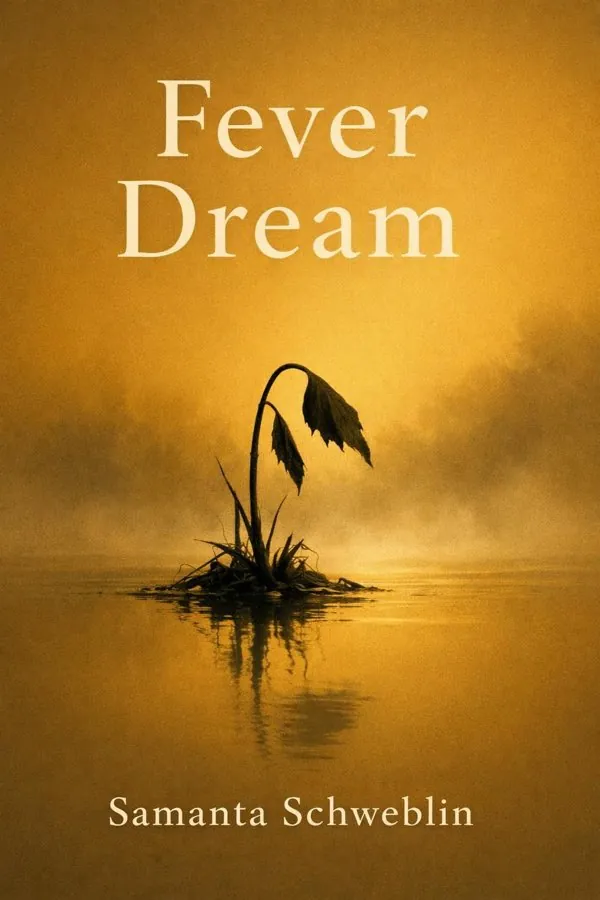
Fever Dream: Summary & Key Insights
 10 min9 chaptersAudio available
Key Takeaways from Fever Dream
Fear becomes most powerful when it arrives before explanation.
Sometimes the most frightening stories are told casually, as if horror has become normal.
Love can be measured as a calculation of danger.
Catastrophe rarely announces itself as a single moment; more often, it arrives as a chain of small misreadings.
Parental love is often romanticized, but Schweblin shows its more exhausting truth: love can feel like permanent alertness.
What Is Fever Dream About?
Fever Dream by Samanta Schweblin is a bestsellers book spanning 4 pages. Samanta Schweblin’s Fever Dream is a short novel with the force of a nightmare: compact, disorienting, and impossible to shake. Set in rural Argentina, it unfolds through a fractured conversation between Amanda, a mother in crisis, and David, a boy who guides her through a memory she can barely endure. As Amanda tries to reconstruct what happened to her daughter Nina, the story reveals a landscape haunted not by monsters in any conventional sense, but by poisoned water, damaged bodies, maternal dread, and the terrifying realization that danger can be invisible until it is too late. What makes the book so powerful is the way Schweblin fuses psychological suspense with ecological horror. The novel becomes both a portrait of motherhood under extreme stress and a subtle but devastating meditation on environmental contamination. Schweblin, one of the most acclaimed contemporary Argentine writers, is known for her unsettling precision and mastery of atmosphere. In Fever Dream, she turns ordinary parental fear into a profound literary experience, asking how we protect those we love when the threat cannot be clearly seen, named, or contained.
This FizzRead summary covers all 9 key chapters of Fever Dream in approximately 10 minutes, distilling the most important ideas, arguments, and takeaways from Samanta Schweblin's work. Also available as an audio summary and Key Quotes Podcast.
Fever Dream
Samanta Schweblin’s Fever Dream is a short novel with the force of a nightmare: compact, disorienting, and impossible to shake. Set in rural Argentina, it unfolds through a fractured conversation between Amanda, a mother in crisis, and David, a boy who guides her through a memory she can barely endure. As Amanda tries to reconstruct what happened to her daughter Nina, the story reveals a landscape haunted not by monsters in any conventional sense, but by poisoned water, damaged bodies, maternal dread, and the terrifying realization that danger can be invisible until it is too late. What makes the book so powerful is the way Schweblin fuses psychological suspense with ecological horror. The novel becomes both a portrait of motherhood under extreme stress and a subtle but devastating meditation on environmental contamination. Schweblin, one of the most acclaimed contemporary Argentine writers, is known for her unsettling precision and mastery of atmosphere. In Fever Dream, she turns ordinary parental fear into a profound literary experience, asking how we protect those we love when the threat cannot be clearly seen, named, or contained.
Who Should Read Fever Dream?
This book is perfect for anyone interested in bestsellers and looking to gain actionable insights in a short read. Whether you're a student, professional, or lifelong learner, the key ideas from Fever Dream by Samanta Schweblin will help you think differently.
- ✓Readers who enjoy bestsellers and want practical takeaways
- ✓Professionals looking to apply new ideas to their work and life
- ✓Anyone who wants the core insights of Fever Dream in just 10 minutes
Want the full summary?
Get instant access to this book summary and 100K+ more with Fizz Moment.
Get Free SummaryAvailable on App Store • Free to download
Key Chapters
Fear becomes most powerful when it arrives before explanation. Fever Dream opens in darkness, with Amanda speaking in fragments while a boy named David presses her to focus, remember, and stay on the “important” details. This strange dialogue immediately destabilizes the reader. We do not know where Amanda is, what has happened to her, or why David seems both childlike and disturbingly authoritative. The result is a narrative atmosphere built on urgency rather than certainty. Instead of offering a clean sequence of events, Schweblin throws us into a mind under pressure, where memory is broken by pain, panic, and the effort to understand catastrophe after it has already begun.
This opening matters because it teaches us how to read the whole novel. Fever Dream is not a story driven by external action alone; it is a reconstruction of threat. David’s repeated insistence that Amanda identify “the worms,” the key moments, and the true source of danger creates a rhythm of interrogation. He becomes part guide, part witness, part riddle. The novel’s emotional force comes from this form: a conversation that feels like a diagnosis, a confession, and a descent into nightmare all at once.
In practical terms, this opening mirrors how people often process trauma in real life. After a crisis, we replay events obsessively, trying to locate the exact second when things turned irreversible. We ask: What did I miss? What should I have seen sooner? Schweblin transforms that familiar mental pattern into literary structure.
Actionable takeaway: Pay attention to what feels unclear at the beginning of a crisis. Confusion is not meaningless; it often contains the first signs of what truly matters.
Sometimes the most frightening stories are told casually, as if horror has become normal. Amanda’s memories lead her to Carla, a local woman whose confessions about her son David become the emotional core of the novel. Carla recounts the day David drank contaminated water and nearly died, and how, in a desperate attempt to save him, she took him to a healer who performed a mysterious “migration” of his spirit. David survives, but not unchanged. Carla believes part of him is elsewhere, or that something unrecognizable has returned. Her story is terrifying not only because of what happened to David, but because it suggests a world in which toxic exposure, spiritual improvisation, and maternal helplessness are woven into daily life.
The landscape itself is central here. Rural Argentina is not presented as pastoral safety but as a contaminated environment shaped by agricultural chemicals and careless practices. Animals die. Children become sick. Water cannot be trusted. Schweblin never turns the novel into a documentary, yet the poisoned land gives the book its deepest realism. The supernatural atmosphere grows from material conditions. In that sense, Carla’s story links ecological damage with psychological disintegration: when the environment becomes unsafe, trust in reality begins to erode as well.
This idea has broad relevance. Communities exposed to pollution often live with uncertainty, denial, and incomplete knowledge. Symptoms appear before causes are acknowledged. People are forced to improvise explanations because institutions fail them. The novel captures that moral injury with chilling precision.
Actionable takeaway: Treat environmental warnings seriously, even when they arrive through rumor, scattered symptoms, or uneasy intuition. Delayed recognition can become irreversible harm.
Love can be measured as a calculation of danger. One of the novel’s most memorable concepts is Amanda’s idea of the “rescue distance,” the invisible space she constantly monitors between herself and her daughter Nina. It is the distance within which she believes she can still protect her child if something goes wrong. This mental measurement becomes a powerful symbol for motherhood, vigilance, and anxiety. Amanda is always evaluating risk: Is Nina too far away? Can I reach her in time? What if danger appears suddenly? In one phrase, Schweblin captures the exhausting emotional labor of caregiving.
The beauty of this concept is that it feels both highly specific and universally recognizable. Parents everywhere understand some version of it. Even outside parenthood, people maintain rescue distances with those they love. We track our ability to intervene, help, defend, or repair. Yet the novel exposes the tragic flaw in this instinct: rescue distance works only against visible threats. It assumes danger can be seen in time. In Fever Dream, contamination is airborne, chemical, delayed, and hidden. Amanda’s protective logic is sincere, loving, and relentless, but it is built for the wrong kind of enemy.
This makes the rescue distance more than a maternal metaphor. It becomes a critique of how humans imagine safety. We feel secure when we can observe, monitor, and react. But many modern dangers—pollution, disease, systemic neglect—do not respect physical proximity or attentive love.
In everyday life, this idea can help us think more honestly about protection. Being close to someone emotionally or physically does not eliminate larger structural risks. Care matters, but so do safe systems, clean environments, and reliable information.
Actionable takeaway: Ask not only how quickly you can respond to danger, but whether you are paying attention to the kinds of danger that cannot be seen coming.
Catastrophe rarely announces itself as a single moment; more often, it arrives as a chain of small misreadings. As Amanda’s recollections sharpen, the novel moves toward bodily collapse and psychic transformation. What seemed at first like unease becomes poisoning, paralysis, and irreversible change. David’s altered presence, Nina’s vulnerability, and Amanda’s own deteriorating condition blur the boundaries between illness and possession, medicine and myth, perception and delirium. Schweblin refuses a simple explanation, and that refusal is part of the novel’s power. The transformation is both literal and symbolic: bodies are changed by contamination, and relationships are changed by fear.
Amanda’s collapse is especially devastating because it exposes the limits of intention. She has not failed to care. On the contrary, she has cared obsessively. Yet devotion does not guarantee control. That is one of the novel’s harshest truths. We often imagine that enough vigilance, enough love, or enough sacrifice will keep disaster away. Fever Dream argues otherwise. Some harms exceed personal effort because they emerge from broader toxic systems.
The transformations in the novel also raise questions about identity. If illness alters behavior, if trauma changes perception, if survival comes at the cost of recognizability, what remains of the self? David appears both himself and not himself. The same anxiety extends to Amanda and Nina. Contamination in the novel is not only physical; it destabilizes categories of personhood.
This theme applies beyond fiction. Serious illness, environmental disaster, and trauma often transform families in ways that are difficult to name. People return changed, and loved ones must adapt to versions of them that are familiar yet estranged.
Actionable takeaway: In moments of crisis, let go of the fantasy of perfect control and focus instead on early prevention, honest attention, and compassionate adaptation when change has already begun.
Parental love is often romanticized, but Schweblin shows its more exhausting truth: love can feel like permanent alertness. Throughout Fever Dream, Amanda’s consciousness is organized by fear for Nina. She watches, calculates, anticipates, and imagines threats with relentless intensity. This is not simply affection; it is a nervous system shaped by responsibility. The novel captures the psychological burden of motherhood as a state in which even rest becomes difficult because danger is always waiting just outside awareness.
What makes this portrayal so compelling is its refusal of sentimentality. Amanda is not presented as a symbolic ideal mother. She is a believable person whose anxiety is both loving and destabilizing. Her thoughts circle around prevention because she knows that once harm occurs, repair may be impossible. In that sense, the novel gives literary form to a common but underexamined experience: the way caregiving can collapse time into constant anticipation. The future is always invading the present through worry.
This idea extends beyond mothers. Anyone responsible for another person—parents, partners, adult children caring for aging parents, even managers or teachers in high-stakes situations—knows the pressure of carrying imagined scenarios in advance. We try to pre-live disasters so that we can stop them. But this habit can become consuming, especially when real conditions justify fear.
Schweblin’s insight is that anxiety is not always irrational. Sometimes it is a reasonable response to an unsafe world. Yet even justified vigilance has a cost. It narrows experience, reduces joy, and makes human connection feel inseparable from dread.
Actionable takeaway: If your care for others has become constant panic, separate what you can realistically control from what requires shared responsibility, expert help, or systemic change.
Modern danger is often hardest to confront when it cannot be seen. One of Fever Dream’s most disturbing achievements is its portrayal of contamination as both ordinary and catastrophic. The threat in the novel is not a creature hiding in the woods or a stranger at the door. It is chemical exposure woven into the landscape: water, fields, animals, and bodies. This makes the horror feel eerily plausible. People continue everyday routines while invisible toxins move through the environment, producing effects only after the damage has begun.
Schweblin turns this invisibility into a moral problem. When harm is delayed, diffuse, and difficult to prove, communities can drift into denial. Individuals blame themselves, misunderstand symptoms, or look for supernatural explanations because the obvious explanation has been normalized out of sight. The novel therefore works as ecological fiction of a particularly sharp kind. It does not lecture about policy, but it reveals how environmental damage enters intimate life. A poisoned field becomes a sick child. A contaminated landscape becomes a shattered family.
This insight is highly relevant in the real world. Many public health crises operate through similar mechanisms: pollution, contaminated water, pesticide exposure, poor air quality, and long-term chemical contact. People often respond only when consequences become visible, but by then prevention is no longer possible.
The novel invites readers to see environmental safety not as an abstract issue but as a private, bodily one. Ecology is not separate from family life. It is family life.
Actionable takeaway: Make invisible risks more visible—learn about local environmental conditions, ask questions about water and chemical exposure, and treat public health information as part of caring for loved ones.
Not understanding what is happening can be as frightening as the event itself. Fever Dream is deliberately disorienting: timelines blur, explanations remain partial, and the line between memory and hallucination is never fully stabilized. This uncertainty is not a literary trick for its own sake. It is the novel’s method for making readers inhabit Amanda’s condition. We do not stand outside the crisis with superior knowledge. We are trapped inside confusion, trying to organize fragments before time runs out.
This matters because uncertainty is one of the defining emotional realities of illness and environmental harm. Families confronting unexplained symptoms often live in exactly this state. They gather anecdotes, watch changes in behavior, revisit minor incidents, and struggle to identify causes. Experts may disagree. Institutions may respond too slowly. Language may fail. Schweblin transforms that experience into form. The reader’s confusion becomes an ethical experience of vulnerability.
The novel also suggests that uncertainty can make people more suggestible. When official explanations are absent or insufficient, alternative systems of meaning rush in—spiritual healers, superstitions, whispered local knowledge. The book does not mock these responses. Instead, it presents them as desperate attempts to regain agency in a world where evidence arrives too late.
In everyday life, this idea reminds us that ambiguity changes behavior. People under uncertainty often make imperfect choices not because they are foolish, but because they are trying to act without enough trustworthy information. Better systems, clearer communication, and faster response save not only bodies but judgment.
Actionable takeaway: When facing unclear danger, resist the urge to choose certainty over truth. Gather evidence, ask better questions, and recognize that confusion itself is a warning sign requiring serious attention.
Children in literature are often symbols of innocence, but in Fever Dream they are also carriers of knowledge adults cannot comfortably absorb. David is one of the novel’s most unsettling creations because he functions as both a child and something more than a child. He sees what Amanda avoids, names what matters, and guides the narrative toward its hidden center. Yet his presence is never comforting. He embodies the consequences of contamination, the distortion of childhood by toxicity, and the frightening possibility that damage can produce forms of awareness adults do not know how to interpret.
This makes David more than a mysterious character; he is a warning. Through him, the novel suggests that children register environmental and emotional realities before adults are willing to face them. They become the first casualties of negligence, but also the clearest evidence that something is wrong. Adults may rationalize, delay, or deny. Children simply change. Their bodies and behaviors reveal the truth with terrible clarity.
The same logic applies to Nina, whose vulnerability intensifies Amanda’s panic. Childhood in the novel is not a protected realm. It is the very place where the failures of the adult world appear most brutally. The poisoned landscape writes itself onto children first.
In practical terms, this theme encourages a different way of thinking about responsibility. Societies often claim to value children while tolerating conditions that endanger them. Fever Dream exposes that hypocrisy by making the child both victim and messenger.
Actionable takeaway: Pay close attention to what the most vulnerable are showing you. When children’s health, behavior, or safety shift unexpectedly, treat those changes as urgent signals rather than isolated incidents.
The most haunting horror does not end when the page does. Fever Dream lingers because it offers no clean separation between fiction and reality. Although the novel uses dream logic, uncanny dialogue, and ambiguous transformation, its deepest terror is realistic: human beings live inside systems capable of harming them without warning or accountability. The book denies the usual comforts of genre. There is no heroic discovery, no decisive confrontation, no full restoration of order. Instead, there is recognition—late, painful, and incomplete.
This is why the novel feels so contemporary. Many of today’s anxieties are systemic rather than singular. Climate instability, chemical exposure, institutional neglect, and public-health failures cannot be solved by individual courage alone. Fever Dream converts that condition into intimate emotional experience. Amanda’s fear becomes our own because it reflects a broader truth: private love is often forced to confront public danger with inadequate tools.
Yet the novel’s bleakness is not emptiness. Its refusal of false comfort is a form of clarity. By showing how panic, contamination, and helplessness interlock, Schweblin compels readers to think more seriously about responsibility. What do we owe one another when threats are shared? What does prevention require? How much suffering comes from noticing too late?
As a reading experience, the book also teaches attentiveness. Its compressed intensity demands that readers listen, infer, and stay alert to implication. That discipline mirrors the ethical demand at the novel’s center: to recognize danger before it becomes irreversible.
Actionable takeaway: Do not wait for threats to become dramatic before treating them as real. Build habits of attention early, especially when the risks involve health, environment, and those who depend on you.
All Chapters in Fever Dream
About the Author
Samanta Schweblin is an Argentine writer born in Buenos Aires in 1978 and widely regarded as one of the most distinctive voices in contemporary Spanish-language literature. She first gained major recognition for her short fiction, which is known for its precision, eerie atmosphere, and ability to turn ordinary situations into deeply unsettling experiences. Her work often blends psychological realism with elements of the uncanny, exploring fear, family, power, and instability. Schweblin’s writing has been translated into many languages and has earned international acclaim, helping her reach a global audience beyond Latin America. Fever Dream became one of her best-known works, confirming her talent for compression, suspense, and thematic depth. Whether in novels or stories, she is admired for fiction that is both hauntingly accessible and formally sophisticated.
Get This Summary in Your Preferred Format
Read or listen to the Fever Dream summary by Samanta Schweblin anytime, anywhere. FizzRead offers multiple formats so you can learn on your terms — all free.
Available formats: App · Audio · PDF · EPUB — All included free with FizzRead
Download Fever Dream PDF and EPUB Summary
Key Quotes from Fever Dream
“Fear becomes most powerful when it arrives before explanation.”
“Sometimes the most frightening stories are told casually, as if horror has become normal.”
“Love can be measured as a calculation of danger.”
“Catastrophe rarely announces itself as a single moment; more often, it arrives as a chain of small misreadings.”
“Parental love is often romanticized, but Schweblin shows its more exhausting truth: love can feel like permanent alertness.”
Frequently Asked Questions about Fever Dream
Fever Dream by Samanta Schweblin is a bestsellers book that explores key ideas across 9 chapters. Samanta Schweblin’s Fever Dream is a short novel with the force of a nightmare: compact, disorienting, and impossible to shake. Set in rural Argentina, it unfolds through a fractured conversation between Amanda, a mother in crisis, and David, a boy who guides her through a memory she can barely endure. As Amanda tries to reconstruct what happened to her daughter Nina, the story reveals a landscape haunted not by monsters in any conventional sense, but by poisoned water, damaged bodies, maternal dread, and the terrifying realization that danger can be invisible until it is too late. What makes the book so powerful is the way Schweblin fuses psychological suspense with ecological horror. The novel becomes both a portrait of motherhood under extreme stress and a subtle but devastating meditation on environmental contamination. Schweblin, one of the most acclaimed contemporary Argentine writers, is known for her unsettling precision and mastery of atmosphere. In Fever Dream, she turns ordinary parental fear into a profound literary experience, asking how we protect those we love when the threat cannot be clearly seen, named, or contained.
More by Samanta Schweblin

You Might Also Like

The Godfather
Mario Puzo
10 min
The Handmaid's Tale
Margaret Atwood
10 min
The Hunger Games
Suzanne Collins
10 min
The Nightingale
Kristin Hannah
10 min
The Seven Husbands of Evelyn Hugo
Taylor Jenkins Reid
10 min
Backwater Justice
Fern Michaels
10 minBrowse by Category
Ready to read Fever Dream?
Get the full summary and 100K+ more books with Fizz Moment.