
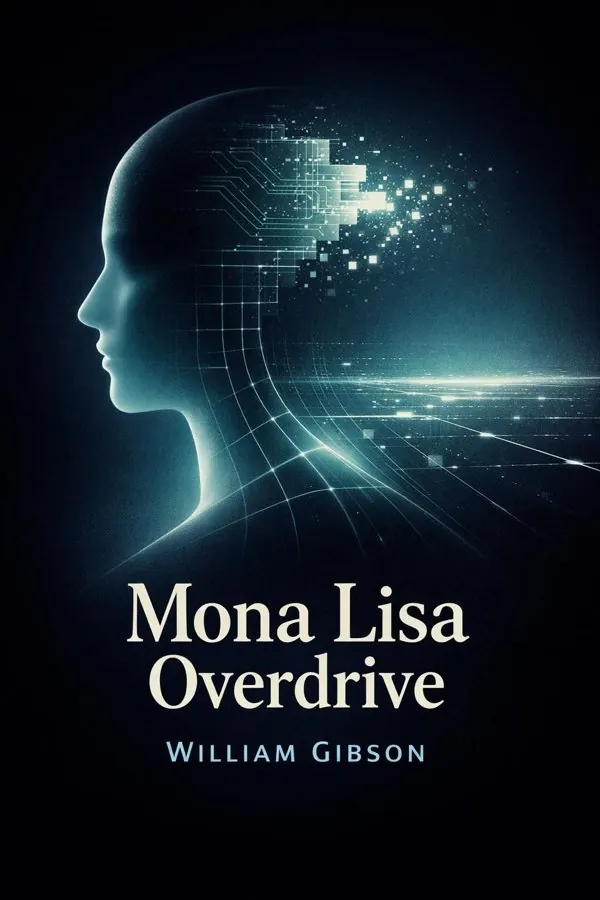
Mona Lisa Overdrive: Summary & Key Insights
 10 min9 chaptersAudio available
Key Takeaways from Mona Lisa Overdrive
A city becomes most dangerous when it stops being a place and starts behaving like an ecosystem.
Identity becomes unstable the moment appearance can be manufactured for profit.
Power is not always liberating; sometimes it is simply a more intimate form of vulnerability.
Privilege can look like protection while functioning as a beautifully furnished prison.
Creation can be an act of survival, especially in places where ordinary life has already broken down.
What Is Mona Lisa Overdrive About?
Mona Lisa Overdrive by William Gibson is a scifi_fantasy book spanning 7 pages. Mona Lisa Overdrive is William Gibson’s dazzling, disorienting conclusion to the Sprawl trilogy, following Neuromancer and Count Zero. Set in a near-future world shaped by global corporations, black-market technology, celebrity manipulation, artificial intelligences, and immersive virtual realities, the novel weaves together several lives that initially seem unrelated: a frightened young girl remade into an image, a celebrity burdened by contact with machine gods, a sheltered heiress trapped inside criminal power structures, and a damaged outsider trying to build meaning from ruin. As these threads converge, Gibson reveals a world where identity can be copied, bodies can be repurposed, and consciousness itself is no longer confined to flesh. What makes the book matter is not just its style or its cyberpunk cool, but its remarkable insight into modern life: mediated fame, networked power, synthetic desire, and the instability of the self. Gibson, often called the father of cyberpunk, writes with unmatched authority about technological futures that now feel uncannily familiar. Mona Lisa Overdrive is both a gripping thriller and a meditation on what remains human when reality becomes programmable.
This FizzRead summary covers all 9 key chapters of Mona Lisa Overdrive in approximately 10 minutes, distilling the most important ideas, arguments, and takeaways from William Gibson's work. Also available as an audio summary and Key Quotes Podcast.
Mona Lisa Overdrive
Mona Lisa Overdrive is William Gibson’s dazzling, disorienting conclusion to the Sprawl trilogy, following Neuromancer and Count Zero. Set in a near-future world shaped by global corporations, black-market technology, celebrity manipulation, artificial intelligences, and immersive virtual realities, the novel weaves together several lives that initially seem unrelated: a frightened young girl remade into an image, a celebrity burdened by contact with machine gods, a sheltered heiress trapped inside criminal power structures, and a damaged outsider trying to build meaning from ruin. As these threads converge, Gibson reveals a world where identity can be copied, bodies can be repurposed, and consciousness itself is no longer confined to flesh. What makes the book matter is not just its style or its cyberpunk cool, but its remarkable insight into modern life: mediated fame, networked power, synthetic desire, and the instability of the self. Gibson, often called the father of cyberpunk, writes with unmatched authority about technological futures that now feel uncannily familiar. Mona Lisa Overdrive is both a gripping thriller and a meditation on what remains human when reality becomes programmable.
Who Should Read Mona Lisa Overdrive?
This book is perfect for anyone interested in scifi_fantasy and looking to gain actionable insights in a short read. Whether you're a student, professional, or lifelong learner, the key ideas from Mona Lisa Overdrive by William Gibson will help you think differently.
- ✓Readers who enjoy scifi_fantasy and want practical takeaways
- ✓Professionals looking to apply new ideas to their work and life
- ✓Anyone who wants the core insights of Mona Lisa Overdrive in just 10 minutes
Want the full summary?
Get instant access to this book summary and 100K+ more with Fizz Moment.
Get Free SummaryAvailable on App Store • Free to download
Key Chapters
A city becomes most dangerous when it stops being a place and starts behaving like an ecosystem. In Mona Lisa Overdrive, the Sprawl is no longer just a backdrop for crime and high technology; it functions like a vast, self-sustaining organism made of capital, media, infrastructure, decay, and desire. Stretching across the eastern seaboard, this urban continuum contains luxury, abandonment, celebrity fantasy, underground markets, and corporate warfare in a single connected field. Gibson shows that no one truly stands outside it. The rich may live in controlled environments and the poor may survive in damaged zones, but both are shaped by the same networks of information and power.
What makes the Sprawl compelling is how familiar it feels. It anticipates our own world of global logistics, platform economies, algorithmic visibility, and hyper-urban inequality. People in the novel navigate systems they do not fully understand but cannot avoid: surveillance, branding, entertainment, data flows, and privatized violence. Place matters less than connection. A street hustler, a celebrity, a gangster, and an heiress all move inside the same circuitry.
This idea applies beyond science fiction. Today, many of us inhabit digital-spatial systems that influence what we buy, how we work, and even how we present ourselves. Modern life often feels like living in overlapping infrastructures rather than in clearly bounded communities. Gibson’s insight is that power hides in the environment itself: in the systems people treat as normal.
Actionable takeaway: Pay attention not just to individual choices, but to the networks, platforms, and institutions shaping those choices. Understanding the system is the first step toward acting freely within it.
Identity becomes unstable the moment appearance can be manufactured for profit. Mona begins as a tough, vulnerable London street girl with limited options and a clear instinct for survival. Her life changes when she is recruited and altered to resemble Angie Mitchell, the celebrity whose face and image are valuable commodities. What begins as opportunity quickly becomes captivity. Mona is not being asked merely to perform; she is being asked to disappear into someone else’s symbolic body.
Through Mona, Gibson examines one of the novel’s central themes: the self is increasingly mediated by images that others control. Mona’s transformation is physical, commercial, and psychological. She becomes a substitute, a mask, a deployable surface. Yet the tragedy of her situation is also what makes her compelling. Beneath the imposed identity remains a frightened but observant person trying to protect some inner core of selfhood.
This resonates strongly with contemporary concerns. Social media avatars, personal branding, cosmetic transformation, influencer culture, and AI-generated likenesses all raise similar questions. What happens when your value lies in looking right rather than being understood? What remains of autonomy when identity is something edited, marketed, and consumed?
Mona’s arc also shows that imitation can produce unexpected agency. Even when trapped inside an imposed role, she adapts, observes, and survives. Gibson does not offer a simplistic lesson about “being yourself.” Instead, he suggests that identity is often negotiated under pressure and that authenticity may consist less in purity than in refusing complete surrender.
Actionable takeaway: Protect the difference between your public image and your private self. If others define your value through appearance, narrative, or utility, deliberately cultivate spaces where your identity is not for sale.
Power is not always liberating; sometimes it is simply a more intimate form of vulnerability. Angie Mitchell, introduced earlier in the trilogy, carries within her an extraordinary and unsettling capacity: direct connection to cyberspace and to emergent artificial intelligences. In Mona Lisa Overdrive, that gift has become a burden. She is famous, mediated, and commercially packaged, yet beneath the celebrity surface she remains haunted by what she can access and by what can access her in return.
Angie embodies Gibson’s suspicion that technological intimacy comes at a cost. Her connection grants insight, transcendence, and proximity to entities beyond normal human understanding, but it also erodes ordinary boundaries. She is never fully private, never entirely self-contained. The machinery of celebrity deepens the problem. Her talent and trauma are transformed into spectacle, making her both powerful and exploitable.
This makes Angie one of the novel’s most modern figures. Today, constant connectivity often feels like empowerment until it becomes exhaustion, overexposure, dependency, or manipulation. The promise of direct access to information, audiences, and systems can become a form of enclosure. To be permanently connected is also to be permanently reachable.
Angie’s storyline asks an important question: if we gain frictionless connection, what protections do we lose? Emotional boundaries, cognitive rest, and control over one’s own attention may matter as much as expanded capability. Gibson suggests that transcendence without safeguards can become another trap.
In practical terms, Angie’s experience mirrors anyone whose gifts are monetized by institutions that do not care about their well-being. Talent alone does not ensure freedom; it can make a person easier to capture.
Actionable takeaway: Treat access as something to manage, not maximize. Whether in technology, work, or relationships, build boundaries around your attention, gifts, and vulnerabilities before others build systems that exploit them.
Privilege can look like protection while functioning as a beautifully furnished prison. Kumiko, the daughter of a powerful yakuza figure, enters the novel from a world of formality, wealth, and inherited danger. Though she appears more sheltered than characters such as Mona or Slick Henry, she is no less constrained. Her life is structured by other people’s strategies, loyalties, and threats. In Gibson’s hands, Kumiko becomes a study in how power extends through family, tradition, and obligation as much as through explicit violence.
What makes her storyline rich is the tension between innocence and awakening. Kumiko is educated enough to observe the coded behavior around her, yet young enough to still discover what those codes really mean. As she navigates bodyguards, criminal politics, and hidden agendas, she learns that being valuable to powerful people is not the same as being safe. Her position grants access, but not freedom.
This theme applies widely. Many people inherit systems they did not choose: family businesses, class expectations, social roles, elite institutions, cultural duties. Outsiders may envy the status attached to such systems, but insiders know that the cost can be obedience. Gibson shows that power reproduces itself not only through force but through the shaping of futures before a person has had the chance to choose one.
Kumiko’s significance lies in her growing awareness. She begins to see that understanding a system is a precondition for resisting it. Rather than remaining merely passive, she becomes a witness to how authority operates behind ritual and etiquette.
Actionable takeaway: When entering any powerful structure, ask what it expects in return for protection or opportunity. Security without agency is dependency, and clarity about hidden obligations is the first form of self-defense.
Creation can be an act of survival, especially in places where ordinary life has already broken down. Slick Henry, living amid the ruined margins of Gibson’s future America, is one of the novel’s most memorable examples of damaged resilience. A veteran marked by trauma and social failure, he inhabits a landscape of abandoned projects, scavenged materials, and economic leftovers. Yet he is not simply a victim of collapse. He makes things. He builds assemblages and robot sculptures from debris, turning waste into form.
Through Slick, Gibson offers a striking counterpoint to corporate technological power. High-end technology in the novel is often controlled by elites, weaponized by criminals, or entangled with manipulation. Slick’s creativity emerges from another register entirely: improvisation, salvage, hand-built meaning. His work suggests that art can reclaim agency where systems have stripped it away. Even in a world saturated by simulation, there remains value in the rough, embodied act of making.
This has obvious real-world parallels. People coping with instability often use creativity not because it solves everything, but because it reorganizes inner chaos. Repair culture, DIY practice, reclaimed materials, outsider art, and trauma-informed creative work all reflect the same principle: making something is a way of insisting on continued personhood.
Slick Henry also reminds readers that broken people are not empty people. Gibson refuses the neat distinction between functionality and worth. A person may be marginalized, unstable, or haunted and still possess insight and generative power.
Actionable takeaway: Use creation as resistance to fragmentation. When life feels dominated by systems you cannot control, build, write, repair, draw, or shape something tangible. Meaning often begins not with mastery, but with salvage.
The most unsettling forms of control are those that treat body and information as interchangeable assets. Mona Lisa Overdrive is filled with schemes involving physical likeness, neural access, celebrity image, and criminal strategy. Beneath the thriller mechanics lies a deeper idea: in Gibson’s world, flesh and data are converging into a single field of manipulation. A face can be copied, a personality can be staged, a body can become infrastructure for someone else’s plan, and digital systems can reach directly into organic life.
This merger of flesh and code defines the book’s conspiratorial atmosphere. Characters are pursued not only because of what they know, but because of what they are or can be made to represent. The line between biological self and informational pattern is increasingly porous. That is what makes the novel feel prophetic. Today, biometric data, algorithmic profiling, digital identity, deepfakes, predictive marketing, and neurotechnology all raise similar concerns. We are becoming legible to systems in ways previous generations could scarcely imagine.
Gibson refuses to romanticize either body or machine. The body is vulnerable to coercion, but the digital is not pure liberation. Instead, he shows an emerging hybrid regime in which power depends on translating human life into usable code while preserving enough embodied reality to make that code valuable. The conspiracy is not merely a villain’s plot; it is a systemic logic.
For readers, the key insight is practical. Whenever a system claims to know you through your data, it gains leverage. Whenever image replaces personhood, substitution becomes easier. The stakes are not abstract. They concern consent, dignity, and ownership of the self.
Actionable takeaway: Treat your body, likeness, and data as linked forms of identity. Guard all three, because in modern systems, losing control of one often compromises the others.
The future becomes truly strange when change is no longer about better tools, but about new kinds of being. One of the most powerful threads in Mona Lisa Overdrive is the idea of transfiguration: the movement of consciousness, desire, and agency beyond traditional human limits. Throughout the Sprawl trilogy, artificial intelligences have evolved from hidden machine entities into something more mythic, opaque, and autonomous. In this final novel, their presence suggests that reality itself is being reorganized around posthuman possibilities.
Gibson does not present this transformation as simple apocalypse or utopia. Instead, it is ambiguous, seductive, and destabilizing. Humans encounter intelligences that do not fit familiar categories of machine, god, or person. Characters are drawn toward states in which identity may persist, dissolve, or be remade in relation to cyberspace. The question is not merely whether machines become human, but whether the human remains a sufficient category for understanding consciousness at all.
This theme matters because it captures a deep contemporary anxiety. As AI, virtual worlds, brain-computer interfaces, and synthetic media develop, we are increasingly pushed to ask what qualities define personhood. Memory? Embodiment? Choice? Narrative continuity? Gibson’s answer is not doctrinal. He dramatizes the uncertainty itself. Becoming “other” may expand freedom, but it may also sever us from the moral frameworks that made freedom meaningful.
The novel’s genius lies in showing transcendence as both aspiration and risk. To exceed the human is not automatically to improve it. Something may be gained, but something may also be surrendered.
Actionable takeaway: Approach every promise of enhancement with philosophical caution. Ask not only what new capacity technology offers, but what model of personhood it assumes—and what parts of humanity it leaves behind.
Fame becomes eerie when the person at its center is less important than the image being circulated. Mona Lisa Overdrive explores celebrity not as glamour but as a technology of control. Angie Mitchell is both a person and a branded surface, while Mona is literally shaped to reproduce that surface. In this world, media does not merely report desire; it manufactures, stabilizes, and sells it. The star becomes an interface through which audiences consume fantasy and institutions extract value.
Gibson was writing before influencer culture, yet his insights now feel startlingly precise. Public figures today are often assembled from management teams, aesthetic strategies, platform demands, and audience analytics. The “authentic” self can become a marketable effect. In the novel, this logic is intensified by surgical transformation, criminal opportunism, and technological mediation, but the underlying mechanism is recognizable: visibility produces vulnerability, and image can outgrow the person it supposedly represents.
The broader implication is that desire itself becomes synthetic. People are trained to want faces, stories, and symbols detached from real human complexity. Once that happens, substitution becomes easy. If audiences love the image, the original body may be replaceable. Gibson uses this to reveal how media systems hollow out individuality even while appearing to celebrate it.
This idea applies to anyone navigating public life online. The pressure to optimize one’s persona can gradually separate external performance from internal experience. Success may depend on consistency of image, not truth of character.
Actionable takeaway: Be skeptical of desires that arrive prepackaged through media. Whether consuming celebrities or curating yourself, ask who benefits when a human being is reduced to a clean, repeatable image.
In fragmented worlds, salvation rarely comes from heroic independence; it comes from fragile, improvised alliances. One of the quiet strengths of Mona Lisa Overdrive is the way Gibson links disparate characters whose lives initially seem isolated by geography, class, age, and circumstance. Mona, Angie, Kumiko, and Slick Henry inhabit different slices of the same world, yet their stories gradually interlock. The novel suggests that in highly networked societies, no life is truly separate, even when people remain strangers to one another.
This interconnectedness is not sentimental. Many of the links are accidental, coercive, or dangerous. But Gibson still shows that survival depends on relation. Information travels through social ties. Protection often arrives from unexpected quarters. Individuals trapped by large systems can sometimes maneuver only because another person, equally constrained, creates a temporary opening.
This has practical relevance far beyond fiction. Modern life often encourages the fantasy of self-sufficiency while making individuals more structurally dependent than ever. Careers depend on networks, safety depends on communities, emotional resilience depends on support systems, and political action depends on coordination. Isolation may feel autonomous, but it usually increases vulnerability.
What makes Gibson’s treatment mature is that connection does not erase difference. His characters do not become a harmonious collective. They remain damaged, suspicious, and incomplete. Yet shared precariousness creates the possibility of contact. In a world ruled by corporations, crime syndicates, and posthuman forces, small acts of mutual recognition still matter.
Actionable takeaway: Invest in relationships before crisis forces you to. Resilient lives are rarely built on autonomy alone; they depend on trustworthy networks, reciprocal care, and the willingness to accept help from unexpected allies.
All Chapters in Mona Lisa Overdrive
About the Author
William Gibson is a Canadian-American novelist and essayist widely regarded as one of the founders of cyberpunk. Born in 1948, he rose to international prominence with Neuromancer, a groundbreaking novel that helped define the language and imagery of the digital age, including the now-famous concept of cyberspace. Gibson’s fiction is known for its sharp prose, noir atmosphere, and uncanny ability to anticipate social and technological change, from virtual identities to networked power and media saturation. His major works include the Sprawl trilogy, the Bridge trilogy, and later contemporary speculative novels such as Pattern Recognition. More than a futurist, Gibson is a writer of cultural perception, exploring how technology reshapes everyday life, memory, class, and human identity.
Get This Summary in Your Preferred Format
Read or listen to the Mona Lisa Overdrive summary by William Gibson anytime, anywhere. FizzRead offers multiple formats so you can learn on your terms — all free.
Available formats: App · Audio · PDF · EPUB — All included free with FizzRead
Download Mona Lisa Overdrive PDF and EPUB Summary
Key Quotes from Mona Lisa Overdrive
“A city becomes most dangerous when it stops being a place and starts behaving like an ecosystem.”
“Identity becomes unstable the moment appearance can be manufactured for profit.”
“Power is not always liberating; sometimes it is simply a more intimate form of vulnerability.”
“Privilege can look like protection while functioning as a beautifully furnished prison.”
“Creation can be an act of survival, especially in places where ordinary life has already broken down.”
Frequently Asked Questions about Mona Lisa Overdrive
Mona Lisa Overdrive by William Gibson is a scifi_fantasy book that explores key ideas across 9 chapters. Mona Lisa Overdrive is William Gibson’s dazzling, disorienting conclusion to the Sprawl trilogy, following Neuromancer and Count Zero. Set in a near-future world shaped by global corporations, black-market technology, celebrity manipulation, artificial intelligences, and immersive virtual realities, the novel weaves together several lives that initially seem unrelated: a frightened young girl remade into an image, a celebrity burdened by contact with machine gods, a sheltered heiress trapped inside criminal power structures, and a damaged outsider trying to build meaning from ruin. As these threads converge, Gibson reveals a world where identity can be copied, bodies can be repurposed, and consciousness itself is no longer confined to flesh. What makes the book matter is not just its style or its cyberpunk cool, but its remarkable insight into modern life: mediated fame, networked power, synthetic desire, and the instability of the self. Gibson, often called the father of cyberpunk, writes with unmatched authority about technological futures that now feel uncannily familiar. Mona Lisa Overdrive is both a gripping thriller and a meditation on what remains human when reality becomes programmable.
More by William Gibson
You Might Also Like
Red Rising
Pierce Brown
10 min
Stranger in a Strange Land
Robert A. Heinlein
10 min
AI Valley
Chen Qiufan
10 min
Bloodchild
Octavia E. Butler
10 min
Do Androids Dream of Electric Sheep?
Philip K. Dick
10 min
Jujutsu Kaisen, Vol. 24
Gege Akutami
10 minBrowse by Category
Ready to read Mona Lisa Overdrive?
Get the full summary and 100K+ more books with Fizz Moment.