
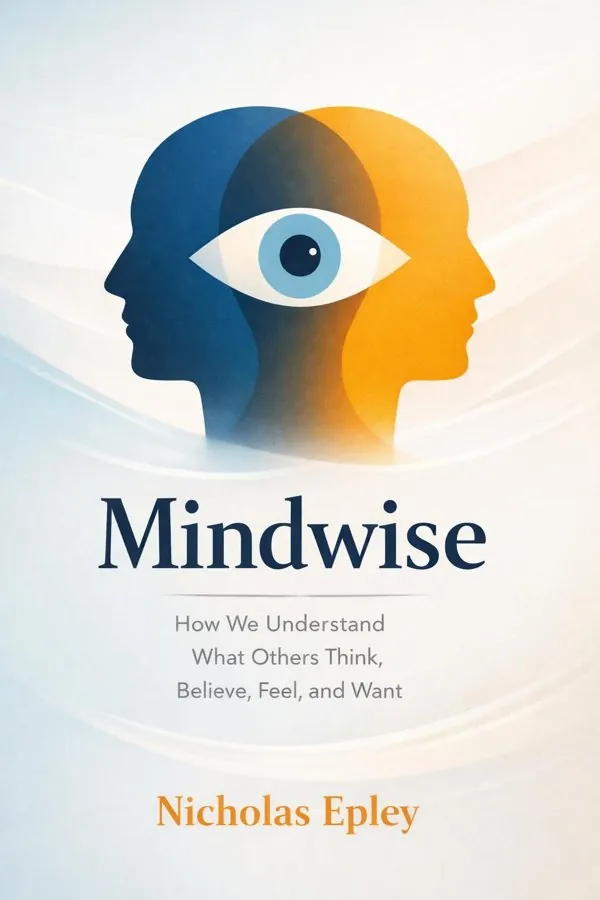
Mindwise: How We Understand What Others Think, Believe, Feel, and Want: Summary & Key Insights
 10 min9 chaptersAudio available
What Is Mindwise: How We Understand What Others Think, Believe, Feel, and Want About?
Mindwise: How We Understand What Others Think, Believe, Feel, and Want by Nicholas Epley is a cognition book spanning 9 pages. In Mindwise, social psychologist Nicholas Epley explores how humans perceive the minds of others—what they think, believe, feel, and want—and why we so often misunderstand them. Drawing on decades of research in psychology and behavioral science, Epley reveals the systematic biases and illusions that shape our social judgments, offering insights into empathy, perspective-taking, and the limits of human understanding.
This FizzRead summary covers all 9 key chapters of Mindwise: How We Understand What Others Think, Believe, Feel, and Want in approximately 10 minutes, distilling the most important ideas, arguments, and takeaways from Nicholas Epley's work. Also available as an audio summary and Key Quotes Podcast.
Mindwise: How We Understand What Others Think, Believe, Feel, and Want
In Mindwise, social psychologist Nicholas Epley explores how humans perceive the minds of others—what they think, believe, feel, and want—and why we so often misunderstand them. Drawing on decades of research in psychology and behavioral science, Epley reveals the systematic biases and illusions that shape our social judgments, offering insights into empathy, perspective-taking, and the limits of human understanding.
Who Should Read Mindwise: How We Understand What Others Think, Believe, Feel, and Want?
This book is perfect for anyone interested in cognition and looking to gain actionable insights in a short read. Whether you're a student, professional, or lifelong learner, the key ideas from Mindwise: How We Understand What Others Think, Believe, Feel, and Want by Nicholas Epley will help you think differently.
- ✓Readers who enjoy cognition and want practical takeaways
- ✓Professionals looking to apply new ideas to their work and life
- ✓Anyone who wants the core insights of Mindwise: How We Understand What Others Think, Believe, Feel, and Want in just 10 minutes
Want the full summary?
Get instant access to this book summary and 100K+ more with Fizz Moment.
Get Free SummaryAvailable on App Store • Free to download
Key Chapters
Most of us believe that we can read other people like open books. We think we can tell when someone is lying or when they’re happy or anxious merely by observing their body language, tone, or choice of words. Yet decades of psychological research show that this belief is largely an illusion. In one experiment, participants were asked to estimate how well they could detect another person’s feelings based on facial expressions or written messages. The results consistently revealed a sharp gap between confidence and accuracy. People thought they understood others far better than they actually did.
This phenomenon is what I call the 'illusion of transparency'—the feeling that our internal states are visible to others and that theirs are visible to us. In reality, our minds are opaque; they are private worlds filtered through imperfect signals. When you feel embarrassed, the heat rising in your face convinces you that everyone must be noticing your discomfort. But studies show that observers barely register it. Conversely, when others are upset with us, we often miss the signs entirely. We live in a social mirage, mistaking signals for understanding.
The danger of this illusion is that it prevents real communication. Believing we can 'just tell' what others think stops us from asking, from listening, from clarifying. This self-assured mindreading creates unnecessary conflict—at home, at work, in every interaction. Recognizing the illusion is the first step toward genuine empathy. It means accepting that other minds are hidden, that understanding requires effort and dialogue. Once you release the belief that you intuitively know what others think, you open yourself to truly finding out. That humble awareness is far more powerful than any supposed insight.
When we try to imagine what others think or feel, we do so from our own point of view—and we rarely escape it. Psychological studies repeatedly show that we project our own beliefs, emotions, and knowledge onto others, even when we’re trying to be objective. This egocentrism in perspective-taking explains why misunderstandings are so pervasive. When you know a fact that others don’t, it becomes almost impossible to imagine what it’s like to *not* know it. This is called the 'curse of knowledge.' It makes clear explanation difficult and empathy superficial.
Consider a simple experiment. Suppose you tap out the rhythm of a familiar song on a table and ask someone else to guess the tune. You’ll believe your tapping instantly conveys the melody, because you can hear it in your head. The listener, however, hears only random taps. This mismatch between what’s in your mind and what’s in theirs is the essence of egocentrism: we cannot fully grasp what it is like to have a different perspective. Yet we act as if we can.
Egocentrism affects everyday decisions—in negotiation, parenting, leadership, friendship. We assume our intentions are clear and our empathy deep, when in fact we are just projecting ourselves outward. The antidote lies not in trying harder to imagine other perspectives but in testing them, by asking questions, by listening actively, by acknowledging what we don’t know. True perspective-taking begins with humility, not imagination. Once you recognize your mind’s tendency to center itself in every judgment, you can begin to decenter it—making room for others’ minds to be seen on their own terms.
+ 7 more chapters — available in the FizzRead app
All Chapters in Mindwise: How We Understand What Others Think, Believe, Feel, and Want
About the Author
Nicholas Epley is the John Templeton Keller Professor of Behavioral Science at the University of Chicago Booth School of Business. His research focuses on social cognition, judgment, and decision-making, particularly how people understand and misinterpret the minds of others.
Get This Summary in Your Preferred Format
Read or listen to the Mindwise: How We Understand What Others Think, Believe, Feel, and Want summary by Nicholas Epley anytime, anywhere. FizzRead offers multiple formats so you can learn on your terms — all free.
Available formats: App · Audio · PDF · EPUB — All included free with FizzRead
Download Mindwise: How We Understand What Others Think, Believe, Feel, and Want PDF and EPUB Summary
Key Quotes from Mindwise: How We Understand What Others Think, Believe, Feel, and Want
“Most of us believe that we can read other people like open books.”
“When we try to imagine what others think or feel, we do so from our own point of view—and we rarely escape it.”
Frequently Asked Questions about Mindwise: How We Understand What Others Think, Believe, Feel, and Want
Mindwise: How We Understand What Others Think, Believe, Feel, and Want by Nicholas Epley is a cognition book that explores key ideas across 9 chapters. In Mindwise, social psychologist Nicholas Epley explores how humans perceive the minds of others—what they think, believe, feel, and want—and why we so often misunderstand them. Drawing on decades of research in psychology and behavioral science, Epley reveals the systematic biases and illusions that shape our social judgments, offering insights into empathy, perspective-taking, and the limits of human understanding.
You Might Also Like

A Field Guide to Lies: Critical Thinking in the Information Age
Daniel J. Levitin
10 min
A Theory of Cognitive Dissonance
Leon Festinger
10 min
Black-And-White Thinking: The Burden of a Binary Brain in a Complex World
Kevin Dutton
10 min
Born Liars: Why We Can’t Live Without Deceit
Ian Leslie
10 min
Collective Illusions: Conformity, Complicity, and the Science of Why We Make Bad Decisions
Todd Rose
10 min
Concrete Mathematics: A Foundation for Computer Science
Ronald L. Graham, Donald E. Knuth, Oren Patashnik
10 minBrowse by Category
Ready to read Mindwise: How We Understand What Others Think, Believe, Feel, and Want?
Get the full summary and 100K+ more books with Fizz Moment.