
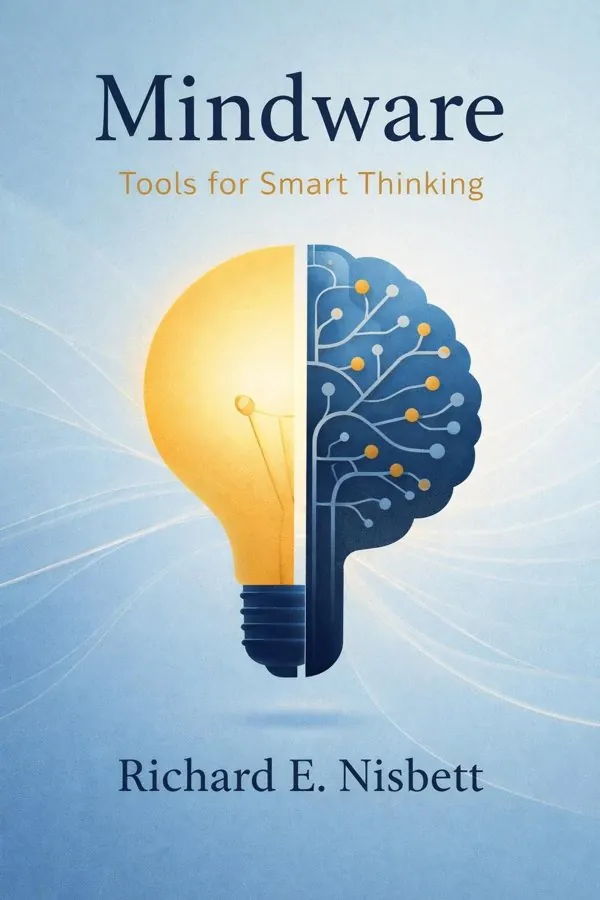
Mindware: Tools for Smart Thinking: Summary & Key Insights
 10 min6 chaptersAudio available
What Is Mindware: Tools for Smart Thinking About?
Mindware: Tools for Smart Thinking by Richard E. Nisbett is a cognition book spanning 6 pages. Mindware: Tools for Smart Thinking es un libro de psicología cognitiva que explora cómo las personas pueden mejorar su razonamiento y toma de decisiones aplicando principios de la lógica, la estadística y la ciencia del comportamiento. Richard E. Nisbett ofrece estrategias prácticas para evitar sesgos cognitivos y pensar de manera más racional en la vida cotidiana.
This FizzRead summary covers all 6 key chapters of Mindware: Tools for Smart Thinking in approximately 10 minutes, distilling the most important ideas, arguments, and takeaways from Richard E. Nisbett's work. Also available as an audio summary and Key Quotes Podcast.
Mindware: Tools for Smart Thinking
Mindware: Tools for Smart Thinking es un libro de psicología cognitiva que explora cómo las personas pueden mejorar su razonamiento y toma de decisiones aplicando principios de la lógica, la estadística y la ciencia del comportamiento. Richard E. Nisbett ofrece estrategias prácticas para evitar sesgos cognitivos y pensar de manera más racional en la vida cotidiana.
Who Should Read Mindware: Tools for Smart Thinking?
This book is perfect for anyone interested in cognition and looking to gain actionable insights in a short read. Whether you're a student, professional, or lifelong learner, the key ideas from Mindware: Tools for Smart Thinking by Richard E. Nisbett will help you think differently.
- ✓Readers who enjoy cognition and want practical takeaways
- ✓Professionals looking to apply new ideas to their work and life
- ✓Anyone who wants the core insights of Mindware: Tools for Smart Thinking in just 10 minutes
Want the full summary?
Get instant access to this book summary and 100K+ more with Fizz Moment.
Get Free SummaryAvailable on App Store • Free to download
Key Chapters
We humans possess extraordinary intuitive capacities. These evolved systems guide us through life efficiently, allowing instant judgments about faces, dangers, and opportunities. Yet the same intuition that speeds decision-making can distort reality. In everyday cognition, we rely on heuristics—mental shortcuts that simplify complexity. They serve us well in familiar contexts but fail catastrophically in the abstract domains of probability, logic, and science.
I begin the journey through *Mindware* by exposing these intuitive mechanisms. For instance, when people are asked whether a coin is ‘due’ to land heads after several tails, intuition whispers yes; logic insists no. Similarly, when we assess risk, we focus on vivid events rather than statistical likelihoods. This tendency is called the availability heuristic, and it defines how memory shapes judgment. The danger lies not in having heuristics, but in trusting them blindly.
I have found through decades of research that our intuitive mind evolved for survival, not for truth. It identifies patterns faster than it verifies them. And because it is intuitive, it rarely admits error. Consider how we explain outcomes in hindsight, believing we ‘knew it all along’. This illusion of knowing—the curse of hindsight—obscures the complexity of genuine prediction and makes us overconfident in our reasoning.
To counter these tendencies, we must first cultivate awareness of them. Learning the architecture of intuition lets us step outside it. Education often fails here—it teaches content but neglects the meta-cognitive skill of recognizing one’s own mental fallibility. The installation of mindware begins precisely at this point: understanding that the mind has default settings, and those settings need upgrading.
The point is not to abandon intuition but to integrate it within analytical systems. Once you grasp that your first reaction is a hypothesis, not a verdict, you can check it against logical or statistical principles. The distance between intuition and reason becomes the place where smarter thinking happens.
Logic is the skeleton of rationality. Without an appreciation for what makes arguments valid or invalid, we drift through discourse guided by persuasion rather than proof. In everyday life, logical principles are not abstract—they are practical devices for clarity. For example, recognizing that an argument is ‘affirming the consequent’ or committing a false equivalence allows you to diagnose hidden errors others overlook.
In *Mindware*, I emphasize how logical structure liberates thought. The ability to distinguish premises from conclusions isn’t merely scholastic—it becomes vital when reading news, evaluating claims, or negotiating decisions. Our society values opinion, but opinion without logic is noise. The logical thinker asks, “What follows from what?” and keeps that question constant.
When I teach logic, I advocate for a mindset rather than a checklist. Logic is not memorizing fallacies but internalizing a style of thinking that demands consistency. Once you grasp that consistency is the lifeblood of clarity, you begin to notice contradictions in daily reasoning. Suppose someone argues that stricter laws reduce violence while also claiming that people will ignore laws regardless of severity—those claims conflict. Logical awareness identifies such contradictions instantly.
With logical mindware installed, communication improves. Arguments become constructive instead of combative, focused on coherence rather than dominance. And when logic joins hands with empathy, understanding flourishes. Thinking clearly is not only intellectually satisfying—it is ethically responsible, because sound reasoning protects truth from distortion.
+ 4 more chapters — available in the FizzRead app
All Chapters in Mindware: Tools for Smart Thinking
About the Author
Richard E. Nisbett es un psicólogo social estadounidense, profesor emérito en la Universidad de Michigan, conocido por sus investigaciones sobre la cognición, la cultura y el razonamiento humano. Es autor de obras influyentes como The Geography of Thought y ha sido miembro de la Academia Nacional de Ciencias de Estados Unidos.
Get This Summary in Your Preferred Format
Read or listen to the Mindware: Tools for Smart Thinking summary by Richard E. Nisbett anytime, anywhere. FizzRead offers multiple formats so you can learn on your terms — all free.
Available formats: App · Audio · PDF · EPUB — All included free with FizzRead
Download Mindware: Tools for Smart Thinking PDF and EPUB Summary
Key Quotes from Mindware: Tools for Smart Thinking
“We humans possess extraordinary intuitive capacities.”
“Without an appreciation for what makes arguments valid or invalid, we drift through discourse guided by persuasion rather than proof.”
Frequently Asked Questions about Mindware: Tools for Smart Thinking
Mindware: Tools for Smart Thinking by Richard E. Nisbett is a cognition book that explores key ideas across 6 chapters. Mindware: Tools for Smart Thinking es un libro de psicología cognitiva que explora cómo las personas pueden mejorar su razonamiento y toma de decisiones aplicando principios de la lógica, la estadística y la ciencia del comportamiento. Richard E. Nisbett ofrece estrategias prácticas para evitar sesgos cognitivos y pensar de manera más racional en la vida cotidiana.
You Might Also Like
A Field Guide to Lies: Critical Thinking in the Information Age
Daniel J. Levitin
10 min
A Theory of Cognitive Dissonance
Leon Festinger
10 min
Black-And-White Thinking: The Burden of a Binary Brain in a Complex World
Kevin Dutton
10 min
Born Liars: Why We Can’t Live Without Deceit
Ian Leslie
10 min
Collective Illusions: Conformity, Complicity, and the Science of Why We Make Bad Decisions
Todd Rose
10 min
Concrete Mathematics: A Foundation for Computer Science
Ronald L. Graham, Donald E. Knuth, Oren Patashnik
10 minBrowse by Category
Ready to read Mindware: Tools for Smart Thinking?
Get the full summary and 100K+ more books with Fizz Moment.