
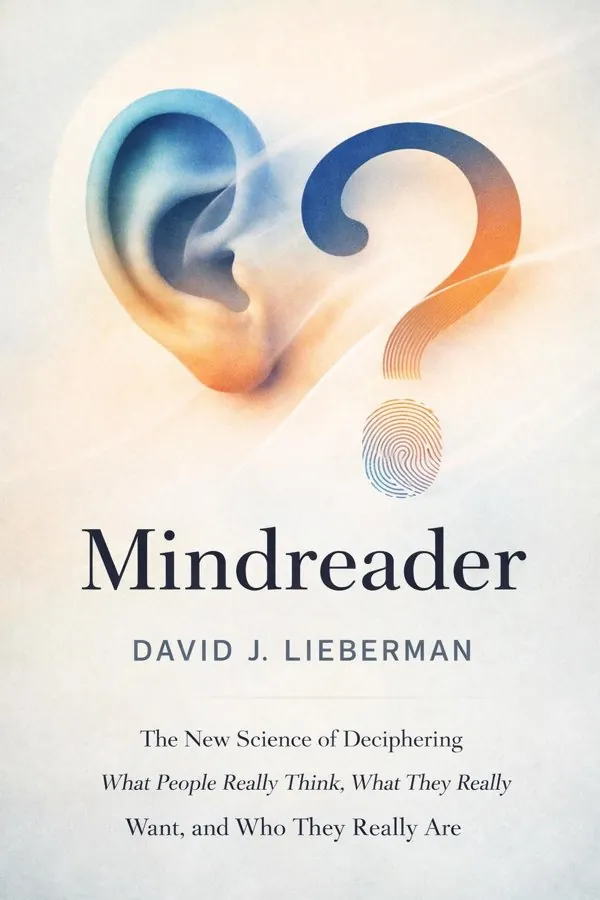
Mindreader: The New Science of Deciphering What People Really Think, What They Really Want, and Who They Really Are: Summary & Key Insights
 10 min6 chaptersAudio available
What Is Mindreader: The New Science of Deciphering What People Really Think, What They Really Want, and Who They Really Are About?
Mindreader: The New Science of Deciphering What People Really Think, What They Really Want, and Who They Really Are by David J. Lieberman is a cognition book spanning 6 pages. This book explores the science of psycholinguistics and behavioral analysis to help readers understand what people truly think and feel. Lieberman presents practical techniques for interpreting verbal and nonverbal cues, enabling readers to assess honesty, intentions, and emotional states in everyday interactions.
This FizzRead summary covers all 6 key chapters of Mindreader: The New Science of Deciphering What People Really Think, What They Really Want, and Who They Really Are in approximately 10 minutes, distilling the most important ideas, arguments, and takeaways from David J. Lieberman's work. Also available as an audio summary and Key Quotes Podcast.
Mindreader: The New Science of Deciphering What People Really Think, What They Really Want, and Who They Really Are
This book explores the science of psycholinguistics and behavioral analysis to help readers understand what people truly think and feel. Lieberman presents practical techniques for interpreting verbal and nonverbal cues, enabling readers to assess honesty, intentions, and emotional states in everyday interactions.
Who Should Read Mindreader: The New Science of Deciphering What People Really Think, What They Really Want, and Who They Really Are?
This book is perfect for anyone interested in cognition and looking to gain actionable insights in a short read. Whether you're a student, professional, or lifelong learner, the key ideas from Mindreader: The New Science of Deciphering What People Really Think, What They Really Want, and Who They Really Are by David J. Lieberman will help you think differently.
- ✓Readers who enjoy cognition and want practical takeaways
- ✓Professionals looking to apply new ideas to their work and life
- ✓Anyone who wants the core insights of Mindreader: The New Science of Deciphering What People Really Think, What They Really Want, and Who They Really Are in just 10 minutes
Want the full summary?
Get instant access to this book summary and 100K+ more with Fizz Moment.
Get Free SummaryAvailable on App Store • Free to download
Key Chapters
Every time a person speaks, they reveal not only what they know but who they are. Psycholinguistics—the science of how language reflects mental and emotional states—is our doorway into that revelation. In *Mindreader*, I explain that the structure of a person’s sentence, their choice of pronouns, and even the rhythm of their speech reflects underlying motivations and emotional patterns.
When someone says, “I guess I might have forgotten,” they’re expressing uncertainty or diffusion of responsibility—often signaling guilt or avoidance. Compare that to “I forgot,” which is direct and unambiguous, likely indicating ownership of the act. These linguistic distinctions might seem minor, yet they hold astonishing diagnostic value. Over years of research and practice, I found that people under psychological strain instinctively alter syntax: they use more qualifying phrases, hesitate longer, and lean toward indirect constructions. The subconscious tries to protect the ego by softening truths.
This chapter allows you to understand why words are windows into thought architecture. You learn how emotional intensity shifts language patterns—how anger compresses speech into short bursts, while anxiety expands it into defensive explanation. Each state carries a linguistic fingerprint. Psycholinguistic analysis extends beyond deception detection; it reveals personality, cognitive style, and emotional reality.
As we explore examples from counseling, negotiation, and forensic interviews, I show how small verbal shifts uncover hidden beliefs. A person who consistently externalizes blame (“It happened to me”) is expressing victim identity, while one who frequently uses active verbs (“I made this happen”) shows personal agency. When we listen closely enough, the truth emerges not in what people say but in how they say it.
You’ll begin to notice patterns in everyday dialogues. You will catch subtle clues—the unnatural precision in a rehearsed story, the casual vagueness of emotional withdrawal, the rhythm of sincerity. The power of psycholinguistics lies not in judgment but illumination. By paying attention to speech, you can distinguish fear from uncertainty, confidence from arrogance, and honesty from pretense. In every conversation, language gives you the x-ray of the mind beneath.
While words give you access to conscious thought, behavior reveals the unconscious. In *Mindreader*, I delve deep into behavioral analysis—the psychological science of decoding what actions, gestures, and postures communicate about inner states. The body speaks its own dialect. It cannot lie for very long.
Every human gesture is linked to an emotional impulse. Crossing arms, shifting weight, touching the face—these are not random movements; they are micro-adjustments that regulate anxiety, defensiveness, or comfort. The key is understanding context. A person may cross their arms because they feel cold, but if they do so while asserting openness, the contradiction itself tells you something crucial.
Nonverbal behaviors act as involuntary emotional leakage. When someone’s verbal statement and body language diverge, the truth lies in the body. This principle has guided my work with behavioral experts in law enforcement and psychology. When interrogators observe incongruities—such as a calm voice paired with anxious gestures—they do not immediately assume deception, but they know there is emotional discord to explore. The same principle applies in everyday life.
Nonverbal cues reveal emotional states: the tightening of the jaw signals restrained anger; the softening of eye muscles indicates genuine happiness; the subtle delay before a smile may suggest social performance. By training yourself to observe these details without prejudice, you begin to perceive what people feel before they articulate it. In the book, I also highlight microexpressions—brief, involuntary facial movements that leak true emotion even when someone tries to conceal it. These microseconds of truth cut through layers of self-control.
Learning to read these cues demands practice, not assumption. You must remain neutral, collecting observations instead of imposing interpretation. Empathy, patience, and curiosity form the triad that makes behavioral analysis humane and effective. As readers progress, they find that understanding unspoken signals transforms trust. People feel seen, understood, and less inclined to guard themselves. The act of mindreading then becomes an act of compassion.
+ 4 more chapters — available in the FizzRead app
All Chapters in Mindreader: The New Science of Deciphering What People Really Think, What They Really Want, and Who They Really Are
About the Author
David J. Lieberman, Ph.D., is a New York Times bestselling author and expert in human behavior and interpersonal communication. He has written several books on psychology and deception detection and has lectured internationally on behavioral science and mental health.
Get This Summary in Your Preferred Format
Read or listen to the Mindreader: The New Science of Deciphering What People Really Think, What They Really Want, and Who They Really Are summary by David J. Lieberman anytime, anywhere. FizzRead offers multiple formats so you can learn on your terms — all free.
Available formats: App · Audio · PDF · EPUB — All included free with FizzRead
Download Mindreader: The New Science of Deciphering What People Really Think, What They Really Want, and Who They Really Are PDF and EPUB Summary
Key Quotes from Mindreader: The New Science of Deciphering What People Really Think, What They Really Want, and Who They Really Are
“Every time a person speaks, they reveal not only what they know but who they are.”
“While words give you access to conscious thought, behavior reveals the unconscious.”
Frequently Asked Questions about Mindreader: The New Science of Deciphering What People Really Think, What They Really Want, and Who They Really Are
Mindreader: The New Science of Deciphering What People Really Think, What They Really Want, and Who They Really Are by David J. Lieberman is a cognition book that explores key ideas across 6 chapters. This book explores the science of psycholinguistics and behavioral analysis to help readers understand what people truly think and feel. Lieberman presents practical techniques for interpreting verbal and nonverbal cues, enabling readers to assess honesty, intentions, and emotional states in everyday interactions.
You Might Also Like

A Field Guide to Lies: Critical Thinking in the Information Age
Daniel J. Levitin
10 min
A Theory of Cognitive Dissonance
Leon Festinger
10 min
Black-And-White Thinking: The Burden of a Binary Brain in a Complex World
Kevin Dutton
10 min
Born Liars: Why We Can’t Live Without Deceit
Ian Leslie
10 min
Collective Illusions: Conformity, Complicity, and the Science of Why We Make Bad Decisions
Todd Rose
10 min
Concrete Mathematics: A Foundation for Computer Science
Ronald L. Graham, Donald E. Knuth, Oren Patashnik
10 minBrowse by Category
Ready to read Mindreader: The New Science of Deciphering What People Really Think, What They Really Want, and Who They Really Are?
Get the full summary and 100K+ more books with Fizz Moment.