
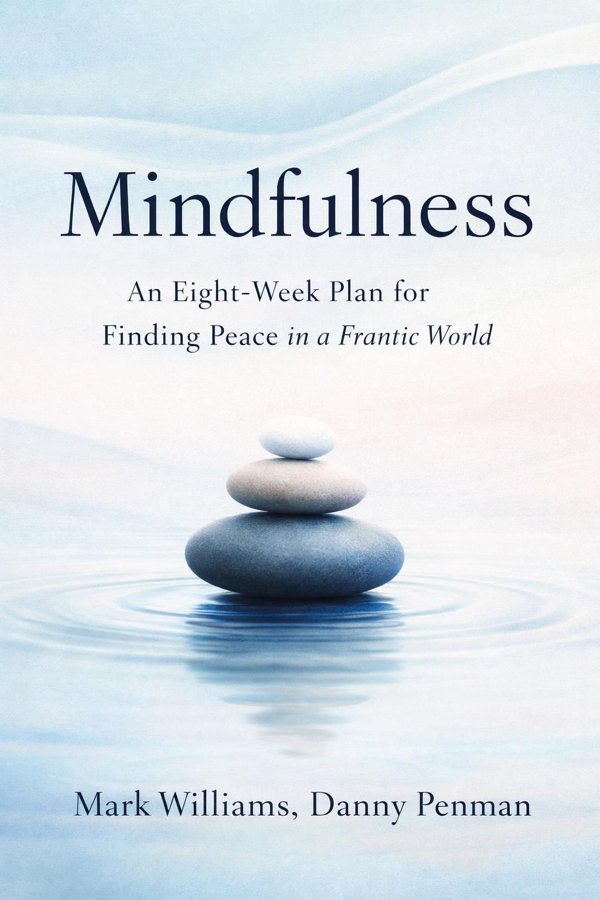
Mindfulness: An Eight-Week Plan for Finding Peace in a Frantic World: Summary & Key Insights
by Mark Williams, Danny Penman
 10 min10 chaptersAudio available
Key Takeaways from Mindfulness: An Eight-Week Plan for Finding Peace in a Frantic World
One of the book’s most powerful insights is that we often miss our own lives not because we are lazy or careless, but because the mind is built to automate experience.
The first week of the program starts with a deceptively simple realization: peace does not begin by changing your whole life, but by noticing the life you already have.
A striking truth runs through the second week: when the mind is overwhelmed, the body often knows it first.
The breath is always with us, yet we rarely use it as the stabilizing resource it can be.
Many people believe mindfulness is useful only when life feels calm.
What Is Mindfulness: An Eight-Week Plan for Finding Peace in a Frantic World About?
Mindfulness: An Eight-Week Plan for Finding Peace in a Frantic World by Mark Williams, Danny Penman is a mental_health book spanning 10 pages. Mindfulness: An Eight-Week Plan for Finding Peace in a Frantic World is a practical guide to breaking free from stress, anxiety, low mood, and the exhausting mental habits that keep many people stuck in overthinking. Rather than offering vague inspiration, Mark Williams and Danny Penman present a structured eight-week program rooted in mindfulness-based cognitive therapy, or MBCT, a clinically tested approach developed to help prevent relapse into depression and improve emotional resilience. The book shows that much of our suffering does not come only from difficult events, but from the mind’s automatic tendency to replay the past, fear the future, and treat thoughts as facts. Through short meditations, simple daily practices, and clear explanations, readers learn how to step out of autopilot and meet life with greater calm and clarity. Williams brings deep scientific authority as a leading clinical psychologist and MBCT pioneer, while Penman translates research into accessible, human language. Together, they make mindfulness feel less like an abstract ideal and more like a trainable skill for modern life.
This FizzRead summary covers all 10 key chapters of Mindfulness: An Eight-Week Plan for Finding Peace in a Frantic World in approximately 10 minutes, distilling the most important ideas, arguments, and takeaways from Mark Williams, Danny Penman's work. Also available as an audio summary and Key Quotes Podcast.
Mindfulness: An Eight-Week Plan for Finding Peace in a Frantic World
Mindfulness: An Eight-Week Plan for Finding Peace in a Frantic World is a practical guide to breaking free from stress, anxiety, low mood, and the exhausting mental habits that keep many people stuck in overthinking. Rather than offering vague inspiration, Mark Williams and Danny Penman present a structured eight-week program rooted in mindfulness-based cognitive therapy, or MBCT, a clinically tested approach developed to help prevent relapse into depression and improve emotional resilience. The book shows that much of our suffering does not come only from difficult events, but from the mind’s automatic tendency to replay the past, fear the future, and treat thoughts as facts. Through short meditations, simple daily practices, and clear explanations, readers learn how to step out of autopilot and meet life with greater calm and clarity. Williams brings deep scientific authority as a leading clinical psychologist and MBCT pioneer, while Penman translates research into accessible, human language. Together, they make mindfulness feel less like an abstract ideal and more like a trainable skill for modern life.
Who Should Read Mindfulness: An Eight-Week Plan for Finding Peace in a Frantic World?
This book is perfect for anyone interested in mental_health and looking to gain actionable insights in a short read. Whether you're a student, professional, or lifelong learner, the key ideas from Mindfulness: An Eight-Week Plan for Finding Peace in a Frantic World by Mark Williams, Danny Penman will help you think differently.
- ✓Readers who enjoy mental_health and want practical takeaways
- ✓Professionals looking to apply new ideas to their work and life
- ✓Anyone who wants the core insights of Mindfulness: An Eight-Week Plan for Finding Peace in a Frantic World in just 10 minutes
Want the full summary?
Get instant access to this book summary and 100K+ more with Fizz Moment.
Get Free SummaryAvailable on App Store • Free to download
Key Chapters
One of the book’s most powerful insights is that we often miss our own lives not because we are lazy or careless, but because the mind is built to automate experience. We move through routines, conversations, meals, and even relationships while half-absorbed in memories, worries, plans, and judgments. This autopilot mode is efficient for repetitive tasks, yet it can become dangerous when it spills into emotional life. Stress then becomes self-sustaining: a difficult feeling appears, the mind reacts automatically, and we are swept into spirals of rumination without noticing what happened.
Williams and Penman explain that mindfulness begins with seeing this process clearly. The goal is not to stop thinking or become passive. It is to notice when awareness has narrowed and to gently return to present-moment experience. A simple example is eating breakfast while checking messages and mentally rehearsing the day’s problems. The meal disappears unnoticed, tension rises, and the body remains ignored. By contrast, mindful attention brings us back to what is actually happening: the taste of food, the sensation of sitting, the breath moving, the mood of the moment.
This shift matters because awareness creates choice. When we notice tension in the shoulders, a rush of irritation, or a familiar loop of self-criticism, we are no longer completely trapped inside it. We can pause before reacting. Over time, that pause becomes the foundation of emotional freedom.
Actionable takeaway: Pick one routine activity today, such as brushing your teeth or making tea, and do it with full attention from beginning to end.
The first week of the program starts with a deceptively simple realization: peace does not begin by changing your whole life, but by noticing the life you already have. Most people assume mindfulness requires special silence, long retreats, or unusual discipline. The book challenges that assumption by inviting readers to rediscover awareness in ordinary moments. Daily life becomes the training ground.
Week one uses practices that reconnect attention to direct experience. You may mindfully eat a raisin, notice the sensations of a shower, or feel each step while walking. These exercises seem small, but they reveal how rarely we truly inhabit the present. Instead of treating each activity as a blur between more important events, mindfulness asks us to arrive for it. This helps weaken the constant pull of rumination and worry.
The authors emphasize that the point is not to have a special experience. Some moments will feel calm, others restless or dull. What matters is learning to observe without immediately judging. If the mind wanders, that is not failure. It is the moment of learning. Every return to the present strengthens awareness.
In practical terms, week one is about interrupting speed. A busy parent can pause while washing dishes and feel the warmth of water. An office worker can notice three conscious breaths before opening email. These micro-moments restore presence and reduce mental fragmentation.
Actionable takeaway: Choose one daily activity you normally rush through and practice doing it slowly, with curiosity, for the next seven days.
A striking truth runs through the second week: when the mind is overwhelmed, the body often knows it first. Stress, sadness, and anxiety are not only mental events; they appear as tight jaws, shallow breathing, clenched stomachs, fatigue, and agitation. Yet many people are so used to living in their heads that they stop listening to these signals until distress becomes intense. Mindfulness restores the body as an anchor.
The authors introduce body-centered practices such as the body scan, which trains attention to move gradually through different regions of the body with openness rather than analysis. This is not about forcing relaxation. In fact, some areas may feel numb, uncomfortable, or emotionally charged. The practice teaches readers to notice sensations as they are. By doing so, they develop a more grounded relationship with experience.
This matters because the body can interrupt spiraling thought. When someone is caught in anxiety, trying to think their way out often makes the problem worse. Bringing attention to the soles of the feet, the contact with a chair, or the rise and fall of the chest offers a nonverbal way to stabilize. It shifts awareness from abstract threat to immediate reality.
In everyday life, body awareness can reveal early warning signs. You may notice that before snapping at a partner, your shoulders harden and breathing shortens. Before procrastinating, your stomach sinks. These clues create a chance to respond with care rather than habit.
Actionable takeaway: Spend 10 minutes each day scanning your body from head to toe, simply noticing sensations without trying to fix or change them.
The breath is always with us, yet we rarely use it as the stabilizing resource it can be. In the third week, Williams and Penman show that breathing is not a magic trick for eliminating pain, but a reliable home base for attention. When the mind becomes scattered, anxious, or overactive, the breath offers a way to return to the present without needing to solve every problem immediately.
Mindful breathing works because it is simple, rhythmic, and embodied. The practice may involve noticing air at the nostrils, the expansion of the rib cage, or the rise and fall of the abdomen. The authors repeatedly stress that wandering is natural. The point is not perfect concentration but a gentle cycle of noticing distraction and returning. That return is the exercise.
In modern life, attention is pulled in hundreds of directions. Notifications, deadlines, and internal pressure keep the nervous system activated. A few minutes of conscious breathing can break that chain. Before an important meeting, a student can pause for three breaths. During a family conflict, someone can silently return to the breath before speaking. In traffic, breath awareness can prevent irritation from turning into full emotional takeover.
The breath also teaches a subtle lesson: experience is changing moment by moment. Inhalation becomes exhalation. Tension arises and passes. Thoughts appear and dissolve. This direct encounter with impermanence makes emotions feel less final and less threatening.
Actionable takeaway: Practice a three-minute breathing space once or twice a day, especially before stressful tasks or difficult conversations.
Many people believe mindfulness is useful only when life feels calm. The fourth week overturns that idea by showing that the real power of practice appears when discomfort arrives. The mind usually responds to unpleasant feelings in one of two ways: resistance or escape. We suppress, distract, explain, blame, or mentally run away. Ironically, these reactions often intensify suffering because they add struggle to pain.
This week focuses on staying present without being overwhelmed. The authors teach readers to widen awareness so that difficult sensations, emotions, or thoughts are held within a larger field of attention. Instead of becoming fused with stress, you notice stress. Instead of becoming anger, you observe anger moving through the body and mind. This shift from identification to observation creates psychological space.
Consider a common example: you receive critical feedback at work. Autopilot might trigger defensiveness, shame, or obsessive replay. Mindfulness invites a pause. You feel the heat in your face, the contraction in your chest, the rush of thoughts. By naming what is happening internally and staying with the bodily experience, you avoid adding another layer of panic or self-judgment. You may still dislike the situation, but you are less likely to be ruled by it.
This is not emotional suppression. It is a brave form of contact with reality. The more skillfully we meet discomfort, the less it controls our choices.
Actionable takeaway: The next time a difficult emotion appears, pause and silently note, “Here is tension,” or “Here is sadness,” while feeling where it shows up in the body.
A surprising source of suffering is the belief that unpleasant inner states must be eliminated immediately. The fifth week teaches a radical alternative: allowing experience to be present without surrendering to it. This is one of the book’s most transformative lessons. We often imagine acceptance means liking pain, approving of injustice, or becoming passive. The authors show that true allowing is simply ending the extra war with reality.
When anxiety, grief, irritation, or exhaustion arises, the usual reflex is to push it away. But resistance can feed the very state we fear. A person anxious about a presentation may become even more anxious because they are angry at themselves for being anxious. Mindfulness loosens this knot by encouraging gentle acknowledgment: this is what is here right now.
Allowing does not mean staying stuck. In fact, change becomes more possible once we stop fighting the raw fact of the moment. If you feel lonely, admitting loneliness is often more healing than covering it with busyness. If your body is tired, noticing that truth may lead you to rest rather than force productivity. Letting be creates honesty, and honesty creates wise action.
In practice, this can be as simple as sitting for a few minutes with an uncomfortable feeling, breathing into it, and dropping the demand that it disappear. Often the experience softens on its own. Even when it does not, your relationship to it changes.
Actionable takeaway: When discomfort arises, try replacing “How do I get rid of this?” with “Can I make space for this, just for now?”
Perhaps the most liberating idea in the entire book is that thoughts, however convincing, are not necessarily true. The mind generates commentary constantly: predictions, interpretations, memories, comparisons, judgments. In low mood or anxiety, these thoughts can sound especially authoritative. “I always fail.” “Nobody cares.” “Something bad is about to happen.” Because they arise internally, we often mistake them for reality rather than mental events.
Drawing from MBCT, the authors teach readers to change their relationship to thinking. The goal is not to suppress thoughts but to recognize them as passing products of the mind. This process, sometimes called decentering, helps break the chain between thought and emotional collapse. If a thought says, “I’m not good enough,” mindfulness invites curiosity: is this a fact, or is this a familiar story my mind tells under stress?
This distinction is crucial for people prone to rumination or depressive spirals. A single setback can trigger a flood of self-critical thinking that feels objective. By observing thoughts rather than inhabiting them, we reduce their grip. For example, after making a mistake, instead of automatically believing “I ruin everything,” you can notice the thought, name it, and return to the breath or body.
Over time, this builds freedom. Thoughts still come, but they no longer define the whole landscape. You become less vulnerable to every mental weather change.
Actionable takeaway: Write down one recurring negative thought and add the phrase, “I am noticing the thought that...” before it to create distance from it.
Mindfulness is not only about awareness; it is also about learning how to respond to your life with kindness and intelligence. In week seven, the program shifts toward self-care. This is not indulgence or escape. It is the practical recognition that mental well-being depends on how we treat ourselves when stress returns. Many people know what drains them, yet they keep overriding their own needs until they crash.
The authors encourage readers to identify nourishing activities and distinguish them from merely numbing ones. Nourishing actions genuinely replenish energy, connection, and clarity: walking in nature, calling a trusted friend, sleeping enough, eating attentively, moving the body, listening to music, or taking a quiet pause. Numbing activities may provide short-term distraction but often leave us more depleted, such as compulsive scrolling, emotional eating, or overworking.
This chapter is especially helpful because it brings mindfulness into daily decision-making. If you notice early signs of low mood or stress, you can ask: what do I need right now? Not what is most urgent, impressive, or habitual, but what is truly supportive? That question can redirect a whole day.
Self-care also includes compassion. Instead of criticizing yourself for struggling, you learn to respond as you might to a friend: with warmth, realism, and encouragement. This softens the harsh inner climate that often fuels anxiety and depression.
Actionable takeaway: Make two lists today, one of activities that nourish you and one of habits that deplete or numb you, then schedule one nourishing activity this week.
The final week makes a crucial point: mindfulness is not an eight-week achievement but a way of relating to life that must be renewed again and again. Programs end, enthusiasm fluctuates, and difficult periods return. The authors prepare readers for this reality by emphasizing continuity over perfection. What matters is not maintaining an ideal practice but returning whenever you drift.
This week helps readers integrate mindfulness into work, relationships, and future setbacks. You learn to recognize personal warning signs of stress or low mood and respond early, before patterns become entrenched. Perhaps you become irritable, lose sleep, withdraw socially, or start replaying failures. Mindfulness lets you spot these signals and use the tools you have practiced: the body scan, breathing space, mindful movement, acceptance, and thought awareness.
The authors also frame mindfulness as a lifelong skill of beginning again. Some days practice will feel easy; others will feel flat, distracted, or emotionally raw. None of that means you are failing. A sustainable practice is flexible. It may be 20 minutes of formal meditation one day and three mindful breaths in a hallway the next.
Ultimately, week eight is about trust. You have learned that peace is not found by controlling every circumstance, but by changing how you meet experience. That is a portable form of resilience.
Actionable takeaway: Create a simple personal mindfulness plan that includes one formal practice, one brief daily pause, and one early warning sign you will watch for.
What gives this book unusual strength is its marriage of scientific rigor and everyday practicality. Mindfulness is often presented either as ancient wisdom without evidence or as clinical technique stripped of humanity. Williams and Penman bridge both worlds. They show that the practices are grounded in meditation traditions, yet also supported by psychological research, especially the development of mindfulness-based cognitive therapy for depression and relapse prevention.
The scientific contribution matters because it reassures skeptical readers that mindfulness is more than a trend. The book explains how habitual mental patterns, particularly rumination, amplify emotional distress. MBCT helps people notice these patterns earlier and disengage from them before they escalate. That makes mindfulness useful not only for severe emotional difficulty but also for ordinary stress, burnout, and reactivity.
Just as important, the authors keep the method accessible. The practices are short, structured, and realistic for busy lives. You do not need to adopt a new identity or believe in anything mystical. You simply experiment with awareness. This lowers the barrier to entry and makes change more likely to last.
The broader lesson is that transformation often comes through repeated small acts rather than dramatic breakthroughs. A few minutes of daily attention can gradually reshape how you think, feel, and respond. The frantic world may not slow down, but your relationship to it can fundamentally change.
Actionable takeaway: Commit to practicing mindfulness for a few minutes daily for one month, treating it as an experiment in changing your relationship with stress rather than a test of willpower.
All Chapters in Mindfulness: An Eight-Week Plan for Finding Peace in a Frantic World
About the Authors
Mark Williams is a British clinical psychologist, researcher, and professor best known as one of the co-developers of mindfulness-based cognitive therapy, an influential approach designed to help prevent relapse in depression and improve emotional resilience. His academic work has played a major role in bringing mindfulness into evidence-based psychology and clinical practice. Danny Penman is a journalist, meditation teacher, and author who writes widely on mindfulness, mental health, and well-being for general audiences. He is known for translating complex psychological and scientific ideas into clear, approachable guidance. Together, Williams and Penman combine rigorous clinical expertise with practical communication, making mindfulness accessible to readers who want both scientific credibility and everyday usefulness.
Get This Summary in Your Preferred Format
Read or listen to the Mindfulness: An Eight-Week Plan for Finding Peace in a Frantic World summary by Mark Williams, Danny Penman anytime, anywhere. FizzRead offers multiple formats so you can learn on your terms — all free.
Available formats: App · Audio · PDF · EPUB — All included free with FizzRead
Download Mindfulness: An Eight-Week Plan for Finding Peace in a Frantic World PDF and EPUB Summary
Key Quotes from Mindfulness: An Eight-Week Plan for Finding Peace in a Frantic World
“One of the book’s most powerful insights is that we often miss our own lives not because we are lazy or careless, but because the mind is built to automate experience.”
“The first week of the program starts with a deceptively simple realization: peace does not begin by changing your whole life, but by noticing the life you already have.”
“A striking truth runs through the second week: when the mind is overwhelmed, the body often knows it first.”
“The breath is always with us, yet we rarely use it as the stabilizing resource it can be.”
“Many people believe mindfulness is useful only when life feels calm.”
Frequently Asked Questions about Mindfulness: An Eight-Week Plan for Finding Peace in a Frantic World
Mindfulness: An Eight-Week Plan for Finding Peace in a Frantic World by Mark Williams, Danny Penman is a mental_health book that explores key ideas across 10 chapters. Mindfulness: An Eight-Week Plan for Finding Peace in a Frantic World is a practical guide to breaking free from stress, anxiety, low mood, and the exhausting mental habits that keep many people stuck in overthinking. Rather than offering vague inspiration, Mark Williams and Danny Penman present a structured eight-week program rooted in mindfulness-based cognitive therapy, or MBCT, a clinically tested approach developed to help prevent relapse into depression and improve emotional resilience. The book shows that much of our suffering does not come only from difficult events, but from the mind’s automatic tendency to replay the past, fear the future, and treat thoughts as facts. Through short meditations, simple daily practices, and clear explanations, readers learn how to step out of autopilot and meet life with greater calm and clarity. Williams brings deep scientific authority as a leading clinical psychologist and MBCT pioneer, while Penman translates research into accessible, human language. Together, they make mindfulness feel less like an abstract ideal and more like a trainable skill for modern life.
More by Mark Williams, Danny Penman
You Might Also Like

Big Feelings: How to Be Okay When Things Are Not Okay
Liz Fosslien, Mollie West Duffy
10 min
Creative Arts Therapies Handbook: Art, Music and Dance Therapy Practices for Wellbeing
Susan I. Buchalter
10 min
Emotional First Aid: Healing Rejection, Guilt, Failure, and Other Everyday Hurts
Guy Winch
10 min
Lost Connections: Why You're Depressed and How to Find Hope
Johann Hari
10 min
No Time to Panic: How to Stop Worrying and Embrace Life
Matt Gutman
10 min
Overcoming Mobbing: A Recovery Guide for Workplace Aggression and Bullying
Maureen Duffy, Len Sperry
10 minBrowse by Category
Ready to read Mindfulness: An Eight-Week Plan for Finding Peace in a Frantic World?
Get the full summary and 100K+ more books with Fizz Moment.