
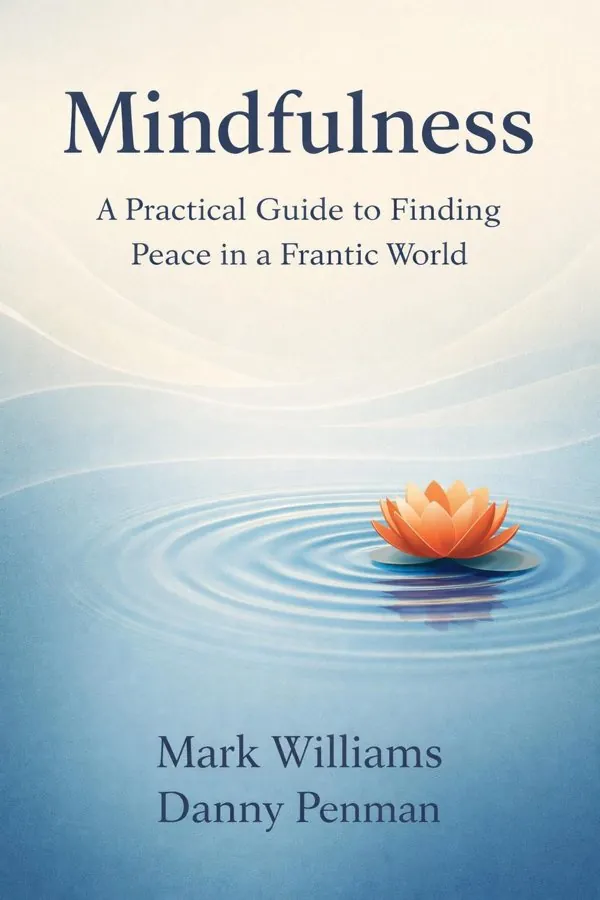
Mindfulness: A Practical Guide to Finding Peace in a Frantic World: Summary & Key Insights
by Mark Williams, Danny Penman
 10 min9 chaptersAudio available
Key Takeaways from Mindfulness: A Practical Guide to Finding Peace in a Frantic World
One of the book’s most important insights is that mindfulness is not simply about calming down—it is about waking up.
A central strength of this book is its insistence that mindfulness is not vague self-help but a practice supported by psychology, neuroscience, and clinical research.
A striking idea in the book is that unhappiness often perpetuates itself through the mind’s attempt to solve it.
Much of life is lived on autopilot, and that is precisely why so many people miss their own experience.
The book is structured around an eight-week program because mindfulness is learned through gradual training, not through intellectual understanding alone.
What Is Mindfulness: A Practical Guide to Finding Peace in a Frantic World About?
Mindfulness: A Practical Guide to Finding Peace in a Frantic World by Mark Williams, Danny Penman is a wellness book spanning 5 pages. Modern life rewards speed, distraction, and constant mental activity, yet those very habits often leave us feeling anxious, exhausted, and strangely disconnected from our own lives. In Mindfulness: A Practical Guide to Finding Peace in a Frantic World, Mark Williams and Danny Penman offer a practical, research-based way out of that cycle. Rather than promising instant calm or demanding spiritual devotion, the book introduces mindfulness as a trainable skill: the ability to pay attention to present-moment experience with openness, curiosity, and kindness. At the heart of the book is mindfulness-based cognitive therapy, or MBCT, a program developed to help people break patterns of stress, rumination, and recurring unhappiness. Williams, a leading Oxford professor and pioneer in MBCT, brings scientific rigor and clinical depth, while Penman translates those ideas into clear, accessible guidance for everyday readers. Together, they show that peace is not found by controlling every thought, but by changing how we relate to our thoughts, emotions, and routines. For anyone overwhelmed by busyness, worry, or emotional autopilot, this book offers a grounded path toward greater clarity, resilience, and inner steadiness.
This FizzRead summary covers all 9 key chapters of Mindfulness: A Practical Guide to Finding Peace in a Frantic World in approximately 10 minutes, distilling the most important ideas, arguments, and takeaways from Mark Williams, Danny Penman's work. Also available as an audio summary and Key Quotes Podcast.
Mindfulness: A Practical Guide to Finding Peace in a Frantic World
Modern life rewards speed, distraction, and constant mental activity, yet those very habits often leave us feeling anxious, exhausted, and strangely disconnected from our own lives. In Mindfulness: A Practical Guide to Finding Peace in a Frantic World, Mark Williams and Danny Penman offer a practical, research-based way out of that cycle. Rather than promising instant calm or demanding spiritual devotion, the book introduces mindfulness as a trainable skill: the ability to pay attention to present-moment experience with openness, curiosity, and kindness.
At the heart of the book is mindfulness-based cognitive therapy, or MBCT, a program developed to help people break patterns of stress, rumination, and recurring unhappiness. Williams, a leading Oxford professor and pioneer in MBCT, brings scientific rigor and clinical depth, while Penman translates those ideas into clear, accessible guidance for everyday readers. Together, they show that peace is not found by controlling every thought, but by changing how we relate to our thoughts, emotions, and routines. For anyone overwhelmed by busyness, worry, or emotional autopilot, this book offers a grounded path toward greater clarity, resilience, and inner steadiness.
Who Should Read Mindfulness: A Practical Guide to Finding Peace in a Frantic World?
This book is perfect for anyone interested in wellness and looking to gain actionable insights in a short read. Whether you're a student, professional, or lifelong learner, the key ideas from Mindfulness: A Practical Guide to Finding Peace in a Frantic World by Mark Williams, Danny Penman will help you think differently.
- ✓Readers who enjoy wellness and want practical takeaways
- ✓Professionals looking to apply new ideas to their work and life
- ✓Anyone who wants the core insights of Mindfulness: A Practical Guide to Finding Peace in a Frantic World in just 10 minutes
Want the full summary?
Get instant access to this book summary and 100K+ more with Fizz Moment.
Get Free SummaryAvailable on App Store • Free to download
Key Chapters
One of the book’s most important insights is that mindfulness is not simply about calming down—it is about waking up. Many people approach meditation expecting instant peace, fewer thoughts, or a blissful mental state. Williams and Penman challenge this assumption. Mindfulness, they explain, is the awareness that arises when we intentionally pay attention to the present moment without judging what we find. That means noticing the breath, bodily sensations, sounds, thoughts, and emotions as they are, rather than immediately trying to change, suppress, or escape them.
This matters because much of our suffering comes not only from difficult experiences themselves, but from our automatic reactions to them. A stressful email arrives, and within seconds the mind spins stories about failure, rejection, or catastrophe. A small physical discomfort becomes a source of frustration. A fleeting sad mood turns into a day-long identity. Mindfulness interrupts this chain reaction by helping us observe experience before being swept away by it.
The authors make clear that mindfulness is not passive resignation. It is active awareness. If you notice tension in your shoulders during a meeting, you may choose to soften your posture. If you notice self-critical thoughts while making a mistake, you may respond with patience instead of harshness. The power lies in seeing clearly enough to respond wisely.
In daily life, mindfulness can begin with very ordinary moments: truly tasting your morning tea, feeling your feet on the ground while walking, or taking three conscious breaths before answering a difficult message. These small acts train attention and loosen the grip of autopilot.
Actionable takeaway: Stop once today for one minute and notice what is happening in your body, mind, and surroundings without trying to fix anything.
A central strength of this book is its insistence that mindfulness is not vague self-help but a practice supported by psychology, neuroscience, and clinical research. Williams and Penman show that our minds are shaped by habits of attention. When we repeatedly worry, ruminate, and react automatically, those patterns become easier to trigger. The brain becomes efficient at reproducing stress. Mindfulness helps build a different kind of efficiency: greater awareness, emotional balance, and flexibility.
The authors draw on research showing that mindfulness practice can reduce stress, improve concentration, lower vulnerability to depressive relapse, and change how people relate to painful thoughts and feelings. Instead of becoming trapped inside emotions, practitioners learn to observe them as temporary mental events. This shift may sound subtle, but it has profound consequences. A thought such as “I’m not coping” no longer has to be treated as a fact. It can be seen as a passing message in the mind.
This scientific framing is especially important for skeptical readers. The book does not ask you to adopt a belief system. It invites you to experiment. Pay attention to the breath for a few minutes. Notice how your mind wanders. Return gently. Over time, this simple practice strengthens attentional control and weakens the reflex of being endlessly pulled around by thoughts.
The science also explains why mindfulness can feel difficult at first. Training attention is like exercising an underused muscle. Restlessness, boredom, and distraction are not proof of failure; they are part of the learning process. Each time you notice wandering and return, you are practicing the skill.
Actionable takeaway: Treat mindfulness as a personal experiment for one week, observing whether brief daily practice changes your focus, mood, or reactivity.
A striking idea in the book is that unhappiness often perpetuates itself through the mind’s attempt to solve it. When sadness, anxiety, or stress appears, the thinking mind immediately goes to work: Why do I feel this way? What does it mean? How do I make it stop? While this analytical mode can be useful for practical problems, it often backfires with emotional pain. Instead of finding relief, we become caught in rumination—replaying the past, forecasting the future, and deepening the very mood we want to escape.
Williams and Penman explain that this is one reason distress can spiral so quickly. A low mood triggers negative thoughts; those thoughts reinforce the low mood; the cycle strengthens itself. The mind starts scanning for confirming evidence: mistakes, disappointments, inadequacies. Soon, a temporary feeling begins to look like a permanent reality. Mindfulness offers a different response. Rather than diving into the content of thoughts, we shift our attention to the process of thinking itself and to direct present-moment experience.
For example, instead of following “Everything is going wrong,” you might notice, “I’m having a stressful thought,” then feel the breath moving in the chest or the pressure of your feet against the floor. This does not deny pain. It creates enough space so pain does not instantly become a story about your entire life.
The book’s approach is especially valuable for people prone to overthinking. It teaches that not every problem needs to be solved with more thought. Sometimes the first step is to step out of mental loops and reconnect with sensing, breathing, and being.
Actionable takeaway: The next time you feel emotionally overwhelmed, label what is happening—“thinking,” “worrying,” or “sadness”—and then return attention to one physical sensation for thirty seconds.
The book is structured around an eight-week program because mindfulness is learned through gradual training, not through intellectual understanding alone. Reading about presence is helpful, but lasting change comes from repeated practice. Williams and Penman guide readers through a progressive sequence that develops awareness step by step, beginning with basic attention to the body and breath and moving toward a more skillful relationship with thoughts, feelings, and daily challenges.
In the early weeks, practices like the body scan help readers reconnect with sensations that are usually ignored. This anchors attention and reveals how much tension and restlessness are carried unconsciously. Later exercises expand awareness to sounds, breath, movement, and thoughts, allowing readers to see the mind’s constant activity more clearly. As the program develops, mindfulness is brought into stressful situations, helping people respond with steadiness instead of reflex.
A major contribution of the eight-week design is its realism. The authors do not suggest that one meditation session will transform a life. They acknowledge resistance, inconsistency, doubt, and boredom. These are not signs to quit; they are expected parts of practice. By giving the reader a clear structure, the book turns mindfulness from an abstract ideal into a manageable routine.
The weekly format also teaches patience. Many people abandon new habits because they expect dramatic immediate results. Mindfulness works more quietly. You may first notice that you pause before reacting, sleep a little better, or feel less fused with anxious thoughts. These subtle shifts accumulate.
Actionable takeaway: If you want results, commit to a structured practice schedule rather than occasional meditation—consistency matters more than intensity.
One of the most liberating ideas in the book is that you do not have to win a war against your thoughts in order to find peace. Many people assume mental well-being depends on eliminating negativity, silencing inner chatter, or replacing every uncomfortable thought with a positive one. Williams and Penman offer a more workable path: change your relationship to thoughts rather than trying to control their appearance.
Thoughts are often treated as truths, commands, or reflections of identity. A thought such as “I’m failing” can instantly feel like a verdict. But mindfulness reveals that thoughts are events in the mind—brief constructions that arise and pass, often influenced by mood, habit, memory, and fear. This does not mean thoughts are meaningless. It means they should not always be obeyed.
A practical example is anxiety before an important conversation. The mind may generate scenarios of humiliation or conflict. If these images are taken literally, avoidance feels necessary. If they are observed mindfully, you can recognize them as anticipatory thoughts, feel the body’s anxiety, breathe with it, and proceed with greater freedom. The same applies to self-criticism, resentment, and hopelessness.
The authors encourage an attitude of kindness toward mental experience. Harshly judging yourself for having anxious or angry thoughts only adds another layer of struggle. A more skillful response is: “This is what my mind is producing right now.” Such acceptance often reduces the intensity of the experience and restores perspective.
Actionable takeaway: When a difficult thought appears, add the phrase “I am noticing the thought that...” before it, to create distance and reduce identification.
Peace is often lost not in major crises but in tiny moments of unconscious escalation. A rushed morning, a sharp comment, an unexpected delay—these can set off a chain of tension that shapes an entire day. The book addresses this with one of its most practical tools: the short breathing space. Rather than requiring long meditation sessions in the middle of real life, this exercise offers a compact way to reset attention and interrupt spirals of stress.
The practice usually unfolds in three movements. First, you acknowledge what is happening right now: thoughts, emotions, and bodily sensations. Second, you narrow attention to the breath, using it as a stabilizing anchor. Third, you expand awareness again to the whole body and the surrounding moment. In just a few minutes, the mind shifts from being completely entangled in experience to holding it more spaciously.
This is powerful because it can be used almost anywhere. Before entering a meeting, after reading bad news, while sitting in traffic, or after an argument, the breathing space creates a pause between stimulus and reaction. That pause is where freedom begins. You may still feel angry or afraid, but you are less likely to be governed by those emotions.
The breathing space also helps bridge formal and informal practice. It reminds readers that mindfulness is not confined to a cushion or a quiet room. It is a life skill meant to function in the middle of ordinary pressure.
Actionable takeaway: Use a three-minute breathing space once during a stressful part of your day this week, especially before responding to something emotionally charged.
The book’s promise is not escape from life but deeper participation in it. Mindfulness becomes truly transformative when it leaves the meditation track and enters conversations, work, parenting, exercise, eating, and rest. Williams and Penman emphasize that presence can infuse ordinary moments with steadiness and meaning. You do not need a retreat center or hours of silence. You need willingness to return, again and again, to what is actually here.
In relationships, mindfulness can reduce reactive listening and increase empathy. Instead of mentally preparing your rebuttal, you can actually hear another person’s words and notice your own internal responses without acting on them immediately. At work, mindfulness can improve attention by countering compulsive multitasking. Doing one task at a time may seem slower, but it often produces better decisions and less mental fatigue. In relation to the body, mindfulness can help people recognize early signs of exhaustion, hunger, or stress before those signals are ignored or overridden.
The authors also point out that mindfulness makes pleasant moments more available. Many people race through good experiences while obsessing over future demands. A child’s laugh, warm sunlight, a satisfying meal, a few quiet breaths—these are often dismissed as too small to matter. Yet a mindful life is built from exactly such moments. Presence restores richness to what busyness flattens.
This idea keeps mindfulness grounded. Its value is not measured only by reduced anxiety, though that matters. It is also measured by how vividly and kindly we inhabit our days.
Actionable takeaway: Choose one daily activity you usually rush through and turn it into a mindfulness cue to slow down, sense fully, and be present.
Perhaps the book’s quietest but most radical message is that change becomes possible when we stop relating to ourselves with constant force. Many readers come to mindfulness because they want to fix stress, conquer sadness, or become more productive. But Williams and Penman show that striving itself can become part of the problem. When every meditation session is judged as good or bad, when every difficult emotion is treated as failure, the mind remains trapped in tension. Acceptance is not giving up; it is dropping the extra resistance that keeps suffering in place.
This is especially relevant for perfectionists and high achievers, who often bring the same harsh standards to inner life that they apply elsewhere. They want to meditate correctly, improve quickly, and never lose focus. Mindfulness gently exposes this pattern. The wandering mind is not an obstacle to practice; noticing wandering is the practice. The difficult day is not disqualifying; it is the very condition in which compassion is needed.
Kindness also changes how we relate to pain. If you feel overwhelmed and then criticize yourself for being overwhelmed, distress multiplies. If instead you acknowledge, “This is hard right now,” and offer a few calm breaths, the nervous system receives a different message. Safety and steadiness become more available.
The book ultimately suggests that peace is not found through self-domination but through honest awareness and a kinder way of being with experience. This makes mindfulness sustainable rather than punitive.
Actionable takeaway: The next time you struggle, pause and speak to yourself as you would to a close friend: truthful, calm, and kind.
All Chapters in Mindfulness: A Practical Guide to Finding Peace in a Frantic World
About the Authors
Mark Williams is a renowned clinical psychologist, researcher, and professor best known for helping develop mindfulness-based cognitive therapy, an approach designed to reduce depression relapse and improve emotional resilience. Formerly based at the University of Oxford, he has been one of the most influential academic voices in bringing mindfulness into mainstream psychology and mental health care. Danny Penman is a journalist, meditation teacher, and author who specializes in translating complex psychological and mindfulness concepts into practical guidance for general readers. Together, Williams and Penman combine scientific authority with accessible communication. Their collaboration has helped introduce millions of readers to mindfulness as a realistic, evidence-based method for managing stress, anxiety, and the pressures of modern life.
Get This Summary in Your Preferred Format
Read or listen to the Mindfulness: A Practical Guide to Finding Peace in a Frantic World summary by Mark Williams, Danny Penman anytime, anywhere. FizzRead offers multiple formats so you can learn on your terms — all free.
Available formats: App · Audio · PDF · EPUB — All included free with FizzRead
Download Mindfulness: A Practical Guide to Finding Peace in a Frantic World PDF and EPUB Summary
Key Quotes from Mindfulness: A Practical Guide to Finding Peace in a Frantic World
“One of the book’s most important insights is that mindfulness is not simply about calming down—it is about waking up.”
“A central strength of this book is its insistence that mindfulness is not vague self-help but a practice supported by psychology, neuroscience, and clinical research.”
“A striking idea in the book is that unhappiness often perpetuates itself through the mind’s attempt to solve it.”
“Much of life is lived on autopilot, and that is precisely why so many people miss their own experience.”
“The book is structured around an eight-week program because mindfulness is learned through gradual training, not through intellectual understanding alone.”
Frequently Asked Questions about Mindfulness: A Practical Guide to Finding Peace in a Frantic World
Mindfulness: A Practical Guide to Finding Peace in a Frantic World by Mark Williams, Danny Penman is a wellness book that explores key ideas across 9 chapters. Modern life rewards speed, distraction, and constant mental activity, yet those very habits often leave us feeling anxious, exhausted, and strangely disconnected from our own lives. In Mindfulness: A Practical Guide to Finding Peace in a Frantic World, Mark Williams and Danny Penman offer a practical, research-based way out of that cycle. Rather than promising instant calm or demanding spiritual devotion, the book introduces mindfulness as a trainable skill: the ability to pay attention to present-moment experience with openness, curiosity, and kindness. At the heart of the book is mindfulness-based cognitive therapy, or MBCT, a program developed to help people break patterns of stress, rumination, and recurring unhappiness. Williams, a leading Oxford professor and pioneer in MBCT, brings scientific rigor and clinical depth, while Penman translates those ideas into clear, accessible guidance for everyday readers. Together, they show that peace is not found by controlling every thought, but by changing how we relate to our thoughts, emotions, and routines. For anyone overwhelmed by busyness, worry, or emotional autopilot, this book offers a grounded path toward greater clarity, resilience, and inner steadiness.
More by Mark Williams, Danny Penman
You Might Also Like

How We Heal: Uncover Your Power and Set Yourself Free
Alexandra Elle
10 min
A Year of Self-Care: Daily Practices and Inspiration for Caring for Yourself
Zoe Shaw
10 min
Biohacker’s Handbook: Upgrade Your Life
Olli Sovijärvi, Teemu Arina, Jaakko Halmetoja
10 min
Bliss More: How to Succeed in Meditation Without Really Trying
Light Watkins
10 min
Body Kindness: Transform Your Health from the Inside Out—and Never Say Diet Again
Rebecca Scritchfield
10 min
Cook, Eat, Run: Cook Fast, Boost Performance with 75 Ultimate Recipes for Runners
Charlie Watson
10 minBrowse by Category
Ready to read Mindfulness: A Practical Guide to Finding Peace in a Frantic World?
Get the full summary and 100K+ more books with Fizz Moment.