
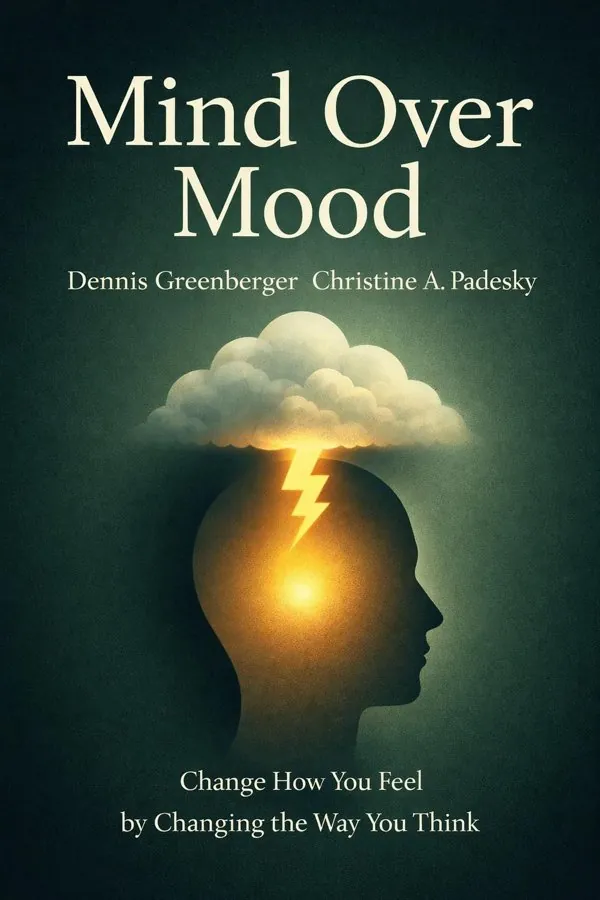
Mind Over Mood: Change How You Feel by Changing the Way You Think: Summary & Key Insights
by Dennis Greenberger, Christine A. Padesky
 10 min6 chaptersAudio available
What Is Mind Over Mood: Change How You Feel by Changing the Way You Think About?
Mind Over Mood: Change How You Feel by Changing the Way You Think by Dennis Greenberger, Christine A. Padesky is a mental_health book spanning 6 pages. Mind Over Mood is a practical cognitive-behavioral therapy (CBT) workbook designed to help readers identify and change unhelpful thinking patterns and behaviors. Through structured exercises, worksheets, and real-life examples, it guides individuals in managing depression, anxiety, anger, guilt, and other emotional challenges by applying evidence-based CBT techniques.
This FizzRead summary covers all 6 key chapters of Mind Over Mood: Change How You Feel by Changing the Way You Think in approximately 10 minutes, distilling the most important ideas, arguments, and takeaways from Dennis Greenberger, Christine A. Padesky's work. Also available as an audio summary and Key Quotes Podcast.
Mind Over Mood: Change How You Feel by Changing the Way You Think
Mind Over Mood is a practical cognitive-behavioral therapy (CBT) workbook designed to help readers identify and change unhelpful thinking patterns and behaviors. Through structured exercises, worksheets, and real-life examples, it guides individuals in managing depression, anxiety, anger, guilt, and other emotional challenges by applying evidence-based CBT techniques.
Who Should Read Mind Over Mood: Change How You Feel by Changing the Way You Think?
This book is perfect for anyone interested in mental_health and looking to gain actionable insights in a short read. Whether you're a student, professional, or lifelong learner, the key ideas from Mind Over Mood: Change How You Feel by Changing the Way You Think by Dennis Greenberger, Christine A. Padesky will help you think differently.
- ✓Readers who enjoy mental_health and want practical takeaways
- ✓Professionals looking to apply new ideas to their work and life
- ✓Anyone who wants the core insights of Mind Over Mood: Change How You Feel by Changing the Way You Think in just 10 minutes
Want the full summary?
Get instant access to this book summary and 100K+ more with Fizz Moment.
Get Free SummaryAvailable on App Store • Free to download
Key Chapters
In my work as a therapist, I’ve often found that the first major breakthrough for clients comes when they can visualize the triangle connecting thoughts, feelings, and behaviors. Imagine a triangle where each corner constantly influences the others. A thought can generate a feeling; a feeling can shape behavior; behavior can in turn reinforce certain thoughts. Once you understand this, emotional change becomes a process of adjusting one part of the system to influence the whole.
Let’s say you come home to find your partner sitting quietly, not speaking. One person might think, “I must have done something wrong,” triggering guilt or anxiety, leading them to withdraw. Another person might think, “They must be tired,” leading to empathy and gentle support. The same event—two very different emotional realities. The key difference lies not in what happened, but in the interpretation. *Mind Over Mood* teaches you how to bring those interpretations into conscious awareness.
By mapping situations, thoughts, moods, and behaviors, you learn to recognize recurring emotional patterns. Each worksheet becomes a mirror reflecting back your psychological habits. Over time, you see how automatic thoughts—those quick internal judgments that seem to spring from nowhere—often distort reality. Recognizing this is the first step toward developing cognitive mastery.
The beauty of CBT lies in its practicality. You don’t need abstract philosophical insight; you need tools to observe how your own mind constructs meaning. In teaching clients this model, I emphasize that change begins not by forcing yourself to think positively, but by training yourself to think accurately. Balanced thinking rarely means relentlessly optimistic thinking—it means fair, evidence-based thinking. This distinction matters deeply. Genuine emotional improvement arises from understanding, not denial.
To change your mood, you must first learn the language of your emotions. Many readers are surprised when we ask them to record how they feel using a five- or ten-point scale. It might seem mechanical, but naming and quantifying your feelings turns vague discomfort into data you can work with.
When you write down your emotional experiences and the specific situations that triggered them, patterns emerge. You may notice that certain thoughts predict certain feelings. For example, if you repeatedly experience sadness when you think, “I’m not good enough,” then the link between that belief and your mood becomes undeniable. Awareness is half the battle.
Recording sheets in the book—the thought record and mood diary—serve as structured spaces where your emotional life becomes understandable. As you practice, you begin to catch automatic thoughts in real time. They’re fleeting, often subtle, like background noise. But once spotted, they can be examined rather than obeyed. This shift—from being submerged in thought to observing thought—is one of the most empowering skills you can acquire.
I encourage you to treat these recordings not as homework but as acts of self-respect. Each note you take tells your mind, “Your feelings matter enough to be understood.” And when you consciously track your emotions, you build self-awareness that replaces helplessness with curiosity.
+ 4 more chapters — available in the FizzRead app
All Chapters in Mind Over Mood: Change How You Feel by Changing the Way You Think
About the Authors
Dennis Greenberger, PhD, is a clinical psychologist and founder of the Anxiety and Depression Center in Newport Beach, California. Christine A. Padesky, PhD, is a clinical psychologist and cofounder of the Center for Cognitive Therapy in Huntington Beach, California. Both are internationally recognized experts in cognitive-behavioral therapy and have coauthored several influential CBT resources.
Get This Summary in Your Preferred Format
Read or listen to the Mind Over Mood: Change How You Feel by Changing the Way You Think summary by Dennis Greenberger, Christine A. Padesky anytime, anywhere. FizzRead offers multiple formats so you can learn on your terms — all free.
Available formats: App · Audio · PDF · EPUB — All included free with FizzRead
Download Mind Over Mood: Change How You Feel by Changing the Way You Think PDF and EPUB Summary
Key Quotes from Mind Over Mood: Change How You Feel by Changing the Way You Think
“In my work as a therapist, I’ve often found that the first major breakthrough for clients comes when they can visualize the triangle connecting thoughts, feelings, and behaviors.”
“To change your mood, you must first learn the language of your emotions.”
Frequently Asked Questions about Mind Over Mood: Change How You Feel by Changing the Way You Think
Mind Over Mood: Change How You Feel by Changing the Way You Think by Dennis Greenberger, Christine A. Padesky is a mental_health book that explores key ideas across 6 chapters. Mind Over Mood is a practical cognitive-behavioral therapy (CBT) workbook designed to help readers identify and change unhelpful thinking patterns and behaviors. Through structured exercises, worksheets, and real-life examples, it guides individuals in managing depression, anxiety, anger, guilt, and other emotional challenges by applying evidence-based CBT techniques.
You Might Also Like

Big Feelings: How to Be Okay When Things Are Not Okay
Liz Fosslien, Mollie West Duffy
10 min
Creative Arts Therapies Handbook: Art, Music and Dance Therapy Practices for Wellbeing
Susan I. Buchalter
10 min
Emotional First Aid: Healing Rejection, Guilt, Failure, and Other Everyday Hurts
Guy Winch
10 min
Lost Connections: Why You're Depressed and How to Find Hope
Johann Hari
10 min
No Time to Panic: How to Stop Worrying and Embrace Life
Matt Gutman
10 min
Overcoming Mobbing: A Recovery Guide for Workplace Aggression and Bullying
Maureen Duffy, Len Sperry
10 minBrowse by Category
Ready to read Mind Over Mood: Change How You Feel by Changing the Way You Think?
Get the full summary and 100K+ more books with Fizz Moment.