
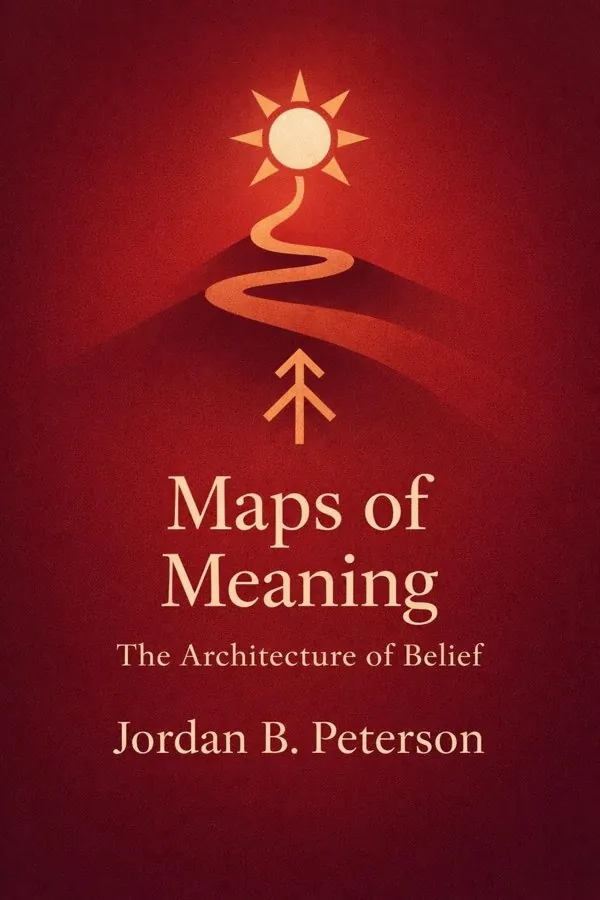
Maps of Meaning: Summary & Key Insights
 10 min9 chaptersAudio available
Key Takeaways from Maps of Meaning
A human being does not first encounter the world as a neutral collection of objects.
Meaning often emerges at the boundary between what you understand and what you do not.
Human beings often personify the structure of reality before they can explain it abstractly.
The hero is not simply the strongest character in a story.
People often think of belief as a set of explicit opinions, but Peterson argues that belief is deeper than what we say we think.
What Is Maps of Meaning About?
Maps of Meaning by Jordan Peterson is a psychology book published in 1999 spanning 7 pages. Maps of Meaning: The Architecture of Belief is Jordan B. Peterson’s ambitious attempt to answer one of the oldest human questions: how do people create meaning strong enough to guide action, endure suffering, and prevent collapse into chaos? First published in 1999, the book brings together clinical psychology, evolutionary theory, neuroscience, mythology, religion, literature, and philosophy to argue that human beings do not merely live in an objective world of facts. We live in a world interpreted through values, stories, symbols, and goals. Peterson examines recurring mythic patterns across cultures and shows how they help individuals orient themselves between order and chaos, certainty and transformation. The book matters because it treats meaning not as a vague spiritual preference but as a psychological necessity. Drawing on his experience as a clinical psychologist and professor, Peterson argues that belief systems are living structures that organize perception, emotion, and morality. Whether or not one agrees with all of his conclusions, Maps of Meaning is a challenging and influential work for anyone trying to understand belief, identity, and the stories that shape human life.
This FizzRead summary covers all 9 key chapters of Maps of Meaning in approximately 10 minutes, distilling the most important ideas, arguments, and takeaways from Jordan Peterson's work. Also available as an audio summary and Key Quotes Podcast.
Maps of Meaning
Maps of Meaning: The Architecture of Belief is Jordan B. Peterson’s ambitious attempt to answer one of the oldest human questions: how do people create meaning strong enough to guide action, endure suffering, and prevent collapse into chaos? First published in 1999, the book brings together clinical psychology, evolutionary theory, neuroscience, mythology, religion, literature, and philosophy to argue that human beings do not merely live in an objective world of facts. We live in a world interpreted through values, stories, symbols, and goals. Peterson examines recurring mythic patterns across cultures and shows how they help individuals orient themselves between order and chaos, certainty and transformation. The book matters because it treats meaning not as a vague spiritual preference but as a psychological necessity. Drawing on his experience as a clinical psychologist and professor, Peterson argues that belief systems are living structures that organize perception, emotion, and morality. Whether or not one agrees with all of his conclusions, Maps of Meaning is a challenging and influential work for anyone trying to understand belief, identity, and the stories that shape human life.
Who Should Read Maps of Meaning?
This book is perfect for anyone interested in psychology and looking to gain actionable insights in a short read. Whether you're a student, professional, or lifelong learner, the key ideas from Maps of Meaning by Jordan Peterson will help you think differently.
- ✓Readers who enjoy psychology and want practical takeaways
- ✓Professionals looking to apply new ideas to their work and life
- ✓Anyone who wants the core insights of Maps of Meaning in just 10 minutes
Want the full summary?
Get instant access to this book summary and 100K+ more with Fizz Moment.
Get Free SummaryAvailable on App Store • Free to download
Key Chapters
A human being does not first encounter the world as a neutral collection of objects. We experience it as a field of significance: what helps, what threatens, what invites, and what obstructs. Peterson argues that perception is fundamentally tied to action. When you look at a chair, you do not simply register shape, color, and material. You also perceive something to sit on, move around, repair, or avoid tripping over. In other words, the world arrives already filtered through value and usefulness.
This insight matters because it challenges the modern assumption that people are mainly rational observers who then decide what matters. Peterson suggests the reverse: what matters comes first. Attention is guided by goals, fears, responsibilities, and habits. A parent entering a playground sees dangers and opportunities for care. A carpenter sees structure and workmanship. A tired commuter sees rest. The same environment means different things depending on the actor.
This action-oriented view helps explain conflict. People often believe they disagree about facts when they are actually inhabiting different maps of value. In a workplace, for example, one person sees a change in procedure as innovation, while another sees instability and risk. Both are responding to perceived consequences for action.
The practical implication is powerful. If you want to change your life, do not begin only by collecting more information. Clarify what you are aiming at. Your goals determine what you notice. Actionable takeaway: examine one recurring problem in your life and ask, “What am I perceiving this situation as, and what goal is shaping that perception?”
Meaning often emerges at the boundary between what you understand and what you do not. Peterson argues that across myths, religions, and stories, human beings repeatedly represent existence through two fundamental domains: order and chaos. Order is the known world—routine, structure, identity, tradition, predictability. Chaos is the unknown—novelty, uncertainty, danger, possibility, breakdown, and transformation.
Neither realm is sufficient on its own. Too much order produces stagnation, rigidity, and dead habit. Too much chaos leads to anxiety, confusion, and disintegration. A healthy life requires movement between them. We rely on order to maintain stability, but we need chaos to grow, adapt, and discover. That is why change is so psychologically charged. A new job, marriage, illness, failure, or relocation can throw a person from familiar structure into uncertainty. The experience feels threatening not only because it is inconvenient, but because it disrupts the map that tells us who we are and how to act.
Peterson sees mythology as a long record of humanity’s attempt to understand this tension. Dragons, floods, deserts, dark forests, tyrant kings, and wise kingdoms are symbolic representations of the same psychological reality: the struggle to preserve order without becoming imprisoned by it, and to encounter chaos without being consumed.
In everyday life, this model is useful for self-diagnosis. If you feel lifeless, you may need more challenge. If you feel constantly overwhelmed, you may need more structure. Actionable takeaway: identify one area of life where you need more order and one where you need more experimentation, then make a small adjustment in each direction this week.
Human beings often personify the structure of reality before they can explain it abstractly. Peterson argues that recurring mythological figures such as the Great Father and the Great Mother symbolize enduring aspects of human experience. The Great Father represents order, law, tradition, hierarchy, protection, discipline, and social structure. At his best, he is the wise ruler or caring guide. At his worst, he becomes the tyrant, the dead hand of custom, or the oppressive authority that smothers growth. The Great Mother represents nature, chaos, possibility, creativity, birth, transformation, and the unknown. At her best, she nourishes and renews. At her worst, she engulfs, destabilizes, and destroys.
These are not merely ancient religious images. They are psychological realities that still shape modern life. The workplace, family, state, school, and even your own conscience can take on “paternal” characteristics of structure and judgment. Unfamiliar situations, emotional upheavals, creative opportunities, and life transitions often feel “maternal” in the symbolic sense of fertile but unpredictable possibility.
Peterson’s point is not that men and women literally are these symbols. Rather, myths encode patterns of experience that recur in everyone’s life. A teenager leaving home confronts the Great Mother as uncertainty and transformation, while also meeting the Great Father in rules, expectations, and institutions. Maturity involves learning how to engage both without being dominated by either.
Practically, this framework helps explain why people simultaneously crave freedom and fear it, or resent authority while depending on it. Actionable takeaway: when facing a difficult situation, ask whether your real challenge is excessive rigidity, excessive uncertainty, or your inability to balance the two.
The hero is not simply the strongest character in a story. For Peterson, the hero is the individual who confronts chaos voluntarily, learns from it, and returns with renewed order. This pattern appears in myths, religions, folktales, and modern narratives because it reflects a basic adaptive truth. Human beings survive and develop not by avoiding the unknown forever, but by approaching it carefully enough to transform it into usable knowledge.
The heroic pattern begins when routine breaks down. Something goes wrong: a relationship fails, a plan collapses, a belief no longer works, a threat appears. At that moment, the person can deny reality, retreat into resentment, or investigate. The hero chooses investigation. He or she enters the metaphorical underworld, confronts danger, extracts insight, and reorganizes life on the basis of what was learned.
This is why honesty matters so much in Peterson’s framework. To tell the truth is to allow outdated maps to die so better ones can emerge. In practical life, the hero’s journey may look ordinary rather than dramatic: admitting addiction, learning a new skill after losing a job, having a painful but necessary conversation, leaving a destructive environment, or questioning inherited assumptions.
Peterson presents the hero as the antidote to both passive conformity and chaotic collapse. The heroic stance accepts vulnerability while refusing paralysis. It is the willingness to act at the edge of competence.
Actionable takeaway: choose one avoided problem you know you must face, reduce it to a manageable first step, and enter that unknown voluntarily instead of waiting for crisis to force you there.
People often think of belief as a set of explicit opinions, but Peterson argues that belief is deeper than what we say we think. Belief is embedded in perception, emotion, habit, and action. Your real beliefs are revealed less by your verbal claims than by what you repeatedly do, avoid, fear, and value. In this sense, belief is neurological and behavioral before it is philosophical.
Peterson draws on neuropsychology to suggest that the brain is continually evaluating the world in relation to goals and expectations. When things proceed as expected, we experience relative emotional stability. When expectations fail, attention heightens, anxiety rises, and the nervous system prepares for adaptation. Emotion is therefore not noise added to reason after the fact. It is part of the mechanism by which the organism registers meaning.
This helps explain why abstract arguments rarely change people quickly. If a belief is tied to identity, habit, social belonging, and emotional regulation, then challenging it feels like destabilizing the person’s operating system. A manager who thinks, “If I am not in control, everything will collapse,” may react to delegation with disproportionate stress. The issue is not merely a bad idea. It is a belief built into emotional expectation.
The practical lesson is that self-understanding requires observing your responses, not just your stated values. Where do you become irrationally angry, defensive, or frightened? Where do you feel energized and meaningful? These reactions point toward the map you are actually using.
Actionable takeaway: for one week, track moments of strong emotional reaction and ask, “What expectation of mine was confirmed or violated here?”
Meaning is not something people invent at random, nor is it merely a pleasant feeling. Peterson argues that meaning is experienced when action aligns with deeply rooted value structures that orient us toward what is better rather than worse. In practice, this often means responsibility. We feel meaningful when we carry burdens voluntarily in service of something that matters—family, truth, competence, community, creativity, or moral order.
This view stands against both hedonism and nihilism. Pleasure alone cannot sustain a person through suffering, and pure skepticism provides no direction for action. Human beings need a hierarchy of values, whether consciously chosen or inherited, because values guide attention and judgment. If you do not know what is worth pursuing, everything becomes equally trivial or equally overwhelming.
Peterson is especially interested in the feeling of meaning as a signal. When people move toward what they perceive as truthful, courageous, and beneficial, they often experience engagement, vitality, and purpose. When they live in bad faith—lying, avoiding, betraying their standards—that sense of meaning decays. This does not mean every difficult task feels good in the moment, but it does mean that meaningful life is tied to integrity between aim and action.
A practical example is parenting. Caring for children is exhausting and often inconvenient, yet many people describe it as deeply meaningful because it organizes sacrifice around love and responsibility. The same principle applies to mastering a craft, serving a cause, or honoring commitments.
Actionable takeaway: write down the three responsibilities in your life that feel burdensome but meaningful, and ask how you can carry them more consciously rather than resentfully.
A crisis of meaning often begins when the map that once guided you no longer works. Peterson argues that psychological suffering intensifies when expectations collapse and a person can no longer predict how to act effectively. This is not just disappointment. It is a deeper destabilization in which the world stops making sense. Betrayal, trauma, public humiliation, unemployment, illness, ideological disillusionment, or personal failure can all trigger this breakdown.
When a meaning system fails, several responses become tempting. Some people retreat into rigid dogma and deny the problem. Others dissolve into cynicism, resentment, or despair. Still others search for scapegoats to restore order artificially. Peterson is acutely concerned with the dangers of ideological possession here: when individuals cannot tolerate uncertainty, they may cling to totalizing explanations that promise certainty at the cost of truth.
Yet collapse also contains the possibility of renewal. If the person can confront the failure honestly, examine what was false or incomplete, and remain engaged with reality, a stronger and more flexible map can emerge. In this sense, suffering is often meaningful only if it contributes to reorganization rather than bitterness.
Modern life makes this especially relevant because rapid social and technological change constantly disrupts old identities. A stable self is no longer maintained by habit alone; it requires ongoing revision.
Actionable takeaway: if you are in a period of confusion, resist the urge to explain everything immediately. Instead, identify what specifically has stopped working, what assumptions failed, and what small truthful adjustment you can make next.
One of Peterson’s central moral claims is that truthful speech is not merely a social virtue; it is a force that keeps reality and culture aligned. Lies distort perception, corrupt relationships, and weaken the structures that allow individuals and communities to function. When people repeatedly say what is convenient rather than what is true, they build fragile systems that eventually collapse under pressure.
In Maps of Meaning, truth is closely related to adaptation. A truthful person updates their map when reality contradicts it. A dishonest person protects ego or status by refusing correction. Over time, this creates increasing disconnection from the world. In relationships, this might mean avoiding hard conversations until resentment poisons trust. In organizations, it might mean hiding errors until disaster becomes unavoidable. In politics or ideology, it can mean maintaining narratives that feel righteous while producing harm.
Peterson does not claim that truth is always easy to know or easy to speak. Much of moral life involves approximation, humility, and revision. But the commitment to honest confrontation with reality is essential to growth. Truthful speech allows error to be detected, pain to be metabolized, and better order to emerge.
This idea becomes practical when applied to daily habits. You do not need to resolve every philosophical problem to benefit from it. Start with smaller acts of honesty: naming your motives accurately, admitting confusion, correcting false impressions, and refusing flattering self-deception.
Actionable takeaway: identify one area where you are currently being vague, evasive, or performative, and replace that pattern with one clear, reality-based statement or conversation.
All Chapters in Maps of Meaning
About the Author
Jordan B. Peterson is a Canadian clinical psychologist, professor, and author whose work focuses on personality, belief systems, mythology, and the psychology of meaning. He taught at Harvard University and later at the University of Toronto, where he became known for his lectures on abnormal psychology, myth, religion, and human motivation. Peterson’s academic background includes research on personality traits, emotion, addiction, and ideological belief. Maps of Meaning, first published in 1999, is one of his foundational works and reflects years of interdisciplinary study across psychology, neuroscience, philosophy, and comparative mythology. He later became widely known through public lectures, interviews, and bestselling books that expanded many of the themes introduced in his earlier academic work.
Get This Summary in Your Preferred Format
Read or listen to the Maps of Meaning summary by Jordan Peterson anytime, anywhere. FizzRead offers multiple formats so you can learn on your terms — all free.
Available formats: App · Audio · PDF · EPUB — All included free with FizzRead
Download Maps of Meaning PDF and EPUB Summary
Key Quotes from Maps of Meaning
“A human being does not first encounter the world as a neutral collection of objects.”
“Meaning often emerges at the boundary between what you understand and what you do not.”
“Human beings often personify the structure of reality before they can explain it abstractly.”
“The hero is not simply the strongest character in a story.”
“People often think of belief as a set of explicit opinions, but Peterson argues that belief is deeper than what we say we think.”
Frequently Asked Questions about Maps of Meaning
Maps of Meaning by Jordan Peterson is a psychology book that explores key ideas across 9 chapters. Maps of Meaning: The Architecture of Belief is Jordan B. Peterson’s ambitious attempt to answer one of the oldest human questions: how do people create meaning strong enough to guide action, endure suffering, and prevent collapse into chaos? First published in 1999, the book brings together clinical psychology, evolutionary theory, neuroscience, mythology, religion, literature, and philosophy to argue that human beings do not merely live in an objective world of facts. We live in a world interpreted through values, stories, symbols, and goals. Peterson examines recurring mythic patterns across cultures and shows how they help individuals orient themselves between order and chaos, certainty and transformation. The book matters because it treats meaning not as a vague spiritual preference but as a psychological necessity. Drawing on his experience as a clinical psychologist and professor, Peterson argues that belief systems are living structures that organize perception, emotion, and morality. Whether or not one agrees with all of his conclusions, Maps of Meaning is a challenging and influential work for anyone trying to understand belief, identity, and the stories that shape human life.
More by Jordan Peterson
You Might Also Like
The Body Keeps the Score
Bessel van der Kolk
10 min
Surrounded by Idiots
Thomas Erikson
10 min
Emotional Intelligence
Daniel Goleman
10 min
Attached
Amir Levine
10 min
Why Does He Do That
Lundy Bancroft
10 min
Women Who Run with the Wolves
Clarissa Pinkola Estés
10 minFeatured In
Browse by Category
Ready to read Maps of Meaning?
Get the full summary and 100K+ more books with Fizz Moment.