
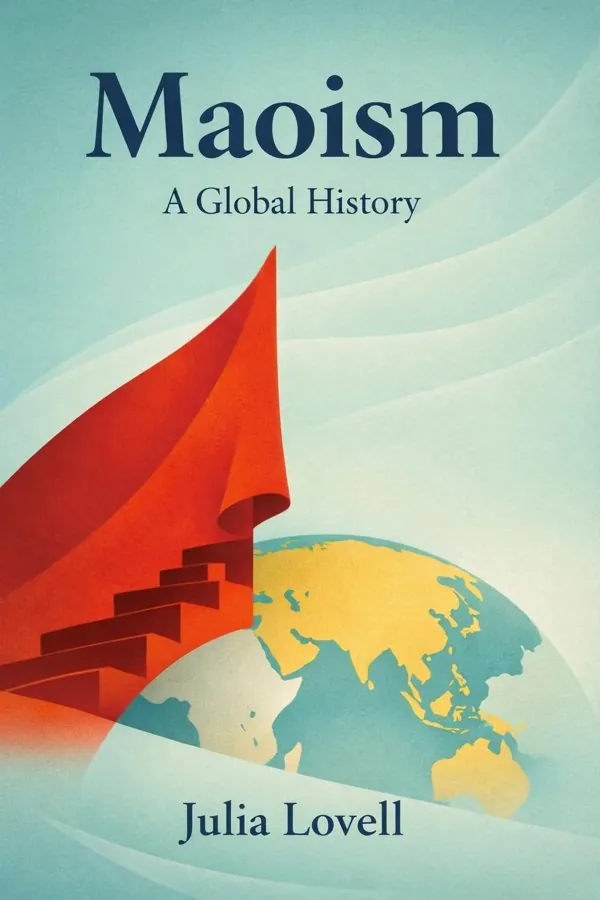
Maoism: A Global History: Summary & Key Insights
by Julia Lovell
 10 min8 chaptersAudio available
Key Takeaways from Maoism: A Global History
Ideas become powerful when they seem to solve real historical problems.
No ideology becomes global by accident.
A rigid ideology rarely travels well; a flexible one can appear universal.
Revolutionary ideas often become most intense far from their birthplace.
Sometimes a domestic upheaval becomes an international spectacle.
What Is Maoism: A Global History About?
Maoism: A Global History by Julia Lovell is a world_history book spanning 6 pages. Some political ideas stay bound to the place that produced them. Maoism did the opposite. In Maoism: A Global History, Julia Lovell shows how a revolutionary doctrine forged in the upheavals of twentieth-century China traveled across continents, inspired guerrilla movements, reshaped anti-colonial politics, energized student radicals, and left violent as well as enduring legacies. This is not simply a biography of Mao Zedong or a history of the Chinese Communist Party. It is an account of how Maoism became one of the modern world’s most portable and adaptable political languages. Lovell argues that Maoism’s power lay in its flexibility: it could speak to peasants in Asia, insurgents in Latin America, liberation leaders in Africa, and intellectual rebels in Europe and the United States. Yet the book is equally attentive to the human costs of that appeal, from authoritarian state-building to revolutionary terror. As a distinguished historian of modern China, translator, and professor, Lovell brings deep archival knowledge and global perspective to a subject often reduced to slogans. The result is a sharp, wide-ranging history that helps explain both the twentieth century and the ideological afterlives still visible today.
This FizzRead summary covers all 8 key chapters of Maoism: A Global History in approximately 10 minutes, distilling the most important ideas, arguments, and takeaways from Julia Lovell's work. Also available as an audio summary and Key Quotes Podcast.
Maoism: A Global History
Some political ideas stay bound to the place that produced them. Maoism did the opposite. In Maoism: A Global History, Julia Lovell shows how a revolutionary doctrine forged in the upheavals of twentieth-century China traveled across continents, inspired guerrilla movements, reshaped anti-colonial politics, energized student radicals, and left violent as well as enduring legacies. This is not simply a biography of Mao Zedong or a history of the Chinese Communist Party. It is an account of how Maoism became one of the modern world’s most portable and adaptable political languages.
Lovell argues that Maoism’s power lay in its flexibility: it could speak to peasants in Asia, insurgents in Latin America, liberation leaders in Africa, and intellectual rebels in Europe and the United States. Yet the book is equally attentive to the human costs of that appeal, from authoritarian state-building to revolutionary terror. As a distinguished historian of modern China, translator, and professor, Lovell brings deep archival knowledge and global perspective to a subject often reduced to slogans. The result is a sharp, wide-ranging history that helps explain both the twentieth century and the ideological afterlives still visible today.
Who Should Read Maoism: A Global History?
This book is perfect for anyone interested in world_history and looking to gain actionable insights in a short read. Whether you're a student, professional, or lifelong learner, the key ideas from Maoism: A Global History by Julia Lovell will help you think differently.
- ✓Readers who enjoy world_history and want practical takeaways
- ✓Professionals looking to apply new ideas to their work and life
- ✓Anyone who wants the core insights of Maoism: A Global History in just 10 minutes
Want the full summary?
Get instant access to this book summary and 100K+ more with Fizz Moment.
Get Free SummaryAvailable on App Store • Free to download
Key Chapters
Ideas become powerful when they seem to solve real historical problems. Lovell begins by showing that Maoism was not an abstract doctrine invented in a study. It emerged from the instability of early twentieth-century China: imperial collapse, warlordism, foreign invasion, social fragmentation, and deep rural poverty. Mao Zedong drew from Marxism-Leninism, but he radically reshaped it for a country that was overwhelmingly peasant rather than industrial. Where orthodox Marxism emphasized the urban proletariat, Mao insisted that revolutionary energy could come from the countryside.
This innovation was crucial. Mao’s experience in Hunan, his role in the Chinese Communist movement, and the brutal pressures of civil war helped produce a strategy centered on peasant mobilization, guerrilla warfare, mass line politics, ideological discipline, and the idea of continuous struggle. The revolution, in Mao’s view, could not wait for ideal economic conditions. It had to be made through organization, persuasion, coercion, and military resilience.
Lovell makes clear that this was not merely Chinese improvisation. It became a transferable model for societies that also lacked large industrial working classes. Revolutionaries in poorer, rural, colonized, or unevenly developed regions could look at China and see a path that seemed more realistic than the Soviet template.
A practical way to apply this insight is to ask, whenever an ideology spreads: what local problem does it appear to solve? Maoism succeeded internationally because it offered a script for politically marginalized populations. Actionable takeaway: to understand any global movement, begin with the concrete crises that gave birth to it rather than with its slogans alone.
No ideology becomes global by accident. Lovell shows that once the People’s Republic of China was established in 1949, Maoism was promoted abroad not only through admiration but through institutions, diplomacy, training networks, propaganda, and strategic calculation. Beijing presented itself as the champion of anti-imperial struggle, especially for newly decolonizing nations that felt overlooked or patronized by both the United States and the Soviet Union.
In the 1950s and 1960s, China offered material aid, revolutionary texts, radio broadcasts, military advice, and political education to movements across Asia, Africa, and Latin America. Maoist writings were translated, circulated, simplified, and turned into portable tools. The Little Red Book became a symbolic object not because everyone read it deeply, but because it represented militancy, purity, and defiance. Chinese support was also shaped by the Sino-Soviet split. As Beijing competed with Moscow for leadership of the communist world, exporting Maoism became a geopolitical strategy as much as an ideological mission.
Lovell is especially strong on the unevenness of this process. China did not control how Maoism was received. Local leaders selected what they wanted: armed struggle, peasant mobilization, anti-elite rhetoric, or self-reliance. In some places Beijing’s support was significant; in others the symbolic force of China mattered more than direct intervention.
The broader lesson is that ideas travel through networks, media, institutions, and rivalry. If you want to understand the spread of any doctrine today, look at who is funding it, translating it, teaching it, and adapting it to local grievances. Actionable takeaway: when evaluating global political influence, follow both the message and the infrastructure that carries it.
A rigid ideology rarely travels well; a flexible one can appear universal. One of Lovell’s most important arguments is that Maoism spread globally because it was continually reinterpreted. Though rooted in Chinese revolutionary experience, it proved unusually adaptable. Different movements borrowed different components: peasant insurgency, protracted people’s war, charismatic leadership, anti-colonial militancy, revolutionary voluntarism, or suspicion of bureaucratic elites.
This adaptability helps explain why Maoism appealed in places with very different histories. In some countries, it became a doctrine of national liberation. In others, it functioned as a strategy for civil war. Elsewhere, it became a cultural style of rebellion among urban students and intellectuals. Maoism’s core language of struggle, sacrifice, and purity was broad enough to unite diverse actors, but that same breadth also made it unstable. What one group considered authentic Maoism, another regarded as heresy.
Lovell’s global perspective reveals that ideological transmission is never copy-and-paste. A Peruvian insurgent, a Nepali revolutionary, a French radical student, and an African liberation leader were not all practicing the same politics in any simple sense. They were drawing from a shared repertoire and recombining it with local ambitions, social structures, and historical trauma.
This matters beyond the history of Maoism. Political concepts still migrate today through social media, protest cultures, and activist networks, and they are always reshaped on arrival. Misunderstanding often begins when observers assume imported ideas remain unchanged.
A useful habit is to ask two questions: what was borrowed, and what was altered? That reveals the real political meaning of adaptation. Actionable takeaway: never judge a global movement solely by its original doctrine; examine how local actors translate it into their own circumstances.
Revolutionary ideas often become most intense far from their birthplace. Lovell’s discussion of Latin America shows how Maoism entered a region already shaped by inequality, oligarchic power, Cold War intervention, and deep frustration with both liberal reform and traditional communist parties. For some militants, Maoism offered an alternative to Soviet-aligned gradualism and to purely urban models of revolt. Its emphasis on rural struggle and moral fervor seemed especially compelling in countries with sharp divides between elites and marginalized populations.
Yet Lovell also demonstrates that Maoism in Latin America was never uniform. In Peru, for example, Sendero Luminoso under Abimael Guzmán pushed Maoist principles into a fanatical and devastating form, combining ideological absolutism with extreme violence against civilians. Here Maoism became not simply a theory of liberation but a weapon of terror, showing how revolutionary purity can slide into dehumanization. Elsewhere in the region, Maoist influence was more diffuse, shaping activist rhetoric, agrarian organizing, and critiques of dependency without always producing large-scale insurgency.
The Latin American case reveals a central tension in the book: Maoism could mobilize the excluded, but it could also sanctify violence by claiming history required it. Lovell resists romantic narratives. She examines why people found Maoism attractive while never losing sight of the destruction often done in its name.
For contemporary readers, the lesson is sobering. Political movements that promise total emancipation can become most dangerous when they treat compromise as betrayal and ordinary people as raw material for revolution. Actionable takeaway: when evaluating radical politics, pay close attention not only to its injustices identified but to the means it justifies in order to overcome them.
Sometimes a domestic upheaval becomes an international spectacle. Lovell shows that China’s Cultural Revolution, launched by Mao in 1966, had a paradoxical global impact. Inside China, it unleashed persecution, factional chaos, public humiliation, destroyed lives, and massive institutional breakdown. Abroad, however, many observers initially saw something else: youthful rebellion against hierarchy, an assault on privilege, and a dramatic attempt to prevent revolution from hardening into bureaucracy.
This gap between reality and perception was one of Maoism’s greatest international advantages. Images of Red Guards, mass rallies, wall posters, and anti-establishment slogans captivated foreign radicals who were disillusioned with conventional parties and consumer society. Students and intellectuals in Europe and North America projected their own frustrations onto China, often knowing little about the violence and coercion unfolding there. Maoist symbolism thus became part of a wider global culture of dissent.
Lovell does not dismiss these foreign admirers as simply naive. She explains the historical conditions that made Maoism attractive: anti-colonial solidarity, anger at capitalism, revulsion at Soviet repression, and a desire for authenticity in politics. But she insists that the Cultural Revolution’s mythology cannot be separated from its catastrophic human cost.
This chapter offers a broader warning about political imagery. Movements can gain influence through symbols that conceal as much as they reveal. Striking visuals, simplified narratives, and selective information can transform repression into romance.
A practical application is to cultivate distance from political theater. Before embracing any movement celebrated for its energy or purity, ask who pays the price behind the spectacle. Actionable takeaway: always compare a movement’s external image with the lived reality experienced by those under its rule.
One of Lovell’s most unsettling insights is that violence was not merely an unfortunate byproduct of Maoism’s spread; in many cases it was integral to its appeal and method. Maoist strategy elevated armed struggle, sacrifice, and revolutionary cleansing as engines of historical change. For movements facing dictatorship, occupation, or entrenched inequality, this militancy could look honest and effective compared with reformist caution. But the same logic often normalized brutality against enemies, rivals, and civilians.
Lovell traces how Maoist organizations across the world frequently developed cultures of discipline that prized obedience, self-criticism, endurance, and ideological certainty. These habits could sustain movements under extreme pressure, yet they also encouraged intolerance and repression. Once a group defined itself as the sole bearer of revolutionary truth, dissent easily became treason. Internal purges, coercive recruitment, and violent punishment followed.
The book does not claim Maoism was uniquely violent compared with all twentieth-century ideologies. Rather, it shows how its celebration of struggle, combined with the ambiguities of guerrilla warfare and the charisma of revolutionary leadership, made violence easier to justify and harder to restrain. This is especially visible in movements that embraced permanent conflict as morally purifying.
For readers today, the lesson extends beyond this specific ideology. Any political framework that glorifies cleansing, purity, or total enemies risks crossing from resistance into dehumanization. The emotional charge of militancy can obscure the moral corrosion it produces.
A concrete test is to ask how a movement speaks about opponents, internal critics, and civilians caught in conflict. Those categories reveal its ethical limits. Actionable takeaway: be wary of political visions that make violence seem noble, inevitable, or morally exempt from scrutiny.
Political movements rarely end cleanly. Lovell argues that Maoism declined as a major global force in the late twentieth century, but it did not simply vanish. Mao’s death in 1976, China’s subsequent reforms under Deng Xiaoping, and widespread disillusionment with revolutionary violence weakened Maoism’s credibility. Beijing itself moved away from exporting world revolution and toward state-led modernization, market reforms, and pragmatic diplomacy. The country most associated with Maoism had ceased to act as its main missionary.
Yet decline is not the same as extinction. In some places Maoist groups fragmented, moderated, or entered mainstream politics. In others, they survived as insurgencies, underground sects, or ideological reference points. Nepal’s Maoists, for instance, transformed themselves from guerrillas into major political actors, illustrating how doctrines of armed struggle can be redirected into parliamentary negotiation. Elsewhere, remnants persisted more destructively, detached from broad support but sustained by organizational discipline and local grievances.
Lovell’s account of transformation is especially valuable because it avoids simple rise-and-fall storytelling. Ideologies often mutate after their apparent defeat. Symbols remain useful, memories remain potent, and old doctrines can be revived when new crises emerge. Maoism’s afterlife demonstrates how political languages outlast the contexts that made them dominant.
This has obvious relevance today. We often underestimate weakened movements because we look only for their original form. But ideas survive by becoming narrower, softer, more nationalist, more local, or more cultural.
A practical way to study political change is to ask not whether a movement is dead, but what form it has taken now. Actionable takeaway: track transformation, not just decline, when assessing the long-term influence of an ideology.
The past is rarely past when its political vocabulary still circulates. Lovell closes by showing that Maoism continues to matter in the twenty-first century, though often in altered and indirect ways. Its legacy survives in active insurgencies in parts of South Asia, in memories of liberation struggles, in state narratives of revolutionary legitimacy, and in recurring fantasies of moral purification through struggle. Even where Maoism no longer commands mass allegiance, its categories remain available: people’s war, self-reliance, anti-elitism, suspicion of compromise, and the appeal of charismatic revolutionary authority.
China itself presents a striking paradox. The contemporary Chinese state no longer practices classic Maoism in economic or international terms, yet Mao remains central to national symbolism and party legitimacy. His image is preserved even as many of his policies have been abandoned. This selective memory demonstrates how states domesticate radical pasts, retaining their authority while shedding their most destabilizing elements.
Globally, Maoism’s afterlife also appears in culture and protest language. Revolutionary chic, anti-establishment posturing, and simplified invocations of “the people” can echo Maoist styles even when participants know little of the original doctrine. Lovell encourages readers to see these echoes critically, not nostalgically.
The enduring lesson is that ideologies leave sediments: habits of speech, images of leadership, myths of renewal, and scripts for resistance. Understanding those sediments helps us interpret current politics more sharply.
A useful application is to notice when modern movements borrow old revolutionary aesthetics without confronting their historical record. Actionable takeaway: when you encounter calls for cleansing renewal or pure people-versus-elite struggle, examine the historical traditions those ideas may be drawing from.
All Chapters in Maoism: A Global History
About the Author
Julia Lovell is a British historian, translator, and professor of modern Chinese history and literature at Birkbeck, University of London. She is widely recognized for her ability to connect Chinese history to broader global themes, combining rigorous scholarship with clear, engaging prose. Lovell has written several acclaimed books, including studies of the Opium War and the Great Wall, and she has translated important modern Chinese literary works into English. Her expertise spans political history, cultural exchange, intellectual movements, and the international impact of China’s modern transformations. In Maoism: A Global History, she brings those strengths together to show how an ideology born in revolutionary China traveled across continents and shaped modern politics far beyond its original setting.
Get This Summary in Your Preferred Format
Read or listen to the Maoism: A Global History summary by Julia Lovell anytime, anywhere. FizzRead offers multiple formats so you can learn on your terms — all free.
Available formats: App · Audio · PDF · EPUB — All included free with FizzRead
Download Maoism: A Global History PDF and EPUB Summary
Key Quotes from Maoism: A Global History
“Ideas become powerful when they seem to solve real historical problems.”
“A rigid ideology rarely travels well; a flexible one can appear universal.”
“Revolutionary ideas often become most intense far from their birthplace.”
“Sometimes a domestic upheaval becomes an international spectacle.”
“One of Lovell’s most unsettling insights is that violence was not merely an unfortunate byproduct of Maoism’s spread; in many cases it was integral to its appeal and method.”
Frequently Asked Questions about Maoism: A Global History
Maoism: A Global History by Julia Lovell is a world_history book that explores key ideas across 8 chapters. Some political ideas stay bound to the place that produced them. Maoism did the opposite. In Maoism: A Global History, Julia Lovell shows how a revolutionary doctrine forged in the upheavals of twentieth-century China traveled across continents, inspired guerrilla movements, reshaped anti-colonial politics, energized student radicals, and left violent as well as enduring legacies. This is not simply a biography of Mao Zedong or a history of the Chinese Communist Party. It is an account of how Maoism became one of the modern world’s most portable and adaptable political languages. Lovell argues that Maoism’s power lay in its flexibility: it could speak to peasants in Asia, insurgents in Latin America, liberation leaders in Africa, and intellectual rebels in Europe and the United States. Yet the book is equally attentive to the human costs of that appeal, from authoritarian state-building to revolutionary terror. As a distinguished historian of modern China, translator, and professor, Lovell brings deep archival knowledge and global perspective to a subject often reduced to slogans. The result is a sharp, wide-ranging history that helps explain both the twentieth century and the ideological afterlives still visible today.
You Might Also Like
The Age of Capital
Eric Hobsbawm
10 min
The Gulag Archipelago
Aleksandr Solzhenitsyn
10 min
Jerusalem: The Biography
Simon Sebag Montefiore
10 min
The Anglo-Saxons
James Campbell
10 min
The Boer War
Thomas Pakenham
10 min
The Industrial Revolutionaries: The Making of the Modern World 1776–1914
Gavin Weightman
10 minBrowse by Category
Ready to read Maoism: A Global History?
Get the full summary and 100K+ more books with Fizz Moment.