
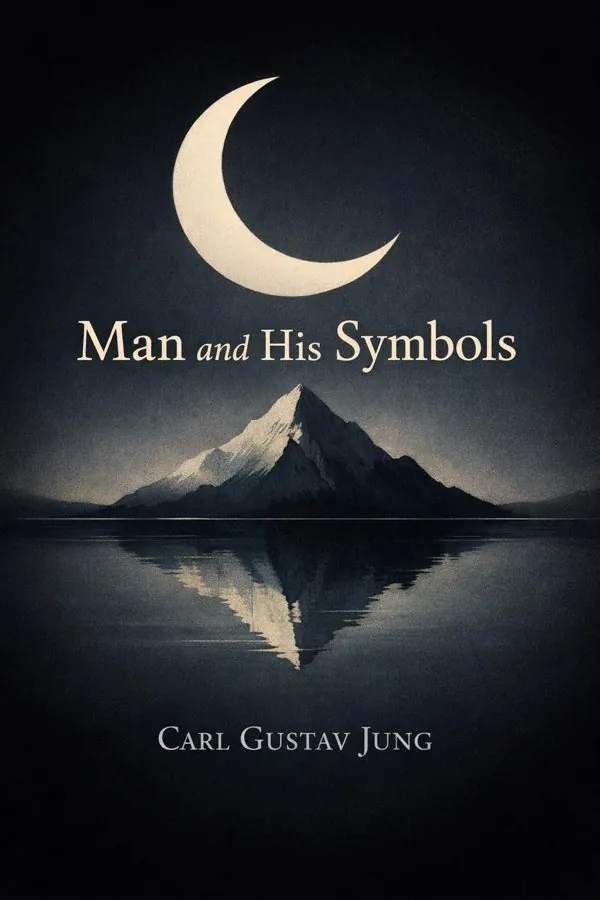
Man and His Symbols: Summary & Key Insights
by Carl Jung
 10 min6 chaptersAudio available
What Is Man and His Symbols About?
Man and His Symbols by Carl Jung is a psychology book published in 1968 spanning 6 pages. This book, conceived and edited by Carl G. Jung, introduces his theories of the unconscious and the role of symbols in human psychology. Written for a general audience, it explores how dreams and myths reveal the workings of the collective unconscious, with contributions from Jung and several of his close collaborators. It remains one of the most accessible introductions to Jungian thought.
This FizzRead summary covers all 6 key chapters of Man and His Symbols in approximately 10 minutes, distilling the most important ideas, arguments, and takeaways from Carl Jung's work. Also available as an audio summary and Key Quotes Podcast.
Man and His Symbols
This book, conceived and edited by Carl G. Jung, introduces his theories of the unconscious and the role of symbols in human psychology. Written for a general audience, it explores how dreams and myths reveal the workings of the collective unconscious, with contributions from Jung and several of his close collaborators. It remains one of the most accessible introductions to Jungian thought.
Who Should Read Man and His Symbols?
This book is perfect for anyone interested in psychology and looking to gain actionable insights in a short read. Whether you're a student, professional, or lifelong learner, the key ideas from Man and His Symbols by Carl Jung will help you think differently.
- ✓Readers who enjoy psychology and want practical takeaways
- ✓Professionals looking to apply new ideas to their work and life
- ✓Anyone who wants the core insights of Man and His Symbols in just 10 minutes
Want the full summary?
Get instant access to this book summary and 100K+ more with Fizz Moment.
Get Free SummaryAvailable on App Store • Free to download
Key Chapters
As I begin to lead you toward the realm of the unconscious, I must first dispel a common misconception: the belief that the psyche consists of only what we are aware of. Consciousness is indeed a fragile island, and beneath it lies a vast sea, both personal and collective.
The personal unconscious stores the forgotten and the repressed, the residues of individual experience. The collective unconscious, however, is distinct; it is a repository of primordial forms shared by all beings, inherited patterns of thought and imagination. These patterns are what I call archetypes—the gods and heroes of mythology, the universal motifs of creation and transformation that recur across ages and cultures. They represent potentialities within each human life.
The symbols that arise from these deeper layers—whether in a dream, a piece of art, or a myth—serve a living function. They are not intellectual constructs; they emerge spontaneously, charged with energy. When an image suddenly appears in a dream—a serpent, a labyrinth, a wise old man—it is a manifestation of psychic energy striving for expression, an attempt by the unconscious to communicate its message.
Modern man, having largely severed himself from mythological consciousness, often encounters these symbols with confusion and anxiety. In analytical psychology, the task is to interpret them not as arbitrary fantasies but as meaningful expressions of inner development. It is through the symbolic image that the unconscious seeks to compensate for the one-sidedness of conscious attitudes. A man who lives only through rational intellect will be confronted by irrational dream images; a woman overwhelmed by emotion may dream of cold landscapes or mechanical forms. Thus, symbols maintain the psychic equilibrium—and through understanding them, one enters into dialogue with the hidden life of the soul.
Approaching the unconscious therefore requires humility and openness. To probe its depths is not merely to analyze data; it is to engage with a mystery that transcends personal limits. Each dream, each spontaneous image, is a small door leading to that inner world—the same world that generated myths, rituals, and the spiritual heritage of humanity.
Marie-Louise von Franz carries forward this exploration into the specific realm of dreams. She reminds us that dreams are not capricious events; they represent the psyche’s way of speaking in its own native imagery. Their language is symbolic, not logical, and therefore it demands interpretation through feeling and imagination as well as intellect.
Von Franz explains that dreams have a compensatory function. If consciousness becomes unbalanced—too rational, too emotional, too identified with social roles—the dream compensates by presenting images of the neglected aspects. Consider, for example, a man whose conscious life revolves around power and success. He may dream of a small child lost in a forest, a symbol of innocence and vulnerability demanding attention. The dream thus restores psychic balance, reminding the dreamer of what his outer life has forgotten.
The interpretation of dreams cannot be reduced to fixed formulas. Symbols are alive, and their meaning evolves with the dreamer’s individual situation. Von Franz demonstrates this through numerous cases, showing how the serpent may signify not evil but renewal, how water represents both danger and purification, how the feminine figure in dreams embodies the soul’s guiding function. She cautions that to understand dreams, one must approach them with reverence, allowing their imagery to reveal itself gradually rather than imposing theories upon it.
Dreams also serve as guides along the path of individuation. They bring to consciousness what is needed for growth, even when it contradicts one’s desires. Many patients feel resistance toward such dreams, for they often challenge the ego’s comfort. Yet, if one learns to listen rather than dismiss, these nightly communications become a compass leading toward inner wholeness.
In the end, the dream’s most profound function is to connect us with the unconscious totality of our being. It mediates between the known and the unknown, reminding us that we are not the masters of our psyche but participants in an ongoing dialogue with it.
+ 4 more chapters — available in the FizzRead app
All Chapters in Man and His Symbols
About the Author
Carl Gustav Jung (1875–1961) was a Swiss psychiatrist and psychoanalyst who founded analytical psychology. His work on the collective unconscious, archetypes, and individuation profoundly influenced psychology, literature, and art. Jung’s ideas continue to shape modern psychotherapy and cultural studies.
Get This Summary in Your Preferred Format
Read or listen to the Man and His Symbols summary by Carl Jung anytime, anywhere. FizzRead offers multiple formats so you can learn on your terms — all free.
Available formats: App · Audio · PDF · EPUB — All included free with FizzRead
Download Man and His Symbols PDF and EPUB Summary
Key Quotes from Man and His Symbols
“As I begin to lead you toward the realm of the unconscious, I must first dispel a common misconception: the belief that the psyche consists of only what we are aware of.”
“Marie-Louise von Franz carries forward this exploration into the specific realm of dreams.”
Frequently Asked Questions about Man and His Symbols
Man and His Symbols by Carl Jung is a psychology book that explores key ideas across 6 chapters. This book, conceived and edited by Carl G. Jung, introduces his theories of the unconscious and the role of symbols in human psychology. Written for a general audience, it explores how dreams and myths reveal the workings of the collective unconscious, with contributions from Jung and several of his close collaborators. It remains one of the most accessible introductions to Jungian thought.
You Might Also Like
The Body Keeps the Score
Bessel van der Kolk
10 min
Surrounded by Idiots
Thomas Erikson
10 min
Emotional Intelligence
Daniel Goleman
10 min
Attached
Amir Levine
10 min
Why Does He Do That
Lundy Bancroft
10 min
Women Who Run with the Wolves
Clarissa Pinkola Estés
10 minFeatured In
Browse by Category
Ready to read Man and His Symbols?
Get the full summary and 100K+ more books with Fizz Moment.