
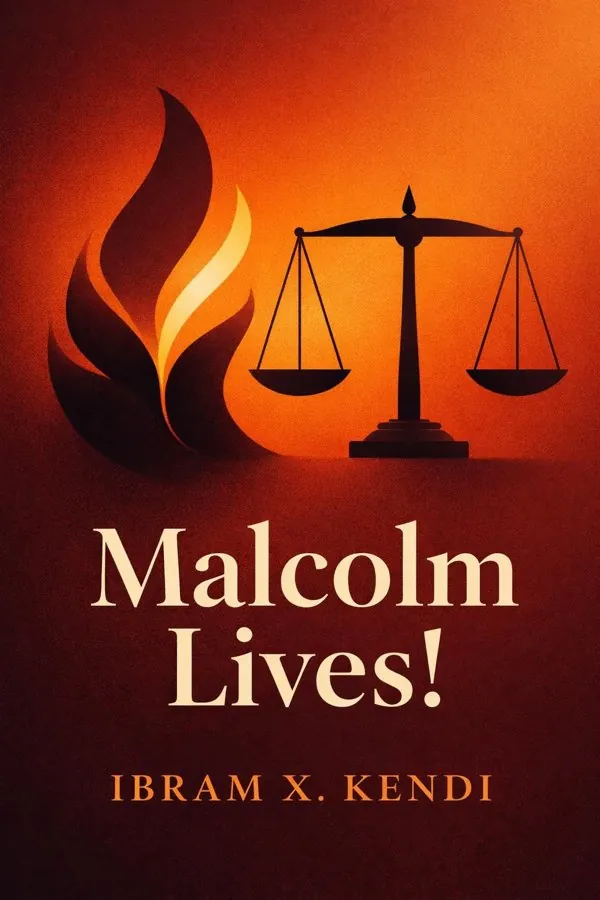
Malcolm Lives!: Summary & Key Insights
 10 min8 chaptersAudio available
Key Takeaways from Malcolm Lives!
The most revealing way to understand Malcolm X is not to ask what he meant in the 1960s, but why he still feels current today.
One reason Malcolm X remains so powerful is that he has also been persistently misunderstood.
A society can condemn prejudice in words while preserving racism in practice.
Freedom becomes fragile when it depends on the goodwill of those who benefit from your unfreedom.
Incremental change can sometimes relieve suffering, but it can also become a way of preserving the deeper system that creates suffering.
What Is Malcolm Lives! About?
Malcolm Lives! by Ibram X. Kendi is a politics book spanning 5 pages. Malcolm Lives! is Ibram X. Kendi’s powerful reflection on why Malcolm X remains one of the most urgent political voices in American life. More than a historical tribute, this essay argues that Malcolm’s ideas did not die with him; they continue to animate struggles over racism, power, identity, liberation, and truth. Kendi explores Malcolm X not as a frozen icon of the civil rights era, but as a living intellectual force whose critiques of white supremacy, liberal moderation, and racial injustice still illuminate the present. In doing so, he invites readers to move beyond simplified myths of Malcolm as merely angry, divisive, or militant, and instead see the depth, flexibility, and moral clarity of his political thought. The book matters because it helps explain why Malcolm’s language and analysis resurface whenever America confronts police violence, structural inequality, or the limits of gradual reform. Kendi is especially well suited to this task. As a leading historian of racism and antiracism, he brings scholarly rigor, historical perspective, and contemporary relevance to a subject that is too often flattened by public memory. The result is a concise but provocative work that bridges past and present.
This FizzRead summary covers all 8 key chapters of Malcolm Lives! in approximately 10 minutes, distilling the most important ideas, arguments, and takeaways from Ibram X. Kendi's work. Also available as an audio summary and Key Quotes Podcast.
Malcolm Lives!
Malcolm Lives! is Ibram X. Kendi’s powerful reflection on why Malcolm X remains one of the most urgent political voices in American life. More than a historical tribute, this essay argues that Malcolm’s ideas did not die with him; they continue to animate struggles over racism, power, identity, liberation, and truth. Kendi explores Malcolm X not as a frozen icon of the civil rights era, but as a living intellectual force whose critiques of white supremacy, liberal moderation, and racial injustice still illuminate the present. In doing so, he invites readers to move beyond simplified myths of Malcolm as merely angry, divisive, or militant, and instead see the depth, flexibility, and moral clarity of his political thought. The book matters because it helps explain why Malcolm’s language and analysis resurface whenever America confronts police violence, structural inequality, or the limits of gradual reform. Kendi is especially well suited to this task. As a leading historian of racism and antiracism, he brings scholarly rigor, historical perspective, and contemporary relevance to a subject that is too often flattened by public memory. The result is a concise but provocative work that bridges past and present.
Who Should Read Malcolm Lives!?
This book is perfect for anyone interested in politics and looking to gain actionable insights in a short read. Whether you're a student, professional, or lifelong learner, the key ideas from Malcolm Lives! by Ibram X. Kendi will help you think differently.
- ✓Readers who enjoy politics and want practical takeaways
- ✓Professionals looking to apply new ideas to their work and life
- ✓Anyone who wants the core insights of Malcolm Lives! in just 10 minutes
Want the full summary?
Get instant access to this book summary and 100K+ more with Fizz Moment.
Get Free SummaryAvailable on App Store • Free to download
Key Chapters
The most revealing way to understand Malcolm X is not to ask what he meant in the 1960s, but why he still feels current today. Kendi’s central claim is that Malcolm lives because the conditions he analyzed have not disappeared. Racism in America did not end with legal desegregation, a handful of reforms, or symbolic representation. It adapted, changed language, and embedded itself in institutions. That is why Malcolm’s insistence on naming power directly still resonates.
Kendi shows that Malcolm was never simply a historical personality trapped in black-and-white photographs. He was a thinker concerned with political realism. He asked what freedom actually required, who benefited from racial hierarchy, and why oppressed people were so often told to wait patiently for justice. Those questions remain alive in debates about policing, voting rights, mass incarceration, education, housing, and economic inequality.
A practical way to apply this idea is to stop treating major historical figures as museum pieces. In classrooms, workplaces, and civic discussions, Malcolm’s speeches can be read alongside current headlines about state violence or public debates on race. His framework helps readers distinguish between symbolic progress and material change. For example, celebrating diversity in advertising means little if communities still face discriminatory lending, underfunded schools, or unequal sentencing.
Kendi’s broader point is that memory can either domesticate radical ideas or reactivate them. Malcolm Lives! chooses the second path. It encourages readers to view Malcolm not as a saint or stereotype, but as a tool for analysis.
Actionable takeaway: Revisit one Malcolm X speech or interview and ask not “What did this mean then?” but “What does this explain now?”
One reason Malcolm X remains so powerful is that he has also been persistently misunderstood. Kendi highlights how public memory often reduces him to a caricature: the angry opposite of Martin Luther King Jr., the prophet of violence, the figure too extreme for mainstream comfort. This simplification makes him easier to dismiss and easier to contain. But it also conceals the sophistication of his political development.
Kendi argues that Malcolm’s critics often seized on his tone while ignoring his analysis. He was blunt because he believed racism was brutal, not because he lacked nuance. He rejected the demand that Black people present their pain in ways that made the powerful feel comfortable. In that sense, the misreading of Malcolm is part of a larger pattern in American politics: the tendency to condemn the style of dissent rather than confront the substance of injustice.
This idea has obvious modern applications. Activists today are often judged less by what they are protesting than by whether they are protesting in an acceptable way. When demonstrations against police killings are criticized as disruptive, divisive, or impolite, the focus shifts away from the violence being challenged. Malcolm helps explain why demands for “civility” can function as tools of delay.
Kendi does not ask readers to romanticize every phrase Malcolm ever uttered. Instead, he asks us to resist lazy binaries and historical convenience. To understand Malcolm seriously is to recognize a disciplined thinker whose ideas changed over time while retaining a fierce commitment to Black dignity and liberation.
Actionable takeaway: When you hear Malcolm X described in one sentence, pause and ask what complexity has been erased to make that description possible.
A society can condemn prejudice in words while preserving racism in practice. Kendi emphasizes that Malcolm X understood racism not simply as a matter of hateful individuals, but as a system of power shaping institutions, opportunities, and life chances. This is one reason Malcolm remains indispensable: he forces readers to look beyond personal morality and examine political structures.
Malcolm’s analysis challenged comforting stories about American innocence. He did not believe racial injustice could be solved merely by changing hearts one by one, though personal transformation mattered. He focused on the ways law, economics, policing, schooling, media, and public policy reproduced inequality. Kendi connects this perspective to contemporary forms of structural racism, from wealth disparities created by generations of exclusion to criminal justice systems that punish marginalized communities disproportionately.
This framework is practical because it changes how we diagnose problems. If a company has almost no Black leadership, the question is not only whether anyone there holds racist views. It is also whether recruitment pipelines, promotion criteria, mentorship structures, and informal networks systematically advantage some groups over others. If a neighborhood lacks investment, the issue is not whether residents made poor choices, but whether redlining, disinvestment, zoning, and state neglect shaped the available choices in the first place.
By centering structure, Kendi follows Malcolm in rejecting shallow reform. Representation alone cannot fix systems designed to preserve inequality. Real change requires altering rules, incentives, and distributions of power.
Actionable takeaway: The next time you encounter a racial disparity, ask “What policy, institution, or incentive helps produce this?” before reducing it to individual behavior.
Freedom becomes fragile when it depends on the goodwill of those who benefit from your unfreedom. Kendi underscores Malcolm X’s commitment to Black self-determination: the belief that oppressed communities must build independent power, define their own interests, and refuse to let liberation be granted only on terms acceptable to dominant institutions.
This idea is often misrepresented as separatism in the narrowest sense, but Kendi shows it is better understood as political seriousness. Malcolm questioned whether communities facing organized oppression could rely solely on appeals to conscience. Self-determination meant creating institutions, leadership, economic networks, cultural confidence, and strategies not wholly dependent on white approval. It was about agency.
In the present, this vision has many forms. It can mean supporting Black-led organizations that address education, housing, legal defense, mental health, or voter mobilization. It can mean investing in independent media that tell stories neglected by dominant outlets. It can also mean resisting token inclusion that leaves decision-making power untouched. A school board may celebrate diversity, for example, while excluding Black parents and teachers from meaningful influence over discipline policies or curriculum.
Kendi presents self-determination not as a rejection of coalition, but as a condition for equitable coalition. Strong alliances are built when communities enter them with clarity and leverage, not dependency. Malcolm’s lesson is that solidarity is most effective when each group can speak for itself rather than be spoken for.
Actionable takeaway: Identify one Black-led institution, publication, or community organization in your area and support it with time, money, skills, or sustained attention.
Incremental change can sometimes relieve suffering, but it can also become a way of preserving the deeper system that creates suffering. Kendi draws on Malcolm X to challenge the politics of moderation, especially the idea that justice should proceed only at a pace that reassures the comfortable. Malcolm was skeptical of reforms that made oppression appear less visible without transforming its underlying logic.
This does not mean all reforms are worthless. Rather, Kendi highlights Malcolm’s suspicion of symbolic or partial change presented as final victory. America often celebrates milestones that suggest racial progress while ignoring the persistence of racial hierarchy. The election of Black officials, the integration of elite institutions, or the adoption of diversity language can coexist with segregated neighborhoods, punitive policing, and concentrated poverty.
The practical relevance is clear in current policy debates. Body cameras, bias training, and corporate antiracism statements may have value, but they can also function as substitutes for deeper reforms such as reallocating resources, changing accountability structures, ending discriminatory practices, or redistributing opportunity. Malcolm’s political lens asks whether a proposal shifts power or merely improves appearances.
Kendi uses this insight to explain why Malcolm’s voice returns during periods of disillusionment. When official narratives say progress has largely been achieved, lived reality often says otherwise. Malcolm speaks to that gap. He gives language to the frustration people feel when the country congratulates itself while inequality endures.
Actionable takeaway: When evaluating any racial justice reform, ask two questions: What concrete conditions will change, and who gains or loses power as a result?
Racial injustice in America looks different when it is seen not as a local flaw, but as part of a global system of domination. Kendi shows that Malcolm X increasingly placed the Black freedom struggle within an international context. He linked the condition of African Americans to colonialism, imperialism, and worldwide struggles against white supremacy. This widened the moral and political frame.
By shifting from a purely domestic civil rights lens to a human rights perspective, Malcolm reframed the issue. He suggested that Black Americans were not merely asking for better treatment inside an otherwise just nation. They were exposing a broader structure of racial power tied to global histories of conquest, extraction, and dehumanization. Kendi emphasizes how this internationalism made Malcolm harder to absorb into patriotic myth.
Today, this perspective helps readers connect seemingly separate issues. Immigration policy, foreign intervention, border enforcement, labor exploitation, and environmental harm often reflect global inequalities with racial dimensions. Activists can learn from Malcolm by looking for common patterns across places: which populations are deemed disposable, whose suffering is normalized, and how state power protects those hierarchies.
This idea also encourages broader solidarity. Movements for Palestinian rights, Indigenous sovereignty, migrant justice, anti-colonial memory, and anti-racist reform are not identical, but they can illuminate each other when examined through structures of power rather than isolated events. Malcolm’s internationalism invites readers to think in systems rather than silos.
Actionable takeaway: Expand your view of racial justice by following one international human rights issue and asking how it connects to domestic conversations about race, power, and state violence.
Growth is not betrayal when it deepens truth rather than abandons it. One of Kendi’s most important contributions is his treatment of Malcolm X as a changing thinker. Public memory often freezes historical figures at a single moment, as if complexity would weaken their symbolic usefulness. But Malcolm evolved. His experiences, travels, and reflections transformed aspects of his worldview. Kendi argues that this evolution should not be used to neutralize him.
Too often, Malcolm’s later years are presented as proof that he became less radical, more acceptable, or simply converged with mainstream liberalism. Kendi resists this comforting narrative. Malcolm changed, but he did not surrender his core critique of racism, exploitation, and white supremacy. His politics became more expansive and globally informed, not less urgent. He remained committed to Black liberation, political clarity, and moral honesty.
There is a practical lesson here for activists, students, and public thinkers. People often fear changing their views because opponents will call them inconsistent, or allies will call them compromised. Malcolm’s life shows that principled evolution is part of serious political thought. The question is not whether one changes, but whether the change produces greater clarity, broader solidarity, and deeper commitment to justice.
In workplaces or civic groups, this means creating space for intellectual growth without rewarding retreat into comfort. A leader can revise strategy, widen analysis, or correct earlier errors while still holding firmly to the goal of structural transformation.
Actionable takeaway: Revisit one belief you hold about racial justice and ask whether new evidence or broader history should sharpen it, expand it, or redirect its practical focus.
Who gets remembered, and how, is never politically neutral. Kendi suggests that Malcolm X’s afterlife in American culture reveals a struggle over historical memory itself. Radical figures are often either demonized while they live or softened after they die. Once stripped of their sharpest critiques, they can be turned into harmless symbols of generic courage or inspiration. Malcolm resists that process, but not without constant contest.
Kendi’s essay reminds readers that commemoration can hide conflict. A quote on a poster, a reference in a speech, or a vague tribute in a curriculum may suggest respect, yet avoid the substance of what Malcolm demanded. Remembering him honestly means remembering his indictment of white supremacy, his distrust of cosmetic reform, and his insistence that oppressed people had the right to defend their dignity and define their future.
This matters in everyday settings. Schools often teach civil rights history as a story of inevitable progress led by a few heroes, ending in national redemption. That version leaves little room for ongoing struggle or for thinkers whose ideas still challenge contemporary institutions. Similarly, companies may invoke figures like Malcolm or King during heritage celebrations while resisting labor fairness, equity audits, or accountability reforms.
To apply Kendi’s insight, readers must treat history as a site of responsibility rather than decoration. Honest remembrance asks not only what a figure said, but what current arrangements that figure would still contest.
Actionable takeaway: The next time you encounter a public tribute to Malcolm X, ask whether it engages his actual political arguments or merely borrows his image without his challenge.
All Chapters in Malcolm Lives!
About the Author
Ibram X. Kendi is an American historian, bestselling author, and leading scholar of racism and antiracism. He is the Andrew W. Mellon Professor in the Humanities at Boston University and the founding director of the Boston University Center for Antiracist Research. Kendi gained wide recognition for his award-winning book Stamped from the Beginning, which examines the history of racist ideas in America, and later reached a broad audience with How to Be an Antiracist. His work combines historical research, public argument, and moral urgency, making complex debates about race accessible to general readers. Across his writing, Kendi explores how policies shape inequality and how societies can move beyond passive opposition to racism toward active antiracist change. Malcolm Lives! reflects his talent for connecting historical figures to present political struggles.
Get This Summary in Your Preferred Format
Read or listen to the Malcolm Lives! summary by Ibram X. Kendi anytime, anywhere. FizzRead offers multiple formats so you can learn on your terms — all free.
Available formats: App · Audio · PDF · EPUB — All included free with FizzRead
Download Malcolm Lives! PDF and EPUB Summary
Key Quotes from Malcolm Lives!
“The most revealing way to understand Malcolm X is not to ask what he meant in the 1960s, but why he still feels current today.”
“One reason Malcolm X remains so powerful is that he has also been persistently misunderstood.”
“A society can condemn prejudice in words while preserving racism in practice.”
“Freedom becomes fragile when it depends on the goodwill of those who benefit from your unfreedom.”
“Incremental change can sometimes relieve suffering, but it can also become a way of preserving the deeper system that creates suffering.”
Frequently Asked Questions about Malcolm Lives!
Malcolm Lives! by Ibram X. Kendi is a politics book that explores key ideas across 8 chapters. Malcolm Lives! is Ibram X. Kendi’s powerful reflection on why Malcolm X remains one of the most urgent political voices in American life. More than a historical tribute, this essay argues that Malcolm’s ideas did not die with him; they continue to animate struggles over racism, power, identity, liberation, and truth. Kendi explores Malcolm X not as a frozen icon of the civil rights era, but as a living intellectual force whose critiques of white supremacy, liberal moderation, and racial injustice still illuminate the present. In doing so, he invites readers to move beyond simplified myths of Malcolm as merely angry, divisive, or militant, and instead see the depth, flexibility, and moral clarity of his political thought. The book matters because it helps explain why Malcolm’s language and analysis resurface whenever America confronts police violence, structural inequality, or the limits of gradual reform. Kendi is especially well suited to this task. As a leading historian of racism and antiracism, he brings scholarly rigor, historical perspective, and contemporary relevance to a subject that is too often flattened by public memory. The result is a concise but provocative work that bridges past and present.
More by Ibram X. Kendi
You Might Also Like
Antifa: The Anti-Fascist Handbook
Mark Bray
10 min
Attack from Within: How Disinformation Is Sabotaging America
Barbara McQuade
10 min
Coercion, Capital, and European States, AD 990–1992
Charles Tilly
10 min
Digital Democracy: Concepts, Methodologies, Tools, and Applications
Various Authors
10 min
Fascism
Stanley G. Payne
10 min
Fire And Fury: Inside The Trump White House
Michael Wolff
10 minBrowse by Category
Ready to read Malcolm Lives!?
Get the full summary and 100K+ more books with Fizz Moment.