
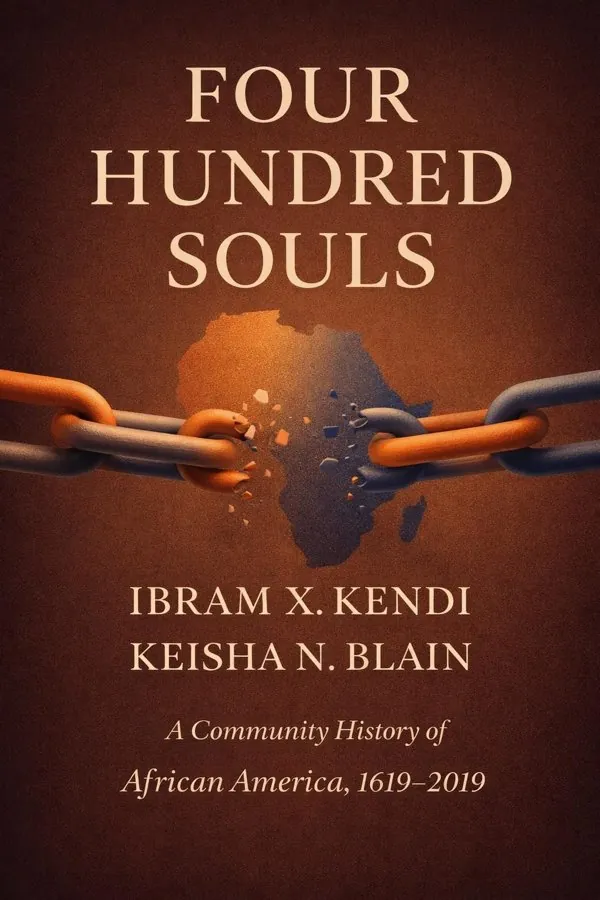
Four Hundred Souls: A Community History of African America, 1619–2019: Summary & Key Insights
by Ibram X. Kendi, Keisha N. Blain
 10 min10 chaptersAudio available
Key Takeaways from Four Hundred Souls: A Community History of African America, 1619–2019
Some beginnings are not merely dates; they are wounds that keep shaping the future.
Oppression becomes durable when custom turns into law.
Ruling classes often respond to unrest not by reducing injustice, but by redesigning it.
A nation can speak the language of freedom while expanding unfreedom.
Emancipation is never a single event; it is a long struggle over what freedom will actually mean.
What Is Four Hundred Souls: A Community History of African America, 1619–2019 About?
Four Hundred Souls: A Community History of African America, 1619–2019 by Ibram X. Kendi, Keisha N. Blain is a world_history book spanning 10 pages. Four Hundred Souls is not a conventional history book. Edited by Ibram X. Kendi and Keisha N. Blain, it is a sweeping, collaborative account of African American history told across four centuries by ninety contributors, each covering a five-year period between 1619 and 2019. Historians, poets, journalists, novelists, and public intellectuals combine to create a layered portrait of Black life in America—its suffering, creativity, resistance, faith, intellect, and political struggle. The result is both panoramic and intimate: a national history built from lived experience. What makes this book especially powerful is its refusal to flatten the Black past into a simple story of victimhood or progress. Instead, it shows how enslavement, racial capitalism, law, migration, gender, culture, religion, and protest continuously shaped one another. Kendi, a leading scholar of racism and antiracism, and Blain, an acclaimed historian of Black politics and feminism, bring deep authority to the project. Yet the book’s greatest strength lies in its collective voice. Four Hundred Souls matters because it argues that American history cannot be understood without centering African American history—not as a sidebar, but as the nation’s core narrative.
This FizzRead summary covers all 10 key chapters of Four Hundred Souls: A Community History of African America, 1619–2019 in approximately 10 minutes, distilling the most important ideas, arguments, and takeaways from Ibram X. Kendi, Keisha N. Blain's work. Also available as an audio summary and Key Quotes Podcast.
Four Hundred Souls: A Community History of African America, 1619–2019
Four Hundred Souls is not a conventional history book. Edited by Ibram X. Kendi and Keisha N. Blain, it is a sweeping, collaborative account of African American history told across four centuries by ninety contributors, each covering a five-year period between 1619 and 2019. Historians, poets, journalists, novelists, and public intellectuals combine to create a layered portrait of Black life in America—its suffering, creativity, resistance, faith, intellect, and political struggle. The result is both panoramic and intimate: a national history built from lived experience.
What makes this book especially powerful is its refusal to flatten the Black past into a simple story of victimhood or progress. Instead, it shows how enslavement, racial capitalism, law, migration, gender, culture, religion, and protest continuously shaped one another. Kendi, a leading scholar of racism and antiracism, and Blain, an acclaimed historian of Black politics and feminism, bring deep authority to the project. Yet the book’s greatest strength lies in its collective voice. Four Hundred Souls matters because it argues that American history cannot be understood without centering African American history—not as a sidebar, but as the nation’s core narrative.
Who Should Read Four Hundred Souls: A Community History of African America, 1619–2019?
This book is perfect for anyone interested in world_history and looking to gain actionable insights in a short read. Whether you're a student, professional, or lifelong learner, the key ideas from Four Hundred Souls: A Community History of African America, 1619–2019 by Ibram X. Kendi, Keisha N. Blain will help you think differently.
- ✓Readers who enjoy world_history and want practical takeaways
- ✓Professionals looking to apply new ideas to their work and life
- ✓Anyone who wants the core insights of Four Hundred Souls: A Community History of African America, 1619–2019 in just 10 minutes
Want the full summary?
Get instant access to this book summary and 100K+ more with Fizz Moment.
Get Free SummaryAvailable on App Store • Free to download
Key Chapters
Some beginnings are not merely dates; they are wounds that keep shaping the future. In Four Hundred Souls, the years 1619 to 1624 mark the arrival of the first captive Africans at Point Comfort, Virginia, a moment often treated as an isolated fact but here presented as a foundational turning point in American history. The book makes clear that this was not simply the start of labor exploitation in the English colonies. It was the beginning of a social order that would bind race, power, land, profit, and law together for centuries.
Kendi and Blain frame these early years as the emergence of a system before it had fully named itself. Africans entered a chaotic colonial world in which categories of servitude were still fluid, yet that fluidity did not mean freedom. Violence, forced labor, and legal uncertainty created conditions in which Black people were made vulnerable to a new kind of permanent dispossession. The narrative also emphasizes that the earliest African arrivals were not passive figures in a tragic prologue. They brought knowledge, memory, agricultural skill, spiritual traditions, and the human determination to survive in a world designed to erase them.
A practical lesson from this section is that institutions rarely appear fully formed. Injustice often begins in ambiguity, improvisation, and exception before hardening into law. That pattern remains visible today in immigration systems, policing, labor exploitation, and voting restrictions. If we wait to oppose injustice until it is complete and obvious, we act too late.
Actionable takeaway: when studying any modern inequality, trace it back to its earliest moments of normalization. Ask not only when a system became legal, but when it first became imaginable and tolerated.
Oppression becomes durable when custom turns into law. The period from 1625 to 1675 shows how colonial authorities transformed African bondage from a set of practices into a racial order with legal force. In these decades, the colonies increasingly defined Blackness as inheritable servitude and whiteness as protected status. This was not a natural social development; it was a political project crafted to secure labor, wealth, and elite control.
Four Hundred Souls highlights how statutes around maternal inheritance, baptism, property, and punishment helped codify the idea that African descent could determine one’s legal fate. By making the status of enslaved children follow that of the mother, colonial lawmakers ensured that slavery would reproduce itself. By refusing to allow Christian conversion to alter bondage, they closed off religious arguments for freedom. By granting different punishments based on race, they taught society to think of human beings through unequal categories of value.
The book also shows that resistance emerged alongside repression. Enslaved Africans ran away, formed networks, preserved culture, and challenged the terms of captivity whenever possible. Their defiance reveals an essential truth: domination is never total, even when law appears overwhelming.
This section has practical relevance because it teaches readers how legal systems can create social reality. Many contemporary inequalities—from housing discrimination to school segregation to sentencing disparities—have similar histories. Laws do not merely reflect prejudice; they organize and legitimize it.
Actionable takeaway: examine how current policies distribute protection and punishment. When rules seem neutral, ask who benefits, who is exposed, and whether the law is quietly teaching society whose lives matter more.
Ruling classes often respond to unrest not by reducing injustice, but by redesigning it. In the years following colonial upheavals such as Bacon’s Rebellion, Four Hundred Souls shows how elites sharpened racial divisions to prevent solidarity among poor Europeans, Africans, and Indigenous people. These decades were crucial in stabilizing whiteness as a political identity—one that offered status and privilege to some in exchange for loyalty to an unequal system.
The book explains that this was a strategic development. Colonial authorities recognized the danger of cross-class alliances among laboring populations. One answer was to elevate white workers above Black workers socially and legally, even when both were economically exploited. In this sense, race became a management tool as much as an ideology. By assigning symbolic and material advantages to whiteness, elites weakened collective resistance.
At the same time, African-descended people continued building community in the face of fragmentation. Kinship networks, oral traditions, spiritual practices, and shared survival strategies became forms of political endurance. The text suggests that community itself was a kind of rebellion: a refusal to become what the system said Black people were.
This insight remains useful today. Divisions based on race, nationality, religion, or culture often serve powerful interests by preventing broader coalitions around wages, healthcare, education, or democratic rights. When people compete for status instead of confronting structures, inequality deepens.
Actionable takeaway: whenever public debate encourages ordinary people to fear one another, look upward. Ask whether that conflict is distracting attention from concentrated power, economic extraction, or democratic erosion.
A nation can speak the language of freedom while expanding unfreedom. In the decades leading to the American Revolution, Four Hundred Souls exposes the deep contradiction at the heart of colonial political thought: demands for liberty from British rule coexisted with the violent entrenchment of slavery. This was not hypocrisy at the margins; it was built into the foundations of early American identity.
The book shows how Black people interpreted and contested revolutionary rhetoric. If colonists claimed taxation without representation was tyranny, what was slavery? If natural rights were universal, why were Africans denied them? Enslaved and free Black people heard these arguments clearly and pressed them to their logical conclusion. Some pursued legal freedom suits; others escaped to whichever side seemed more likely to weaken slavery; still others used the language of Christianity and rights to expose colonial double standards.
This period reveals a key theme of the book: African Americans have repeatedly forced the United States to confront the meaning of its own ideals. Black struggle did not merely seek inclusion in existing principles. It expanded, clarified, and tested them. Democracy in America has often advanced because Black people insisted that lofty words be made real.
Readers can apply this lesson to modern civic life. Political slogans about freedom, security, fairness, or opportunity should always be measured against who is excluded from their benefits. The gap between ideals and institutions is where serious citizenship begins.
Actionable takeaway: when leaders invoke national values, compare the rhetoric with outcomes. Ask who remains unprotected, unheard, or unfree, and let that gap guide moral and political judgment.
Emancipation is never a single event; it is a long struggle over what freedom will actually mean. The years after the American Revolution did not deliver broad liberation for African Americans, but they did open new spaces for Black institution-building, political imagination, and self-definition. Four Hundred Souls traces how free Black communities grew in the North, mutual aid organizations emerged, churches became centers of leadership, and Black intellectual life expanded despite legal and social hostility.
The book resists the temptation to frame the post-Revolutionary era simply as national disappointment. It also highlights Black initiative. African Americans organized schools, published petitions, formed benevolent societies, and created networks that linked faith, education, labor, and politics. Figures and communities from this period recognized that formal liberty without land, safety, mobility, and civil rights remained fragile. They therefore built structures of collective support from below.
This section also makes clear that white backlash was immediate. Restrictions on movement, voting, employment, and assembly showed that even free Black advancement triggered repression. Freedom was tolerated only when it remained narrow and controlled. That pattern would recur throughout American history.
A practical application of this idea is recognizing that communities facing exclusion often cannot wait for institutions to become just. They create parallel systems of support—schools, advocacy groups, cultural centers, independent media, legal defense funds, and economic networks. These are not secondary to politics; they are politics.
Actionable takeaway: if a system denies equal access, support community institutions that build resilience and power. Lasting change depends not only on protest against injustice, but on constructing spaces where dignity can be practiced now.
When unjust systems crack, societies face a defining question: will they transform or merely rearrange power? In Four Hundred Souls, the period from 1826 to 1875 captures one of the most explosive and consequential eras in African American history. Abolitionist organizing intensified, Black activists reshaped public debate, the Civil War destroyed slavery as a legal institution, and Reconstruction briefly opened radical possibilities for democracy.
The book stresses that enslaved and free Black people were central actors in this transformation. They did not wait to be rescued by history. Through rebellion, escape, military service, journalism, preaching, and political organizing, they pushed slavery into crisis and redefined the war’s meaning. Once emancipation came, Black communities demanded more than the end of chains. They sought land, voting rights, education, family reunification, legal protection, and political representation.
Reconstruction appears here not as a tragic footnote but as a bold democratic experiment. Black officeholders, teachers, veterans, laborers, and organizers helped remake southern politics and public life. Yet the book also shows how swiftly white supremacist violence, economic coercion, and political betrayal moved to crush that experiment. The failure to secure land and sustained federal protection left freedom exposed.
This period offers a practical lesson for anyone interested in reform: legal breakthroughs are vulnerable without material backing and institutional enforcement. Rights on paper can be rolled back by terror, bureaucracy, and economic dependency.
Actionable takeaway: support policies that connect civil rights to real power—resources, enforcement, representation, and protection. Justice lasts only when moral victories are anchored in durable structures.
Even in eras of severe repression, people create worlds that oppression cannot fully control. From 1876 to 1925, Four Hundred Souls chronicles the rise of Jim Crow, lynching, disfranchisement, convict leasing, and racial apartheid—yet it also insists on Black cultural, intellectual, and communal creativity during these decades. This dual focus is one of the book’s greatest strengths. It shows that survival was not merely physical. It was artistic, spiritual, educational, and political.
The collapse of Reconstruction did not end Black aspiration. It pushed it into new forms. African Americans founded colleges, built businesses, nurtured musical traditions, expanded Black journalism, migrated in search of safety and opportunity, and debated strategies for advancement. The book captures the tension between accommodation and protest, local endurance and national organizing, rural roots and urban reinvention.
Importantly, this period demonstrates how culture can function as both refuge and resistance. Spirituals, blues, sermons, literature, visual art, and civic ritual preserved memory while also imagining futures beyond white control. Black culture was not an ornamental byproduct of hardship; it was a method of analysis, healing, and assertion.
Readers can apply this idea by treating cultural production as a serious historical force. Music, storytelling, language, style, and ritual are not separate from politics. They help people understand themselves, endure pressure, and sustain collective identity through periods when formal power is denied.
Actionable takeaway: pay attention to the cultural life of marginalized communities. If you want to understand resilience, do not study laws alone—study songs, schools, newspapers, churches, and everyday acts of world-making.
History changes when private pain becomes organized public action. The years from 1926 to 1975 encompass the Great Migration, the Harlem Renaissance’s afterlives, labor struggles, World War II, the long civil rights movement, Black feminism, urban rebellion, and Black Power. Four Hundred Souls presents this era not as a neat march toward equality but as a dense landscape of competing strategies, local campaigns, ideological debates, and cultural revolutions.
The book highlights how migration transformed Black political possibility. Moving from the rural South to northern and western cities altered voting power, labor markets, artistic expression, and social networks. Black workers challenged industrial exploitation; Black veterans returned from war unwilling to accept second-class citizenship; Black women organized as strategists, theorists, and movement builders even when history books marginalized their leadership.
The civil rights movement appears here as broad and ongoing rather than confined to a few famous speeches or laws. Sit-ins, freedom rides, grassroots voter drives, freedom schools, community self-defense, and anti-colonial thinking all shaped the period. The later rise of Black Power is presented not as a rejection of civil rights, but as a demand for deeper self-determination, economic justice, and control over institutions.
This section teaches an important practical lesson: social change requires many approaches at once—electoral pressure, litigation, culture, direct action, mutual aid, scholarship, and local organizing. Movements are ecosystems, not single leaders.
Actionable takeaway: if you want change, do not wait for one perfect strategy. Contribute where you have strength—education, organizing, research, art, fundraising, policy, or community care—and understand that durable movements need all of it.
The end of legal segregation did not end the structures that segregation built. In the final stretch of Four Hundred Souls, the period from 1976 to 2019 reveals how racial inequality adapted to a new era. The language changed, but the machinery often remained. Deindustrialization, mass incarceration, neoliberal policy, voter suppression, educational inequity, housing discrimination, environmental racism, and police violence created fresh forms of old hierarchies.
The book resists the comforting myth that modern America is simply post-civil-rights and therefore post-racial. Instead, it shows how policy choices intensified Black vulnerability while public discourse increasingly framed inequality as personal failure. The war on drugs, the growth of prisons, the hollowing out of urban economies, and the privatization of social risk all had profound consequences for Black communities. At the same time, Black intellectuals, artists, organizers, and everyday citizens continued developing traditions of resistance—from local campaigns to national mobilizations such as Black Lives Matter.
A major contribution of this section is its insistence on continuity. Contemporary crises do not emerge from nowhere. Police killings, wealth gaps, maternal mortality disparities, and attacks on voting rights are linked to longer histories of racial governance. Understanding those links prevents superficial solutions.
This is immediately applicable to current events. News cycles encourage short memory, but democratic judgment requires historical memory. Without it, reform remains symbolic and repetitive.
Actionable takeaway: when confronting a present-day racial issue, ask what older system it descends from. Effective action begins when we see continuity, not just crisis.
Not every truth can be carried by argument alone. One of the most distinctive features of Four Hundred Souls is its alternation between historical essays and poems. These poetic interludes are not decorative pauses; they are essential to the book’s method. They remind readers that African American history is not only a sequence of events to be explained, but also a field of feeling—grief, endurance, love, terror, joy, memory, rage, and imagination.
The poems perform work that conventional historical prose often cannot. They condense experience, preserve ambiguity, and bring emotional immediacy to eras that might otherwise feel remote. In a book spanning four hundred years, this matters enormously. The interludes help readers feel continuity across time. They make history breathe. They connect statistics and policies to families, landscapes, bodies, voices, and dreams.
This formal choice also reinforces the editors’ central claim that no single mode of knowledge is sufficient. To understand a people’s history, readers need archives and lyricism, documentation and witness, analysis and art. African American history has always been carried through sermons, songs, folktales, newspapers, novels, speeches, and poems. The book honors that fullness.
There is a practical lesson here for anyone trying to understand difficult subjects. Facts matter, but so do forms that help us process and remember them. Art deepens attention. It can reveal what data alone leaves hidden.
Actionable takeaway: when studying history, include voices from multiple genres. Read scholarship, but also read poetry, memoir, fiction, music, and oral testimony. Understanding expands when knowledge engages both mind and feeling.
All Chapters in Four Hundred Souls: A Community History of African America, 1619–2019
About the Authors
Ibram X. Kendi is an American historian, public intellectual, and leading scholar of racism and antiracism. He is the author of several influential works on the history of racist ideas, racial policy, and social transformation, and he has helped bring academic debates about race into mainstream public conversation. Keisha N. Blain is an award-winning historian and professor whose research focuses on African American history, Black women’s political activism, and global Black freedom struggles. She is widely respected for her work on Black political thought and social movements. Together, Kendi and Blain combine rigorous historical scholarship with a broad public vision. As co-editors of Four Hundred Souls, they assembled an extraordinary community of writers to produce a collective, multivoiced history of African America across four centuries.
Get This Summary in Your Preferred Format
Read or listen to the Four Hundred Souls: A Community History of African America, 1619–2019 summary by Ibram X. Kendi, Keisha N. Blain anytime, anywhere. FizzRead offers multiple formats so you can learn on your terms — all free.
Available formats: App · Audio · PDF · EPUB — All included free with FizzRead
Download Four Hundred Souls: A Community History of African America, 1619–2019 PDF and EPUB Summary
Key Quotes from Four Hundred Souls: A Community History of African America, 1619–2019
“Some beginnings are not merely dates; they are wounds that keep shaping the future.”
“Oppression becomes durable when custom turns into law.”
“Ruling classes often respond to unrest not by reducing injustice, but by redesigning it.”
“A nation can speak the language of freedom while expanding unfreedom.”
“Emancipation is never a single event; it is a long struggle over what freedom will actually mean.”
Frequently Asked Questions about Four Hundred Souls: A Community History of African America, 1619–2019
Four Hundred Souls: A Community History of African America, 1619–2019 by Ibram X. Kendi, Keisha N. Blain is a world_history book that explores key ideas across 10 chapters. Four Hundred Souls is not a conventional history book. Edited by Ibram X. Kendi and Keisha N. Blain, it is a sweeping, collaborative account of African American history told across four centuries by ninety contributors, each covering a five-year period between 1619 and 2019. Historians, poets, journalists, novelists, and public intellectuals combine to create a layered portrait of Black life in America—its suffering, creativity, resistance, faith, intellect, and political struggle. The result is both panoramic and intimate: a national history built from lived experience. What makes this book especially powerful is its refusal to flatten the Black past into a simple story of victimhood or progress. Instead, it shows how enslavement, racial capitalism, law, migration, gender, culture, religion, and protest continuously shaped one another. Kendi, a leading scholar of racism and antiracism, and Blain, an acclaimed historian of Black politics and feminism, bring deep authority to the project. Yet the book’s greatest strength lies in its collective voice. Four Hundred Souls matters because it argues that American history cannot be understood without centering African American history—not as a sidebar, but as the nation’s core narrative.
You Might Also Like
The Age of Capital
Eric Hobsbawm
10 min
The Gulag Archipelago
Aleksandr Solzhenitsyn
10 min
Jerusalem: The Biography
Simon Sebag Montefiore
10 min
The Anglo-Saxons
James Campbell
10 min
The Boer War
Thomas Pakenham
10 min
The Industrial Revolutionaries: The Making of the Modern World 1776–1914
Gavin Weightman
10 minBrowse by Category
Ready to read Four Hundred Souls: A Community History of African America, 1619–2019?
Get the full summary and 100K+ more books with Fizz Moment.