
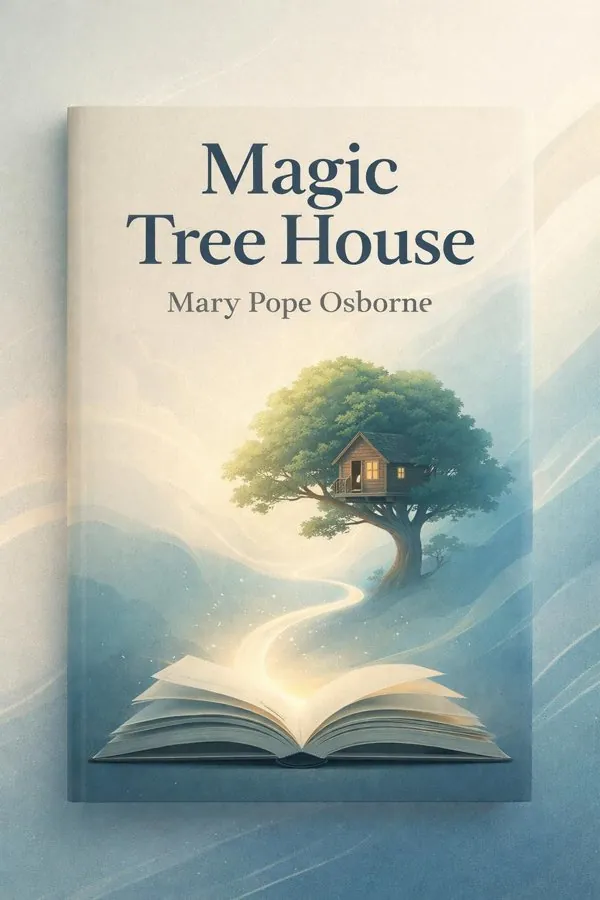
Magic Tree House: Summary & Key Insights
 10 min9 chaptersAudio available
Key Takeaways from Magic Tree House
Great adventures often begin in ordinary places, which is one reason Magic Tree House feels immediately believable to young readers.
Children often learn best when wonder arrives before explanation, and Magic Tree House understands this perfectly.
Courage is not the absence of fear; it is the ability to keep moving while fear is present.
A good adventure changes how home feels when you return, and Magic Tree House captures that beautifully.
One of the most powerful ideas in Magic Tree House is also one of its simplest: books can take you places.
What Is Magic Tree House About?
Magic Tree House by Mary Pope Osborne is a education book spanning 4 pages. What if reading did more than entertain—what if it could carry you into another world and quietly teach you how to look at your own? Magic Tree House begins with that irresistible possibility. In this beloved children’s series opener, Mary Pope Osborne introduces Jack and Annie, two ordinary siblings from Frog Creek, Pennsylvania, who stumble upon a mysterious tree house filled with books. But these are not ordinary books. When Jack points to a picture and wishes to see it for himself, the tree house whisks them through time to the age of dinosaurs, turning curiosity into adventure. What makes Magic Tree House especially powerful is how seamlessly it blends imagination with learning. Young readers are drawn in by suspense, humor, and wonder, yet along the way they absorb history, science, geography, and the habits of brave, thoughtful problem-solving. Osborne has a rare gift for writing stories that feel accessible to early readers without ever talking down to them. Her work has helped generations of children associate books with excitement, discovery, and possibility. Magic Tree House matters because it shows that knowledge is not dry information—it is a doorway, and every question can become the start of an adventure.
This FizzRead summary covers all 9 key chapters of Magic Tree House in approximately 10 minutes, distilling the most important ideas, arguments, and takeaways from Mary Pope Osborne's work. Also available as an audio summary and Key Quotes Podcast.
Magic Tree House
What if reading did more than entertain—what if it could carry you into another world and quietly teach you how to look at your own? Magic Tree House begins with that irresistible possibility. In this beloved children’s series opener, Mary Pope Osborne introduces Jack and Annie, two ordinary siblings from Frog Creek, Pennsylvania, who stumble upon a mysterious tree house filled with books. But these are not ordinary books. When Jack points to a picture and wishes to see it for himself, the tree house whisks them through time to the age of dinosaurs, turning curiosity into adventure.
What makes Magic Tree House especially powerful is how seamlessly it blends imagination with learning. Young readers are drawn in by suspense, humor, and wonder, yet along the way they absorb history, science, geography, and the habits of brave, thoughtful problem-solving. Osborne has a rare gift for writing stories that feel accessible to early readers without ever talking down to them. Her work has helped generations of children associate books with excitement, discovery, and possibility. Magic Tree House matters because it shows that knowledge is not dry information—it is a doorway, and every question can become the start of an adventure.
Who Should Read Magic Tree House?
This book is perfect for anyone interested in education and looking to gain actionable insights in a short read. Whether you're a student, professional, or lifelong learner, the key ideas from Magic Tree House by Mary Pope Osborne will help you think differently.
- ✓Readers who enjoy education and want practical takeaways
- ✓Professionals looking to apply new ideas to their work and life
- ✓Anyone who wants the core insights of Magic Tree House in just 10 minutes
Want the full summary?
Get instant access to this book summary and 100K+ more with Fizz Moment.
Get Free SummaryAvailable on App Store • Free to download
Key Chapters
Great adventures often begin in ordinary places, which is one reason Magic Tree House feels immediately believable to young readers. Jack and Annie are not superheroes, chosen ones, or children living in a fantasy kingdom. They are a brother and sister from Frog Creek, Pennsylvania, wandering through familiar woods on a regular day. Jack is cautious, curious, and bookish. Annie is energetic, fearless, and eager to explore. Their contrasting personalities create a natural tension that becomes one of the story’s greatest strengths. When they spot a tree house high in the branches, the moment feels magical precisely because it interrupts the everyday.
Inside, they find books—dozens of them. That detail matters. The tree house is not powered by technology, weapons, or secret codes. It is powered by reading and imagination. Jack’s instinct is to research, observe, and take notes. Annie’s instinct is to leap into experience. Together, they model two equally valuable ways of learning: thinking and doing. The discovery scene introduces not only the fantasy premise of the series, but also its deeper idea that books are portals. Reading can transport us beyond our neighborhoods, beyond our present moment, and beyond what we think we know.
In practical terms, this opening offers children a framework for approaching the unfamiliar. When faced with something new, one child might respond like Jack—carefully gathering facts—while another might respond like Annie—testing the world directly. Parents and teachers can use this contrast to discuss different learning styles and how collaboration turns differences into strengths. The tree house also makes libraries and bookshelves feel newly alive. A child who sees Jack and Annie travel through books may begin to approach reading with more excitement and ownership.
Actionable takeaway: Treat the next book you open as a doorway. Before reading, ask: Where might this take me, and what can I discover if I enter with both curiosity and courage?
Children often learn best when wonder arrives before explanation, and Magic Tree House understands this perfectly. When Jack and Annie look out from the tree house and realize Frog Creek has vanished, they do not enter a textbook version of prehistory. They step into a living world filled with ferns, distant calls, strange movement, and the thrilling uncertainty of being somewhere impossible. The age of dinosaurs is not introduced as a dry lesson but as an experience—one that begins with amazement and quickly becomes personal.
This shift from observation to immersion is what gives the story educational force. Young readers are not simply told that dinosaurs lived long ago; they feel what it might be like to stand among them. Jack’s note-taking reflects a scientific impulse: identify, classify, remember. Annie’s openhearted excitement reflects a child’s instinctive sense of wonder. Together, they invite readers to balance information with imagination. A dinosaur is no longer just a fact on a page. It becomes something to understand, respect, and survive.
The prehistoric setting also teaches perspective. Jack and Annie are suddenly small in a vast world that does not revolve around them. That can be a transformative realization for children. It encourages humility and curiosity at the same time. The natural world is older, larger, and more complex than any one person’s immediate experience. This idea can be extended into practical learning: children can compare fictional depictions of dinosaurs with museum exhibits, create journals like Jack’s, or talk about how scientists piece together evidence from fossils.
By making the past vivid, Osborne shows that knowledge becomes memorable when tied to emotion. Excitement, fear, curiosity, and surprise all deepen learning. A child who reads about a pteranodon swooping overhead is more likely to remember the encounter than a child who simply memorizes a name from a worksheet.
Actionable takeaway: Pair facts with vivid imagination. When learning about a new topic, ask not only “What happened?” but also “What would it have felt like to be there?”
Courage is not the absence of fear; it is the ability to keep moving while fear is present. That lesson runs quietly but powerfully through Jack and Annie’s first adventure in the dinosaur world. Once the thrill of arriving wears off, uncertainty takes over. The landscape is unfamiliar, the creatures are enormous, and the children have no clear control over how or when they will return home. Fear becomes part of the journey, not an interruption to it.
What makes this especially meaningful for young readers is that the story does not shame caution or glorify recklessness. Jack’s nervousness is understandable and useful. He notices danger, asks questions, and tries to make sense of what is happening. Annie’s bravery is equally valuable. She keeps the adventure moving, trusts her instincts, and remains emotionally open rather than shutting down. Their friendship as siblings becomes the structure that helps them endure uncertainty. Jack grounds Annie. Annie energizes Jack. Together, they become more capable than either would be alone.
This dynamic offers a practical model for children navigating unfamiliar experiences in real life, whether that means starting school, joining a team, sleeping away from home, or speaking in front of others. One child may identify with Jack’s hesitation, another with Annie’s boldness, but both can see that fear is manageable when shared. The book also suggests that naming fear makes it less overwhelming. Jack often expresses what worries him, and doing so helps him think more clearly.
Adults can use this part of the story to ask useful questions: What kinds of situations make you feel like Jack? When does it help to be a little more like Annie? Who helps you feel brave? These questions turn fantasy into emotional literacy. The prehistoric setting may be extraordinary, but the feelings are not.
Actionable takeaway: The next time fear appears, do two things—name what scares you and lean on someone you trust. Bravery grows faster in companionship than in isolation.
One of the most powerful ideas in Magic Tree House is also one of its simplest: books can take you places. In the story, that idea becomes literal. Jack and Annie use books to travel through time and space. But beneath the fantasy is a truth children can understand immediately. Reading expands life. A child may be physically in a bedroom, classroom, or small-town library, yet mentally exploring ancient worlds, distant cultures, wild landscapes, and unfamiliar ideas.
Mary Pope Osborne turns this metaphor into the engine of the plot, which is why the story has such lasting educational value. The children do not gain access to adventure by breaking rules or rejecting learning. They gain access through attention, curiosity, and books. Jack reads carefully. He studies pictures. He writes things down. His literacy skills are not side details—they are survival tools. Annie, meanwhile, reminds readers that books should not become barriers to experience. Reading should lead to wonder, empathy, and action, not mere accumulation of facts.
This combination makes the series especially effective for emerging readers. It quietly reinforces the idea that reading has purpose. Vocabulary, observation, comprehension, and memory all matter because they help the children understand the world they enter. For educators, this creates wonderful opportunities. Students can make prediction charts, map settings, keep explorer journals, and connect fictional adventures with nonfiction research about dinosaurs, ancient civilizations, or historical periods.
There is also an emotional lesson here: books can help children feel less confined by their circumstances. Not every child has access to travel, museums, or broad life experience. Magic Tree House tells them that reading is not a lesser substitute. It is a real form of exploration and growth.
Actionable takeaway: Build a “portal shelf” of books about different times and places, and after each one, write down one fact learned, one feeling felt, and one question worth exploring next.
Many children’s stories praise bravery, but Magic Tree House offers a more useful lesson: the best adventures require both caution and curiosity. Jack and Annie represent two necessary instincts. Jack wants to observe before acting. He notices details, worries about risks, and prefers evidence. Annie moves quickly, trusts wonder, and resists overthinking. If either child acted alone, the journey would likely fail. Jack might stay frozen by uncertainty. Annie might rush into danger without enough reflection. Together, they create balance.
This balance is one of the series’ most practical contributions to young readers. Children are often labeled too simply: shy or bold, careful or reckless, thoughtful or impulsive. Osborne suggests that these traits are not fixed flaws or virtues. They are tendencies that can complement each other when managed well. Jack’s caution keeps the pair safer. Annie’s curiosity prevents fear from shutting the adventure down. Neither personality is presented as superior; both must grow.
That idea can be applied in everyday life. In school, curiosity inspires students to ask questions, try new subjects, and participate in discussions. Caution helps them check instructions, avoid careless mistakes, and think through consequences. In friendships, curiosity invites openness to others. Caution helps establish boundaries and good judgment. In problem-solving, curiosity generates options while caution evaluates them.
Adults can use Jack and Annie as conversation starters: When is it wise to pause and think? When is it important to take a chance? Students can even identify moments in their own day that called for “Jack thinking” or “Annie energy.” This framework helps children see self-regulation not as suppressing personality, but as integrating strengths.
Magic Tree House ultimately argues that growth happens when children learn not to erase their natural instincts, but to pair them with complementary skills. Jack becomes braver. Annie becomes more attentive. That is development in its healthiest form.
Actionable takeaway: In your next challenge, deliberately use both modes—first pause to notice and plan like Jack, then take one bold step forward like Annie.
Facts are easier to remember when they matter to someone, and Magic Tree House succeeds because it wraps information inside a story children care about. Rather than presenting history or science as separate from entertainment, Mary Pope Osborne fuses them. Dinosaurs are not introduced in a detached lesson; they are part of a problem Jack and Annie must navigate. As a result, learning becomes emotionally charged. Readers want to know what kind of dinosaur they have encountered because the answer could affect what happens next.
This storytelling method has real educational power. Narrative creates sequence, consequence, and context. Children remember the order of events, the setting, and the emotional stakes, and those elements act like hooks for information. If a child recalls Jack writing in his notebook while facing prehistoric creatures, that memory can anchor new knowledge about paleontology, extinction, habitats, or scientific observation. In other words, story gives facts a home.
The series also lowers resistance to learning. Some children approach educational content with anxiety or boredom, especially if they have already decided that school subjects are difficult or dull. Magic Tree House bypasses that resistance by leading with wonder. Once attention is captured, knowledge can enter naturally. This is a valuable reminder for parents, teachers, and anyone designing learning experiences: engagement is not the enemy of rigor. Often, it is the path to it.
Practical applications are easy to imagine. After reading, children can create timeline posters, compare fiction to nonfiction, dramatize scenes, or research one creature from the story. They can practice descriptive writing by imagining a first look out the tree house window. They can discuss how scientists know what they know about the distant past.
Actionable takeaway: Whenever you need to learn something new, try placing it inside a story. Ask: who is affected, what is at stake, and why does this information matter in a real or imagined journey?
Imagination is often treated as play, but in Magic Tree House it becomes a serious tool for growth. Jack and Annie’s journey asks readers to imagine themselves in a world radically different from their own. That act of imaginative entry does more than entertain. It stretches the mind, invites empathy, and builds confidence. A child reading the story practices mentally leaving the familiar and adapting to the unknown—skills that matter in real life as much as in fiction.
Imagination supports empathy because it asks, “What would it feel like to be there?” Even in a dinosaur adventure, readers must consider fear, excitement, uncertainty, and wonder from the characters’ point of view. Over time, that habit of perspective-taking transfers outward. Children who can imaginatively inhabit a story are often better prepared to consider experiences beyond their own. This is especially important in a series that later travels across cultures, historical eras, and distant places.
Imagination also supports confidence. Jack and Annie begin as ordinary children, not experts. They do not know exactly what to do. They learn by noticing, trying, failing, correcting, and continuing. Readers absorb the message that uncertainty is survivable. You do not need complete mastery before beginning. You need willingness. That is an empowering lesson for children who may hesitate to try difficult books, new activities, or unfamiliar environments.
There is a practical developmental value here as well. Imaginative play and reading help children rehearse emotional situations safely. A child can experience suspense, danger, and relief through the story and come away stronger, having processed those feelings in a contained way. Teachers can deepen this by inviting students to imagine alternate choices in the plot or write their own time-travel missions.
Actionable takeaway: Use imagination as practice for life. When facing something new, spend two minutes picturing yourself entering it, handling it, and learning from it. Confidence often begins in the mind before it appears in action.
Few children’s books become lasting cultural touchstones, and Magic Tree House endures because it solves several problems at once. It is approachable for young readers, exciting enough to sustain attention, educational without feeling heavy, and structured in a way that rewards continuation. Each adventure is self-contained, which makes entry easy, yet each one also points toward a larger mystery, which encourages loyalty. That combination is rare and remarkably effective.
The series also endures because it respects children. Mary Pope Osborne writes clearly, but never condescendingly. She trusts that young readers can handle suspense, absorb new information, and appreciate unresolved questions. Jack and Annie are competent without being unrealistic. They make mistakes, get scared, and rely on each other. Their growth feels earned, not imposed. This realism within fantasy is part of what gives the books emotional credibility.
Another reason for the series’ longevity is its usefulness across contexts. Parents value it because it encourages independent reading. Teachers value it because it opens doors to cross-curricular learning in history, science, geography, and writing. Children value it because it is fun. When a book satisfies all three audiences at once, it tends to last.
The format matters too. Short chapters, vivid stakes, and recurring characters create reading momentum. For many children, Magic Tree House becomes a bridge series—the set of books that transforms reading from a school task into a personal habit. Once that shift happens, the benefits compound for years.
In a wider sense, the series endures because its central promise never stops appealing: the world is bigger than you think, and books can help you reach it. That is a timeless invitation.
Actionable takeaway: If you want to build a lasting reading habit, choose books that combine accessibility, recurring characters, and genuine curiosity—stories that make turning the next page feel like opening the next door.
All Chapters in Magic Tree House
About the Author
Mary Pope Osborne is an acclaimed American author best known for the bestselling Magic Tree House series, which has introduced millions of children to the joys of reading. Born in 1949 in Fort Sill, Oklahoma, she spent part of her childhood traveling with her military family, an experience that helped shape her fascination with different places, cultures, and stories. Before becoming a full-time writer, she explored theater, traveled widely, and developed a strong interest in mythology and history. Those influences are visible throughout her work, which often blends adventure with learning. Osborne’s writing is especially admired for making complex subjects accessible and exciting for young readers. Through Jack and Annie’s journeys, she has built one of the most enduring bridges between children’s fiction and educational discovery.
Get This Summary in Your Preferred Format
Read or listen to the Magic Tree House summary by Mary Pope Osborne anytime, anywhere. FizzRead offers multiple formats so you can learn on your terms — all free.
Available formats: App · Audio · PDF · EPUB — All included free with FizzRead
Download Magic Tree House PDF and EPUB Summary
Key Quotes from Magic Tree House
“Great adventures often begin in ordinary places, which is one reason Magic Tree House feels immediately believable to young readers.”
“Children often learn best when wonder arrives before explanation, and Magic Tree House understands this perfectly.”
“Courage is not the absence of fear; it is the ability to keep moving while fear is present.”
“A good adventure changes how home feels when you return, and Magic Tree House captures that beautifully.”
“One of the most powerful ideas in Magic Tree House is also one of its simplest: books can take you places.”
Frequently Asked Questions about Magic Tree House
Magic Tree House by Mary Pope Osborne is a education book that explores key ideas across 9 chapters. What if reading did more than entertain—what if it could carry you into another world and quietly teach you how to look at your own? Magic Tree House begins with that irresistible possibility. In this beloved children’s series opener, Mary Pope Osborne introduces Jack and Annie, two ordinary siblings from Frog Creek, Pennsylvania, who stumble upon a mysterious tree house filled with books. But these are not ordinary books. When Jack points to a picture and wishes to see it for himself, the tree house whisks them through time to the age of dinosaurs, turning curiosity into adventure. What makes Magic Tree House especially powerful is how seamlessly it blends imagination with learning. Young readers are drawn in by suspense, humor, and wonder, yet along the way they absorb history, science, geography, and the habits of brave, thoughtful problem-solving. Osborne has a rare gift for writing stories that feel accessible to early readers without ever talking down to them. Her work has helped generations of children associate books with excitement, discovery, and possibility. Magic Tree House matters because it shows that knowledge is not dry information—it is a doorway, and every question can become the start of an adventure.
You Might Also Like

Bedtime Biography: Florence Nightingale
Isabel Thomas
10 min
Introduction To Museum Studies
Howard H. Hoyt
10 min
A Mind for Numbers: How to Excel at Math and Science (Even If You Flunked Algebra)
Barbara Oakley
10 min
AI for Educators: Learning Strategies, Teacher Empowerment, and the Future of Education
Matt Miller
10 min
Animation For Beginners
Morr Meroz
10 min
Artificial Intelligence for Learning
Donald Clark
10 minBrowse by Category
Ready to read Magic Tree House?
Get the full summary and 100K+ more books with Fizz Moment.