
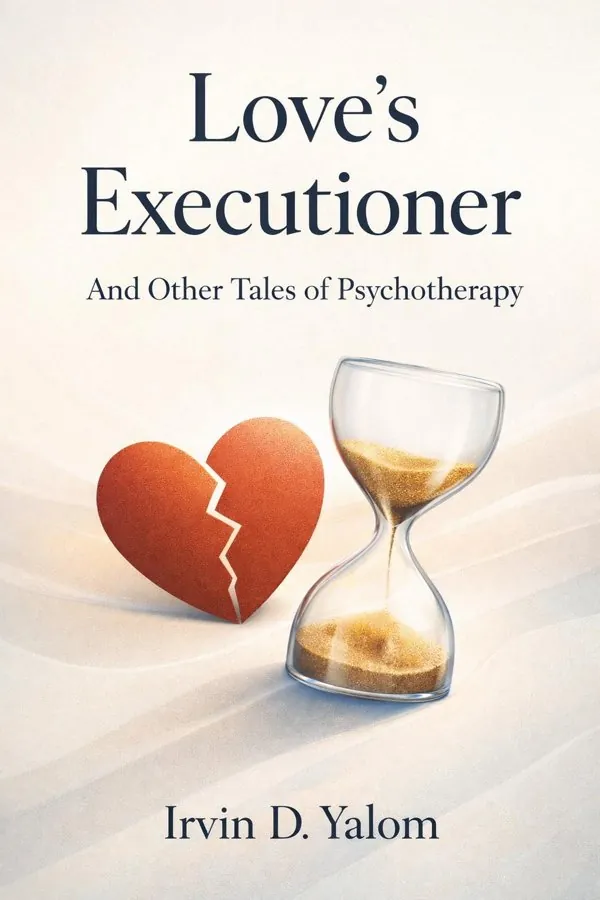
Love’s Executioner: And Other Tales of Psychotherapy: Summary & Key Insights
 10 min9 chaptersAudio available
Key Takeaways from Love’s Executioner: And Other Tales of Psychotherapy
One of the most unsettling truths in psychotherapy is that the therapist is never a perfectly clean instrument.
People do not cling to fantasies because they are foolish; they cling to them because those fantasies protect them from realities that feel unbearable.
Much of human behavior makes more sense when viewed through the lens of mortality.
Few emotions isolate as powerfully as shame.
Dreams matter not because they are magical codes but because they condense emotion, conflict, fear, and desire into vivid symbolic form.
What Is Love’s Executioner: And Other Tales of Psychotherapy About?
Love’s Executioner: And Other Tales of Psychotherapy by Irvin D. Yalom is a mental_health book spanning 9 pages. What happens inside a therapy room is often hidden from public view, yet few places reveal human nature more honestly. In Love’s Executioner: And Other Tales of Psychotherapy, Irvin D. Yalom opens that door through ten deeply human case narratives that examine obsession, grief, shame, mortality, loneliness, and the longing to be truly seen. Rather than presenting psychotherapy as a tidy science with neat solutions, Yalom shows it as a living encounter between two imperfect people, each bringing fears, blind spots, and hopes into the room. What makes this book so powerful is Yalom’s unusual candor. He does not only describe his patients; he also exposes his own reactions, judgments, frustrations, and vulnerabilities as a therapist. That honesty gives the book rare psychological depth and moral credibility. A pioneering psychiatrist and one of the leading voices in existential psychotherapy, Yalom uses these stories to illuminate timeless questions: How do we live knowing we will die? Why do we cling to painful illusions? What does healing really require? The result is a compassionate, unsettling, and profoundly insightful book that speaks to therapists, readers interested in psychology, and anyone trying to understand the hidden forces shaping human behavior.
This FizzRead summary covers all 9 key chapters of Love’s Executioner: And Other Tales of Psychotherapy in approximately 10 minutes, distilling the most important ideas, arguments, and takeaways from Irvin D. Yalom's work. Also available as an audio summary and Key Quotes Podcast.
Love’s Executioner: And Other Tales of Psychotherapy
What happens inside a therapy room is often hidden from public view, yet few places reveal human nature more honestly. In Love’s Executioner: And Other Tales of Psychotherapy, Irvin D. Yalom opens that door through ten deeply human case narratives that examine obsession, grief, shame, mortality, loneliness, and the longing to be truly seen. Rather than presenting psychotherapy as a tidy science with neat solutions, Yalom shows it as a living encounter between two imperfect people, each bringing fears, blind spots, and hopes into the room.
What makes this book so powerful is Yalom’s unusual candor. He does not only describe his patients; he also exposes his own reactions, judgments, frustrations, and vulnerabilities as a therapist. That honesty gives the book rare psychological depth and moral credibility. A pioneering psychiatrist and one of the leading voices in existential psychotherapy, Yalom uses these stories to illuminate timeless questions: How do we live knowing we will die? Why do we cling to painful illusions? What does healing really require? The result is a compassionate, unsettling, and profoundly insightful book that speaks to therapists, readers interested in psychology, and anyone trying to understand the hidden forces shaping human behavior.
Who Should Read Love’s Executioner: And Other Tales of Psychotherapy?
This book is perfect for anyone interested in mental_health and looking to gain actionable insights in a short read. Whether you're a student, professional, or lifelong learner, the key ideas from Love’s Executioner: And Other Tales of Psychotherapy by Irvin D. Yalom will help you think differently.
- ✓Readers who enjoy mental_health and want practical takeaways
- ✓Professionals looking to apply new ideas to their work and life
- ✓Anyone who wants the core insights of Love’s Executioner: And Other Tales of Psychotherapy in just 10 minutes
Want the full summary?
Get instant access to this book summary and 100K+ more with Fizz Moment.
Get Free SummaryAvailable on App Store • Free to download
Key Chapters
One of the most unsettling truths in psychotherapy is that the therapist is never a perfectly clean instrument. In the opening case, “Love��s Executioner,” Yalom confronts his own resistance toward Thelma, an older woman consumed by an obsessive attachment to a former lover. Instead of feeling immediate compassion, he feels irritation, dread, and aversion. That confession is the point: therapists, despite training and good intentions, are not immune to bias, vanity, impatience, or emotional fatigue.
Yalom’s honesty matters because it challenges a fantasy many people have about therapy—that healing happens because one wise, detached expert simply applies the right method. In reality, psychotherapy is shaped by the therapist’s inner life as much as the patient’s. The real professional task is not to be free of feeling, but to recognize feeling without letting it control the work. Yalom studies his own reactions and asks what they reveal. Is his dislike merely personal? Or is he reacting to something important in Thelma’s way of relating—her dependence, her eroticized fantasy, her demand to keep an illusion alive?
This idea applies far beyond psychotherapy. Teachers, managers, doctors, coaches, and parents all influence others through relationships colored by their own histories. When we fail to examine ourselves, we become less helpful and more reactive. When we become curious about our reactions, we gain freedom.
A practical application is to pause whenever someone triggers disproportionate irritation or fascination. Ask: What exactly am I feeling? What expectation of mine is being violated? What might this reaction teach me about the relationship? Self-awareness does not eliminate bias, but it makes bias less dangerous.
Actionable takeaway: When your emotions toward someone feel unusually strong, treat that reaction as information to examine, not a truth to obey.
People do not cling to fantasies because they are foolish; they cling to them because those fantasies protect them from realities that feel unbearable. Thelma’s fixation in “Love’s Executioner” is not merely romantic confusion. Her obsession with a brief affair gives structure, intensity, and meaning to an otherwise lonely life. By replaying a vanished relationship, she avoids facing aging, emptiness, and the terror of being fundamentally alone.
Yalom shows that symptoms often serve a hidden function. What looks irrational from the outside may be psychologically useful from the inside. This is one of the central lessons of psychotherapy: before trying to remove a symptom, understand what job it is doing. If you strip away a defense too quickly, you may leave the person exposed to feelings they are not ready to bear. In Thelma’s case, her love fantasy keeps despair at bay. It is painful, but it is also protective.
This pattern appears in everyday life. Some people obsess over a former partner to avoid rebuilding their identity. Others overwork to avoid grief, scroll endlessly to avoid loneliness, or fixate on self-improvement to avoid mortality and uncertainty. The surface behavior differs, but the structure is similar: the mind chooses a manageable pain over a larger, more existential one.
The practical implication is not to shame yourself for your coping mechanisms, but to ask what they are helping you avoid. Journaling can help: What would I have to feel if this habit, fantasy, or obsession disappeared? What emptiness, fear, or decision would then confront me? Compassionate inquiry is more useful than self-criticism.
Actionable takeaway: The next time you feel trapped in an obsession, ask not only “How do I stop this?” but also “What painful truth might this obsession be protecting me from?”
Much of human behavior makes more sense when viewed through the lens of mortality. Across several cases, including the story of a man facing terminal illness, Yalom shows that the awareness of death is not a distant philosophical idea but an active psychological force. People often deny it, distort it, or distract themselves from it, yet it quietly shapes their routines, ambitions, relationships, and fears.
Existential psychotherapy begins with a hard proposition: we suffer not only from personal wounds but from universal conditions of existence. Death is one of them. Some patients respond to mortality with numbness and triviality, focusing on appointments, possessions, and rituals instead of confronting what is happening. Others respond with panic, rage, or a desperate search for unfinished meaning. Yalom does not treat death anxiety as pathology alone. He sees it as a deeply human confrontation that can either shrink a life through denial or deepen it through awakening.
This insight matters because many people live as if they have unlimited time, postponing difficult conversations, meaningful work, forgiveness, or change. Yet the awareness that life is finite can cut through pettiness and reveal what actually matters. Yalom suggests that when patients face death honestly, they often become less interested in performance and more interested in authenticity.
In daily life, this might mean asking mortality-based questions: If I had one year left, what conflict would I stop feeding? Whom would I call? What fear would seem less important? This is not morbid; it is clarifying. Awareness of death can become a guide to life.
Actionable takeaway: Use mortality as a focusing tool—regularly ask what you would prioritize if time were visibly limited, then act on one answer now.
Few emotions isolate as powerfully as shame. In “Fat Lady,” Yalom examines his own discomfort with a patient whose body and eating habits trigger disgust and judgment in him. This chapter is not simply about weight; it is about the violence of being seen through contempt, even subtle contempt. Shame tells a person, “I am not merely struggling; I am repulsive.” Under that pressure, growth becomes harder because the self retreats, hides, or attacks itself.
Yalom’s brilliance lies in recognizing that therapeutic failure can begin in unexamined disgust. If a therapist silently recoils, the patient often senses it. Human beings are extraordinarily sensitive to facial expression, tone, and withdrawal. What we do not say can still wound. The challenge, then, is not to perform false acceptance but to transform judgment into understanding. Why does this patient eat this way? What loneliness, self-hatred, deprivation, or rebellion is being enacted? Only curiosity can interrupt disgust.
This lesson reaches into ordinary relationships. Shame-based interactions happen when parents label children as lazy instead of overwhelmed, when partners mock vulnerabilities, or when workplaces humiliate rather than coach. In each case, the person becomes identified with the problem instead of supported through it.
A practical application is to notice your first reaction and then deliberately add a second one. The first may be impatience or criticism; the second should be inquiry. Replace “What is wrong with you?” with “What pain might be operating here?” This shift does not excuse harmful behavior, but it creates a path toward change.
Actionable takeaway: When confronted by someone’s behavior that repels or frustrates you, pause long enough to look for the suffering underneath the surface before responding.
Psychological suffering never unfolds in a social vacuum. In “If Rape Were Legal,” Yalom explores fantasies, aggression, and gendered power in ways that force the reader to confront uncomfortable realities. The title itself shocks because it points toward desires and hostilities people would rather deny. Yalom’s deeper point is that the therapeutic room must be able to hold morally troubling material without collapsing into either indulgence or moral panic.
This is one of the book’s bravest contributions. Therapy often involves listening to impulses that are unacceptable in action but revealing in fantasy. Beneath violent or degrading imaginings may lie humiliation, impotence, rage, fear of rejection, or a desperate need to reverse vulnerability. To understand is not to approve. Yalom models a discipline of facing what is psychologically true without flinching from its ethical seriousness.
The chapter also highlights how power and gender dynamics shape both suffering and treatment. Women and men are socialized differently in relation to desire, aggression, shame, and safety. Patients bring these social scripts into therapy, and therapists do too. Ignoring those dynamics can make therapy shallow. Naming them can make it more honest.
In everyday life, this idea encourages us to examine where our fantasies of domination, escape, revenge, or submission come from. Often they are attempts to regulate pain or recover a sense of agency. Honest reflection can interrupt unconscious reenactment.
A practical approach is to separate urge from action. Instead of being frightened or morally simplistic about a disturbing inner impulse, ask: What wound, fear, or humiliation is this fantasy trying to solve? That question opens responsibility instead of denial.
Actionable takeaway: When an uncomfortable fantasy or impulse arises, investigate the vulnerability beneath it rather than either acting on it or pretending it does not exist.
Modern culture often treats grief as a problem to solve quickly, but Yalom shows that grief is not a technical malfunction. In “Seven Advanced Lessons in the Therapy of Grief” and “The Wrong One Died,” he explores mourning as a complex encounter with love, guilt, anger, identity, and mortality. Loss is never only about the person who died; it is also about the part of oneself that was organized around that relationship.
Yalom is especially sensitive to the irrational aspects of grief. Survivors may feel relief, resentment, envy, or guilt about being alive. They may believe they should have died instead, or that they somehow betrayed the dead by continuing to live. These reactions can feel shameful, which makes people hide them. Yalom’s therapeutic gift is to legitimize emotional complexity without trivializing the pain.
A key insight is that grief cannot be bypassed by advice. The bereaved do not mainly need explanations; they need accompaniment, language, and time. The task is not to “get over” loss but to integrate it into a changed life. That integration often involves reworking internal bonds, accepting unfinished business, and allowing contradictory feelings to coexist.
This applies to losses beyond death: divorce, illness, estrangement, moving, retirement, or the loss of a hoped-for future. In each case, healing begins when we stop demanding that sorrow obey a schedule.
Practically, grief work can include writing a letter to the person or future you lost, speaking aloud unresolved feelings, or creating rituals of remembrance. These practices help convert mute suffering into mourned reality.
Actionable takeaway: Do not rush grief into neatness; create space to name the love, anger, guilt, and longing that coexist inside loss.
Technique matters, but in Yalom’s world, relationship matters more. Again and again, Love’s Executioner argues that change often occurs not because a therapist gives brilliant interpretations, but because two people risk a more truthful encounter. Yalom is willing to examine moments of distance, idealization, manipulation, boredom, tenderness, and misunderstanding within the therapy relationship itself. Those live moments become the real material of healing.
This is a radical idea for anyone who imagines therapy as one-way analysis. Yalom emphasizes that patients repeat old relational patterns in the therapy room: they seduce, test, withdraw, submit, accuse, cling, conceal, and hope. The therapist also participates. If these patterns are noticed and discussed in the present, therapy becomes more than storytelling about the past; it becomes a place to experience something new.
The lesson extends far beyond clinical practice. Many relationships fail not because people lack affection but because they avoid process. They discuss events, logistics, and accusations, but not what is happening between them in real time. “I notice I am pulling away.” “I realize I want your approval.” “I’m afraid you’ll reject me if I say this.” These statements open the door to genuine contact.
A practical application is to shift difficult conversations from content alone to process. Instead of arguing only about what happened, include how the interaction felt and what pattern seems to be repeating. This reduces blame and increases clarity.
Yalom’s work suggests that honesty is healing when it is offered in the service of connection rather than attack. Truth without compassion wounds; compassion without truth stagnates.
Actionable takeaway: In an important relationship, name one present-moment pattern directly and kindly instead of only debating surface events.
One of Yalom’s deepest existential themes is that meaning is rarely handed to us fully formed. Many patients come to therapy hoping to discover a hidden answer that will dissolve uncertainty. Instead, Yalom repeatedly points toward a harder but liberating truth: meaning is built through choices, commitments, relationships, and courage in the face of life’s givens.
The cases in this book reveal how emptiness often emerges when old structures collapse. A romance ends, a spouse dies, youth fades, illness arrives, or career identity fails. In those moments, people confront not only pain but the absence of a script. Yalom does not offer simplistic positivity. He does not claim that suffering is automatically meaningful. Rather, he shows that suffering can become meaningful when a person engages it honestly and reshapes life around what matters.
This insight is practical because many modern people confuse meaning with constant passion or certainty. Yet meaning often feels quieter: caring for someone, creating something, telling the truth, accepting limitation, or participating in a community larger than oneself. It is less a mood than a direction.
A useful exercise is to identify moments in the past month when you felt most alive, useful, or deeply present. Then ask what values were active in those moments—love, mastery, contribution, beauty, curiosity, service, courage. Meaning leaves traces. Following those traces is more effective than waiting for revelation.
Yalom’s existential stance is not that life comes with guaranteed significance, but that humans possess the freedom and burden of constructing significance anyway.
Actionable takeaway: Stop waiting for perfect certainty about purpose; choose one value-based action this week that makes your life feel more aligned with what matters.
All Chapters in Love’s Executioner: And Other Tales of Psychotherapy
About the Author
Irvin D. Yalom is an American psychiatrist, psychotherapist, and bestselling author widely regarded as one of the leading voices in existential psychotherapy. Born in Washington, D.C., he built a distinguished academic career and later became Professor Emeritus of Psychiatry at Stanford University. Yalom is known for bringing together clinical wisdom, philosophical depth, and literary storytelling in a way that reaches both professionals and general readers. His work explores core human concerns such as death, isolation, freedom, meaning, and the complexity of relationships. In addition to Love’s Executioner, his notable books include Existential Psychotherapy, The Gift of Therapy, and several acclaimed novels. His influence extends far beyond psychiatry, making him one of the most respected interpreters of the psychological and existential dimensions of human life.
Get This Summary in Your Preferred Format
Read or listen to the Love’s Executioner: And Other Tales of Psychotherapy summary by Irvin D. Yalom anytime, anywhere. FizzRead offers multiple formats so you can learn on your terms — all free.
Available formats: App · Audio · PDF · EPUB — All included free with FizzRead
Download Love’s Executioner: And Other Tales of Psychotherapy PDF and EPUB Summary
Key Quotes from Love’s Executioner: And Other Tales of Psychotherapy
“One of the most unsettling truths in psychotherapy is that the therapist is never a perfectly clean instrument.”
“People do not cling to fantasies because they are foolish; they cling to them because those fantasies protect them from realities that feel unbearable.”
“Much of human behavior makes more sense when viewed through the lens of mortality.”
“Few emotions isolate as powerfully as shame.”
“Dreams matter not because they are magical codes but because they condense emotion, conflict, fear, and desire into vivid symbolic form.”
Frequently Asked Questions about Love’s Executioner: And Other Tales of Psychotherapy
Love’s Executioner: And Other Tales of Psychotherapy by Irvin D. Yalom is a mental_health book that explores key ideas across 9 chapters. What happens inside a therapy room is often hidden from public view, yet few places reveal human nature more honestly. In Love’s Executioner: And Other Tales of Psychotherapy, Irvin D. Yalom opens that door through ten deeply human case narratives that examine obsession, grief, shame, mortality, loneliness, and the longing to be truly seen. Rather than presenting psychotherapy as a tidy science with neat solutions, Yalom shows it as a living encounter between two imperfect people, each bringing fears, blind spots, and hopes into the room. What makes this book so powerful is Yalom’s unusual candor. He does not only describe his patients; he also exposes his own reactions, judgments, frustrations, and vulnerabilities as a therapist. That honesty gives the book rare psychological depth and moral credibility. A pioneering psychiatrist and one of the leading voices in existential psychotherapy, Yalom uses these stories to illuminate timeless questions: How do we live knowing we will die? Why do we cling to painful illusions? What does healing really require? The result is a compassionate, unsettling, and profoundly insightful book that speaks to therapists, readers interested in psychology, and anyone trying to understand the hidden forces shaping human behavior.
More by Irvin D. Yalom




You Might Also Like

Big Feelings: How to Be Okay When Things Are Not Okay
Liz Fosslien, Mollie West Duffy
10 min
Creative Arts Therapies Handbook: Art, Music and Dance Therapy Practices for Wellbeing
Susan I. Buchalter
10 min
Emotional First Aid: Healing Rejection, Guilt, Failure, and Other Everyday Hurts
Guy Winch
10 min
Lost Connections: Why You're Depressed and How to Find Hope
Johann Hari
10 min
No Time to Panic: How to Stop Worrying and Embrace Life
Matt Gutman
10 min
Overcoming Mobbing: A Recovery Guide for Workplace Aggression and Bullying
Maureen Duffy, Len Sperry
10 minBrowse by Category
Ready to read Love’s Executioner: And Other Tales of Psychotherapy?
Get the full summary and 100K+ more books with Fizz Moment.