
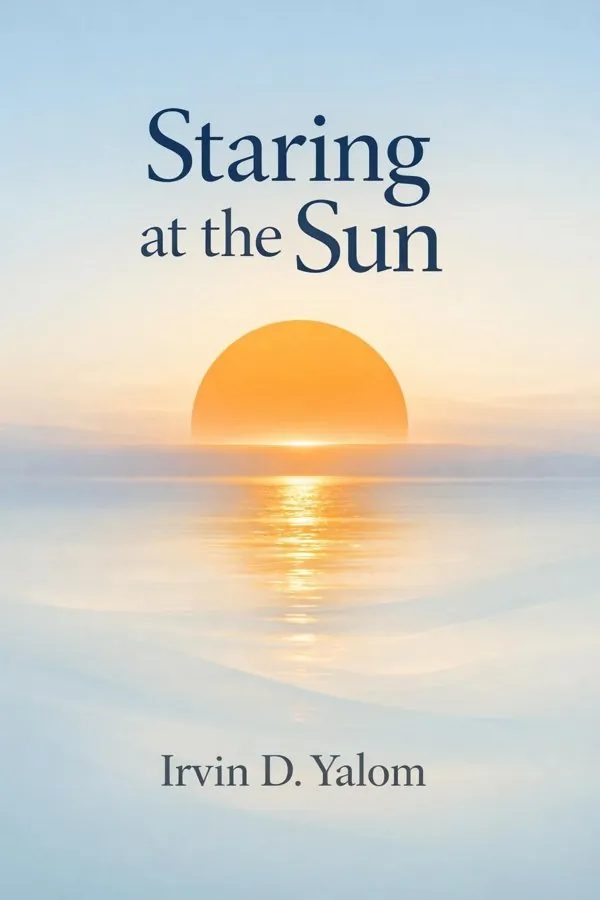
Staring at the Sun: Overcoming the Terror of Death: Summary & Key Insights
 10 min9 chaptersAudio available
Key Takeaways from Staring at the Sun: Overcoming the Terror of Death
One of the strangest facts about being human is that we know we will die, yet we live as if we do not.
Most people do not confront mortality through abstract reasoning; they confront it through shock.
Psychological suffering is not always rooted only in childhood conflict, distorted thinking, or present stress.
What helps people face death anxiety is not a clever argument alone, but a human relationship strong enough to hold the fear.
Many people fear death not only because life ends, but because they fear disappearing without trace.
What Is Staring at the Sun: Overcoming the Terror of Death About?
Staring at the Sun: Overcoming the Terror of Death by Irvin D. Yalom is a psychology book spanning 8 pages. Death is the one certainty every human being shares, yet most of us spend our lives trying not to think about it. In Staring at the Sun, renowned psychiatrist and psychotherapist Irvin D. Yalom argues that this hidden fear of death quietly shapes far more of our lives than we realize: our ambition, our anxiety, our relationships, our regrets, and our search for meaning. Rather than treating death anxiety as a dark topic to avoid, Yalom approaches it with unusual warmth, clarity, and compassion. He shows that confronting mortality directly can reduce fear, deepen intimacy, and help us live with greater honesty and purpose. Blending decades of clinical practice with existential philosophy, literature, and personal reflection, Yalom offers both insight and practical wisdom. He draws on thinkers such as Epicurus, Nietzsche, and Schopenhauer while grounding his ideas in real therapeutic encounters. The result is a book that feels intellectually rich yet deeply human. It matters because death anxiety is universal, even when disguised, and because Yalom offers a rare promise: we do not overcome the terror of death by denying it, but by facing it and allowing that awareness to transform the way we live.
This FizzRead summary covers all 9 key chapters of Staring at the Sun: Overcoming the Terror of Death in approximately 10 minutes, distilling the most important ideas, arguments, and takeaways from Irvin D. Yalom's work. Also available as an audio summary and Key Quotes Podcast.
Staring at the Sun: Overcoming the Terror of Death
Death is the one certainty every human being shares, yet most of us spend our lives trying not to think about it. In Staring at the Sun, renowned psychiatrist and psychotherapist Irvin D. Yalom argues that this hidden fear of death quietly shapes far more of our lives than we realize: our ambition, our anxiety, our relationships, our regrets, and our search for meaning. Rather than treating death anxiety as a dark topic to avoid, Yalom approaches it with unusual warmth, clarity, and compassion. He shows that confronting mortality directly can reduce fear, deepen intimacy, and help us live with greater honesty and purpose.
Blending decades of clinical practice with existential philosophy, literature, and personal reflection, Yalom offers both insight and practical wisdom. He draws on thinkers such as Epicurus, Nietzsche, and Schopenhauer while grounding his ideas in real therapeutic encounters. The result is a book that feels intellectually rich yet deeply human. It matters because death anxiety is universal, even when disguised, and because Yalom offers a rare promise: we do not overcome the terror of death by denying it, but by facing it and allowing that awareness to transform the way we live.
Who Should Read Staring at the Sun: Overcoming the Terror of Death?
This book is perfect for anyone interested in psychology and looking to gain actionable insights in a short read. Whether you're a student, professional, or lifelong learner, the key ideas from Staring at the Sun: Overcoming the Terror of Death by Irvin D. Yalom will help you think differently.
- ✓Readers who enjoy psychology and want practical takeaways
- ✓Professionals looking to apply new ideas to their work and life
- ✓Anyone who wants the core insights of Staring at the Sun: Overcoming the Terror of Death in just 10 minutes
Want the full summary?
Get instant access to this book summary and 100K+ more with Fizz Moment.
Get Free SummaryAvailable on App Store • Free to download
Key Chapters
One of the strangest facts about being human is that we know we will die, yet we live as if we do not. Yalom argues that denial of death is not merely a philosophical curiosity; it is one of our deepest psychological defenses. We build routines, identities, ambitions, and distractions that help us avoid directly confronting mortality. This denial often appears subtle rather than dramatic. It may surface as compulsive busyness, obsession with status, excessive health anxiety, relentless achievement, or the assumption that serious loss and death belong to some distant future.
In therapy, Yalom observed that many forms of emotional suffering are connected to this hidden dread. A person terrified of aging may not simply fear wrinkles or illness; they may be reacting to what aging symbolizes. Someone who cannot tolerate stillness may be fleeing the existential silence in which mortality becomes harder to ignore. Even our fantasies of exceptionalism, the belief that somehow ordinary rules do not fully apply to us, can serve as protective shields against death awareness.
Yalom does not claim denial is entirely avoidable. In fact, some degree of defensive distance is necessary for functioning. The problem begins when denial becomes rigid and unconscious, shrinking life rather than protecting it. When we refuse to acknowledge death, we may also refuse to fully appreciate time, love, and choice.
A practical application is to notice where your behavior may be organized around avoidance. Do you overwork because slowing down would force reflection? Do you postpone important conversations as if time were unlimited? Do you live according to other people’s expectations because it helps you avoid asking what truly matters?
Actionable takeaway: Spend ten quiet minutes writing about one area of your life where you act as though time is endless, and identify one concrete change you can make this week to live with greater awareness and intention.
Most people do not confront mortality through abstract reasoning; they confront it through shock. Yalom calls these moments awakening experiences: events that pierce the everyday illusion of permanence and force us to feel death as personally real. A medical diagnosis, the death of a parent, a near accident, a birthday marking old age, the sight of one’s aging face, or even watching a child grow can suddenly alter the emotional landscape. What was once theoretical becomes immediate.
These experiences are often painful, but Yalom insists they can also be transformative. They interrupt automatic living. A person who has drifted through years of obligation may suddenly ask, “Whose life am I living?” Another may recognize how much affection has gone unspoken. Someone consumed by petty resentment may realize how absurd it feels under the shadow of finitude.
Yalom does not romanticize crisis, but he suggests that mortality awareness can become a turning point rather than merely a source of panic. The key is whether we metabolize the experience. Some people numb themselves and rush back into distraction. Others use the rupture to reexamine priorities, relationships, and purpose.
This idea has practical relevance because awakening experiences are common, even if we rarely name them. Instead of asking only how to recover from a destabilizing event, Yalom invites us to ask what it is revealing. If your fear intensifies after a loss or health scare, that may not mean you are broken; it may mean reality has become harder to avoid.
Actionable takeaway: Reflect on a moment that made you suddenly aware of mortality. Write down three changes that experience suggests you should make, then choose one small step today so the insight does not fade back into habit.
Psychological suffering is not always rooted only in childhood conflict, distorted thinking, or present stress. Yalom’s existential psychotherapy begins with a deeper claim: much distress emerges from our confrontation with four ultimate concerns of existence—death, freedom, isolation, and meaninglessness. In Staring at the Sun, death takes center stage, but Yalom shows that it is inseparable from the others. We fear death partly because it exposes how alone we are, how responsible we are for our lives, and how urgently we must create meaning within limited time.
This therapeutic framework differs from models that focus solely on symptom reduction. Yalom is not uninterested in symptoms, but he believes anxiety, depression, compulsions, and relational problems may be expressions of existential conflict. For example, a person who feels trapped in a life they never consciously chose may experience anxiety not just because of circumstances, but because mortality heightens the pain of wasted time. A person terrified of abandonment may be reacting not only to relationship history, but to a deeper existential aloneness.
Yalom’s great contribution is to make these concerns discussable. He invites therapist and client alike to speak openly about topics often considered too overwhelming: death, regret, loneliness, and the struggle for significance. Far from deepening despair, this honesty often creates relief. Naming what has been avoided reduces its ghostly power.
Outside therapy, this framework can help readers reinterpret their own unease. Instead of asking only, “What is wrong with me?” we can ask, “What ultimate human concern might this feeling be touching?” That shift brings dignity and depth to suffering.
Actionable takeaway: When you feel recurring anxiety, pause and ask whether it may be linked to one of four existential concerns—death, freedom, isolation, or meaning—and jot down which one feels most active in your life right now.
What helps people face death anxiety is not a clever argument alone, but a human relationship strong enough to hold the fear. Yalom’s therapeutic encounters demonstrate that healing often begins when mortality is spoken aloud in the presence of an attentive, unflinching other. Instead of hiding behind professional distance, Yalom advocates a genuine therapeutic relationship marked by honesty, presence, and shared humanity. The therapist is not a detached expert who has transcended death; he is another mortal person accompanying the patient.
This matters because death anxiety is often surrounded by shame or isolation. People may feel childish for fearing death, selfish for grieving their own mortality, or guilty for thinking about dying when others suffer more. In such conditions, fear intensifies underground. A meaningful conversation can loosen that grip. Patients discover that what seemed unspeakable is, in fact, profoundly human.
Yalom often uses stories from practice to illustrate how apparently unrelated struggles can lead back to mortality. A patient’s panic attacks, jealousy, rigid control, or despair may soften when the deeper terror is recognized. Importantly, he does not reduce every problem to death, but he repeatedly shows that direct exploration can open new freedom.
The broader lesson extends beyond psychotherapy. Friends, partners, family members, and caregivers can all create spaces where existential concerns are acknowledged rather than dismissed. Instead of rushing to reassure with phrases like “Don’t think that way,” we can ask, “What about death feels most frightening to you?” That simple invitation can be deeply relieving.
Actionable takeaway: Have one honest conversation this month with someone you trust about aging, loss, regret, or mortality, and practice listening without immediately trying to fix, minimize, or redirect the discomfort.
Many people fear death not only because life ends, but because they fear disappearing without trace. Yalom offers a consoling but unsentimental idea he calls the ripple effect: even after we are gone, our actions continue to move through other lives in ways we may never fully see. A kindness influences a child, who later comforts a friend, who then changes a family. A teacher’s encouragement shapes a student’s confidence decades later. A parent’s courage, gentleness, or even repaired mistakes become part of another person’s inner world.
This is not a promise of literal immortality, nor is it a denial of death. Instead, it reframes continuity. We are finite, but our influence is not neatly contained within our lifespan. Yalom found that this idea helped many patients, especially those worried that death meant total erasure. The ripple effect affirms that a meaningful life is not measured only by fame or monument. Ordinary acts matter. Presence matters. Integrity matters.
Practically, this perspective can shift how we think about legacy. Many people imagine legacy as something grand: books, buildings, achievements, or wealth. Yalom points to a humbler but often more powerful reality. The tone of voice you use with your children, the care you offer a friend, the fairness you show a colleague, the wisdom you share in passing—these become part of the social and emotional fabric that outlives you.
This idea also creates responsibility. If our lives ripple outward, then our daily choices carry more significance than we often assume. We are always shaping the future in small ways.
Actionable takeaway: Identify one positive quality or lesson you want to pass on—such as patience, courage, curiosity, or kindness—and practice expressing it deliberately in one relationship every day this week.
Death becomes more terrifying when life feels unlived, accidental, or empty. Yalom argues that one of the most effective ways to soften death anxiety is not to solve death intellectually, but to live more meaningfully. Meaning, in his view, is rarely handed down fully formed. It must be created through engagement, love, work, responsibility, creativity, and genuine participation in life. The question is not simply how to stop fearing death, but how to build a life that feels worth inhabiting before death arrives.
This is an existential rather than a formulaic approach. Yalom does not provide a universal meaning system. Instead, he invites readers to take responsibility for constructing a life aligned with their deepest values. For one person, meaning may come through parenting. For another, teaching, service, art, friendship, learning, spiritual practice, or moral courage. What matters is not external prestige but felt vitality and authenticity.
He also warns that many people seek substitutes for meaning: constant consumption, social approval, accumulation, and routine without reflection. These may distract from death temporarily, but they do not satisfy the hunger for significance. In fact, they may intensify anxiety by making time feel wasted.
A practical way to apply this insight is to evaluate not only what you are doing, but why. Which parts of your week generate energy and connection? Which leave you feeling numb or absent from your own life? Meaning often grows where contribution, interest, and relationship intersect.
Actionable takeaway: Make two columns labeled “drains life” and “gives life.” List your recurring activities, then choose one small adjustment—adding more of a meaningful activity or reducing one empty obligation—to bring your calendar closer to your values.
Human beings naturally seek ways to outlast themselves. Yalom explores this longing through the idea of symbolic immortality: the desire to persist through children, work, values, traditions, memory, or contribution. Even those who reject religious immortality often crave continuity in some form. We want to feel that our existence matters beyond the final boundary of death.
Yalom treats this longing with sympathy. He does not mock the wish to continue, nor does he pretend it can be fully erased. Instead, he helps readers recognize the many healthy ways people create continuity. Parenting is one form, but not the only one. Mentoring, creating art, building institutions, preserving knowledge, strengthening a community, or transmitting moral values can all express the wish to leave something living behind.
At the same time, he suggests that symbolic immortality becomes problematic when it turns grandiose or desperate. If a person bases all self-worth on being remembered forever, no achievement will feel secure enough. The goal is not to become immortal through legacy, but to participate in a stream of life larger than oneself.
This perspective can be especially helpful in later life, when people naturally review what they have built and what will remain. It invites less fixation on fame and more appreciation for contribution. You do not need a global audience to matter. A family system healed because of you, a student encouraged by you, a compassionate standard established at work—these are real forms of continuity.
Actionable takeaway: Ask yourself what you most want to pass forward. Then choose one concrete project of continuity—writing family stories, mentoring someone, creating something useful, or sharing hard-won wisdom—that you can begin this month.
The fear of death is often intensified by the fear of not having truly lived. Yalom repeatedly suggests that authenticity is one of the strongest antidotes to existential dread. To live authentically is to make choices more consciously, to own one’s freedom, to stop hiding inside borrowed expectations, and to accept the costs of becoming oneself. Death is frightening in any case, but it is especially painful when it reveals a life spent in evasion.
Authenticity does not mean impulsively rejecting all duties or endlessly chasing self-expression. It means examining where your life has become false. Are you staying in a role, relationship, or ambition because it reflects your values, or because it protects you from uncertainty and judgment? Are you saying what you believe? Are you devoting time to what actually matters to you, or only to what looks impressive from the outside?
Yalom links authenticity with freedom and responsibility. We are not free to avoid death, but we are free to decide how to live before it arrives. This can feel burdensome, because genuine choice removes excuses. Yet it is also empowering. Mortality gives urgency to truthfulness. If time is limited, pretending becomes more costly.
In practical terms, authenticity often grows through small acts: speaking honestly in a relationship, stopping performative busyness, pursuing neglected interests, setting boundaries, or admitting regret. These shifts may seem modest, but they gradually transform one’s sense of aliveness.
Actionable takeaway: Identify one place where you are living inauthentically—perhaps saying yes when you mean no, or following a path that no longer feels like yours—and take one honest step this week that aligns your actions more closely with your real values.
Many people assume that awareness of death worsens with age, but Yalom offers a more nuanced picture. While aging undeniably brings losses—health changes, bereavement, shrinking time horizons—it can also bring a clearer perspective that softens death anxiety. Older adults often become less captivated by trivial competition and more attuned to gratitude, presence, and emotional truth. In this way, age can mature the soul even as it challenges the body.
Yalom notes that some fears intensify not because of age itself, but because unresolved regrets become harder to avoid. If a person reaches later life still estranged from loved ones, disconnected from purpose, or bound by old self-deceptions, mortality can feel especially threatening. But if aging is accompanied by inner work, reconciliation, and acceptance, it may generate a surprising serenity.
This insight challenges a youth-centered culture that treats aging mainly as decline. Yalom encourages us to see later life as an existential opportunity: a period for life review, repair, simplification, generosity, and transmission. Rather than trying desperately to remain psychologically young, one can become psychologically deeper.
The lesson is relevant at any age. Younger readers need not wait for old age to begin asking mature questions. What would you regret if your time were shorter than expected? What unfinished conversations or neglected values deserve attention now? In this sense, aging wisdom can be practiced early.
Actionable takeaway: Conduct a brief life review by asking yourself what you would want to feel more complete about if you were twenty years older, then choose one act of repair, gratitude, or simplification to begin now rather than postponing it.
All Chapters in Staring at the Sun: Overcoming the Terror of Death
About the Author
Irvin D. Yalom is an American existential psychiatrist, psychotherapist, and author whose work has had a major influence on modern psychotherapy. Born in 1931, he served for many years as a professor of psychiatry at Stanford University and became widely known for bringing existential ideas about death, freedom, isolation, and meaning into clinical practice. Yalom is respected not only for his theoretical contributions, but also for his unusually humane, direct, and personal style. His books include both nonfiction works on therapy and bestselling novels that dramatize philosophical and psychological themes. Across his writing, he combines clinical experience, literary skill, and philosophical depth to explore the central dilemmas of being human. He remains one of the most accessible and trusted voices on existential psychology.
Get This Summary in Your Preferred Format
Read or listen to the Staring at the Sun: Overcoming the Terror of Death summary by Irvin D. Yalom anytime, anywhere. FizzRead offers multiple formats so you can learn on your terms — all free.
Available formats: App · Audio · PDF · EPUB — All included free with FizzRead
Download Staring at the Sun: Overcoming the Terror of Death PDF and EPUB Summary
Key Quotes from Staring at the Sun: Overcoming the Terror of Death
“One of the strangest facts about being human is that we know we will die, yet we live as if we do not.”
“Most people do not confront mortality through abstract reasoning; they confront it through shock.”
“Psychological suffering is not always rooted only in childhood conflict, distorted thinking, or present stress.”
“What helps people face death anxiety is not a clever argument alone, but a human relationship strong enough to hold the fear.”
“Many people fear death not only because life ends, but because they fear disappearing without trace.”
Frequently Asked Questions about Staring at the Sun: Overcoming the Terror of Death
Staring at the Sun: Overcoming the Terror of Death by Irvin D. Yalom is a psychology book that explores key ideas across 9 chapters. Death is the one certainty every human being shares, yet most of us spend our lives trying not to think about it. In Staring at the Sun, renowned psychiatrist and psychotherapist Irvin D. Yalom argues that this hidden fear of death quietly shapes far more of our lives than we realize: our ambition, our anxiety, our relationships, our regrets, and our search for meaning. Rather than treating death anxiety as a dark topic to avoid, Yalom approaches it with unusual warmth, clarity, and compassion. He shows that confronting mortality directly can reduce fear, deepen intimacy, and help us live with greater honesty and purpose. Blending decades of clinical practice with existential philosophy, literature, and personal reflection, Yalom offers both insight and practical wisdom. He draws on thinkers such as Epicurus, Nietzsche, and Schopenhauer while grounding his ideas in real therapeutic encounters. The result is a book that feels intellectually rich yet deeply human. It matters because death anxiety is universal, even when disguised, and because Yalom offers a rare promise: we do not overcome the terror of death by denying it, but by facing it and allowing that awareness to transform the way we live.
More by Irvin D. Yalom
The Schopenhauer Cure
Irvin D. Yalom
10 min
When Nietzsche Wept
Irvin D. Yalom
10 min
The Gift of Therapy: An Open Letter to a New Generation of Therapists and Their Patients
Irvin D. Yalom
10 min
Love’s Executioner: And Other Tales of Psychotherapy
Irvin D. Yalom
10 minYou Might Also Like
The Body Keeps the Score
Bessel van der Kolk
10 min
Surrounded by Idiots
Thomas Erikson
10 min
Emotional Intelligence
Daniel Goleman
10 min
Attached
Amir Levine
10 min
Why Does He Do That
Lundy Bancroft
10 min
Women Who Run with the Wolves
Clarissa Pinkola Estés
10 minBrowse by Category
Ready to read Staring at the Sun: Overcoming the Terror of Death?
Get the full summary and 100K+ more books with Fizz Moment.