
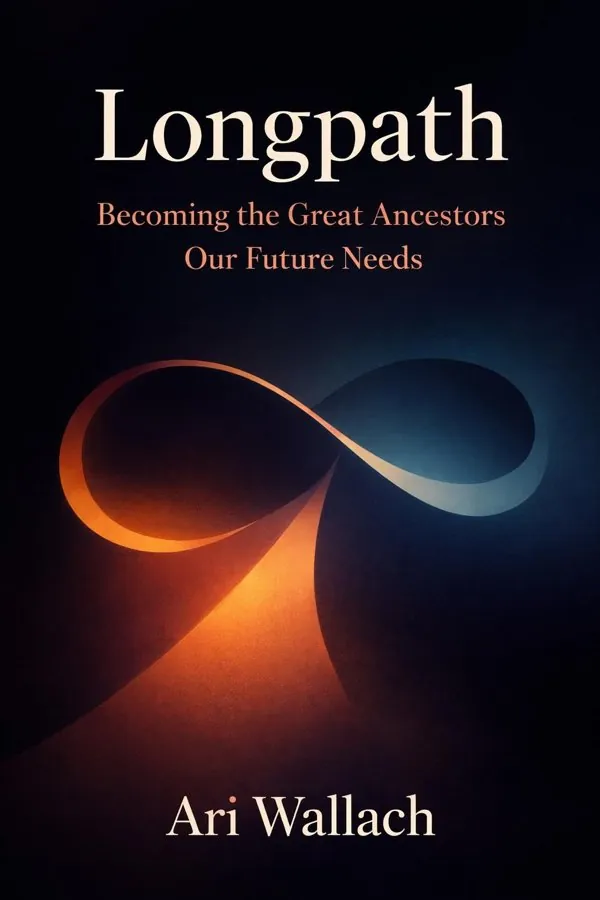
Longpath: Becoming the Great Ancestors Our Future Needs: Summary & Key Insights
by Ari Wallach
 10 min7 chaptersAudio available
What Is Longpath: Becoming the Great Ancestors Our Future Needs About?
Longpath: Becoming the Great Ancestors Our Future Needs by Ari Wallach is a future_trends book spanning 7 pages. Longpath es una obra que invita a pensar más allá del corto plazo y a adoptar una visión de largo alcance para construir un futuro más humano y sostenible. Ari Wallach propone un marco de pensamiento que combina filosofía, psicología y liderazgo para ayudar a individuos y organizaciones a tomar decisiones con conciencia intergeneracional. El libro explora cómo superar la mentalidad de inmediatez y cultivar una perspectiva que priorice el bienestar colectivo y la continuidad de la humanidad.
This FizzRead summary covers all 7 key chapters of Longpath: Becoming the Great Ancestors Our Future Needs in approximately 10 minutes, distilling the most important ideas, arguments, and takeaways from Ari Wallach's work. Also available as an audio summary and Key Quotes Podcast.
Longpath: Becoming the Great Ancestors Our Future Needs
Longpath es una obra que invita a pensar más allá del corto plazo y a adoptar una visión de largo alcance para construir un futuro más humano y sostenible. Ari Wallach propone un marco de pensamiento que combina filosofía, psicología y liderazgo para ayudar a individuos y organizaciones a tomar decisiones con conciencia intergeneracional. El libro explora cómo superar la mentalidad de inmediatez y cultivar una perspectiva que priorice el bienestar colectivo y la continuidad de la humanidad.
Who Should Read Longpath: Becoming the Great Ancestors Our Future Needs?
This book is perfect for anyone interested in future_trends and looking to gain actionable insights in a short read. Whether you're a student, professional, or lifelong learner, the key ideas from Longpath: Becoming the Great Ancestors Our Future Needs by Ari Wallach will help you think differently.
- ✓Readers who enjoy future_trends and want practical takeaways
- ✓Professionals looking to apply new ideas to their work and life
- ✓Anyone who wants the core insights of Longpath: Becoming the Great Ancestors Our Future Needs in just 10 minutes
Want the full summary?
Get instant access to this book summary and 100K+ more with Fizz Moment.
Get Free SummaryAvailable on App Store • Free to download
Key Chapters
Short-term thinking did not arise by accident. It was cultivated through decades of cultural, psychological, and economic conditioning. In my research and work with leaders across sectors, I found that modern society’s fixation on immediacy is rooted in anxiety—fear of uncertainty, fear of losing relevance, fear of falling behind. We’ve constructed institutions and technologies that amplify that fear. Quarterly earnings reports, political cycles, and algorithmic feedback loops keep everyone looking narrowly at the next outcome rather than the next century. It has created what I call a crisis of temporal imagination.
This narrowness affects not only institutions but our inner worlds. It shapes how we perceive meaning. The self becomes compressed into moments—posts, transactions, and fleeting achievements. Psychologically, this is exhausting; existentially, it’s impoverishing. As I often tell audiences, we are suffering from a poverty of time. When every decision becomes a reaction to short-term stimuli, empathy dries up. Longpath invites us to re-expand our temporal field—to recover the ability to sense ourselves as part of deep time.
To make this shift, we must understand how short-termism benefits from illusion. It tells us progress equals growth, that newness always trumps longevity. Yet when we examine the legacy of societies that thrived, we find they practiced continuity—preserving traditions while innovating within ethical constraints. Approaching time as something we inherit and transmit reshapes the way we define success. In my work developing Longpath Labs, I have seen teams realize that their metrics must include future impact, not just present profit. This transition from immediate to intergenerational awareness is the first step toward reclaiming agency from the tyranny of the urgent.
Longpath thinking stands on three pillars: transgenerational empathy, futures thinking, and telos. Together, they form a framework for sustained human flourishing. Let me explain how each arises and interacts.
Transgenerational empathy begins with storytelling—seeing ourselves as characters in a multi-generational narrative. I often ask people to imagine standing between their ancestors and their descendants; the question becomes, what wisdom is moving through you? This empathy is not sentimentality—it’s strategic compassion. When a leader considers how decisions ripple into future lives, it deepens ethics and creativity. It reminds us that we owe the future not perfection, but momentum: the effort to leave conditions better than we found them.
Futures thinking expands possibility. It counters the false sense that the future is linear or predetermined. By envisioning multiple potential worlds, we loosen the grip of inevitability and open space for agency. Futures thinking invites you to imagine alternative narratives—realms where technology serves dignity, where governance is built for continuity, where we collaborate across difference. In my practice, I’ve seen how this exercise invigorates innovation while grounding it in purpose. When we hold many futures in view, we can act with both humility and determination.
Telos, the third pillar, gives Longpath direction. It means purpose—but not in the corporate slogan sense. Telos is philosophical clarity about why we exist and what we serve. For an individual, telos might express as a commitment to stewardship or justice. For an organization, it might manifest as values guiding growth toward the common good. Telos protects us from aimless expansion; it ensures our ambitions align with intergenerational ethics. When transgenerational empathy, futures thinking, and telos combine, leadership transforms—strategic choices become legacy choices. This triad, this deep-time framework, is what Longpath offers as an antidote to the restless present.
+ 5 more chapters — available in the FizzRead app
All Chapters in Longpath: Becoming the Great Ancestors Our Future Needs
About the Author
Ari Wallach es un futurista y estratega estadounidense, fundador de Longpath Labs. Ha trabajado como asesor en innovación y planificación a largo plazo para gobiernos, empresas y organizaciones sin ánimo de lucro. Su trabajo se centra en fomentar una visión ética y sostenible del futuro.
Get This Summary in Your Preferred Format
Read or listen to the Longpath: Becoming the Great Ancestors Our Future Needs summary by Ari Wallach anytime, anywhere. FizzRead offers multiple formats so you can learn on your terms — all free.
Available formats: App · Audio · PDF · EPUB — All included free with FizzRead
Download Longpath: Becoming the Great Ancestors Our Future Needs PDF and EPUB Summary
Key Quotes from Longpath: Becoming the Great Ancestors Our Future Needs
“Short-term thinking did not arise by accident.”
“Longpath thinking stands on three pillars: transgenerational empathy, futures thinking, and telos.”
Frequently Asked Questions about Longpath: Becoming the Great Ancestors Our Future Needs
Longpath: Becoming the Great Ancestors Our Future Needs by Ari Wallach is a future_trends book that explores key ideas across 7 chapters. Longpath es una obra que invita a pensar más allá del corto plazo y a adoptar una visión de largo alcance para construir un futuro más humano y sostenible. Ari Wallach propone un marco de pensamiento que combina filosofía, psicología y liderazgo para ayudar a individuos y organizaciones a tomar decisiones con conciencia intergeneracional. El libro explora cómo superar la mentalidad de inmediatez y cultivar una perspectiva que priorice el bienestar colectivo y la continuidad de la humanidad.
More by Ari Wallach

You Might Also Like
Futureproof: 9 Rules for Humans in the Age of Automation
Kevin Roose
10 min
The Third Wave
Alvin Toffler
10 min
2030: How Today's Biggest Trends Will Collide and Reshape the Future of Everything
Mauro F. Guillén
10 min
A Very Human Future: Enriching Humanity in a Digitized World
Rohit Talwar, Steve Wells, Alexandra Whittington
10 min
AI 2041: Ten Visions for Our Future
Kai-Fu Lee, Chen Qiufan
10 min
Abundance: The Future Is Better Than You Think
Peter H. Diamandis, Steven Kotler
10 minBrowse by Category
Ready to read Longpath: Becoming the Great Ancestors Our Future Needs?
Get the full summary and 100K+ more books with Fizz Moment.